THE BRILLIANT THINGS

This is the day that the Lord has made; let us rejoice and be glad in it. [Psalm 118:24 (ESV)]

What would you do if you were six and your father said that your mom is in the hospital because she finds it hard to be happy and “did something stupid”? That question is answered in Duncan Macmillan and Jonny Donahoe’s one-act play, Every Brilliant Thing. In their play, that boy, now a grown man, tells the audience that he made of list of everything that was “brilliant” about the world—everything worth living for—and left it on his mother’s pillow. Reflecting a six-year old’s priorities, the list included ice cream, Kung-Fu movies, laughing so hard you shoot milk out your nose, burning things, construction cranes, and “me.” Although she returns the list with its spelling corrected, the boy’s mother never comments on it. Nevertheless, he keeps adding to his list. Although his mother eventually takes her life, the narrator tells how his list took on a life of its own and eventually saved him from his own depression and suicidal thoughts.

Throughout the play, the audience learns of additions to the list—everything from peanut butter, water fights, and sunlight to peeing in the sea with nobody knowing, someone lending you a book, cycling downhill, and completing a task. Sort of a theatrical and secular version of Ann Voskamp’s One Thousand Gifts, Every Brilliant Thing is a poignant reminder of the importance of noticing and naming the little “brilliant” things in our lives—to step out of ourselves to take in the small blessings with which God blesses us every day—to pause and feel God’s love in a stranger’s smile, a nurses’ gentle touch, the sound of children’s laughter, the smell of lemon zest, the taste of a fresh-baked warm chocolate chip cookie, a mockingbird’s serenade, a compliment, or the smell of a campfire! No one’s list is the same nor should they be.

Nearly three years ago, Voskamp’s book inspired me to start my own list of “gifts” (what Macmillan and Donahoe called “brilliant” things). But, like the play’s narrator, I put it aside after a while. Although there were moments I thought, “That’s one for the list,” I rarely added them and they were forgotten. It wasn’t until my most recent bout with depression and pain that I resumed adding to it. Of course, I couldn’t add to the list without making a point of opening my eyes to God’s presence in the ordinary stuff of life. Some were big things like taking Communion or learning that my girls are visiting in a few weeks. Most things, however, are pretty mundane—the aroma of night-blooming jasmine, the two standard poodles that sit regally beside their person as he chauffeurs them around the community in his golfcart, Savannah Guthrie’s  book Mostly What God Does, whipped cream on a cup of hot cocoa, and monarch butterflies. There’s nothing extraordinary about these “brilliant” things; nevertheless, they bring a smile to my face and remind me of God’s presence in all things.

Although our cups overflow with God’s blessings, it’s been said that joy comes in sips rather than gulps. May we always remember that it wasn’t in the storm that Elijah heard God—it was in His whisper. Indeed, God whispers to us in the seemingly insignificant but “brilliant” things of life. Let us take note of each and every one!

There is not one little blade of grass, there is no color in this world that is not intended to make men rejoice. [John Calvin]
You serve me a six-course dinner right in front of my enemies. You revive my drooping head; my cup brims with blessing. Your beauty and love chase after me every day of my life. I’m back home in the house of God for the rest of my life. [Psalm 23:5-6 (MSG)]

Copyright ©2025 jsjdevotions. All rights reserved.

IN PAIN

So to keep me from becoming conceited because of the surpassing greatness of the revelations, a thorn was given me in the flesh, a messenger of Satan to harass me, to keep me from becoming conceited. Three times I pleaded with the Lord about this, that it should leave me. But he said to me, “My grace is sufficient for you, for my power is made perfect in weakness.” [2 Corinthians 12:7-9 (ESV)]

But pain insists upon being attended to. God whispers to us in our pleasures, speaks in our conscience, but shouts in our pain: it is His megaphone to rouse a deaf world… [C.S. Lewis]

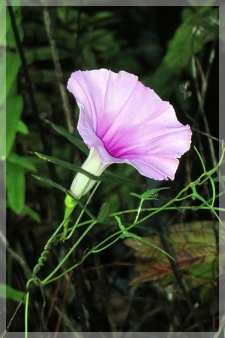
morning gloryDuring that dark time about which I recently wrote, I was in intense pain and it seemed like God had turned His back on me. When I confided to a friend that God seemed deaf to my pleas, she asked the simple question, “Have you turned it over to the Lord?” I assured her I had but, as the day wore on, I wondered if that were true.
In my prayers for relief, I was telling God the outcome I desired, but that really isn’t “turning it over” to Him. If any human had a direct line to God’s heavenly office, it would have been the Apostle Paul and yet God didn’t relieve him of whatever his thorn was! Instead of demanding the result I wanted, I had to place myself in God’s loving hands as did Paul and pray for God’s grace and the power to accept what He’d placed in my lap.

Each morning, I prayed for grace enough for the day—for the strength, endurance, peace, patience, courage, and joy needed to get through the next twenty-four hours. I asked God to reassure me of His lovingkindness and to protect me from the doubt, fear, and negativity Satan was whispering in my ears. The hardest thing, however, was to hand the outcome of my upcoming surgery into His loving hands. I had to trust in His plan and presence regardless of its outcome. The physical pain remained but, with the power of the Spirit, I dealt with it.

I don’t think God decides our fate with a toss of the dice and, while a quick view of my MRI told me the why of my present physical pain, I asked God to help me understand its purpose. Paul knew his thorn was to keep him from being conceited; what was my pain telling me? In The Problem of Pain, C.S. Lewis points out how easy it is to ignore God when all is well. “We will not seek it [our happiness] in Him as long as He leaves us any other resort where it can even plausibly be looked for. While what we call ‘our own life’ remains agreeable we will not surrender it to Him.” Admittedly, I’d been in a state of “meh” and become self-sufficient rather than God-dependent and lax in my spiritual disciplines. Like the Apostle Paul, perhaps I’d become too sure of myself; the intense pain reminded me of my need for God!

As C.S. Lewis wisely pointed out, an intellectual understanding of pain is far easier than the fortitude, courage, and patience needed to endure it. It’s far easier to talk the talk than walk the walk! Nevertheless, endure it we must and through the power of the Holy Spirit, we can!

By the time this devotion is published, I will have had the surgery that, God willing, will relieve my pain. While I don’t know what my future holds, I do know who holds it in His loving hands and I trust that He will supply me with all I need to face whatever it may be.

And we know that for those who love God all things work together for good, for those who are called according to his purpose. … Who shall separate us from the love of Christ? Shall tribulation, or distress, or persecution, or famine, or nakedness, or danger, or sword?… No, in all these things we are more than conquerors through him who loved us. For I am sure that neither death nor life, nor angels nor rulers, nor things present nor things to come, nor powers, nor height nor depth, nor anything else in all creation, will be able to separate us from the love of God in Christ Jesus our Lord. [Romans 8:28, 35, 37-39 (ESV)]

Copyright ©2025 jsjdevotions. All rights reserved.

WHERE IS HE?

How long, Lord? Will you forget me forever? How long will you hide your face from me? How long must I wrestle with my thoughts and day after day have sorrow in my heart? How long will my enemy triumph over me? Look on me and answer, Lord my God. Give light to my eyes, or I will sleep in death, and my enemy will say, “I have overcome him,” and my foes will rejoice when I fall. [Psalm 13:1-4 (NIV)]

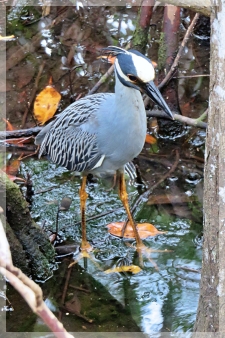
yellow crowned night heronWhen I first started reading the psalms, I suspected David might have been bi-polar—his highs seemed so high and his lows so very low; now I understand that he was just being truthful. In his psalms, David unabashedly expressed his deepest feelings to God. Pouring out his soul, he openly shared his emotions—whether anger, disappointment, sorrow, regret, shame, joy, love, fear, doubt, or even his desire for vengeance upon his enemies. No matter how troubled he was, David never was afraid to speak from his heart. I’m not sure we are willing to be as vulnerable and straightforward in our prayers as was David.

Thinking God had forgotten him (or was deliberately ignoring him), David dared to complain of the Lord’s unkindness in Psalm 13. In A Grief Observed, C.S. Lewis expressed a similar feeling of being ignored by the Lord. After noting how present God seemed in the good times, Lewis asked “where is God?… Go to Him when your need is desperate, when all other help is vain, and what do you find? A door slammed in your face, and a sound of bolting and double bolting on the inside. After that, silence.” He asked, “Why is He so present a commander in our time of prosperity and so very absent a help in time of trouble?”

Indeed, it is easy to see God in times of safety, prosperity, and health. We perceive in Him a hillside of flowers but not when a wildfire destroys an entire town. We see His work in the birth of a child but not in a child’s death at the hands of a school shooter. We feel His presence when a loved one defeats cancer but He seems absent when we suffer from chronic pain. C.S. Lewis warned that the danger we face in those dark times is not so much that we’ll stop believing in God but that we’ll come to believe that God is not good! We’re tempted to give up on Him because it seems He’s given up on us!

In this fallen world, there will be times when, like C.S. Lewis and David, it seems that God has turned his back to us. We feel forsaken and disregarded. Having recently gone through a dark time when it felt like God’s office door was closed to me, I found myself praying the words of Psalm 13. Fortunately, I didn’t stop at the first four verses. After expressing his feeling of being abandoned, David turned to praise and proclaimed his confidence in God’s love, faithfulness, and deliverance.

Like David, I will trust in the Lord’s goodness in all things—even those things I don’t understand. Rather than believing in the goodness of life, I will choose to believe in the goodness of God.

But I trust in your unfailing love; my heart rejoices in your salvation. I will sing the Lord’s praise, for he has been good to me. [Psalm 13:5-6 (NIV])

But this I call to mind, and therefore I have hope: The steadfast love of the Lord never ceases; his mercies never come to an end; they are new every morning; great is your faithfulness. “The Lord is my portion,” says my soul, “therefore I will hope in him.” [Lamentations 3:21-24 (ESV)]

Copyright ©2025 jsjdevotions. All rights reserved.

RESOLUTIONS

Search me, O God, and know my heart; test me and know my anxious thoughts. Point out anything in me that offends you, and lead me along the path of everlasting life. [Psalm 139:23-24 (NLT)]

The tradition of New Year’s resolutions goes back over 4,000 years to the ancient Babylonians (whose new year began in mid-March with the spring equinox). During their 12-day celebration called Akitu, they either crowned a new king or reaffirmed their loyalty to the old one. To ensure the gods’ favor, they promised to return borrowed items and pledged the repayment of all their debts.

Around 46 BC, Julius Caesar altered the calendar and began the year in January to honor the two-faced Janus—the Roman god who could look back into the past and forward into the future at the same time. Romans believed that the rest of the year would go pleasantly if that was how they spent its first day. Trying to spend January 1st as happily as possible, there were games, feasts, gifts, sweet treats, and plenty of wine while complaint, gossip, and quarrels were avoided. By making sacrifices to Janus and promising to live a better life, Romans believed the year ahead would bring prosperity and success.

Did you spend yesterday as pleasantly as possible—with no spats or spite? Did you start the new year with a resolution or two? While pledging to become a better person in the coming year or promising to return borrowed items and pay one’s debts are good goals for 2025, the majority of our New Year’s resolutions usually have something to do with health, exercise, or diet.

Before resolving to floss, eat more vegetables, or run a 5K, we should pray and ask God what He would like to see us change. “Search me, O God,” is what could be called a dangerous prayer because, when we ask God to search, we should be ready for what He finds. Chances are that it will have nothing to do with developing better dental or nutrition habits.

Asking God to examine our innermost being is like asking Him to perform exploratory surgery in search of sin. While a surgeon may not find a malignancy, God is sure to find plenty of areas in our lives that need excising or change. In medicine, a surgeon usually removes a malignancy if it is found. In God’s hospital, it’s a little different. If He finds disease or malignancy in our hearts, after pointing it out, He expects us to repent and turn away from it.

According to Drive Research, only 9% of those who make New Year’s resolutions successfully keep them all year. Sadly, our spiritual goals can fail as readily as the non-spiritual ones. For 20 years, one Christ-following friend has resolved to read the Bible, cover-to-cover; so far, she’s not gotten past Leviticus! Perhaps we’d do better if we remember that we can’t change by ourselves. While will-power alone might keep us away from Dunkin’ Donuts or Krispy Kreme (at least for a while), it’s not enough when we’re combating spiritual enemies. Fortunately, we are empowered by the Holy Spirit and, through Him, all things are possible—even reading the Bible.

Let us remember that Jesus is in the business of transformation. He transformed water into wine, the blind into the sighted, the lame into the strong, and the diseased into the healthy. He changed the churning sea into calm water, a few morsels of food into a feast, and the dead into the living. Jesus’ miracles of transformation continue today. He turns darkness into light, anger into peace, fear into hope, animosity into love, selfishness into generosity, mourning into joy, shame into honor, and sinners into saints. If you’re still not sure what your resolution should be, you can always borrow Jonathon Edward’s: “Resolution One: I will live for God. Resolution Two: If no one else does, I still will”

May you have a blessed new year.

The object of a new year is not that we should have a new year. It is that we should have a new soul. [G. K. Chesterton]

And I will give you a new heart, and I will put a new spirit in you. I will take out your stony, stubborn heart and give you a tender, responsive heart. And I will put my Spirit in you so that you will follow my decrees and be careful to obey my regulations. [Ezekiel 36:26-27 (NLT)]

 Copyright ©2025 jsjdevotions. All rights reserved.

THE BEST WE CAN

Post this at all the intersections, dear friends: Lead with your ears, follow up with your tongue, and let anger straggle along in the rear. God’s righteousness doesn’t grow from human anger. So throw all spoiled virtue and cancerous evil in the garbage. In simple humility, let our gardener, God, landscape you with the Word, making a salvation-garden of your life. [James 1:19-21 (MSG)]

Some days, doing “the best we can” may still fall short of what we would like to be able to do, but life isn’t perfect – on any front – and doing what we can with what we have is the most we should expect of ourselves or anyone else. [Fred Rogers]

gardeniaAs a teen and young adult, it was easy to be critical of my parents and their parenting. Vowing I’d never say or do some of the things they did, I was sure I’d never make any of their mistakes. Once I became a mother, however, I became far more forgiving and much less judgmental. Turns out, I made some of the same mistakes my parents did (and plenty more of my own).
Parents want to keep their children from heartbreak, disappointment, and harm; they want more and better for their children than they had. As a result, despite their best intentions, they can be over-protective, judgmental, enabling, dictatorial, or stubborn. All things considered, I now realize my parents did the best they could. While they didn’t always make the right decisions, they thought they were the correct ones at the time. It’s only in hindsight that we get twenty-twenty vision!

Most people don’t wake each morning intending to be unforgiving, unsympathetic, intractable, or indifferent. Rather than planning on being selfish, temperamental, hypercritical, or rude, we probably wake up hoping to be kind, patient, and loving. Unfortunately, we’re not always good at doing that! I certainly never begin the day intending to be impatient, inconsiderate, or negative, but that has been known to happen—far more frequently than I’d like. None of us are perfect; being human, we all make plenty of mistakes. My prayer each morning is simple: to be a better person that day than the one I was the day before. Through the power of the Holy Spirit, that is gradually happening.

When we remember that sometimes our best efforts are not nearly good enough, it becomes much easier to forgive others for their failings. Forgiveness doesn’t mean those actions were right or good and it doesn’t mean we approve or accept them. It simply means we forgive them. While we’re forgiving others, we should forgive ourselves for our shortcomings as well. Let’s start the new year by releasing our regrets and resentments and granting grace both to others and ourselves. Every one of us made mistakes and we all could have done better; nevertheless, what’s done is done. If God can forgive us, we ought to be able to do so, too.

Father, replace any hidden resentment, anger, and regret from our hearts with compassion, love, and forgiveness. Help us accept that flaws, both ours and those of others, are part of being human. Show us how to learn from our mistakes and the mistakes of others. Fill us with your Holy Spirit so that we can be better people today than we were yesterday, and even better ones tomorrow.

Forgive, forget. Bear with the faults of others as you would have them bear with yours. Be patient and understanding. Life is too short to be vengeful or malicious. [Phillips Brooks]

Most of all, love each other as if your life depended on it. Love makes up for practically anything. [1 Peter 4:8 (MSG)]

If you, God, kept records on wrongdoings, who would stand a chance? As it turns out, forgiveness is your habit, and that’s why you’re worshiped. [Psalm 130:3-4 (MSG)]

Copyright ©2024 jsjdevotions. All rights reserved.

“HALLELUJAH” RATHER THAN “HUMBUG”

The Spirit of the Sovereign Lord is upon me, for the Lord has anointed me to bring good news to the poor. He has sent me to comfort the brokenhearted and to proclaim that captives will be released and prisoners will be freed. He has sent me to tell those who mourn that the time of the Lord’s favor has come, and with it, the day of God’s anger against their enemies. [Isaiah 61:1-2 (NLT)]


Unfortunately, much of our Advent season is not spent joyfully looking forward to celebrating the birth of the Christ child. In hope of finding the perfect gift for everyone on our list, we pore over catalogues and search for sales and coupons. Either we fight for parking spots at the mall and spend hours standing in line or spend those hours sitting at the computer while shopping on line! We then fret and fuss over wrapping those gifts, mailing packages and Christmas cards, hosting and attending parties, baking cookies, making travel arrangements, decorating the house, preparing holiday dinners, and paying the ever-mounting bills. When we say, “Merry Christmas!” we might find ourselves mumbling a Scrooge-like “Bah! Humbug” under our breath! Instead of looking forward to Christmas with anticipation, there are times we can’t wait until it’s all over and done.

Dr. Seuss’ Grinch eventually realized Christmas really has nothing to do with all those trappings; I wonder why we have so much trouble remembering that same thing. Christmas isn’t about gifts, parties, cards, peppermint bark, decorations, or the “roast beast feast.” Jesus with His message of love, redemption, forgiveness, and salvation is the only reason for the season! Mary didn’t send out 100 birth announcements or bake dozens of cookies and the stable that housed the Holy Family wasn’t decorated with wreaths, ribbons, holly, or tinsel. God took care of the only decoration with a bright star and a heavenly chorus announced the birth. Shepherds were the first holiday guests and they didn’t expect gingerbread cookies or care about the stable’s decor or cleanliness. The Magi’s Christmas presents were odd gifts for an infant and probably arrived two years late.

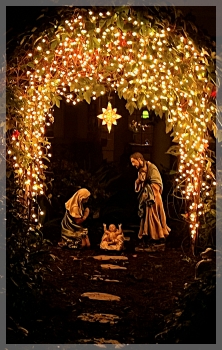
Today, consider pausing from all your preparations to re-read Zechariah’s prophecy of a Savior who would redeem His people and the beautiful story of His birth in Luke 1 and 2. Tonight, take a drive and look at the Christmas lights festooned around your town; let them remind you of Isaiah’s promise; “The people who walk in darkness will see a great light … For a child is born to us.” Then let us joyfully raise our voices in a “Hallelujah!” instead of “Humbug!”

And the Grinch, with his Grinch-feet ice cold in the snow, stood puzzling and puzzling, how could it be so? It came without ribbons. It came without tags. It came without packages, boxes or bags. And he puzzled and puzzled ’till his puzzler was sore. Then the Grinch thought of something he hadn’t before. What if Christmas, he thought, doesn’t come from a store. What if Christmas, perhaps, means a little bit more. [From “How the Grinch Stole Christmas” by Dr. Seuss]

The people who walk in darkness will see a great light. For those who live in a land of deep darkness, a light will shine … For a child is born to us, a son is given to us. The government will rest on his shoulders. And he will be called: Wonderful Counselor, Mighty God, Everlasting Father, Prince of Peace. [Isaiah 9:2,6 (NLT)]

Copyright ©2024 jsjdevotions. All rights reserved.