THOUGHTS AND PRAYERS

Dear children, let’s not merely say that we love each other; let us show the truth by our actions. [1 John 3:18 (NLT)]

In another Pearls before Swine comic (drawn by Stephen Pastis), we see Goat, in the middle of the desert, on the phone with Rat. “My car broke down and I’m stranded in the middle of nowhere. Can you help me?” asks Goat. “Sure,” answers Rat, “I’m sending you thoughts and prayers.” In the last frame, Rat says to Pig, “It’s so much easier than getting up.”

Following Hurricane Harvey’s devastation in 2017, I saw a meme of an empty cargo truck with the words, “Don’t worry Texas! The first load of thoughts and prayers just arrived!” Let’s face it, thoughts and prayers don’t help people in the same way that donating blood, packing supplies, or sending money, clothing, food, or clean water do. But, as Rat said to Pig, sending thoughts and prayers is “so much easier than getting up!”

The old cliché doesn’t even make sense. Although we can think about someone, how do we send them our thoughts? Does it involve telepathy or clairvoyance? Sending anyone other than God our prayers seems an awful lot like idolatry and promised prayers frequently never materialize. I suspect that the Levite in the parable of the Good Samaritan told the injured traveler he was sending thoughts and prayers before departing and leaving the man half dead beside the road. Rather than promising thoughts and prayers, it was the Samaritan who compassionately served the man’s needs.

Jesus spent a lot of time in prayer but He also was a man who turned His thoughts and prayers into action! Rather than sending thoughts and prayers to the widow of Nain, He returned her son to life! Instead of sending thoughts and prayers to the man with the deformed hand, the ten lepers, or blind Bartimaeus, Jesus healed them! He didn’t send thoughts and prayers to His mother when she ran out of wine in Cana or to Martha and Mary when Lazarus lay in the tomb. When the disciples said the crowd was hungry, rather than telling them to send the people home with their thoughts and prayers, He said, “Feed them.” Whether an observant Jew, collaborating tax collector, Roman centurion, adulterer, demoniac, or Samaritan, Jesus never responded to their suffering simply by sending thoughts and prayers.

Since seeing that meme in 2017, I no longer say that I’m sending my thoughts and prayers but that doesn’t mean I’ve stopped thinking about and praying for those who are suffering. It’s that I know I am called to do more. Prayer without action is as incomplete as faith without works. While we may not be able to reach out and personally impact the lives of those for whom we pray, we can pray for those who are serving them. As we pray for others, we find our hearts and eyes are opened not only to their needs but also to the needs of those right in front of us—the people whose lives we can change. We can reach out and touch them in some small way, even if it’s with cans of soup for the food bank, shopping for a neighbor, or talking with someone whose skin is a different color than ours.

Right now, our fallen world is filled with pain, anger, disease, hate, hopelessness, and sorrow. Economic wreckage, racism, a pandemic, and political unrest have come together in a perfect storm that is raining chaos, fear, frustration and violence. In Sunday’s Op-Ed for The Washington Post, Presiding Bishop of the Episcopal Church, Michael Curry, said, “We must still choose love.” That love consists of more than sending thoughts and prayers. Instead of sending thoughts, I’m examining my own thoughts and attitudes to determine whether I am part of the problem or can become part of the solution. In addition to praying for the those who are hurting, afraid, angry, or troubled, I am praying that God will show us all how to participate in the healing so necessary in this troubled time. After asking what love looks like, the Bishop answered his own question: ”I believe that is what Jesus of Nazareth taught us. It looks like the Biblical Good Samaritan, an outsider who spends his time and money healing somebody he doesn’t know or even like.”

The following is a prayer for “the power of the Spirit among the people of God.” Written by a team of Lutheran and Episcopal prayer leaders, it is meant to unite believers in common prayer and revive us for a common mission. Let that mission be one of love.

God of all power and love, we give thanks for your unfailing presence and the hope you provide in times of uncertainty and loss. Send your Holy Spirit to enkindle in us your holy fire. Revive us to live as Christ’s body in the world: a people who pray, worship, learn, break bread, share life, heal neighbors, bear good news, seek justice, rest and grow in the Spirit. Wherever and however we gather, unite us in common prayer and send us in common mission, that we and the whole creation might be restored and renewed, through Jesus Christ our Lord. Amen.

This is real love—not that we loved God, but that he loved us and sent his Son as a sacrifice to take away our sins. Dear friends, since God loved us that much, we surely ought to love each other. No one has ever seen God. But if we love each other, God lives in us, and his love is brought to full expression in us. [1 John 4:10-12 (NLT)]

Copyright ©2020 jsjdevotions. All rights reserved.

TAKE A CENSUS

Mallard ducksHe will say to them, “Listen to me, all you men of Israel! Do not be afraid as you go out to fight your enemies today! Do not lose heart or panic or tremble before them. For the Lord your God is going with you! He will fight for you against your enemies, and he will give you victory!” [Deuteronomy 20:3-4 (NLT)]


The book of Numbers lives up to its name with two censuses commanded by the Lord. The first was taken a year after the Israelites’ departure from Egypt, around 1444 BC, in the Sinai wilderness. Only men over twenty (not counting Levites) were counted and the total was 603,550. With the addition of women, children and Levites, the number of people in the exodus is estimated at two million. The purpose of the census was to assess Israel’s military strength, to keep an accurate record of genealogies, and to organize this enormous group into effective groups for both travel and battle. Family banners identified the tribal units so they could stay together as they moved and camped. A year later, convinced that the power of God and over 600,000 fighting men were not enough to defeat their enemies, the Israelites refused to enter Canaan.

Thirty-seven years later, when a new generation of Israelites was camped on the east side of the Jordan River, a second census was conducted. Like the first, this census ascertained military strength but also determined the amount of land allotted to each tribe. 601,730 fighting men were counted—slightly less than when they refused to enter Canaan the first time. Their opponents were no less formidable a generation later but this generation didn’t underestimate the power of God and the value of each man; they conquered the same people their parents had feared.

If we took a census of our assets, what would we list? Along with our faith in God, we might list things like bank accounts, investments, homes, possessions, education, experience, reputation, and even family. Would we list our sisters and brothers in Christ? I ask because I recently overlooked this valuable asset.

It had been a difficult week for me; writing had gone badly, the news was worse, loved ones were hurting, and a cloud of sadness enveloped me. While I’d been prayerfully bringing my concerns to God, I was trying to muddle through on my own. During our weekly church board teleconference, I reluctantly admitted my struggle and asked for prayers. Our pastor immediately led us in prayer before we continued our meeting. Immediately after its adjournment, my phone rang. On the other end was a fellow board member with words of encouragement—words I desperately needed to hear.

Sometimes we’re so determined to be good examples of faith that we let pride get in the way. We allow God to see the chinks in our armor but no one else. We’re told to share one another’s burdens and to encourage, pray for, and counsel one another but how willing are we to ask for help, encouragement, prayers, or counsel when we need it? We don’t have an army of over 600 thousand fighting men but we are blessed with an army of people who care: the prayer warriors, encouragers, comforters, helpers, and even correctors who are found the body of Christ. They aren’t, however, mind readers!

A Christian isn’t meant to go it alone. Jesus never compared us to solitary animals like bears or leopards; He compared us to sheep, creatures that follow a shepherd and gather in a flock. Take a census today and count the people in your life who give you strength—the people who will walk with you on your rocky road and prop you up when you weaken. Let us never be afraid to ask for assistance from our brothers and sisters in Christ. Unlike the Israelites, we shouldn’t underestimate the power of God and His army! Remember, it’s not the size of the army that’s as important as the size of their faith!

Blest be the tie that binds Our hearts in Christian love;
The fellowship of kindred minds Is like to that above. …
We share each other’s woes, Our mutual burdens bear;
And often for each other flows The sympathizing tear.
[John Fawcett]

Share each other’s burdens, and in this way obey the law of Christ. [Galatians 6:2 (NLT)]

Copyright ©2020 jsjdevotions. All rights reserved.

THE LEIDENFROST EFFECT

I praise God for what he has promised. I trust in God, so why should I be afraid? What can mere mortals do to me? [Psalm 56:4 (NLT)]

leidenfrost effect

Two businessmen were touring a foundry. When they entered the smelting area with its vats of molten metal, their guide said it was possible to safely pour that hot metal over someone’s hand if the hand was first dipped into water. When he asked if either gentleman cared to give it a try, the first man said, “I’ll just take your word for it.” The second man agreed and dipped his hand in a tub of water. When the molten metal was poured over the wet hand, it streamed off without causing him pain or injury. Although the first man said he believed the guide, the second one showed his faith in the man by acting on his belief.

Because of something called the Leidenfrost Effect, you really can dip your hand into water and then pour a stream of molten metal over it without pain or injury; a tiny layer of steam would insulate and protect your damp hand from the hot metal. Just because we could do it, however, doesn’t mean we should. The effect is short lived and I don’t suggest trying it at home!

I understand the Leidenfrost Effect and have seen it demonstrated; in theory, I believe in it. In actuality, however, I’d never trust it enough to give it a try! I’m like the Israelites during the Exodus. Although they witnessed God’s power over and over again in the plagues God visited on Egypt and when they safely crossed the Red Sea, saw the defeat of Pharaoh’s army, drank sweet water that once was bitter, gathered both quail and manna from heaven, and saw water spring from a rock, they continued to doubt. In spite of God demonstrating the truth of His promises throughout their journey, the Israelites spurned the God of miraculous provision while camped at Kadesh by refusing to enter Canaan, the land He’d promised to them. How much proof did they need that God would be true to them? Sometimes, even seeing isn’t enough to truly believe and trust.

It’s easy to have faith when the outcome is known. Our challenge is to believe and trust when the outcome is unknown or there is an element of risk, such as third degree burns or formidable foes. Because the power to believe a promise depends on our faith in the one who makes the promise, I wouldn’t have trusted the factory guide enough to put my wet hand under molten metal and, without trusting that God would be true to His promises, the Israelites wouldn’t obey Him!

Unlike the Israelites, do we have faith in the One who guides us through life? In the end, the difference between intellectual belief and actual faith is a willingness to take action: to step out in obedience. We have more proof of God’s faith, love, and power in Scripture than all the YouTube videos about the Leidenfrost Effect. Yet, there are many who probably would place their damp hands under molten metal before trusting their unknown fate to a known God! Isaac Watts said, “I believe the promises of God enough to venture an eternity on them.” What about you? Who do you trust? In whose hands have you rested your fate?

God never made a promise that was too good to be true. [Dwight L. Moody]

For the word of the Lord holds true, and we can trust everything he does. [Psalm 33:4 (NLT)]

Let us hold tightly without wavering to the hope we affirm, for God can be trusted to keep his promise. [Hebrews 10:23 (NLT)]

Copyright ©2020 jsjdevotions. All rights reserved.

GOOD SOIL (Soil – Part 4)

Still other seed fell on fertile soil. This seed grew and produced a crop that was a hundred times as much as had been planted! … And the seeds that fell on the good soil represent honest, good-hearted people who hear God’s word, cling to it, and patiently produce a huge harvest. [Luke 8:8a,15 (NLT)]

strawberriesIn Jesus’ parable of the four soils, the farmer’s seed finally falls on fertile soil: the people who do more than just hear the Word. Receiving it into their hearts, the Word takes root, grows, and eventually bears fruit. This is the kind of soil we’d all like to think describes us!

The very same seed was sown in what we think of as four different soils but, in actuality, it was the same kind of dirt in four different conditions: hard packed, shallow and rocky, filled with weeds, and fertile. All of that soil had the potential to receive the word—but only if it yielded to the plow! Sadly, at various times in our lives, our hearts can grow hard, become shallow, or be overwhelmed by life’s weeds. If we are willing to yield to God’s plow and accept His seed, even the hardest soil can be farmed.

We often think of the heart only in terms of emotions but, in the Bible, the heart is more than the core of our feelings. The center and source of our belief and faith, the heart is the seat of our thinking: our imagination, ideas, interests, intentions, purposes, and understanding. Fertile soil is the honest and good heart that receives the word eagerly and with good intentions. Moreover, such hearts don’t stop at hearing the word (receiving the seed); they retain it, let it shape their lives and, with perseverance, yield a large harvest.

In this parable, we are both the soil—the hearer of the Word—and the farmer—the one who spreads the Word. The fertile soil of a receptive heart allows us to see, hear, understand and apply God’s Word so that we bring forth an abundant harvest of good fruit. To bring forth that harvest, however, the cycle must continue as we become the farmer in the parable and sow God’s word far and wide. It is our responsibility to spread the seed; whether or not it takes root, however, is between God and the soil!

The quality of the soil determines the future of the seed. [Mike Murdock]

I said, “Plant the good seeds of righteousness, and you will harvest a crop of love. Plow up the hard ground of your hearts, for now is the time to seek the Lord, that he may come and shower righteousness upon you.” [Hosea 10:12 (NLT)]

And I will give them singleness of heart and put a new spirit within them. I will take away their stony, stubborn heart and give them a tender, responsive heart, so they will obey my decrees and regulations. Then they will truly be my people, and I will be their God. [Ezekiel 11:19-20 (NLT)]

Copyright ©2020 jsjdevotions. All rights reserved.

THORNS AND THISTLES (Soil – Part 3)

Other seed fell among thorns that grew up and choked out the tender plants so they produced no grain. [Mark 4:7]

nodding - musk thistleSome of the farmer’s seeds fell among the thorns (probably what we’d call thistles). Prolific seed producers, thorny plants like thistles can grow in the harshest environment. While they may have been cut down and no longer were visible to the farmer, their seeds and roots remained. With their deep roots, thistles are masters of survival and can flourish in adverse conditions. Stealing the moisture and sunlight from the plants around them, they stunt their growth and, if allowed to grow, can overtake a field.
The farmer’s seed was good, it took root, and started to grow but, because of the thistles, it never developed into maturity. The thistles represent the material concerns of the world—the cares, riches and pleasures that distract us from God’s word and, like a thistle’s roots, are deeply seated in our hearts. Rather than robbing us of water, sunlight, and nutrients, they stunt our growth by keeping us from God’s living water, the light of Christ, and the nourishment of His church. The busyness, distractions, and cares of life; the challenges of work and tending a family; the pursuit of wealth; the desire for possessions, status, amusement, contentment, and even revenge: all of these distract us from letting God’s Word bear fruit in our lives.

The faith of Judas was like a field with thistles. He heard the word and followed Jesus as a faithful disciple and yet he betrayed our Lord. We never know exactly why. Perhaps, it was simply for riches. John tells us he was a thief who stole from the disciples’ purse and we know he received money for his betrayal. Judas also may have been distracted by politics and a desire to be among the elite when Jesus defeated the Romans. Disillusionment may have set in when he realized that wouldn’t happen. Whatever it was, like a field of thistles, those distractions allowed Satan to enter him

In God’s perfect plan, there were no weeds and He didn’t mean for thorns or thistles to be in hearts, either. Weeds and sin both came with the fall. Ridding a field of thistles and other weeds is nearly impossible but, with diligence and hard work, it can be done. It takes continual inspection of the field and, once spotted, the weeds must be eradicated. The questions we must ask are simple ones. What are the thistles or thorns in my life? What is holding me back? What is keeping me from bearing His fruit? Is my faith genuine?

Examine yourselves to see if your faith is genuine. Test yourselves. Surely you know that Jesus Christ is among you; if not, you have failed the test of genuine faith. [2 Corinthians 13:5 (NLT)]

When the ground soaks up the falling rain and bears a good crop for the farmer, it has God’s blessing. But if a field bears thorns and thistles, it is useless. The farmer will soon condemn that field and burn it. [Hebrews 6:7-8 (NLT)]

Copyright ©2020 jsjdevotions. All rights reserved.

ROCKY SOIL (Soil – Part 2)

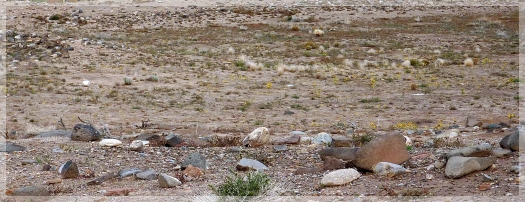
rocky soilOther seed fell among rocks. It began to grow, but the plant soon wilted and died for lack of moisture. [Luke 8:6 (NLT)]

If sinners take up religion in a fair day, they will lay it down in a foul day. They are willing to go to seas, but on condition there are no storms. They think too much of wearing a thorn, though it is borrowed from Christ’s crown. [D.L. Moody]

In the parable of the four soils, some of the farmer’s seed falls among the rocks. Again, this is not the farmer’s fault. Much of the soil of Israel and Judah was rocky and only a thin layer of topsoil covered the limestone base. While seeds might germinate, the seedlings would have weak root systems. Any moisture falling on such shallow soil evaporates quickly and, with roots unable to penetrate the stone, the sprouts soon wither and die. Just as the seed that fell on the pathway could be snatched away, it’s easy for the enemy to pull such weak seedlings out of the soil.

The rocky soil represents a shallow and impulsive faith—a faith based on emotions rather than a conscious decision to trust God with all things. We must never mistake outward fervor (in others or ourselves) as evidence of conversion. This is a “fair-weather faith” that answers the altar call with joy but disappears at the first sign of difficulty, service, or sacrifice. Superficial, it’s more about being religious than being obedient or devoted to God. This shallow response is what Dietrich Bonhoeffer might call “cheap grace…forgiveness without repentance, baptism without discipline, communion without confession, and grace without discipleship or the cross.” The Apostle James called it “dead” or “useless” faith because it goes through the motions without growing or producing fruit. With no depth of understanding, it is vulnerable and easily deceived.

Although human emotion can’t sustain our faith, with enough effort rocky soil can be broken up and shallow faith can deepen. When we deliberately choose to yield our lives to God’s plow and allow His Word to penetrate deep into our hearts, our faith can flourish and survive both drought and flood!

So you see, faith by itself isn’t enough. Unless it produces good deeds, it is dead and useless. … You say you have faith, for you believe that there is one God. Good for you! Even the demons believe this, and they tremble in terror. How foolish! Can’t you see that faith without good deeds is useless? [James 2:17,19-20 (NLT)]

But blessed are those who trust in the Lord and have made the Lord their hope and confidence. They are like trees planted along a riverbank, with roots that reach deep into the water. Such trees are not bothered by the heat or worried by long months of drought. Their leaves stay green, and they never stop producing fruit. [Jeremiah 17:7-8 (NLT)]

Copyright ©2020 jsjdevotions. All rights reserved.