BIBLE BRACKETS

Jesus answered them, “Healthy people don’t need a doctor—sick people do. I have come to call not those who think they are righteous, but those who know they are sinners and need to repent.” [Luke 5:31-32 (NLT)]

March brought more than basketball brackets. In honor of St. Patrick’s Day, the Today show pitted 16 Irish favorites like U-2, Irish whiskey, step dancing, and soda bread against one another. The final bracket was a showdown between Guinness and corned beef and cabbage with the Irish beer winning. Since I don’t Twitter (Tweet?), I missed Bible Gateway’s March madness tournament pitting favorite Bible stories against one another.  

I can understand why some stories didn’t make the top sixteen. Gruesome ones like those of Jael pounding a tent peg through Sisera’s head (Judges 4); Dinah’s rape and the vengeful massacre of Shechem (Genesis 34); and the trickery of Ehud who assassinated the fat King Eglon (Judges 3) aren’t exactly Sunday school fare. Entirely missing from the competition, however, were Sunday school favorites like the Christmas story, the feeding of the multitude, and Pharaoh’s daughter finding Moses.

In actuality, there are far more than sixteen great stories in the Bible and, while my brackets would have differed from Bible Gateway’s, I can’t argue with theirs. Nevertheless, it was no surprise that Jericho’s walls collapsing (Joshua 6) beat the lesser known story of Ezekiel’s vision of dry bones (Ezekiel 37). While the prophet’s vision is a beautiful illustration of Israel’s restoration and spiritual rebirth, picturing those dried bones reattaching, muscles and skin forming over them, and coming to life as a great army is unsettling. The story of the exodus easily beat the lesser known one of Balaam’s donkey. The visual of Moses raising his hand, the Red Sea parting, and the Israelites walking across the dry sea bed with walls of water on each side beats a talking donkey any day!

Before I tell you the winner of the contest, consider your favorite Bible stories. What would you include in your “sweet sixteen” – the wise men, the miracle at Cana, the faith of the woman with the bleeding disorder, Solomon suggesting a baby be cut in half, Zacchaeus climbing a tree, Elijah’s smack down with the prophets of Baal, Nehemiah rebuilding Jerusalem’s walls, Paul and Silas singing in prison, or Shadrach, Meshach, and Abednego in the fiery furnace? They’re all wonderful stories and well worth reading and re-reading over and over again.

The final match-up pitted the story of David and Goliath against the parable of The Prodigal (or Lost) Son. Everyone loves a story about an underdog hero and the boy shepherd who felled the Philistine warrior with a single shot was a sure favorite. It tells us that, even against insurmountable odds, when we trust in God, we can emerge victorious.

Nevertheless, it’s easy to see why the parable of the lost son won. Described by the Expositor’s Bible Commentary as “the crown and flower of all the parables,” it reassures us that no matter how far we stray, how low we fall, or how much we squander or misuse God’s gifts, His unconditional love is waiting for us when we return to Him. By focusing on the father’s love and forgiveness, however, we often miss an important part of that story—the son’s repentance! This was the last of three parables about the lost—a sheep, a coin, and a son—and the celebration when they are found. Jesus finished them all by tying repentance to the celebration. Let us never forget that we have to repent before we can attend the party!

In the same way, there is more joy in heaven over one lost sinner who repents and returns to God than over ninety-nine others who are righteous and haven’t strayed away! … In the same way, there is joy in the presence of God’s angels when even one sinner repents. … We had to celebrate this happy day. For your brother was dead and has come back to life! He was lost, but now he is found! [Luke 15:7,10,32 (NLT)]

Copyright ©2021 jsjdevotions. All rights reserved.

WHAT CHANGED THEM? (Easter – Part 2)

But beware! For you will be handed over to the courts and will be flogged with whips in the synagogues. You will stand trial before governors and kings because you are my followers. … Then Jesus said to his disciples, “If any of you wants to be my follower, you must give up your own way, take up your cross, and follow me.” [Matthew 10:17-18,16:24 (NLT)]

rabbitThe Federal Trade Commission is charged with enforcing truth-in-advertising laws so that all advertisements are truthful, not misleading, and backed by scientific evidence. Although drug companies abide by the FTC’s regulations by listing their products’ side effects, between the fine print and the announcer’s fast talk, most consumers don’t understand them. Jesus didn’t resort to fast talk, deceit, or ambiguity when he told His disciples the cost of following him. He was brutally honest and told the disciples they would arrested, persecuted and hated because of Him.

While the disciples may not have comprehended completely, they couldn’t say they weren’t warned and Jesus told them the possibility of losing their lives was very real. Nevertheless, I imagine they thought He was speaking figuratively when He spoke of them carrying a cross. Even though He’d predicted His own death, I suspect his followers really didn’t understand what lay ahead until that fateful night when Jesus was arrested. Once He’d been tried, sentenced, and crucified, I’m sure the Lord’s cautionary words echoed in their minds and they finally understood the reality of that cross they’d be expected to carry! No wonder they cowered together in a locked room. The next step after arresting a revolutionary was to arrest his followers.

It was only John and a few women followers at the foot of the cross and it was a stranger, not a follower, who carried the cross for Christ. Jesus’ disciples, the men with whom he’d lived for three years, weren’t there to carry his heavy load or share his final hours. Rather than His friends, it was a secret follower of Jesus, Joseph of Arimathea, who placed Him in a borrowed tomb. Rather than a day of rest, the disciples’ Sabbath probably was a day of mourning, disappointment, confusion, and fear. Sunday morning, with the Sabbath over, some followers returned home while the rest continued to cower together in fear.

What turned a veritable group of despondent deserters into men who bravely spread the good news of Christ the Savior? These are the same men who fled from Jesus when He was arrested and Peter publicly denied knowing Him three times that night. What caused the two disheartened men from Emmaus to return to Jerusalem and the disciples in that locked room? What turned Jesus’ followers into people who courageously faced persecution and martyrdom? Of the disciples, all but John are thought to have been martyred. They had nothing to gain from a lie but everything to lose with the truth. What turned a bunch of deserters into evangelists? They saw the risen Christ! They spoke with Him, touched his scars, and broke bread with Him. They knew it to be the truth!

We haven’t walked with Jesus, but we’ve read the words of those who have. We haven’t been in the same room with Him, but we’ve heard His voice. We’ve not touched Him, but He has touched us. We haven’t seen his wounds, but He’s healed ours. We didn’t see His ascent into heaven, but we’ve experienced his Holy Spirit. No—we haven’t actually seen the risen Christ but, as Jesus people, “We live by believing and not by seeing.” [2 Corinthians 5:7]

You can kill us. But you cannot hurt us. [Justin Martyr (c. AD 150)]

During the forty days after he suffered and died, he appeared to the apostles from time to time, and he proved to them in many ways that he was actually alive. And he talked to them about the Kingdom of God. [Acts 1:3 (NLT)]

Then Jesus told him, “You believe because you have seen me. Blessed are those who believe without seeing me.” [John 20:29 (NLT)]

WHEN GOD MOVES A STONE (Easter – part 1)

On the way they were asking each other, “Who will roll away the stone for us from the entrance to the tomb?” But as they arrived, they looked up and saw that the stone, which was very large, had already been rolled aside. [Mark 16:3-4 (NLT)]

Easter tombAlthough Jesus repeatedly predicted that He’d rise from the dead, the women didn’t bring clean clothes for a living man that Sunday morning when they went to the tomb. Instead, they brought burial spices of their own with which to anoint His dead body. Because of the Sabbath, Jesus’ burial was rushed and His body laid in a borrowed tomb. Although Joseph and Nicodemus had anointed Him, perhaps the women were concerned that, in the men’s haste to finish before sunset, they hadn’t done a proper job of preparing the body. The spices they brought would conceal the stench of decay and, out of love for Jesus, they wanted to complete the burial rites properly.
Not knowing about the guards Pilate had posted at the tomb, the women wondered how they would manage entry into it. Many Judean tombs were caves. The opening was covered by a large disc-shaped stone set into a groove cut in the bedrock. Getting the stone in place was fairly easy as it was rolled down a slight incline to cover the tomb’s opening. Several men, however, would be needed to roll it up the incline. “Who will roll the stone away?” they asked. Even though the women didn’t know how it would be done, they trusted that it could be done and proceeded in faith.

For a moment, consider that heavy stone at the cave’s opening. It was impossible to remove from within the tomb but it wasn’t removed so Jesus could exit the tomb. The Messiah who raised the dead, walked on water, and healed the sick certainly didn’t need anyone to move the stone for Him. Regardless of size, no boulder could block the way of the one whose resurrection meant that death had been conquered. That stone wasn’t moved so He could get out; it was moved so that His followers could get in, find the tomb empty, and share the good news!

The women didn’t let their reservations about moving the stone stop them from going to the burial site and serving their Lord. What about us? When we are called to serve Him, do we worry about the stones that might block our way and allow them to stop us? Let the Easter story remind us that, just as that stone was removed for the women so they could tell the good news, God will remove the barriers blocking our way from sharing the resurrected Christ!

Then the angel spoke to the women. “Don’t be afraid!” he said. “I know you are looking for Jesus, who was crucified. He isn’t here! He is risen from the dead, just as he said would happen. Come, see where his body was lying. And now, go quickly and tell his disciples that he has risen from the dead, and he is going ahead of you to Galilee. You will see him there. Remember what I have told you.” [Matthew 28:5-7 (NLT)]

Copyright ©2021 jsjdevotions. All rights reserved.

SHE DIDN’T KNOW – GOOD FRIDAY

You will conceive and give birth to a son, and you will name him Jesus. He will be very great and will be called the Son of the Most High. The Lord God will give him the throne of his ancestor David. And he will reign over Israel forever; his Kingdom will never end! [Luke 1:31-33 (NLT)]

Then Simeon blessed them, and he said to Mary, the baby’s mother, “This child is destined to cause many in Israel to fall, but he will be a joy to many others. He has been sent as a sign from God, but many will oppose him. As a result, the deepest thoughts of many hearts will be revealed. And a sword will pierce your very soul.” [Luke 2:34-35 (NLT)]

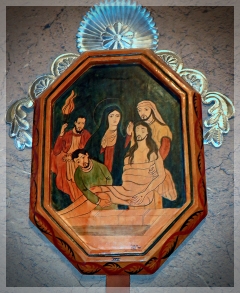
Golindrinas - 14 Station of the CrossSeveral years ago, my mother-in-law was despondent when my brother-in-law’s deteriorating health necessitated hospice care. Parkinson’s disease had taken a terrible toll on him and a mother’s heart breaks when she sees her child’s life disintegrating before him. Yet, that’s what happened to Mary.

My sister was distraught when her son was diagnosed with inoperable cancer; his promising future was cut short and she grieved as she saw him in pain. In the prime of his life, he wasn’t much older than was Jesus when He walked to Calvary. Any mother’s heart breaks when she sees her child suffer. Yet, that’s what happened to Mary.

At a funeral many years ago, I remember the mourning mother speak to me of her child’s death. “It’s not right!” she protested, “I’m the one who is supposed to go first. A mother isn’t supposed to bury her child.” No, a mother isn’t supposed to watch her child suffer and die nor should she witness him laid in his grave. Yet, that’s what happened to Mary.

Like any mother, Mary had high hopes for her special child. The angel’s words more than thirty years before led her to think He’d reign over Israel. That horrible Friday, as her beloved son hung on the cross, did she remember Simeon’s prophetic words and feel that sword pierce her soul?

Did Mary know that Isaiah’s prophecies were about her boy Jesus—that it was her son who would be beaten and whipped, unjustly condemned, “led like a lamb to the slaughter,” and have his life “cut short in midstream?” [Isaiah 53:5-8] Could she possibly have understood how this miraculously conceived son—the infant she nursed at her breast whose birth was heralded by angels, the babe given costly gifts and worshipped by magi from the East, the child Simeon said would be the glory of Israel, the boy smart enough to converse with rabbis, the young man who turned water into wine—would end up dying a criminal’s death?

Standing at the foot of the cross, her hopes for her boy were dashed as He was spat upon and mocked. As He struggled to take His last few breaths, Mary heard his anguished cries and she watched her baby boy die a tortuous death. Her mama’s heart broke as He was placed in a borrowed tomb. Mary didn’t know what Sunday would bring.

When the grief-stricken women went to the tomb that Sunday morning, they didn’t bring clean clothes for a resurrected man; they brought spices for the anointing of a dead body. They weren’t expecting an empty tomb. Like Mary, the mother of Jesus, they didn’t know.

He had done no wrong and had never deceived anyone. But he was buried like a criminal; he was put in a rich man’s grave. [Isaiah 53:9 (NLT)]

Copyright ©2021 jsjdevotions. All rights reserved.

WASHING THE FEET – MAUNDY THURSDAY

If any of you wants to be great, he must be your servant. If any of you wants to be first, he must be the slave of all. That’s how it is with the son of man: he didn’t come to have servants obey him, but to be a servant – and to give his life as “a ransom for many.” [Matthew 20:26b-28 (NTE)]

tri-colored heronWhile the accounts of the anointing of Jesus’ feet in Luke 7:36-50 and John 12:1-8 are similar, they are different events and different people were involved. Luke tells of an unnamed woman and John tells of Mary of Bethany. Although both women wiped Jesus’ feet with their hair, the unnamed woman, a notorious sinner, was an uninvited and unwelcome guest in the Pharisee’s home. Mary was a well-respected and devout friend of Jesus and welcome in her sister’s house. Pharisees were present at one and Christ’s disciples at the other. Where the Pharisees saw a sinful woman’s bad character, Jesus only saw a repentant sinner. Where the disciples saw an extravagant waste of money, Jesus saw a woman who offered a gift of love. He defended one woman’s actions by pointing out that she’d done what His host had failed to do. He defended the other woman’s extravagance by reminding his disciples that she was preparing Him for burial.

They were different times and different places but both women humbled themselves at Jesus’ feet. Both women took on a job that belonged to servants and, while most people chased after Jesus because they wanted something from him, neither woman asked anything of Him. Instead, they offered all they had. One woman’s old life died as she washed His feet and the other woman’s brother, who died, now lived. Their generous acts declared the women’s faith in Jesus as the Messiah. We may come to Jesus as a repentant sinner or we may come to him with praise and thanksgiving but, like both of these women, we must always come with a humble heart that is ready to serve.

The most radical act of humility and service, however, occurred shortly after the disciples argued over who among them was the greatest. That night, in the room where they’d gathered for their Passover meal, Jesus (the greatest of them all) knelt at the feet of His disciples. Knowing full well that soon one of them would betray Him, another would deny him, and all would desert him, Jesus humbly washed their feet. That was God incarnate kneeling in front of them and washing their feet but we don’t read of any of the disciples offering to wash His!

Today is Maundy Thursday and several Christian denominations will have communion services in remembrance of that last supper. As a visual reminder that loving Christ means service and there is dignity in serving others, some churches also will observe a religious rite called Washing of the Feet. As members of the Body of Christ, we are to follow His example by serving one another in humility and love. Like the unnamed woman, Mary of Bethany, and Jesus, we must have the heart of a servant.

One of the principal rules of religion is, to lose no occasion of serving God. And, since he is invisible to our eyes, we are to serve him in our neighbour; which he receives as if done to himself in person, standing visibly before us. [John Wesley]

“Do you know what I’ve done to you?” he asked. “You call me ‘teacher,’ and ‘master,’ and you’re right. That’s what I am. Well, then: if I, as your master and teacher, washed your feet just now, you should wash each other’s feet. I’ve given you a pattern, so that you can do things in the same way that I did to you.” [John 13:12-15 (NTE)]

Copyright ©2021 jsjdevotions. All rights reserved.

BUT THERE’S A DRESS CODE! (Matthew 22:1-14 – part 2)

And he said to his servants, “The wedding feast is ready, and the guests I invited aren’t worthy of the honor. Now go out to the street corners and invite everyone you see.” So the servants brought in everyone they could find, good and bad alike, and the banquet hall was filled with guests. [Matthew 22:8-10 (NLT)]

mute swanIn Jesus’ Parable of the Wedding Dinner, after the initial guests refused to come, the king’s servants invited everyone they could find. Since it was a royal wedding, you’d expect the new guests to be dignitaries but everyone was to be called—regardless of social standing, race, nationality, wealth, or even moral character.

What seems like a beautiful example of God’s grace takes a turn when we learn that the king seems to have set a condition—a wedding garment must be worn. When I’m going to a wedding, it takes days (and probably a shopping trip or two) to put together the proper apparel and this was a royal wedding! People came from all walks of life and, with little time to prepare or purchase fancy clothing, we’re surprised when the king notices a man not wearing wedding clothes. Confronting the guest, the king asks how he could be there without proper attire. When the man has no reply, the king has him bound and cast into “the outer darkness.”

It’s easy to think the host’s problem is that the man is poor and has only rags to wear but the host’s anger seems so unlike Jesus that I was troubled by this part of His story. Scripture, however, never says the man was poor or dressed in tattered clothing and the speechless man, by never explaining himself or even asking how to get such a garment, seems to know he doesn’t belong at the feast.

By eating with sinners, touching lepers, healing on the Sabbath, and talking theology with a Samaritan woman, Jesus never seemed overly concerned with propriety or etiquette so it’s hard to think He took much notice of clothing. Some commentators speculate that the king must have furnished all of his guests with suitable apparel and that the man slighted the king by refusing to wear it. While it makes for a convenient explanation, there is no evidence of this being a Jewish custom so I’m not sure Jesus’ listeners would have understood it that way. Then again, perhaps “proper clothes” shouldn’t be taken too literally!

Rather than fabric and jewelry, could the wedding garment be the righteousness of Christ? By accepting the invitation, the evicted guest professed his belief, but the absence of a wedding garment testified to the falseness of his profession. A wedding garment would be the evidence of salvation—a way of life showing rebirth, repentance, and the works of righteousness. If we want to enjoy the feast, lip service is not enough; we must be righteous in character!

Jesus concludes the parable by saying, “For many are called, but few are chosen.” [22:14] God will not have an empty banquet hall and His invitation has been extended to all. He will, however, reject those who refuse His offer (as did the first invitees) along with those who are false in their acceptance (as was the man without the wedding garment.)

When sinners come in repentance, trusting in Christ, then He clothes them with the garment of salvation, with the robe of righteousness. This is the wedding garment that makes one presentable at the marriage supper. [Harry Ironside]

Not everyone who calls out to me, “Lord! Lord!” will enter the Kingdom of Heaven. Only those who actually do the will of my Father in heaven will enter.  [Matthew 7:21 (NLT)]

What good is it, dear brothers and sisters, if you say you have faith but don’t show it by your actions? Can that kind of faith save anyone? …  Just as the body is dead without breath, so also faith is dead without good works. [James 2:14,26 (NLT)]

Copyright ©2021 jsjdevotions. All rights reserved.