
For I am not ashamed of this Good News about Christ. It is the power of God at work, saving everyone who believes—the Jew first and also the Gentile. This Good News tells us how God makes us right in his sight. This is accomplished from start to finish by faith. As the Scriptures say, “It is through faith that a righteous person has life.” [Romans 1:16-17 (NLT)]
 Among the 613 mitzvot were laws about not adding to or detracting from the commandments. Unfortunately, man’s need for rules and regulations must be ingrained. Finding the original 613 laws an insufficient guide to Jewish life, the religious leaders stayed busy for the next several centuries clarifying the law by creating even more laws about how to keep the initial ones and then determining the proper way to atone for every infraction.
For example, finding the simple prohibition of work on the Sabbath too general, thirty-nine categories of work were created which led to sub-categories and then more laws about handling any of the implements used in such work. Among the work subcategories were sewing two stitches and hammering which meant handling needles or hammers on the Sabbath also was prohibited. There were, however, exceptions to the rules. If necessary, you could move a needle to open your prayer book and, if you had nothing else, a hammer could be used to crack nuts!
The laws in Leviticus said a priest with a physical defect could not serve in the sanctuary but, since a “defect” was not explicitly defined, 140 disqualifying physical blemishes were categorized that covered everything from head to toe (and even body odor). Even the size of a disqualifying mole was specified (but, if a mole had any hair, it was prohibited regardless of size).
True to form, when an expert in religious law spoke with Jesus about the law of loving his neighbor, he wanted to define who his neighbor might be. While a fellow Jew surely would be a neighbor, what about a convert, an Edomite or an Egyptian? Would Moabites and Ammonites (who were barred from citizenship) be considered neighbors? And what about those hated Samaritans?
Interpreting those 615 laws became as difficult as understanding today’s complicated tax code. Eventually, it became more about doing a deed than following a creed—more about works than worship—rules than relationship—laws than love—penalties rather than penitence—and thinking it possible to save oneself rather than be saved. Jesus brought a covenant that fulfilled the true intent and purpose of the law—one in which our salvation rests solely with God by grace through faith. There’s a lot we can do for ourselves but one thing we can’t do is to save ourselves by following rules. Salvation is God’s business; ours is getting saved, not by laws but by faith.
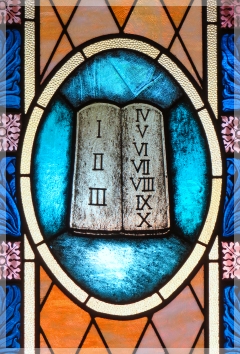 The Ten Commandments are the foundation of both Jewish and Christian principles, conduct, and accountability, but they are just ten of the 613 mitzvot or commandments given to the Jewish people. In light of the big ten, many of those commands, such as using accurate scales and weights and fulfilling our promises make perfect sense as do prohibitions about speaking derogatorily of others or standing idly by if another person’s life is in danger. Moreover, laws regarding boundary markers, evidence, assessing property damages, and not perverting justice or accepting bribes certainly were necessary in a new nation. Some laws, like the ones regarding latrine placement, covering excrement, and making a guard rail around a flat roof seem reasonable from a health and safety viewpoint. Other laws may have served as a way to separate the Jews from their pagan neighbors. Perhaps it was because the Hittites, Elamites, and Sumerians were clean-shaven and the Egyptians often were clean shaven or had shaped goatees that Jewish men were not to trim the hair on their temples or shape their beards. Many laws, such as the intricate laws of sacrifice, the blue tassels on hems, reciting the Shema twice a day, and saying a blessing after meals, were related to worship and God.
 Yesterday, when writing about notable liars in Scripture, I thought of other less commendable circumstances when people lied. When David was on the run from Saul, he arrived in the town of Nob and visited Ahimelech, the high priest. Although his purpose was to obtain food for his men and a weapon for himself, David blatantly lied and said he was there on a private matter for the king and lied again to explain being weaponless. Ahimelech, who didn’t know of the rift between Saul and David, gave David bread for his men along with Goliath’s sword.
 A 2010 study on “Human Communication Research,” found that people average 1.65 lies per day. I suspect the 1,000 they people surveyed were not completely truthful and the number is probably higher! We’re all liars but are all lies equal? Is a POW’s lie to his interrogator about his platoon’s position the same as a thief’s lie to a detective? Is an undercover policeman’s lie to a drug dealer the same as not reporting all your income on your 1040? Is deceiving someone so you can give him a surprise party the same as saying the check’s in the mail when it isn’t?
 Yesterday, I made reference to the story of Jael. Her story takes place about 200 years after the Israelites entered Canaan in the time of the Judges—a time when “all the people did whatever seemed right in their own eyes.” [17:6] Because of Israel’s disobedience, the Lord allowed King Jabin of Hazor to subjugate the people of Israel. Sisera led Jabin’s army and, with their 900 iron chariots, the Canaanites had oppressed the Israelites for twenty years. Deborah, a prophetess, was judge at the time.
