HE HEALED

“What do you want me to do for you?” Jesus asked. “My Rabbi,” the blind man said, “I want to see!” And Jesus said to him, “Go, for your faith has healed you.” Instantly the man could see, and he followed Jesus down the road. [Mark 10:51-52 (NLT)]

Bartimaeus, the blind beggar, ran after Jesus. “Son of David, have mercy on me!” he called. The crowd tried to quiet him, but he only shouted louder. No doubt about it, he wanted to be healed and he was. A paralyzed man wanted healing so much that he had his friends carry him to Jesus. When they couldn’t get through the crowd to the Lord, the men climbed onto the roof, made an opening and lowered their friend down to Jesus. Nothing was going to keep him from healing. A bleeding woman spent every penny she had on doctors to no avail. She followed after Jesus, desperately trying to touch his robe in hope of healing. Like the blind beggar and lame man, she truly wanted to be healed.

What a contrast they are to the man who lay by the pool at Bethesda for thirty-eight years. Sick people congregated there every day in hope of a miraculous healing. It was said that an angel of the Lord would come from time to time and stir up the water. Whoever was first to step in that water would be healed instantly. When Jesus came to the pool, he saw the man and asked if he wanted to be healed. It’s odd that the answer wasn’t a resounding “Yes!” Instead, the man complained that he had no one to put him in the water when it rippled.

The sick man by the pool blamed others for his lack of healing; no one would take him to the edge of the pool. Was there no one in thirty-eight years who might have helped the sick man if he’d only asked? Had he been abandoned or had he gotten so comfortable in his misery that he hadn’t requested help? Did he really want to be healed or had he found it easier to be an invalid? Fortunately, Jesus saw and took pity on him, commanded him to pick up his mat and walk. The man obeyed and was healed. If he’d replied, “I can’t; I’m too sick!” he would probably have lain there for the rest of his years.

Some of us may need physical healing; others may need spiritual or emotional healing. Sickness and disease are part and parcel of our imperfect world. No matter how much faith we have or how many doctors or counselors we visit, not every illness will be cured. There is no promise that we’ll stay healthy and death is inevitable. When we need healing, however, we can’t lay helpless by a pool waiting for a miraculous and effortless cure. Healing takes work. That means prayer along with such things as regular medication, physical therapy, a 12-step program, counseling, an exercise regimen or special diet, healthier habits, hospitalization, a support group, or even a simple change in attitude. We can, however, do all of that and still not be healed. Cures are never guaranteed but, if we’re unwilling to put forth some effort, it’s a guarantee that we’ll never be able to stand up, pick up our mats and walk.

The wish for healing has always been half of health. [Seneca]
When Jesus saw him and knew he had been ill for a long time, he asked him, “Would you like to get well?” “I can’t, sir,” the sick man said, “for I have no one to put me into the pool when the water bubbles up. Someone else always gets there ahead of me.” Jesus told him, “Stand up, pick up your mat, and walk!” Instantly, the man was healed! [John 5:6-9a (NLT)]

TRUTH IN ADVERTISING

“Take nothing for your journey,” he instructed them. “Don’t take a walking stick, a traveler’s bag, food, money, or even a change of clothes. … Then he said to the crowd, “If any of you wants to be my follower, you must turn from your selfish ways, take up your cross daily, and follow me. If you try to hang on to your life, you will lose it. But if you give up your life for my sake, you will save it.” [Luke 9:3,23 (NLT         

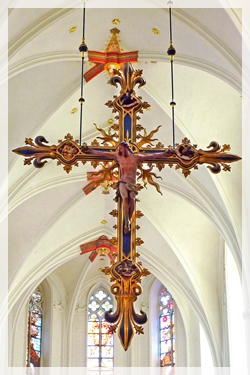
Our Lady Cathedral, AntwerpVarious other translations of these verses from Luke say the follower of Christ is to “stop thinking about,” “lose sight of,” “deny,” or “disown” himself and give up his interests and the things he wants. Many translations are far less poetic when mentioning the taking up of one’s cross. The Expanded Bible, for instance, say followers must “be willing to give up their lives” and the Complete Jewish Bible bluntly refers to the cross as an “execution-stake.” It’s bad enough that Jesus told us to take nothing when we follow him. He then tells us that we won’t be staying at the Hilton nor having room service. In fact, there might not even be a bed at the Motel 6 with coffee and stale rolls in the morning. Moreover, since we’re to deny ourselves the things we want, there may be no bed at all and it’s quite possible we’ll go hungry. We have to learn to rely on God rather than ourselves. Finally, there’s that that whole “taking up the cross” thing meaning a loss of one’s life-style or, even worse, the possible loss of one’s life! It seems to me that Jesus needed to consult with a better advertising agency if He was going to get followers. There would be plenty of Christians if He, like most politicians, offered us a care-free life, one of effortless comfort and ease, instead of telling us how difficult it would be. Jesus, however, laid it all on the line. A follower of Christ must rely on God’s provision, not his own; God-dependence must replace independence and obedience must replace self-determination. Long-standing habits, desires and attitudes must be renounced and the old self crucified so we can be made new in Christ. Our old lives have to be left behind if we’re going to journey with Jesus. Indeed, his early followers and even some Christians today face the actual loss of life for their belief. Jesus certainly didn’t make Christianity sound very easy. Why would anyone follow him? Then again, when we consider the benefits, why would anyone not?

 If you try to hang on to your life, you will lose it. But if you give up your life for my sake, you will save it. [Luke 9:24 (NLT

My old self has been crucified with Christ. It is no longer I who live, but Christ lives in me. So I live in this earthly body by trusting in the Son of God, who loved me and gave himself for me. [Galatians 2:20 (NLT)]


RESCUE AND REDEEM

Give your love of justice to the king, O God, and righteousness to the king’s son. … He will rescue the poor when they cry to him; he will help the oppressed, who have no one to defend them. He feels pity for the weak and the needy, and he will rescue them. He will redeem them from oppression and violence, for their lives are precious to him. [Psalm 72:1,12-14 (NLT)]

hands-cropWEBIn Psalm 72, David, by now an old man, penned a prayer for Solomon who would soon become king. It may well have been David’s last psalm. In it he asked God to help his son to rule the kingdom justly and compassionately. “Rescue” and “redeem,” “help” and “pity” – these are pretty serious requirements, yet this is what a good king will do for his people. This is what Jesus, our king, did for us. Moreover, this is what we should do for others.

God cares for the poor, the oppressed, the weak and needy. He expects us to care for them, too. We need to consider how we can reach out to these people with God’s love. Like a good king, we can’t ignore their plight. The government we choose helps determine their fate. Do we remember the poor and oppressed, weak and needy when we vote? Do we remember them when we pass by the Salvation Army’s kettles at Christmas time? Do we remember them when we make our offerings at church? Do we remember their needs when we pray? Do we volunteer at a shelter or hospital or charity re-sale shop? Do we support missions with donations of supplies and money? Do we open our checkbooks freely for those who need our financial help? Do we open our hearts? Do we reach out our hands? Jesus was in the rescue and redeem business; are we?

In all their suffering he also suffered, and he personally rescued them. In his love and mercy he redeemed them. He lifted them up and carried them through all the years. [Isaiah 63:9 (NLT)]

Praise the Lord God, the God of Israel, who alone does such wonderful things. Praise his glorious name forever! Let the whole earth be filled with his glory. Amen and amen! [Psalm 72:18-19 (NLT)]

WE DIDN’T DO IT ON OUR OWN

The Lord sent a prophet to the Israelites. He said, “This is what the Lord, the God of Israel, says: I brought you up out of slavery in Egypt. I rescued you from the Egyptians and from all who oppressed you. I drove out your enemies and gave you their land. I told you, ‘I am the Lord your God. You must not worship the gods of the Amorites, in whose land you now live.’ But you have not listened to me.” [Judges 6:8-10 (NLT)]

God made it quite clear: the Israelites were not to worship the Amorite gods, yet they fell into a life of disobedience and idolatry. With such a concise and simple prohibition, why did the Israelites fail to obey God? Had they forgotten who freed them and fed them, gave them victory in battle and led them to a “land of milk and honey”? Perhaps they had and they began to think they had accomplished everything on their own. Lack of gratitude can be a dangerous thing. For the Israelites, it meant that they suffered for seven years at the hands of the Midianites; homes, crops and livestock were destroyed and Israel was on the brink of starvation. Let us never make the mistake of worshiping the false gods of self, fame, or fortune. While we enjoy the blessings of this life, we must never forget who made them all possible.

However, if you do not listen to me or obey all these commands, and if you break my covenant by rejecting my decrees, treating my regulations with contempt, and refusing to obey my commands, I will punish you. I will bring sudden terrors upon you—wasting diseases and burning fevers that will cause your eyes to fail and your life to ebb away. You will plant your crops in vain because your enemies will eat them. I will turn against you, and you will be defeated by your enemies. Those who hate you will rule over you, and you will run even when no one is chasing you! [Leviticus 26:14-17 (NLT)]

SPLISH, SPLASH, TAKIN’ A BATH!

3-5-15- tanzania-WEB
I am overwhelmed with joy in the Lord my God! For he has dressed me with the clothing of salvation and draped me in a robe of righteousness. I am like a bridegroom in his wedding suit or a bride with her jewels. [Isaiah 61:10 (NLT)]

When on a photo safari in Tanzania, I couldn’t believe how grimy I got. Tooling around on unpaved roads all day long in an open Range Rover meant for a lot of dust and, by the end of the day, I was caked with it. I’m sure you’ve had days when you’ve gotten incredibly dirty, as well. There’s nothing like hours spent gardening or cleaning out the garage to leave you and your clothes filthy, sweaty, and less than fragrant. Your hands and fingernails are coated with grime and even your teeth feel gritty. How refreshing it feels to strip off your dirty clothing and step into a hot shower and scrub away the dirt. Once clean, isn’t it pleasant to step into freshly laundered clothes? You feel like a new person.

3-15-15 wildebeest-WEBThe prophet Zechariah had a vision. In it, the high priest Jeshua, representing the nation of Israel, was standing before the angel of the Lord. Representing the sins of his people, Jeshua’s clothes were filthy. His clothing was removed and the angel said, “See, I have taken away your sins, and I am giving you fine new clothes.” [Zechariah 3:4 (NLT)] What an amazing image this is. Sins are literally being stripped off and replaced with garments of God’s goodness. Just as we feel refreshed after a shower and fresh clothes, imagine how much better we feel when we have shed the grime of sin. Our confession and repentance serve as soap and God’s forgiveness is the warm water showering over us, cleansing us of our sins. God’s grace is like the fresh outfit that is waiting for us. He will clothe us with his love and mercy; we just have to put on our new apparel. We won’t just feel like a new person; we can be a new person!

So remove your dark deeds like dirty clothes, and put on the shining armor of right living. … Clothe yourself with the presence of the Lord Jesus Christ. [Romans 13:12,14 (NLT)]

Throw off your old sinful nature and your former way of life, which is corrupted by lust and deception. Instead, let the Spirit renew your thoughts and attitudes. Put on your new nature, created to be like God – truly righteous and holy. [Ephesians 4:22-24 (NLT)]


MOTHERS-IN-LAW – MOTHER’S DAY

“Yes, I know,” Boaz replied. “But I also know about everything you have done for your mother-in-law since the death of your husband. I have heard how you left your father and mother and your own land to live here among complete strangers. May the Lord, the God of Israel, under whose wings you have come to take refuge, reward you fully for what you have done.” [Ruth 2:11-12 (NLT)]

5-11-15smartweedWEB

Now in my seventh decade, I view the Bible story of Ruth from an entirely different perspective than when I was younger. While I used to connect with the youthful woman, Ruth, I now relate to the older one (and mother-in-law), Naomi. In a time of famine, Naomi and her husband Elimelech moved from Judah to Moab with their two sons. Even though Jewish law forbade it, their sons married local girls: Orpah and Ruth. Unfortunately, all three men died, leaving Naomi, Orpah, and Ruth widows. In those days, there was little worse than being a widow; widows were ignored, usually poverty stricken, and often victimized. Since a widow’s closest relative was supposed to take care of her, Naomi decided to return to her relatives in Judah. Orpah and Ruth set out to go with her, but Naomi stopped and advised them to go back to their families in Moab, telling the young women that she had nothing for them. Orpah, perhaps wisely, chose to return home. Ruth, however, chose to stay and said those words we often hear repeated in wedding ceremonies: “Don’t ask me to leave you and turn back. Wherever you go, I will go; wherever you live, I will live. Your people will be my people, and your God will be my God. Wherever you die, I will die, and there I will be buried.” [Ruth 1:16-17 (NLT)]

What an amazing declaration of love! It’s one you might expect from a wife to a husband but not from a son’s wife to her mother-in-law. What was it about Naomi that could inspire such words from her daughter-in-law? What kind of woman earns that much love and loyalty? What kind of woman arouses such devotion that her daughter-in-law willingly leaves the safety of her homeland to share a poverty-stricken existence with her? She’s certainly not the kind about whom bad mother-in-law jokes are written.

Naomi must have been cool and calm, loving and gracious. Perhaps she kept the Biblical equivalent of duct tape handy to place over her mouth when necessary. I’m sure she never interfered or told her sons’ wives how to manage their households. In spite of the fact they weren’t Jewish, Naomi must have accepted, loved and respected her daughters-in-law as if they were her very own daughters. Finally, she must have had a deep faith in God that was evident in the way she lived. Otherwise, why would Ruth chose to follow Naomi’s one God rather than the pagan gods of Moab?

My fervent prayer is that I can be a Ruth to my mother-in-law, a women deserving of such love and devotion. Moreover, I pray that I can be a Naomi to my daughters-in-law. Heavenly Father, show me how to be a woman filled with kindness and wisdom, love and faith. May I be the sort of woman who can inspire these loving words: “Your people will be my people, and your God will be my God.”

She is clothed with strength and dignity, and she laughs without fear of the future. When she speaks, her words are wise, and she gives instructions with kindness. … Charm is deceptive, and beauty does not last; but a woman who fears the Lord will be greatly praised. [Proverbs 31:25-26,30 (NLT)]