
Then they said, “Let’s bring the Ark of the Covenant of the Lord from Shiloh. If we carry it into battle with us, it will save us from our enemies.” [1 Samuel 4:3b (NLT)]
 Sorting through cabinets, I came across a video of Raiders of the Lost Ark. As I recall, archaeologist/adventurer Indiana Jones was authorized by the government to find the Ark of the Covenant before Hitler’s Nazis could obtain its supernatural powers and dominate the world. Indiana was told that the Bible speaks of the Ark’s power to level mountains, lay waste to entire regions, and that any army carrying the Ark is invincible.
The only other Indiana Jones movie I remember is Indiana Jones and the Last Crusade. Like its predecessor, it had equally poor Biblical history and theology. Indiana again found himself up against the Nazis when his father disappeared while pursuing the Holy Grail (the cup from the Last Supper). Since drinking water from the chalice would grant immortality, the Nazis wanted to possess it.
Of course, we should never get our religious education from popular movies. As for an army being invincible when carrying the Ark, the opposite actually happened. Thinking God’s power was in the Ark, the Israelites carried it into battle and were defeated by the Philistines; 30,000 of their soldiers died and the Ark was captured. As for drinking from the Holy Grail, the disciples all drank from it and they all died. Belief in Jesus is the only way to gain eternal life.
While it seems silly to think that merely possessing the real Ark would bring world domination or that drinking water from a cup used by Jesus would bring immortality, the Israelites made the same mistake of venerating some of God’s things rather than God. Instead of reminding them who to worship, objects like the bronze serpent became what was worshipped. When approaching Canaan for the second time, the impatient Israelites spoke against God and Moses. In judgment, God sent poisonous serpents into their camp. As people began to die, the people confessed their sin, and begged for mercy. God then commanded Moses to make a bronze serpent, telling him that all who looked at it would be healed. The Bible makes no more mention of Moses’ bronze serpent until some 700 years later when King Hezekiah began to rule Judah. When he eradicated idolatry throughout the country, Hezekiah destroyed the bronze serpent because people had started to worship it rather than God. Instead of being a symbol of God’s mercy, forgiveness, and healing, the bronze serpent became an idol.
Power comes from God, not from things. Central to the Israelites’ faith, the Ark was a sign of God’s covenant with them. Even though it symbolized a holy pledge, the Ark was no more worthy of worship than a rainbow, the symbol of God’s covenant with Noah. Although it contained precious relics, it had no more power than does my jewelry box. The Holy Grail had no more power than my coffee cup and the bronze serpent possessed no more power than the bandage on my knee.
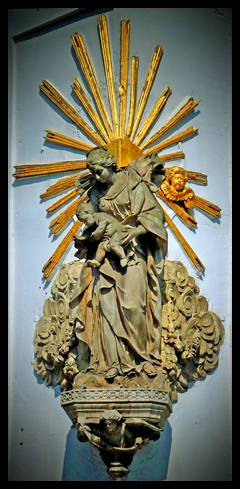
None of those items were graven images nor were they made to be idols and yet people turned them into objects of worship. While we have no ancient artifacts tempting us, let us never make the error of turning respect for a religious symbol into the worship of it. While worthy of reverence, the cross in the sanctuary or on the chain around one’s neck, the Communion chalice, a statue of Mary or picture of Jesus, dried palms from Palm Sunday, or a mezuzah at the doorway have no more power than a rabbit’s foot or a lucky penny. While they may aid in prayer or worship, salvation comes from God—not from any of His things!
 Under King Solomon’s reign, the temple and palace were built in Jerusalem. Unfortunately, to accomplish this task, the people were severely overworked and heavily taxed. When Solomon’s son Rehoboam became king, the populace pled with him to reduce their taxes and ease up on the labor demands. The sacrifices they’d endured during the building of the temple could not be sustained forever. They pledged to be Rehoboam’s loyal subjects in return for his lightening their load.
 When Jesus stopped in Jericho, He was on His way to Jerusalem; His trial and crucifixion would soon follow. Although our Lord knew He would not pass that way again, no one else did; certainly not Zacchaeus. What if the publican had been too busy collecting taxes that day to go and see Jesus? What if it looked like it might rain or he was just too tired to make the effort? What if Zacchaeus had been discouraged by the large crowd and his inability to get a good viewing spot? Thinking he always could see Jesus the next time He passed through Jericho, what if he hadn’t run ahead and climbed that tree? Zacchaeus would have missed meeting Jesus and accepting His call.
 Consider the determination of Zacchaeus, the despised little man who, unable to shove his way through the crowd to see the rabbi from Nazareth, doggedly ran ahead and climbed a tree just to catch a glimpse of Him. Running and climbing were undignified behavior and certainly inappropriate for a wealthy businessman like Zacchaeus. Do we desire Jesus so much that we’d push our way through obstacles or risk looking ridiculous for Him? Are we as determined as the publican to learn about the Lord or do we use any flimsy excuse to miss church, Bible study or time in prayer?
 The little ones at Sunday school love singing the song about the “wee little man” who “climbed up in a sycamore tree, for the Lord he wanted to see.” While “wee little man” makes Zacchaeus sound somewhat endearing, if we were casting him in a movie, we’d hire the short man audiences love to hate: 4’10” Danny DeVito who, with his deep raspy voice, has specialized in playing mean-spirited ruthless people. Zacchaeus was a tax collector (publican) and could have been the poster boy for corruption in Judea. Under Roman rule, people bid on the right to collect taxes. While publicans had to pay a fixed amount to Rome, in lieu of salary, they could charge far more than required and keep the difference for themselves. As the chief tax collector in Jericho, Zacchaeus got a share of everybody’s taxes and had become a rich man.
 After God rejected Saul as king, He sent Samuel to the home of Jesse, telling him that one of Jesse’s sons had been selected as the next king. Samuel was sure he’d found the new king after taking one look at Eliab, Jesse’s eldest boy. Like Saul, Eliab must have been tall, muscular, and handsome, but mere good looks hadn’t served the people well with Saul. Telling Samuel not to judge by outward appearances, God said that He judges by what’s in the heart. In Samuel’s day, only God could see into the heart; that’s not so today!
