
God blesses those who work for peace, for they will be called the children of God. [Matthew 5:9 (NLT)]
Do all that you can to live in peace with everyone. … Don’t let evil conquer you, but conquer evil by doing good. [Romans 12:18,21 (NLT)]
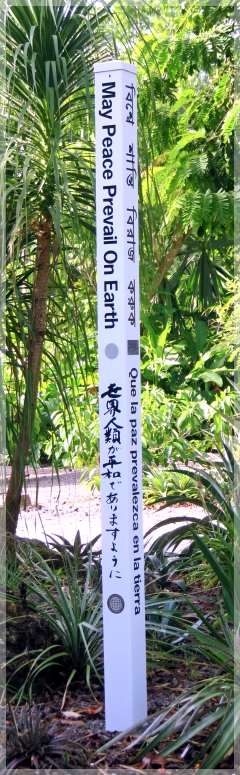 COVID kept us from the Botanic Gardens for well over a year. When we finally returned to one of our favorite places, we came upon a peace pole planted among the palms, bamboo and bromeliads. Although a similar pole is in the city park downtown, I don’t remember seeing one here when last we visited. These poles are just two of the more than 250,000 that have been erected in over 180 nations. Symbolizing the oneness of humanity, the words “May Peace Prevail on Earth” are written in eight different languages. The languages chosen for this pole were English, Arabic, Bengali, Chinese, Hawaiian, Hindi, Japanese, and Spanish—the languages of people who, like us, live at the 26th parallel north. Peace poles stand as a visual reminder to pray for peace on earth and to think, speak and act in the spirit of harmony and peace.
Forty years ago, the United Nations designated today as the annual International Day of Peace (commonly called World Peace Day). In 2011, the General Assembly unanimously voted to designate it as a day of cease-fire and non-violence. They ask every person and nation to halt hostilities and fighting for this one twenty-four-hour period. Unfortunately, I doubt the world can make one hour, let alone twenty-four, without aggression, hostility and bloodshed. Hopefully, you and I can go longer than twenty-four hours without conflict or violent behavior!
The causes of world conflict are many and, according to the UN, include poverty, social inequality, hunger, dwindling natural resources, water scarcity, environmental decline, disease, corruption, racism, and xenophobia (an intense fear of foreigners). This year’s theme, “Recovering Better for an Equitable and Sustainable World,” continues the UN’s focus on finding ways to overcome those causes. Indeed, as our world struggles to recover from what seems to be a never-ending pandemic, we can see how the underprivileged and marginalized have been hit the hardest. In the last eighteen months, we have seen both the best and the worst of our fellow travelers on this planet. This day is a reminder that instead of fighting with one another, we should join in fighting mankind’s common enemies!
As Christians, we have the peace of God—the peace that passes understanding—but we must be more than possessors of peace. Jesus calls us to be makers of peace but erecting a peace pole is not enough! We can start by bringing peace to our little corner of the world, beginning at home and then moving on to work, school, church and community. Our peacemaking efforts, however, can’t stop at the borders of our neighborhood or even our nation. We must take Christ’s message of peace out into the world by thinking, speaking, and acting in the cause of peace. While we each have an obligation to improve the various conditions that promote conflict, changing people’s circumstances is just a beginning. For true peace, the peace that is found in a relationship with God, we must change people’s hearts.
World peace, while a lofty goal, is not something I expect to see in my lifetime. Nevertheless, we each must do our part.
We hear much of love to God; Christ spoke much of love to man. We make a great deal of peace with heaven; Christ spoke much of peace on earth. [Henry Drummond]

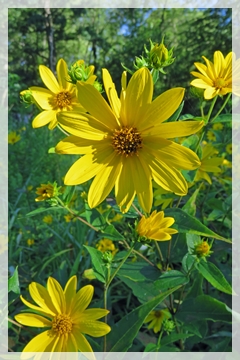 While we usually reap what we sow, we also can receive unexpected and undeserved harvests! When we lived in the north, courtesy of God and nature, wildflower seeds took root in the field next to our house and Spiderwort, Sunflowers, Dame’s Rocket, and Wild Bergamot grew there without any effort on my part. Although I hadn’t sowed them, I never protested those beautiful wildflowers; I just thanked God for them. None of us are likely to complain to God about the many undeserved blessings He regularly bestows on us!
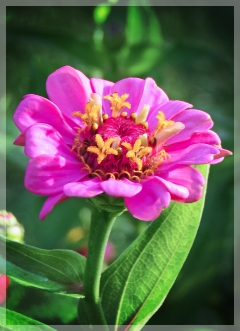 Found in Buddhism and Hinduism, the concept of karma is the idea that how you live your life now determines the quality of life you’ll have after reincarnation. Christians, however, believe that “each person is destined to die once and after that comes judgment,” [Hebrews 9:27] which means that karma, with its continual opportunities to get it right, is not compatible with Christianity. Nevertheless, the karmic idea of good and bad actions yielding similar consequences—that “what goes around comes around”—is present throughout the Bible. Because many of the Bible’s metaphors about cause and effect have to do with agriculture and farming, a pastor friend likes to call this concept “farma.”
 Back in the ‘70s, comedian Flip Wilson coined the phrase, “The devil made me do it!” Actually, Wilson really can’t be credited with its origin. Eve used pretty much the same excuse when she blamed the serpent back in Eden and Adam kept the ball rolling when he blamed Eve! Instead of the devil, Aaron blamed the people for the golden calf, Moses blamed the Israelites for his failure to enter Canaan, and Saul blamed his soldiers for his refusal to follow God’s command. Of course, they all were wrong. The responsibility for all of our actions falls solely on us and yet, like them, we’d prefer blaming our missteps on someone or something else.
 Devotions of the Heart