
But let all who take refuge in you be glad; let them ever sing for joy. Spread your protection over them, that those who love your name may rejoice in you. [Psalm 5:11 (NIV)]
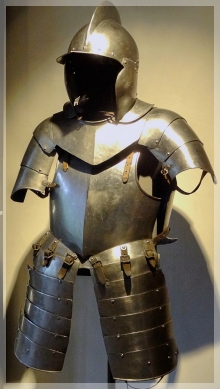 A Latin word, lorica originally meant armor or breastplate. Because of an ancient practice of inscribing a prayer on the armor or shields of knights who then recited the prayer before combat, lorica came to mean a prayer of protection.
Although there are many such prayers, the most famous is the Lorica of St. Patrick (also known as St. Patrick’s Breastplate). Legend has it that around 433 AD, St. Patrick wrote this prayer for protection. As the story goes, on Easter morning, Patrick led his fellow missionaries in a procession to the court of the pagan King Laoghhaire. Suspecting that they would be ambushed by the army of his pagan adversary, Patrick took his men through the woods while chanting this prayer/lorica. Rather than seeing the missionaries amid the trees, their enemies saw a mother deer followed by twenty fawns and let them pass. Having been brought safely through the ambush by God, Patrick and his companions marched into the king’s presence while chanting: “Let them that will, trust in chariots and horses, but we walk in the name of the Lord.”
Whether the story is fact, legend or, as I suspect, somewhere in-between, this beautiful hymn (also known as The Deer’s Cry) appears to be the first one ever written in Gaelic and quite likely by the beloved Patrick. In 1889, Cecil Alexander produced a metrical version of the prayer from an earlier English translation and the resulting hymn was set to traditional Irish tunes. Called “I Bind Unto Myself Today,” this beautiful old lorica can be found in the hymnals of many denominations and heard on You Tube.
Prayers for protection and deliverance are found throughout Scripture. Moses, David, Ezra, and Nehemiah all prayed for protection for themselves and others and Jesus prayed for the protection of His followers. We may not be facing Druids in the woods, but we enter into battle against evil every day. While we don’t wear armor or carry shields, we can proceed as did Patrick and his men: by wearing the armor of God, binding ourselves to Him in prayer, and walking in the name of the Lord.
I bind unto myself today
The strong name of the Trinity,
By invocation of the same
The Three in One and One in Three. …
I bind unto myself today
The power of God to hold and lead,
His eye to watch, His might to stay,
His ear to hearken to my need.
The wisdom of my God to teach,
His hand to guide, His shield to ward,
The word of God to give me speech,
His heavenly host to be my guard. …
Christ be with me, Christ within me,
Christ behind me, Christ before me,
Christ beside me, Christ to win me,
Christ to comfort and restore me.
Christ beneath me, Christ above me,
Christ in quiet, Christ in danger,
Christ in hearts of all that love me,
Christ in mouth of friend and stranger.
I bind unto myself the name,
The strong name of the Trinity,
By invocation of the same,
The Three in One and One in Three.
By whom all nature hath creation,
Eternal Father, Spirit, Word:
Praise to the Lord of my salvation,
Salvation is of Christ the Lord.
[St. Patrick’s Breastplate (Attributed to St. Patrick)]
 When we celebrate St. Patrick’s Day tomorrow, I suspect the revered bishop who brought Christianity to Ireland in the 5th century wouldn’t recognize this day in his honor. Originally a religious feast, it’s now a day for parades, sales, “Kiss Me I’m Irish” t-shirts, corned beef and cabbage, music, dancing, and lots of green (including hair, cookies, the Chicago River, milk shakes, and kegs of beer). St. Patrick, however, would recognize the common symbol of the day: the shamrock. Of course, to Patrick, the shamrock, with its three leaflets bound by a common stem, was a metaphor for the Holy Trinity. The shamrock’s three leaflets also came to symbolize faith, hope, and love.
 Flawed people that we are, we want to play down our culpability before God by minimizing sin and thinking of some sins as less significant than others. We’d like to think if we avoid the “big ten” Moses brought down from Mt. Sinai that we’re good and righteous people. God didn’t stop telling us how to behave with those two tablets! What about the hundreds of commands we find in the New Testament? Can we truthfully say we do nothing “out of selfish ambition or conceit” while we do everything “without grumbling and arguing?” [Phil 2:3,14] Are we ever conceited, boastful, or envious? [Gal 5:26] Do we show favoritism or partiality? [James 2:3-4] How are we doing in the loving our enemies and praying for them, forgiveness, and self-denial departments? [Matt 5:22,44;16:24] Are we truly free of “malice, all deceit, hypocrisy, envy, and all slander”? [1 Pet 2:1] Those sins are no less an affront to God than worshipping an idol or murdering a spouse. Every sin we commit damages our relationship with God.
 Having spared Israel’s first-born males during the final plague on Egypt, God called for every first-born Israelite male, whether man or beast, to be consecrated to Him. The entire male population of the tribe of Levi was 22,000 (about the same number of first-born Israelite men) and God substituted the Levites for the other first-born males. Substituting the Levites for the first-born male in every tribe centralized the sacred duties to one tribe without disrupting the other tribes’ families.
 We’re two weeks into the season of Lent. While we typically associate this time before Easter with giving up something, it is more than simply abstaining or fasting from some thing or things. Fasting without prayer is nothing more than a diet and abstaining from some pleasure without prayer is more like dry January than a Lenten discipline! Without prayer, fasting and abstinence are physical acts but not spiritual ones! When we give up something for Lent, we need to deliberately and intentionally seek the Lord in prayer at the same time!
 Devotions of the Heart