
All the believers devoted themselves to the apostles’ teaching, and to fellowship, and to sharing in meals (including the Lord’s Supper), and to prayer. …They worshiped together at the Temple each day, met in homes for the Lord’s Supper, and shared their meals with great joy and generosity—all the while praising God and enjoying the goodwill of all the people. And each day the Lord added to their fellowship those who were being saved. [Acts 2:42,46-47 (NLT)]
 When a friend won a trivia contest because she knew the day and year Elvis Presley died, I asked how she recalled the exact date. She replied, “I remember because August 16, 1977, was the day I traded one king for another one—it’s the day I accepted Jesus!” Indeed, it is an important date for her to remember. I don’t know when my mother-in-law became a Christ follower but my father-in-law marked his acceptance of Jesus with his baptism at the age of 17 (in 1925). I only know this because my in-laws kept a certificate attesting to his baptism in their safe deposit box along their birth certificates, passports, voter registrations, social security cards, and marriage certificate.
The day of our rebirth is as important as the date of our birth and our commitment to Christ is more important than the commitment we made to our spouse, so I understand why my friend knows the date of Elvis Presley’s death and my father-in-law treasured his baptismal certificate. The dates of my baptism and confirmation are recorded in my prayer book, but the day I clearly remember is the November afternoon my freshman year at Northwestern University when I knelt in the Alice Millar Chapel and truly accepted Jesus.
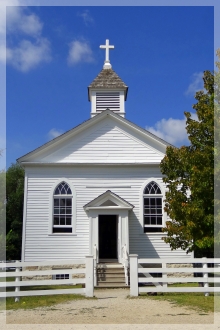
As followers of Jesus, we are members of the body of Christ or, as the Apostles’ and Nicene creeds state, the holy catholic (or universal) Church. The Christian life, however, is not meant to be lived in isolation and it is important to belong to a local community of believers. In joining a church, we make a visible commitment to Jesus and His body. Just as hanging a Cubs flag indicates our favorite team or a bumper sticker indicates our politics, our church membership is an outward and visible sign of our faith in Jesus. Joining a church is like joining a movement; we become part of something far bigger than ourselves. My in-laws understood that and cherished their church membership. In their safety deposit box, we also found the membership certificate and church bulletin from the Sunday they joined the local church they attended until their deaths.
A church provides a place to learn God’s word so that our faith is grounded. It’s the place to openly ask questions and get them answered. It’s where we find fellowship with other believers and learn from, share with, help, and encourage one another. It’s where we observe the Lord’s Supper and break bread in Christian fellowship. The church is where we pray both as a unified body and as individuals; we pray for the world at large and in answer to our brothers’ and sisters’ specific requests. The church is where we minister, not just to one another, but to the community by providing for both physical and spiritual needs. The church is where we are held accountable. Rather than complain when the pastor’s words make us squirm in our seats, we should be thankful for them. If we’re just looking for a feel-good message, there are plenty of afternoon talk shows and New Age self-help books for that. Jesus, however, was never about making us feel good—he was about making us better and making us better is what His shepherds (our pastors) are called to do!
As the body of Christ, the Apostle Paul compared us to the physical parts of a body. Although we are different parts of that one body, no part of the body can function by itself. You never see an ear, eye, or hand strolling around by itself! We need one another just as much as our feet need our legs and our lungs need the nose and mouth. Although many of us don’t remember the date we accepted Jesus or the date we joined our church, may we always honor our commitment to be a valuable part of the body of Christ.
 When writing about nitroglycerin recently, I realized there’s something else in our lives much like this strange chemical that is both helpful and harmful. Like nitroglycerin, man’s capabilities are a dichotomy between good and evil, constructive and destructive, and beneficial or detrimental. The same mind capable of creating a vaccine that saves thousands of lives is capable of creating a nuclear bomb that can take those lives. James speaks of this incongruity when writing about the way we use our words, “We use our tongues to praise our Lord and Father, but then we curse people, whom God made like himself. Praises and curses come from the same mouth! My brothers and sisters, this should not happen.” [3:9-10]
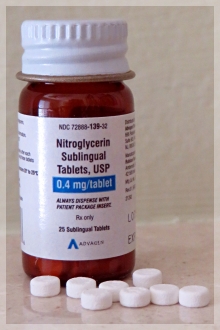 Back in the days before coronary artery bypass surgery and angioplasty, my father had heart disease and often suffered from the burning chest pain of angina. When that occurred, he would stop briefly, place a nitroglycerin tablet under his tongue, and his pain would ease. Medical nitroglycerin acts as a vasodilator by dilating or expanding the blood vessels so the heart doesn’t have to work as hard to pump blood through those vessels.
 Proof of the truth is no substitute for our faith; nevertheless, it is important to know the truth of what we believe. At some point, we will ask ourselves how we can believe the validity of what we’re reading in our Bibles. Fortunately, we have Christian apologists to help us see its truth. Rather than offering apologies for the wrongs committed by evil people in the name of Jesus, apologists share the objective reasons and evidence that Christianity is true and should be believed. The Apostle Paul was probably the first apologist when he showed that Jesus’ fulfillment of Scripture’s prophecies proved He was the Messiah. Paul knew that the truth could stand up to scrutiny and it still does today. As for those prophecies: by conservative estimate, Jesus fulfilled at least 300 prophecies while on earth.
 I came across an article questioning whether we have to believe certain things to be a Christian or is it enough just to trust God. The author believed that Christians don’t have to “assent intellectually” to the facts of traditional Christian teaching or agree with the Christian creeds. “Faith” to the author is simply placing one’s confidence in “Spirit” (not the Holy Spirit) and following Jesus’ teaching is more important than believing certain things about Him. Having nothing to do with dogma or creeds, Christianity was seen as a wisdom tradition and way of life rather than a belief. Claiming they were “man-made” and date from the 4th century and Emperor Constantine, the author believed Christianity’s creeds should be disregarded.
 Aaron’s four sons were priests and, in Leviticus 10, his oldest sons Nadab and Abihu offer incense to God in the Tabernacle. The incense symbolized the people’s prayers rising up to God and the coals used for burning it were to be taken from the altar of burnt offerings outside the sanctuary. Although priests were required to fulfill their duties precisely, Scripture tells us the two offered “strange” or “unauthorized” fire and were immediately consumed by fire from God!
 Devotions of the Heart