GETTING RIGHT, RIGHT NOW

Then Jesus turned to the crowd and said, “When you see clouds beginning to form in the west, you say, ‘Here comes a shower.’ And you are right. When the south wind blows, you say, ‘Today will be a scorcher.’ And it is. You fools! You know how to interpret the weather signs of the earth and sky, but you don’t know how to interpret the present times.” [Luke 12:54-59 (NLT)]

After admonishing the crowd surrounding Him for being able to predict the weather but being oblivious to the signs of the arrival of God’s Kingdom, Jesus told a parable about getting right with God before judgment. As He was speaking, he was told about a recent incident in which Pontius Pilate ordered his soldiers to murder some Galileans while they offered their Temple sacrifices. On Monday, in “The Man from Galilee,” I wrote about the stereotypes Judeans had of Galileans; along with thinking them to be uneducated peasants, many Judeans regarded Galileans as trouble-making rebels against Rome. Indeed, Galileans had revolted after Herod the Great was named King, and, in 6 AD, another rebellion was led by Judas of Galilee. Indicating Rome’s expectation of armed resistance from Jesus and his Galilean disciples, a contingent (around 500) of heavily armed soldiers were sent to arrest Him in Gethsemane. Jesus even asked if they thought him a dangerous revolutionary. While turning the other cheek and loving one’s enemies was a revolutionary concept, that was not the kind of revolution people expected from a Galilean.

Understanding the crowd’s bias makes it likely that their specific mention of the murdered men being Galilean indicates their suspicion that the men may have been trouble-makers who deserved their deaths. Perceiving the crowd’s smug viewpoint, Jesus asked whether those Galileans deserved their brutal deaths more than any other Galilean and immediately answered His own question with a firm, “Not at all!” Turning the tables on his questioners, He mentioned a recent disaster that had horrified the nation when eighteen men were crushed to death after a tower they’d been building collapsed on them. He then asked, “Were they the worst sinners in Jerusalem?” before repeating His caution to repent lest His listeners perish as well.

As long as life goes smoothly for us, it’s easy to self-righteously think that those who suffer deserve God’s judgment. After all, that’s what Job’s friends mistakenly thought about his afflictions. When life takes a turn for the worse and we’re on the receiving end of tragedy as it did for Job, that reasoning flies out the window. None of those laborers were any more deserving of their deaths than were the “Galileans.” By the same token, none of them were less deserving of their suffering, even if they all were truly evil people.

Whether the devastation and loss of life from events like Hurricane Ian or the unbearable horror of a school shooting like Uvalde, experiencing tragedy has nothing to do with one’s righteousness. The Book of Job makes it clear that even the most righteous among us have no right to question God. Suffering, disease, and death originate from God’s curse because of that first sin. Even terms like “innocent child” and “good person” are relative terms since we all are sinners and deserving of God’s righteous judgment.

Tragedies show us that life is fragile and that we must get right with God before we die and face judgment. If nothing else, catastrophe and misfortune should drive us to repentance and Jesus warned the crowd to do just that: “Repent of your sins and turn to God.” It is repentance that keeps us from perishing—not from suffering and certainly not from dying—but from perishing!

“Do you think those Galileans were worse sinners than all the other people from Galilee?” Jesus asked. “Is that why they suffered? Not at all! And you will perish, too, unless you repent of your sins and turn to God. And what about the eighteen people who died when the tower in Siloam fell on them? Were they the worst sinners in Jerusalem? No, and I tell you again that unless you repent, you will perish, too.” [Luke 13:2-5 (NLT)]

Copyright ©2023 jsjdevotions. All rights reserved.

 

THE MAN FROM GALILEE

There was nothing beautiful or majestic about his appearance, nothing to attract us to him. He was despised and rejected—a man of sorrows, acquainted with deepest grief. We turned our backs on him and looked the other way. He was despised, and we did not care. [Isaiah 53:2-3 (NLT)]

poppyBecause we know little about the geography or politics of Jesus’ time, we sometimes miss subtleties in the gospel accounts. We know Jesus was from Galilee but what do we know of Galilee? Located north of Judea with the province of Samaria separating them, Galilee originally was settled by the tribes of Naphtali, Asher, Issachar, and Zebulun—all of whom failed to drive out the Canaanites. King Solomon gave twenty towns in the northern part of Galilee to King Hiram of Tyre either as payment for the cedar, cypress, and gold Hiram provided for the Temple’s construction or as collateral to cover later payments. In any case, Hiram later returned the cities to Solomon who then settled Israelites in them. When the kingdom divided, this region became part of the northern kingdom of Israel.

When Assyria defeated Israel, much of the Jewish population was relocated while those remaining often intermarried with the Gentiles sent there to repopulate the area. By the 7th century BC, the region was known as Galilee with Upper (northern) Galilee known as the “Galilee of the Gentiles.” This was a rich and fertile region and, with the Sea of Galilee being the largest freshwater lake in the area, it was an ideal location for settlements and fishing. After returning from their exile in Babylon, Judean immigrants resettled the region.

By the time of Jesus, Galilee was a heavily populated area. Jesus was raised in Nazareth in Lower Galilee. Most, if not all, of His disciples were from Galilee and He spent much of his ministry preaching around the northern shore of the Sea of Galilee in towns like Capernaum and Bethsaida. It was in Galilee that he turned water into wine, gave the Sermon on the Mount, and performed miracles like feeding the 5,000, healing the centurion’s servant, raising Jairus’ daughter and the widow of Nain’s son, walking on water, and calming a storm.

What we 21st century believers probably don’t know is that, in Jesus’ day, Judeans disparaged Galileans. Even though most Galileans were Jewish, the pureness of their ancestry had been diluted by intermarriage and Judeans considered them of questionable ancestry. The Galilean Aramaic dialect differed enough from Judean Aramaic that Galileans (like New Yorkers) were recognizable by their accents. It was Peter’s accent that identified him as a Galilean when he denied Jesus and it was their distinctive accent that caused Judeans to consider Galileans uneducated. One story in the Babylonian Talmud told of prohibiting them from speaking in the Temple for fear they might mispronounce something and offend God! In Acts 4:32, we find the Council amazed at the confidence with which Peter and John spoke because they were “unlearned and ignorant” men. It was their thick Galilean accents, not their words, that caused the incorrect assumption of ignorance.

Regional prejudices were as prominent in Jesus’ time as they are in ours and Judeans, especially Jerusalemites, viewed Galileans as uncultured peasants. “Galilean” was as derogatory a term as are “redneck” or “hillbilly.” Consider Nathanael’s surprise when Philip told him the Messiah was from Nazareth: “Can anything good thing come from Nazareth?” When Nicodemus dared to defend Jesus by pointing out He deserved a trial, his fellow Pharisees taunted him with their answer: “Are you from Galilee, too? Search the Scriptures and see for yourself—no prophet ever comes from Galilee!” Not only did their scorn prove their bias and prejudice, but it also revealed their own ignorance. The prophet Jonah came from Gath-Hepher, just a few miles north of Nazareth, in Galilee! Their bias also kept them from seeing how Jesus filled Isaiah’s prophecy of a Messiah in Isaiah 9 (repeated in Matthew 4:13-16).

Are we as judgmental as were the Pharisees? Do we make assumptions about groups of people based on pre-existing beliefs about their heritage, race, accent, attire, age, gender, religion, or disability? Many in Judea turned their backs on Jesus and the disciples because all they saw were uneducated peasants who spoke with a Galilean accent! Because of their prejudice, they continued to sit in the darkness in the presence of the Light! Let’s not make a similar mistake!

He went first to Nazareth, then left there and moved to Capernaum, beside the Sea of Galilee, in the region of Zebulun and Naphtali. This fulfilled what God said through the prophet Isaiah:  “In the land of Zebulun and of Naphtali, beside the sea, beyond the Jordan River, in Galilee where so many Gentiles live, the people who sat in darkness have seen a great light. And for those who lived in the land where death casts its shadow, a light has shined.” [Matthew 4:13-16 (NLT)]

Copyright ©2023 jsjdevotions. All rights reserved.

ON WHAT DO WE LEAN?

Trust in the Lord with all your heart and lean not on your own understanding; in all your ways submit to him, and he will make your paths straight. [Proverbs 3:5-6 (NIV)]

pickerel weedWhile pondering an important decision, I realized I was trying to figure it out on my own rather than taking it to God. Relying on my own perception and trusting in my wisdom, however, is what got me into my dilemma in the first place. Based on some of the truly stupid choices I’ve made when leaning on my own understanding, it’s only through God’s grace that my life is not a total disaster.


It all started with Adam and Eve who, after listening to the serpent’s advice, leaned on their own understanding of God’s prohibition about that one tree. Doubting God’s goodness, they thought the fruit would make them as wise as God and foolishly took those bites rather than check with Him. Not trusting God’s promise of descendants to Abraham, Sarah looked to her own solution and gave Hagar to her husband. What part of “Don’t look back or stop anywhere!” did Lot’s wife fail to understand when she looked back at Sodom? It was leaning on their own understanding that made Aaron mold a golden calf and sacrifice burnt offerings to it or Saul spare Agag and take the best of the sheep, goats, cattle, and plunder from the Amalekites. There were grievous consequences to all those decisions to lean on themselves rather than God!

Consider the Israelites who made it through the wilderness from Egypt to Canaan by following God’s plan. Before crossing the Jordan, Moses sent twelve scouts on a reconnaissance mission to determine the lay of the land and the region’s agriculture. They weren’t supposed to assess the people or determine if they would enter Canaan—that was a given because God promised Israel both the land and their victory over its residents. But, when the scouts returned with reports of giants, the Israelites leaned on their own understanding rather than trusting God—an error that cost them forty more wilderness years

Although Israel’s  strength was in the power of their God, David’s logic told him a nation’s strength lay in the size of its army. Ignoring the advice of Joab, he trusted his reasoning more than God and took a census of all who could “handle a sword.” As a result of his foolishness, Israel suffered a plague and 70,000 people died. Although leaning on our own understanding doesn’t necessarily result in tragedy, it frequently does.

When faced with a decision, like David, we consult advisors and friends, or turn to that font of information and misinformation—the Internet. Unfortunately, our human understanding is pitifully limited and our motives often suspect. Writing and debate classes taught me that a case can be made for any stand on an issue—whether it’s the right stand is an entirely different matter! It’s human nature to search deepest for information and advisors supporting our desires and to disregard as faulty anything that doesn’t support our position. Rehoboam did just that when he followed the advice of his greedy friends rather than Mosaic law and the godly advice of his father’s advisors. When he leaned on his own understanding, the kingdom divided.

We see just a portion of what is right in front of us but, in just one glance, God sees the whole picture—the past, present, and future. While our flawed understanding of God and His plan isn’t a requirement for obedience to Him, our trust is! The first part of today’s verse tells us to trust in the Lord—which is what Adam, Eve, and the rest should have done! Rather than lean on our own understanding or that of other flawed humans, we must turn to the true giver of wisdom—God—and His book of wisdom—the Bible.

“I wish I knew what to do!” we exclaim. While I can’t tell anyone what to do, I can tell everyone what not to do—don’t lean on your own understanding!

This foolish plan of God is wiser than the wisest of human plans, and God’s weakness is stronger than the greatest of human strength. [1 Corinthians 1:25 (NLT)]

Copyright ©2023 jsjdevotions. All rights reserved.


THERE’S NO EXCUSE

Get rid of all bitterness, rage, anger, harsh words, and slander, as well as all types of evil behavior. Instead, be kind to each other, tenderhearted, forgiving one another, just as God through Christ has forgiven you. [Ephesians 4:31-32 (NLT)]

If you forgive those who sin against you, your heavenly Father will forgive you. But if you refuse to forgive others, your Father will not forgive your sins. [Matthew 6:14-15 (NLT)]

mourning doves
The husband quietly arranged for a week’s vacation from work and the wife also arranged for a week off from her job before they joined one another on a romantic getaway. Unfortunately, they weren’t married to one another and their respective spouses were blindsided by their heartless and public betrayal. Since the man was finance director of the school district, unfounded rumors abounded in our small town that he’d absconded with funds along with someone else’s wife. Even though this occurred decades ago, I still remember my shock a week later when, having found the forbidden fruit wasn’t near as tasty as they’d expected, the two adulterers returned to town and their respective homes.

I don’t know how the betrayed husband welcomed his wife or what became of their marriage but, since the betrayed wife lived three doors down and our children played together, I do know what happened to hers. Amazingly, the deceived wife forgave her repentant husband and welcomed him home. While forgiveness doesn’t necessarily end in reconciliation, in this case it did. “How could she forgive him?” asked a shocked (and very gossipy) neighbor. “After all,” she added, “There’s just no excuse for his shameful behavior.” Her question gave me pause since I wondered the very same thing—how could she forgive such an indefensible act?

Rather than look to gossipy neighbors, however, I turned to Scripture. Does God only forgive my “excusable” sins—when I accidentally fall into the mud—and not forgive the ones in which I deliberately go play in the muck? There was no acceptable excuse for the man’s abysmal behavior and nothing could justify the way he so publicly wounded and humiliated his wife but isn’t that the point of forgiveness? Regardless of the circumstances or how we choose to justify our actions, there never is an excuse for sin! If something was excusable—if extenuating circumstances justified a transgression or if there were a valid reason behind an offense, there really would be no need for forgiveness! Forgiveness is what God does because there is absolutely no excuse for our offenses, no defense for our sinful behavior, and no exception to the rules broken by our transgressions.

There was no excuse for that adulterous couple’s behavior but one woman let her faith guide her. Choosing love over hate, hope over despair, and mercy over retaliation, she quietly forgave her repentant husband and continued their marriage. There was no excuse for Gomer’s betrayal of Hosea and yet the loving prophet redeemed her from slavery, forgave her, and welcomed her back into their home. David had no excuse for dallying with Bathsheba and Peter had none for denying Jesus yet both were forgiven. There was absolutely no excuse for the first sin and yet God loved us enough to redeem mankind with the blood of his Son, Jesus Christ.

There is no way we ever can justify any of our sins and yet, when we confess with repentant hearts, we are forgiven. It is precisely when there is no possible excuse that forgiveness is necessary. Let us never forget—if we want to be forgiven of all our sins, we are expected to do the same—even when there is no excuse!

Make allowance for each other’s faults, and forgive anyone who offends you. Remember, the Lord forgave you, so you must forgive others. Above all, clothe yourselves with love, which binds us all together in perfect harmony. [Colossians 3:13-14 (NLT)]

Copyright ©2023 jsjdevotions. All rights reserved.

TATTOOS – Part 2

Don’t you realize that your body is the temple of the Holy Spirit, who lives in you and was given to you by God? You do not belong to yourself, for God bought you with a high price. So you must honor God with your body. [1 Corinthians 6:19-20 (NLT)]


While the New Testament does not specifically address tattooing, my friend’s question about tattoos got me wondering whether it’s addressed in general terms. Because tattoos apparently originated in things like pagan symbolism, superstition, and idolatry, some maintain they’re prohibited in Scripture. Indeed, the Israelites were prohibited from worshipping the pagans’ gods, following their customs, and participating in “detestable acts” like child sacrifice and the New Testament warns of sorcery and idolatry, but applying those words to tattoos seems a long stretch. The dates of holidays like Christmas (Saturnalia), All Saints’ Day (Samhain), and Valentine’s Day (Lupercalia) have pagan beginnings as do customs like placing flowers on graves, embalming, and celebrating birthdays. Must we abandon those (along with the heart symbol) because of their pagan origins? In that case, we’ll need to ditch our calendars since both the days of the week and the names of the months are founded in astrology and pagan gods (i.e., Saturday/Saturn, Thursday/Thor, March/Mars, and June/Juno)! Where do we draw the line?

Just because pagans did something doesn’t necessarily mean it is sinful. Before condemning every pagan custom, we should remember that even the pagans ate, harvested crops, worshipped, and prayed! In fact, much of the early church’s success was because it adapted to (but didn’t adopt) the pagan culture of its time without compromising the gospel message. “Like the apostle Paul,” said pastor and theologian Dr. E. Glenn Hinson, “they sought to be all things to all people, that Christianity might become the religion of as many as possible.”

The Apostle Paul refers to a Christian’s body as God’s temple and some condemn tattoos with this verse. Likening tattoos to graffiti in the sanctuary of a church, they consider them nothing short of vandalism or defilement. Citing Paul, they maintain that altering our bodies in any way is a sin. Again, where do we draw the line—at make-up, plucking eyebrows, shaving, piercings, coloring hair, Lasix and cataract surgery, corrective and reconstructive plastic surgeries, Botox, or even Spanx? All alter our bodies in one way or another. Since the Apostle was specifically addressing sexual immorality among believers, that’s not what Paul had in mind with his words.

Perhaps the best Scripture to guide us regarding any body embellishment is found in 1 Peter 3. Rather than prohibiting adornments altogether, Peter was emphasizing a proper sense of values. Materialism, boastfulness, conceit, attention seeking, and obsession with sex existed in the 1st century just as they do today. Whether it’s a body entirely covered with tattoos, one enhanced with every sort of plastic surgery, a see-though gown with plunging neckline, heavy gold chains around the neck and gold rings on every finger, or tee shirts with rude or hateful messages on them, none seem to display the Spirit of God or represent the way our humble, gentle, and holy Lord would have appeared.

How we adorn our bodies is one of those grey areas that, to some extent, is a matter of taste and judgment. Remembering that we are created in God’s image and hold His Holy Spirit within us, we must be led by the Spirit, the Word, and common sense. Clearly, any practice that is vulgar, ostentatious, insensitive, or a distraction to one’s Christian influence should be avoided yet, even those guidelines are open to interpretation. When in doubt, I find it best to err on the side of caution and ask, “What would Jesus do?”

Our lifestyle, language, attitudes, and manner of dress reflect on His name. He leads us in paths of righteousness for His name’s sake. Unless you are honestly convinced that the thing in question will bring glory to God, then don’t do it. [Curtis Hutson]

Don’t be concerned about the outward beauty of fancy hairstyles, expensive jewelry, or beautiful clothes. You should clothe yourselves instead with the beauty that comes from within, the unfading beauty of a gentle and quiet spirit, which is so precious to God. [1 Peter 3:3-4 (NLT)]

Copyright ©2023 jsjdevotions. All rights reserved.

TATTOOS – Part 1

Do not cut your bodies for the dead, and do not mark your skin with tattoos. I am the Lord. [Leviticus 19:28 (NLT)]

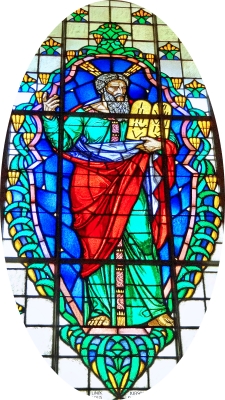
Moses - Meiringen - Michaelskirch
Since Leviticus 19:28 seems to prohibit tattoos, some people mistakenly believe that that it’s a sin for a Christian to be tattooed. My attention was drawn to this specific verse because a friend’s parents had cautioned him throughout his youth that a tattoo would keep him out of God’s kingdom.

Even though the word “tattoo” appears in most Bible translations of this verse, Scripture makes no specific reference to tattoos as we understand them today—a permanent mark or design on one’s body made by depositing pigment beneath the surface of the skin. The original Hebrew word was kethobeth; appearing just this one time, it appears to mean incised writing. Whether this was a scar from cutting (previously mentioned in this verse), a brand, or a mark using dye is unclear. The English word “tattoo” comes from tatau, tatatau, and similar words found in the tribal cultures of Polynesia and didn’t even enter the English language until 1771 when Captain James Cook (and his freshly tattooed sailors) returned from their first South Pacific voyage. Published in 1611, the King James Bible more correctly translates kethobeth as “mark.”  We really don’t know if Leviticus 19:28 was a blanket prohibition of all body markings or just certain types nor do we know if it applied to all circumstances or just specific ones like mourning, idolatry, or blasphemy.

Nevertheless, we’re curious about the various prohibitions in the Mosaic law and often wonder about God’s reasoning behind them. Many laws that seem quite arbitrary, like that in Leviticus 19:28, may well have been to distinguish the Israelites from the pagan customs they left in Egypt and would encounter in Canaan. Archeology indicates that ritualistic cutting was common in the Canaanite, Hittite, and Mesopotamian cultures when mourning the dead or honoring their gods. In their false belief that drawing blood called the attention of the gods, 1 Kings 18 tells us the prophets of Baal, “following their normal custom,” cut themselves with knives and swords “until the blood gushed out!” after they failed to call down fire from heaven.

Since we can’t understand God any better than an ant can understand us, trying to determine His reasoning behind many of the Torah’s laws is an exercise in futility. Moreover, obedience to God’s word isn’t dependent upon our understanding; His laws are to be obeyed simply because He is God and we are not. If the Israelites were presumptuous enough to ask God’s justification for the 613 mitzvot (commandments) in the Torah, His answer would have been the same one our parents gave us when we whined about curfews, TV time, proper attire, and being nice to our annoying little brother: “Because I said so!” God doesn’t need to justify His reasoning to His children any more than did our parents to us!

Heeding his parents’ caution about tattoos, my friend never got one but his grandchildren have! I assured him that their body ink has no bearing on their final destination. While many of the Old Testament laws are guidelines for knowing how to love God and our neighbor, they are not the standard by which Christians measure their conduct. We wear garments made of two or more kinds of fabric, trim our beards and side burns, consume dairy and meat in the same meal, and eat things like bacon, shrimp, and shellfish—all of which defy the Torah’s laws, yet no one claims any of those things will keep us out of the Kingdom and neither will tattoos!

When Jesus died on the cross, He put an end to the Old Testament law (even the one about body markings). As Christians the only law we are under is that of Christ: to love God with our heart, soul, and mind and to love our neighbors as ourselves!

Before the way of faith in Christ was available to us, we were placed under guard by the law. We were kept in protective custody, so to speak, until the way of faith was revealed. … The law was our guardian until Christ came; it protected us until we could be made right with God through faith. And now that the way of faith has come, we no longer need the law as our guardian. [Ephesians 3:23, 24-25 (NLT)]

Copyright ©2023 jsjdevotions. All rights reserved.