DINNER GUESTS

Now when Job’s three friends heard of all this evil that had come upon him, they came each from his own place. … to show him sympathy and comfort him. And when they saw him from a distance, they did not recognize him. And they raised their voices and wept, and they tore their robes and sprinkled dust on their heads toward heaven. And they sat with him on the ground seven days and seven nights, and no one spoke a word to him, for they saw that his suffering was very great. [Job 2:11-13 (ESV)]
Tanzania sculptureLabor Day weekend at the cottage was to be our last opportunity to enjoy time at the lake until next summer. Family would be visiting most of the time and the little guys were sure to keep us on the run. Closing the house for the season also meant a lot of chores: the house cleaned, sporting equipment brought up from the lake, deck furniture scrubbed and stowed, windows washed, the pantry emptied, and so on. The last thing either of us wanted was more work.

Before the kids and grands arrived, we had one day to quietly (and leisurely) finish up some tasks. It was also the only day we’d be free to spend any time with our neighbors until our return next June. The husband is suffering from a debilitating form of dementia so time with them is precious. By next summer, the man we’ve come to know and love may no longer even remember us. The easiest thing for us would have been to take them to dinner at a local restaurant but the noise would make it difficult for our hard-of-hearing friend and the crowd would cause him discomfort. While dinner at our house was the obvious solution, neither my husband nor I felt we had the time to spend shopping, prepping, cooking and cleaning up.

The Bible is filled with stories of friendship and people who found time for one another: Ruth and Naomi, Jonathan and David, Elisha and Elijah, Abraham and Lot, and Daniel, Shadrach, Meshach, and Abednego. Even Job’s three friends spent several days with him sitting at his side. A friend loves at all times, not just when it is convenient, so we knew we had to spend time encouraging and loving on our neighbors. Somewhat reluctantly, we invited them to dinner. Panic briefly set in as we scoured the kitchen to see what provisions we had. Cheese and homemade cookies for the appetizer and dessert were found in the freezer. We had enough tomatoes for a salad and the refrigerator held the ingredients for two easy make-ahead side dishes. A quick trip into town would provide the entrée in the way of an already prepared rotisserie chicken. Typically, our dinner party preparations are more complex, involving lots of prep work, but the Holy Spirit reminded us that friendship has nothing to do with an impeccably set table or a gourmet meal; friendship is breaking bread together in love. Perfection isn’t necessary in friendship; presence, however, is. Friendship is accepting and loving one another in our imperfection. While it’s good to remember friends in our thoughts and prayers, real friendship actually sits beside them whenever possible. Jesus gave his life for his friends and few of us will ever be asked to do as much as that. A little inconvenience now and then is a small price to pay for the blessings of friendship and the opportunity to share Christ’s love.

Father, thank you for the blessing of friends—brothers and sisters connected to one another, not by blood, but by their love for one another. Thank you for gifting us with people with whom we share good times and bad, sorrow and joy, laughter and tears, health and illness. May we never hesitate to be as generous with our time as our friends are with theirs. Guide us to love in the way we hope to be loved and to do for one another in the way we want to have done for us.

A friend loves at all times, and a brother is born for adversity. [Proverbs 17:17 (ESV)]

Above all, keep loving one another earnestly, since love covers a multitude of sins. Show hospitality to one another without grumbling. [1 Peter 4:8-9 (ESV)]

 

LIST THE BLESSINGS

Yours, O Lord, is the greatness, the power, the glory, the victory, and the majesty. Everything in the heavens and on earth is yours, O Lord, and this is your kingdom. We adore you as the one who is over all things. Wealth and honor come from you alone, for you rule over everything. Power and might are in your hand, and at your discretion people are made great and given strength. O our God, we thank you and praise your glorious name! [1 Chronicles 29:11-13 (NLT)]

deer- does-webAfter returning home from nearly three weeks on the road, we hit the ground running and occupied ourselves with unpacking, laundry, sorting through piles of mail, paying bills, returning calls, watering plants, and restocking the pantry before leaving three days later to go out of town again. Busy with household tasks, editing photos, answering emails, writing devotions and updating the website, and knowing we’d soon be leaving again, I hadn’t even bothered to unpack my book bag. This morning, in a quiet moment, I reached in the bag to read some C.S. Lewis and found my gratitude journal. Sadly, no entries had been made for five days. Was there nothing for which I was grateful? On the contrary, there was plenty. Granted, the journal was buried under a pile of books but that was no excuse. I had simply been too busy and involved in doing things that I’d neglected the most important thing: pausing and being with God. Oh, I’d spent time in prayer every morning but, admittedly, those prayers had been rather rushed and the thanks had been pretty generic. Writing in the gratitude journal, however, makes me pause and truly consider the specific gifts with which God has blessed me each day.

As I reviewed the last several days, there was much for which I’d not offered thanks: over 3,000 miles driven without incident, accident or ticket; the littlest grand started preschool with a smile and another grand is adjusting well to her new school; the flowers survived our absence and neglect; neighbors had taken in the mail we’d forgotten to put on hold; my 98-year old mother-in-law continues to do well; five devotions got written; my shoulder is no longer sore and my foot has finally healed; a friend is recovering well from surgery; another friend is healing from the pain of losing his wife; my children sent pictures of the grands; I got caught up on my paper work; hurricane Erika petered out; my husband cooked one of my favorite meals; and I saw a buck and two does walk through our yard this morning. The list goes on and on. None of it is earth-shattering, none of it is deep, but all of it is worthy of thanks to God. Since He never seems too busy to grant His blessings, why is it so easy to become too busy to thank Him?

Heavenly Father, forgive us when we take your blessings for granted or neglect to acknowledge them. Daily, you bestow upon us gifts of every shape and size. May we always recognize the source of our blessings and never take them for granted or forget to express our gratitude to the Giver of all gifts.

For each new morning with its light, For rest and shelter of the night,
For health and food, For love and friends, For everything Thy goodness sends.
[Ralph Waldo Emerson]

Enter his gates with thanksgiving; go into his courts with praise. Give thanks to him and praise his name. For the Lord is good. His unfailing love continues forever, and his faithfulness continues to each generation. [Psalm 100:4-5 (NLT)]

TREKKING POLES – LESSONS FROM THE TRAIL (3)

But he said to me, “My grace is sufficient for you, for my power is made perfect in weakness.” Therefore I will boast all the more gladly of my weaknesses, so that the power of Christ may rest upon me. [2 Corinthians 12:9 (ESV)]

Trust in the Lord with all your heart and do not lean on your own understanding. In all your ways acknowledge him, and he will make straight your paths. [Proverbs 3:5-6 (ESV)]

chipmunk- SSCO9368awebI always had a false sense of pride about not using trekking poles when hiking. They were for novices or ersatz hikers—not a seasoned hiker like me. After reading about hiking the Appalachian Trail, however, it occurred to me that I could be mistaken. With my arthritic knees, perhaps I could use a little assistance.

After a few hikes in the Rockies, I am now a proponent of trekking poles. Where, I wondered, are the aching muscles, stiff joints, and sore feet I expected after several strenuous hikes? The poles, however, greatly reduced the impact on my legs, knees, ankles and feet. Why was I able to walk as quickly and steadily? The poles helped propel me forward and maintain a rhythm. Why hadn’t I struggled more on the steeps? The poles increased my traction and helped me maintain my balance. Why hadn’t I been more frightened on the most challenging sections? I felt more secure with the poles’ assistance. Why no scratches from the brambles? The poles helped me push away nuisances like thorny branches. I suppose I could have used them as defense weapons if attacked, but the squirrels and chipmunks posed no threat and the dogs I met were all friendly.

It took a bit of humility to admit that I might need some help when hiking and now I wonder why it took me so long to realize what seasoned hikers have known for so long. Sometimes our relationship with God is that way, as well. We struggle on, exhausting ourselves, defenseless, getting discouraged, struggling, frightened, and even hurt, before admitting, “Lord, I can’t do it alone!” When we finally admit our weakness, He will ease our fears, keep us steady, and provide us with the skill, strength, confidence and protection needed to complete our walk.

So we can confidently say, “The Lord is my helper; I will not fear; what can man do to me?” [Hebrews 13:6 (ESV)]

For God have us a spirit not of fear but of power and love and self-control. [2 Timothy 1:7 (ESV)]

The Lord is my light and my salvation; whom shall I fear? The Lord is the stronghold of my life; of whom shall I be afraid? [Psalm 27:1 (ESV)]

THE INDIRECT WAY – LESSONS FROM THE TRAIL (2)

When Pharaoh let the people go, God did not lead them on the road through the Philistine country, though that was shorter. For God said, “If they face war, they might change their minds and return to Egypt.” So God led the people around by the desert road toward the Red Sea. [Exodus 13:17-18a (NIV)]

Paul and his companions traveled throughout the region of Phrygia and Galatia, having been kept by the Holy Spirit from preaching the word in the province of Asia. When they came to the border of Mysia, they tried to enter Bithynia, but the Spirit of Jesus would not allow them to. … After Paul had seen the vision, we got ready at once to leave for Macedonia, concluding that God had called us to preach the gospel to them. [Acts 16:6-7,10 (NIV)]

9-3-15_9280web
While hiking up the ski mountain, we discovered that what takes only nine minutes on the gondola takes several hours. A 2,200 vertical rise became a more than five mile hike. When looking at the trail map, it is easy to see why—rather than walking straight up the face and following the path of the gondola, the trail traverses back and forth across the mountain. Geometry taught us that the shortest distance between two points is a straight line yet, sometimes, the most direct way is not always the best way. In actuality, going straight up the face of the mountain is near impossible except for the fittest, most adventurous, and possibly craziest of hikers. Being none of those, we followed the meandering trail. There were moments of discouragement as we crossed back and forth across the face of the mountain, catching a brief glimpse of our destination in the distance, before passing again into the woods and continuing our slow ascent.

Is that what it felt like for the Israelites who spent forty years on a trip that should have taken only a matter of days? The forty years, of course, were tacked on for disobedience, but their initial route, given them by God, wasn’t the shortest one either. The shorter route from Goshen to Canaan, a four or five day’s journey, would have led them through Philistine country and was heavily guarded by a string of Egyptian fortresses. God wisely knew that His people, their spirits broken by years of slavery, were not yet ready for war. Their inexperience and possible cowardice would make them shrink from conflict and want to return to Egypt. Knowing this, God sent them the long way around to the Red Sea, an eleven days’ journey. Then, just as they’d gotten to the edge of the wilderness, instead of going forward, God re-directed them back to make camp by the sea. It probably made no sense to the people but it did to God. Pharaoh, thinking them lost and discouraged, would be lulled into a false sense of confidence. He would pursue them, giving God the opportunity at the Red Sea to prove to the Egyptians (and Israelites) exactly with whom they were dealing: the one true God.

God knows our abilities, our weaknesses and fears. By giving us lesser trials, He prepares us for greater ones, just as he did for the Israelites. Sometimes, the less direct route is necessary for us to gain knowledge and experience and learn to trust, obey and appreciate God and His blessings. Other times, God takes us the less direct route because He has a greater task for us elsewhere. When Paul wanted to go into the provinces of Asia, for example, he was directed instead to Macedonia where he brought the gospel message to Europe. He eventually got back to Asia but one look at his missionary journeys shows us that the Apostle never took the most direct route; instead, he followed God’s plan. Admittedly, when our journey takes longer than expected, it is frustrating to think we’ll never reach our objective. We must remember that God is guiding us to the destination that He has chosen by the path that He wants us to take. It may not be the shortest or easiest trail; it will, however, be the best.

There is a long way which is short and a short way which is long. [Babylonian Talmud, Eruvin 53b]

I know, O Lord, that a man’s life is not his own; it is not for man to direct his steps. [Jeremiah 10:23 (NIV)]

SMOOTH PATHS – LESSONS FROM THE TRAIL (1)

But for those who are righteous, the way is not steep and rough. You are a god who does what is right, and you smooth out the path ahead of them. [Isaiah 26:7 (NLT)]

Tears of joy will stream down their faces, and I will lead them home with great care. They will walk beside quiet streams and on smooth paths where they will not stumble. [Jeremiah 31:9a (NLT)]

9-2-15_9047web
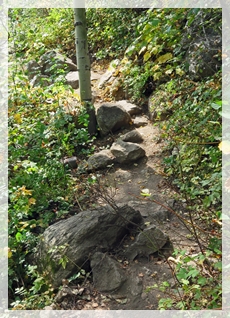
While hiking on one of our favorite mountain trails last month, my husband noted how much easier it was to hike it during the winter. As I stumbled over an exposed root and then tripped on a rock, I had to agree. When covered with snow, I hadn’t realized how uneven its terrain and how rough the trail actually was. Even while wearing our rather cumbersome snowshoes, the winter hike was much easier because several feet of packed-down snow had filled in all of the irregular and rutted parts. The uneven and rocky trail was still there—the rocks, stumps and roots don’t miraculously disappear in the winter—but the snow smoothed out the path. The ruts and other hazards were still there, but we were far less affected by them.

Walking with Jesus is like a trek on a snow-packed trail. Life’s obstacles are still there but Jesus makes the way smoother and easier to traverse. Like the rocks on the path, our troubles won’t miraculously disappear, but we will be less aware, less affected, and less troubled by them. Instead of blindly stumbling along, we will walk confidently because the Lord is smoothing the path ahead and holding us steady with His hand.

The Lord directs the steps of the godly. He delights in every detail of their lives. Though they stumble, they will never fall, for the lord holds them by the hand. [Psalm 37:23-24 (NLT)]

I will lead blind Israel down a new path, guiding them along an unfamiliar way. I will brighten the darkness before them and smooth out the road ahead of them. Yes, I will indeed do these things; I will not forsake them. [Isaiah 42:16 (NLT)]

INVITATIONS

The Angel said to me, “Write this: ‘Blessed are those invited to the Wedding Supper of the Lamb.’” He added, “These are the true words of God!” [Revelation 19:9 (MSG)]

IMGa_8372webI love seeing those thick envelopes in my mail that signify a special invitation. Usually included with the invitation is a request to RSVP. In spite of providing the invitees with a stamped pre-addressed envelope and a response card that requires only a name and check mark, most hosts spend several frantic days shortly before the event trying to track down the people who rudely haven’t bothered to reply. Worse manners, however, are exhibited by the guests who accept an invitation and then fail to attend. Justifiably, the host becomes annoyed; he probably has to pay for the absentee guests whether present or not. Moreover, those people may well have taken the place of others who might have truly appreciated the invitation.

Jesus was dining at the home of a Pharisee. When a dinner companion commented that it will be a blessing to feast in the Messianic kingdom to come, Jesus responded with a parable about a man who hosted a great banquet. Although the initial invitation to his feast had already been accepted, when the host sent his servants to tell the guests the banquet was prepared and ready to be served, the invitees used flimsy excuses about being too preoccupied with their everyday lives to attend. This was a major breach of etiquette; they’d already accepted, animals had been butchered, food was prepared and now the guests rejected the invitation! To add insult to injury, that all of the guests declined at the last minute implies some collusion among them to insult the host. Angry at their rejection, the master of the house, determined not to have an empty table, sent his servants out to bring in the poor, blind and lame—the people who normally would never be invited to such a feast. When that was done, since there was still room at the large table, the master sent his servants beyond the city gates to summon everyone else to his banquet. The host also vowed that not one of those who had been invited and rejected him would ever be invited again; they would never be allowed to dine at his table!

This story was Jesus’ way of warning the Jews that, since they didn’t accept His invitation of salvation, everyone else who came to him by faith would be welcome at His table. Anyone who chose to reject His offer, however, would never dine in God’s Kingdom. This parable, while specifically aimed at the Pharisees attending the banquet, still has meaning to us over 2,000 years later. Jesus reassures us that, while we are totally unworthy to eat at God’s banquet, He will welcome us. All we have to do is accept his invitation and show up when we’re called. The parable also serves as a warning if we don’t accept. God has given us an invitation and, being a gracious host, He’s prepared a heavenly banquet for us. How will He feel and what will He do if we reject his generous offer? I’m not planning on being a “no-show,” how about you?

“All things are ready,” come to the feast! Come, for the table now is spread;
Ye famishing, ye weary, come, and thou shalt be richly fed.
“All things are ready,” come to the feast! Come, for the door is open wide;
A place of honor is reserved For you at the Master’s side.
“All things are ready,” come to the feast! Come, while He waits to welcome thee;
Delay not while this day is thine,Tomorrow may never be.
“All things are ready,” come to the feast! Leave ev’ry care and worldly strife;
Come, feast upon the love of God, And drink everlasting life.
[“Come to the Feast” by Charles H. Gabriel]

Taken aback, Jesus said, “I’ve yet to come across this kind of simple trust in Israel, the very people who are supposed to know all about God and how he works. This man is the vanguard of many outsiders who will soon be coming from all directions—streaming in from the east, pouring in from the west, sitting down at God’s kingdom banquet alongside Abraham, Isaac, and Jacob. Then those who grew up ‘in the faith’ but had no faith will find themselves out in the cold, outsiders to grace and wondering what happened.” [Matthew 8:10-12 (MSG)]