
For wicked men are found among my people; they lurk like fowlers lying in wait. They set a trap; they catch men. [Jeremiah 5:26 (ESV)]
 Fowlers are professional bird catchers. In ancient Israel, they supplied the market with wild pigeons and doves destined for sacrifice, small birds (like quail) for food, and doves and other birds for caged pets. Since most of us get our poultry at the grocery, we’re probably unfamiliar with the fowler and his methods. To capture birds, fowlers spread nets or set traps and snares on the ground, camouflage them with natural materials, and cover them with grain. Tempted by the food, the birds leave the safety of the sky and come down to the ground where they are caught.
The fowler studies his prey’s behavior to find the best way to trap it. He wouldn’t hunt for a heron in the middle of a forest as he would for a dove, bait an eagle’s snare with seeds as he would for a sparrow, or use ground level noose traps for swifts as he might for quail. Sometimes the fowler used decoys by taking young birds from their nest and raising them by hand. Once tame, they were confined in hidden cages so that their voices would call others of their kind to the spot where they’d be trapped or killed. Knowing this about the fowler and his snares or traps, we can see why they frequently were used metaphorically in Scripture and likened to Satan. The enemy was the fowler, his schemes were the fowler’s methods and snares, and people were the silly birds with neither sense nor strength enough to escape the fowler’s snare.
When the prophet Amos asked, “Does a bird land in a trap on the ground if there is no bait for it?” [3:5] he wasn’t speaking of sunflower seeds and sparrows; he was speaking of the bait Satan uses in his snares. Each of us is tempted by different things—it could be pride and resentment for one person and gambling and anger for another. Whether it’s selfishness, wealth, hypocrisy, appetite, indolence, lust, envy, or something else, Satan knows what appeals to each of us and his traps will be placed and baited accordingly. Like the fowler’s bait, the lure Satan uses promises pleasure but delivers disaster! After all, a few bits of millet is all the trapped quail gets before it ends up as someone’s dinner!
Just as the fowler knows, “It is useless to spread a net where any bird can see it,” [Prov. 1:17], Satan’s snares don’t look like the traps they are! Few of us would deliberately step into a “den of iniquity” but things aren’t always what they seem. Like the fowler, Satan uses decoys to bring others into his snare. The influence of the pagans remaining in Canaan became a “snare and a trap” for Israel just as bad examples, friends, acquaintances, influencers, or associates can lure us into Satan’s snare.
The fowler doesn’t stand by his traps and shout out his plans and neither does Satan. Like the fowler, he uses trickery, deceit, distraction, and disguise to keep his prey from realizing the danger. We, however, are far smarter than little birds and God has not left us defenseless. Satan may be laying traps, but we don’t have to be his prey. Along with God’s word to light our way, we have God’s protection and the power of His Holy Spirit—when we’re dwelling in the “shelter of the Most High,” our “Maker’s care” will keep us “from the fowler’s snare.”
He that hath made his refuge God Shall find a most secure abode,
Shall walk all day beneath his shade, And there at night shall rest his head.
Then will I say, “My God, thy power Shall be my fortress and my tower;
I, that am formed of feeble dust, Make thine almighty arm my trust.”
Thrice happy man! thy Maker’s care Shall keep thee from the fowler’s snare;
Satan, the fowler, who betrays Unguarded souls a thousand ways. [Isaac Watts]
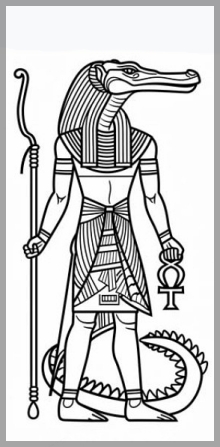 Over a period of 3,000 years, ancient Egypt’s pantheon of gods numbered between 1,400 and 2,000. During that time, some faded in prominence and new gods appeared. Often depicted as part human and part animal, Egypt’s gods had names, unique back-stories, and their own domain and expertise. Each god/goddess was responsible for a certain part of daily life, from motherhood to music, record keeping to funerals, and cosmic order to hunting. While the ten plagues God sent Egypt through Moses and Aaron may seem somewhat arbitrary to us in the 21st century, every one of them was a direct attack on one or more Egyptian god. They were the ultimate “smack-down” between God Almighty and Egypt’s deities.
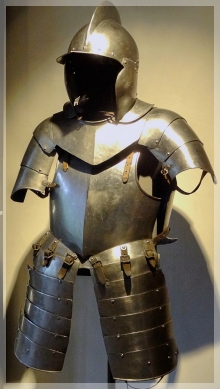 A Latin word, lorica originally meant armor or breastplate. Because of an ancient practice of inscribing a prayer on the armor or shields of knights who then recited the prayer before combat, lorica came to mean a prayer of protection.
 When we celebrate St. Patrick’s Day tomorrow, I suspect the revered bishop who brought Christianity to Ireland in the 5th century wouldn’t recognize this day in his honor. Originally a religious feast, it’s now a day for parades, sales, “Kiss Me I’m Irish” t-shirts, corned beef and cabbage, music, dancing, and lots of green (including hair, cookies, the Chicago River, milk shakes, and kegs of beer). St. Patrick, however, would recognize the common symbol of the day: the shamrock. Of course, to Patrick, the shamrock, with its three leaflets bound by a common stem, was a metaphor for the Holy Trinity. The shamrock’s three leaflets also came to symbolize faith, hope, and love.
 Flawed people that we are, we want to play down our culpability before God by minimizing sin and thinking of some sins as less significant than others. We’d like to think if we avoid the “big ten” Moses brought down from Mt. Sinai that we’re good and righteous people. God didn’t stop telling us how to behave with those two tablets! What about the hundreds of commands we find in the New Testament? Can we truthfully say we do nothing “out of selfish ambition or conceit” while we do everything “without grumbling and arguing?” [Phil 2:3,14] Are we ever conceited, boastful, or envious? [Gal 5:26] Do we show favoritism or partiality? [James 2:3-4] How are we doing in the loving our enemies and praying for them, forgiveness, and self-denial departments? [Matt 5:22,44;16:24] Are we truly free of “malice, all deceit, hypocrisy, envy, and all slander”? [1 Pet 2:1] Those sins are no less an affront to God than worshipping an idol or murdering a spouse. Every sin we commit damages our relationship with God.
 Having spared Israel’s first-born males during the final plague on Egypt, God called for every first-born Israelite male, whether man or beast, to be consecrated to Him. The entire male population of the tribe of Levi was 22,000 (about the same number of first-born Israelite men) and God substituted the Levites for the other first-born males. Substituting the Levites for the first-born male in every tribe centralized the sacred duties to one tribe without disrupting the other tribes’ families.
 Devotions of the Heart