WHAT WILL YOU DO FOR THE NEXT SIX WEEKS? (Ash Wednesday)

That is why the Lord says, “Turn to me now, while there is time. Give me your hearts. Come with fasting, weeping, and mourning. Don’t tear your clothing in your grief, but tear your hearts instead.” Return to the Lord your God, for he is merciful and compassionate, slow to get angry and filled with unfailing love. [Joel 2:12-13 (NLT)]

monarch butterflyAlthough its customs and rituals have changed over time, Lent has been observed in some way by believers for centuries. In the early years of the church, the days leading up to Easter were a time of fasting and prayer in preparation for Easter baptisms and as penance for those who’d been excluded from communion. Irenaus of Lyons (c.130-200) wrote of such a season that lasted only a few days (or forty hours) and commemorated what was believed to be the duration of Christ’s time in the tomb. By the mid-third century, Bishop Dionysius spoke of a six-day fast practiced by the devout in Alexandria and, according to the Byzantine historian Socrates, the Roman Christians kept a pre-Easter fast of three weeks.

It wasn’t until the Council at Nicaea in 325 that the observance of Lent formally began. Starting six Sundays (42 days) before Easter, it ended on Holy Thursday eve. Even though people fasted on Good Friday and Holy Saturday, those days were not considered part of Lent. Whether this Lenten observance was initially intended just for those preparing for baptism or for everyone is unclear but the whole church adopted the practice in some way or another.

Even in the early church, Sunday (as a sort of mini-Easter celebrating the victory of the resurrection) was considered a feast day. In the 6th century, finding it inappropriate to fast on a feast day, Pope Gregory the Great declared that there should be no fasting on the six Sundays of Lent. This, however, cut the Lenten observance back to 34 days and the people wanted to reenact the forty days Jesus spent in the wilderness. Eventually, to make up for the missing Sundays, four more days were added to the beginning of Lent (now starting on Ash Wednesday) and the two fasting days of Good Friday and Holy Saturday were added to the end of the season, making Lent forty days long. Although fasting from food was the emphasis in the beginning, new practices evolved over time and the concept of personal sacrifice eventually became Lent’s focus. In preparation for Easter and crossing denominational lines, Lent has now become a season of self-examination, penitence, self-denial, and spiritual growth.

Lent, like Christmas and Easter, is without scriptural basis. Man-made, not God-ordained, it is a matter of choice as to if and how we keep this season. If we choose to observe Lent, we shouldn’t think of Lent’s self-denial or fasting as a second chance to keep our failed New Year’s diet resolutions. Moreover, no Lenten practice should be thought of as a way to earn salvation or score brownie points with God. We are saved by God’s grace through faith, not works! Pastor Eric Ferris reminds us that, “You could observe 1,000 Lents and it won’t ever accomplish in your life what the cross of Jesus has.”

The purpose of Lent is self-reflection, self-denial, repentance, and seeking to live more for Christ and less for self. Rather than asking what we’re going to give up for Lent, the better questions would be ones like, “What can I do to draw nearer to God?” and “How can I grow more like Christ?” Asking the questions, of course, is not enough; the next step is doing those things! In preparation for Easter, what will you do for the next six weeks?

Search me, O God, and know my heart; test me and know my anxious thoughts. Point out anything in me that offends you, and lead me along the path of everlasting life. [Psalm 139:23-24 (NLT)]

Teach me to do your will, for you are my God. May your gracious Spirit lead me forward on a firm footing. [Psalm 143:10 (NLT)]

Copyright ©2021 jsjdevotions. All rights reserved.

THE PRIVILEGE OF PRAYER

I urge you, first of all, to pray for all people. Ask God to help them; intercede on their behalf, and give thanks for them. [1 Timothy 2:1 (NLT)]

Those who deny their neighbors prayers of intercession deny them a service Christians are called to perform. … Intercessory prayer is a gift of God’s grace for every Christian community and for every Christian. Because God has made us such an immeasurably great offer here, we should accept it joyfully. [Dietrich Bonhoeffer]

zebra longwing butterflyIntercessory prayer simply is praying on behalf of others and we find it throughout Scripture. After Israel’s shameful behavior with the golden calf, for example, Moses interceded for a sinful people before an angry God who was ready to wipe them out. The man pled for mercy rather than condemnation. Later, he interceded for his sister Miriam when God struck her with leprosy after her opposition to Moses’ leadership. When the Israelites again rebelled, refused to enter Canaan, and talked of choosing another leader to take them back to Egypt, Moses again interceded for the Israelites.

Abraham prayed for Ishmael, Sodom and Abimelech; Samuel prayed for Saul and the people of Israel; Daniel prayed for Jerusalem; Job prayed for his family and friends; Stephen prayed for his executioners; Paul prayed for the churches at Corinth and Ephesus; and Jesus prayed not only for his disciples but also for the people who crucified Him. There was, however, nothing weak or wishy-washy about any of these prayers; they were specific, heartfelt and urgent pleas.

While reading Dietrich Bonhoeffer’s words about intercessory prayer in a recent Lenten devotion, I felt them convict me. I have a list of people for whom I regularly offer prayers. Unfortunately, unless there is an urgent need, my prayers are often more perfunctory than earnest and more superficial than thorough. I confess to thinking of praying for others as more of an obligation than a gift from God. Bonhoeffer’s words point out that we are part of a community and, therefore, are touched by everything that touches our brothers and sisters. When they hurt, we hurt; when they mourn, we mourn; when they hunger, we hunger; and when they are joyful, so are we. His words reminded me that we should approach intercessory prayer not as a duty but rather as a privilege, not half-heartedly but enthusiastically.

It is an honor to thank God for the people for whom we pray and to bring them into His presence with our prayers. There’s no need to worry about having the right words, the Holy Spirit will see to that, but we must offer our prayers with the faith, joy, fervor and love of a true member of the Christian family!

So we have not stopped praying for you since we first heard about you. We ask God to give you complete knowledge of his will and to give you spiritual wisdom and understanding. Then the way you live will always honor and please the Lord, and your lives will produce every kind of good fruit. All the while, you will grow as you learn to know God better and better. We also pray that you will be strengthened with all his glorious power so you will have all the endurance and patience you need. May you be filled with joy, always thanking the Father [Colossians 1:11 (NLT)]

Copyright ©2021 jsjdevotions. All rights reserved.

HOPE

It is the same way with the resurrection of the dead. Our earthly bodies are planted in the ground when we die, but they will be raised to live forever. Our bodies are buried in brokenness, but they will be raised in glory. They are buried in weakness, but they will be raised in strength. [1 Corinthians 15:42-43 (NLT)]

lake lucerne sailboatThe anchor, the Christian symbol of hope, is the most prevalent of all the Christian symbols found in the Roman catacombs. In fact, all of the symbols, paintings, mosaics, and reliefs found in the miles of labyrinth-like narrow tunnels and thousands of graves in the catacombs reflect hope in some way. Instead of the dark funereal images you might expect in an underground cemetery, the white walls of the Christian catacombs feature living things like flowers and birds along with Bible stories expressing hope in God’s plan of salvation. Prominent themes from the Old Testament include Daniel emerging untouched from the lions’ den and Shadrach, Meshach, and Abednego exiting unharmed from the fiery furnace. Frequently depicted are the stories of Noah, who escaped from the flood, and Jonah who was delivered from the sea monster. Continuing the theme of deliverance are many images of the good shepherd so frequently mentioned in Psalms. New Testament stories usually showed Jesus raising the dead (with over fifty representations of Lazarus), healing people, and feeding the multitude. The art of the catacombs is all about man’s hope in God’s deliverance, provision, and plan of salvation.
As I read about the displays of hope found in this ancient place of grief and death, I thought of my mother’s final days. I was only fifteen when I sat at her hospital bedside. Even though she knew her end was near, my mother had no tears. Instead of worry or fear, she radiated a sense of peace and hope. I recall my father reaching under the plastic of her oxygen tent, brushing back her hair, caressing her face, and saying, “You look like an angel tonight.” Indeed, no angel could have been more beautiful that she was that night. My mother smiled back at him and said in a voice filled with hope, “Maybe tomorrow, I’ll be with them!” She could say those words so confidently because my mother was a believer and, like those early Roman Christians, she knew Jesus and trusted the promises of God.

The stories and symbols found in those ancient catacombs remind us that, for a Christian, death is not something to fear. Going beyond the here and now, Christian hope reaches past the grave into the glorious tomorrow promised by God! Death, for a Christian is not an end but a beginning; it is like emerging from the trials of a lion’s den, fiery furnace, or whale’s belly unharmed. When that last breath is taken, the Christian simply pulls up anchor and sets sail for a new land—one where tears, pain, and sorrow are replaced by peace, joy, and praise. That is the hope seen in the art found in the catacombs of Rome and the hope I saw firsthand in a Detroit hospital room nearly sixty years ago.

Death to the Christian is the exchanging of a tent for a permanent palace. Here we are as pilgrims or gypsies living in a frail, flimsy home subject to disease, pain and peril. But at death we exchange this crumbling, disintegrating tent for a house not made with hands, eternal in the heavens. [Billy Graham]

And we believers also groan, even though we have the Holy Spirit within us as a foretaste of future glory, for we long for our bodies to be released from sin and suffering. We, too, wait with eager hope for the day when God will give us our full rights as his adopted children, including the new bodies he has promised us. [Romans 8:23 (NLT)]

Copyright ©2021 jsjdevotions. All rights reserved.


THE ANCHOR

So God has given both his promise and his oath. These two things are unchangeable because it is impossible for God to lie. Therefore, we who have fled to him for refuge can have great confidence as we hold to the hope that lies before us. This hope is a strong and trustworthy anchor for our souls. It leads us through the curtain into God’s inner sanctuary. [Hebrews 6:18-19 (NLT)]

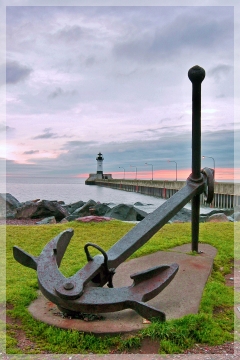
duluth MN harbor - anchorThe sign in front of a nearby church read, “Our hope is anchored in the Lord,” which got me thinking about anchors. I’d never given them much thought until we took a Windjammer cruise off the coast of Maine many years ago. Accompanied by four friends and a crew of two, we sailed for a week. At dusk, we’d lower the sails and anchor in a harbor for the night. After breakfast, we’d pull up anchor for another relaxing day of sailing by lighthouses, granite cliffs, fishing villages, and even a few seals. One day, however, gale force winds replaced the gentle breeze and the calm sea turned violent. The sky darkened as rain and hail poured down on us. We immediately pulled into the nearest inlet, lowered the sails, and dropped two anchors to keep from being blown into the rocks! If we’d had two more anchors (as did the sailors in Acts 27), I suspect we would have dropped them, as well. After donning my life jacket and slicker, all I could do was pray and hope those anchors held. You really don’t appreciate the worth of an anchor until you’ve needed one in a storm!

Since the anchor symbolized hope in the ancient secular world, the recipients of the letter to the Hebrews would have understood the author’s use of the anchor as a metaphor for hope. It is a vivid picture of what keeps us steady and safe in the storms of life—times of trial, danger, hardship, anxiety and uncertainty. An anchor, however, is only as secure as that to which it is fastened. The anchor of hope is not buried in sand or hooked onto a rock that might pull loose. The believer’s hope in Christ is secure, because it is fixed in the very presence of the Almighty.

When the epistle writer says that hope “leads us through the curtain into God’s inner sanctuary,” he’s referring to the Holy of Holies—the inner room of the Temple holding the Ark of the Covenant. Only the high priest could go into this holy place (anyone else would be killed). The priest entered just one day a year, on the Day of Atonement, and only to offer a blood sacrifice. The Holy of Holies was the special dwelling place of God and the curtain emphasized His inaccessibility because of man’s sins. When Jesus died, the curtain tore in half, symbolizing that the way to God was now open to all.

Just as a boat’s anchor holds it safely in position, a Christian’s hope keeps him safe and secure. Like an anchor, God will keep us steady in the storms of life—when the wind of fear blows, suffering rains down, opposition crashes into us, trials threaten us, and uncertainty rocks us to and fro. A boat’s anchor goes down and digs into the bottom of the sea but a Christian’s hope goes up to the heavenly sanctuary and attaches itself to God!

What an anchor is to a vessel in its tossings, so the hope is to us in our times of trial, difficulty and stress. The anchor is outside the ship, is connected with it, and keeps it secure. [W.E. Vine]

Let us hold tightly without wavering to the hope we affirm, for God can be trusted to keep his promise. [Hebrews 10:23 (NLT)]

I pray that God, the source of hope, will fill you completely with joy and peace because you trust in him. Then you will overflow with confident hope through the power of the Holy Spirit. [Romans 15:13 (NLT)]

Copyright ©2021 jsjdevotions. All rights reserved.


DAILY MAINTENANCE – VALENTINE’S DAY

Relish life with the spouse you love each and every day of your precarious life. [Ecclesiastes 9:9 (MSG)]

in the hammock

When getting out a chip n’ dip bowl for some Super Bowl noshing, I noticed the heavy tarnish on the silver candle holders. Because COVID and social distancing have kept us from entertaining, they’ve been ignored in the back of the cupboard for nearly a year. Feeling guilty about letting them get so black, I started polishing off the tarnish. They were a wedding gift to my parents more than 80 years ago and my thoughts turned to marriage as I worked. It’s easy it is to allow our marriages to grow as dull as those candlesticks had. Marriages, like silver, shouldn’t be ignored or neglected.

A pastor friend once remarked that the relationship we have with our spouse is probably the one thing in our lives about which we truly care but which we regularly neglect. We care about our houses, so we paint, repair, renovate, remodel, vacuum, dust, mop, and mow the lawn to maintain them. When we value our health, we take vitamins, get vaccinated, eat healthy food, and exercise. If our children’s education is important to us, we volunteer at school, help with homework, drill them on their spelling, and shuffle them to assorted activities. When we care about our community, we vote, attend meetings, volunteer, or even run for office. If church is important, we tithe, regularly worship, attend Bible study, and serve on committees. Although we usually work at preserving or bettering anything we hold precious, we tend to take the relationship with our spouse for granted.

Marriage is the second most important relationship we have (God, of course, being first) and yet it’s often neglected. Unless we’re experiencing serious marital difficulties, most of us do little to consciously improve it. In fact, we probably spend more time perusing the catalogues and magazines that fill our mailboxes, watching our favorite television programs, or browsing the internet than we do on consciously bettering our marriages. Just because we’re secure in a relationship doesn’t mean we shouldn’t put a little shine on it.

It isn’t that we’re not spending time with one another! Because of this pandemic, couples probably spend more time together than they ever expected. Instead of kissing each other before leaving for work, they just clear off the kitchen counter or move to the dinner table and open their computers. The lines between jobs, home, school, family, entertainment, and leisure have become blurred. Yet, in spite of all the time we’re spending with our loved one (or perhaps because of it), we may have settled into a routine where we’ve stopped noticing one another. We don’t have to ask how their day went or what they did because we already know! Even though we’re together all day in the same house, our lives are more parallel than intersecting.

Sunday is Valentine’s Day—a day we traditionally celebrate romance and love. Even a marriage of more than 50 years needs some tweaking occasionally. Candlelight dinners aren’t just for newlyweds or guests and celebrating pandemic style doesn’t have to be fancy. Like shining silver, it just takes a little effort to shine up a relationship. It can be as simple as grocery store flowers, playing a game together, an unexpected kindness, changing out of the sweat pants, a love note, shaving or putting on make-up, skipping Netflix for a night, taking a walk together while holding hands, having a picnic in the park (or in front of the fireplace), or dancing to slow music (even if it’s in the kitchen and the kids are there). It’s noticing, listening, caring, encouraging, sharing and praying together and often takes less effort than polishing silver. Marriages may be made in heaven but their maintenance work is done here on earth!

Rather than put those now polished candlesticks back into the cupboard, I put them out on the table. They’ve gotten a few dents over the years, just as marriages do, but the dents remind me that marriage is beautiful even when it’s less than perfect. Any tarnish that appears on them will remind me that a good marriage takes effort. While God should be our first priority, our spouse needs to be our second one and not just on Valentine’s Day! Our significant others should be of significance every day; let us be sure to let them know it!

 Remember that children, marriages and flower gardens reflect the kind of care they get. [H. Jackson Brown, Jr.]

Summing up: Be agreeable, be sympathetic, be loving, be compassionate, be humble. That goes for all of you, no exceptions. No retaliation. No sharp-tongued sarcasm. Instead, bless—that’s your job, to bless. You’ll be a blessing and also get a blessing. [1 Peter 3:8-9 (MSG)]

Copyright ©2021 jsjdevotions. All rights reserved.

YOKE OR EASY BUTTON?

yoke - easy button

Then Jesus said, “Come to me, all of you who are weary and carry heavy burdens, and I will give you rest. Take my yoke upon you. Let me teach you, because I am humble and gentle at heart, and you will find rest for your souls. For my yoke is easy to bear, and the burden I give you is light.”  [Matthew 11:28-30 (NLT)]

Several years ago, an office supply company featured an “easy” button in its advertisements and you still can purchase one for less than $9. “Don’t stress it; press it,” their web site suggests. Apparently, when placed on your desk, you can show others how easy it is to find solutions to their problems. Wouldn’t it be nice if all we had to do was push a button to make things easy (or at least easier)?

Rather than a button, however, Jesus offers us a yoke: a wooden frame used as a sort of harness to join two draft animals so they can work together. Among assorted farm implements that once decorated our mountain home, we had the yoke pictured above. It hung upside down but that heavy wooden beam actually rested on the animals’ necks. Without any padding, it doesn’t look that easy to bear! If it is all the same to God, I’d much rather push an easy button than take on anything like a yoke! Fortunately, Jesus was speaking figuratively.

The heavy burden to which Jesus was referring was that of the Pharisees and their legalistic law-keeping that went far beyond God’s demands. For example, there were 39 major categories with hundreds of subcategories defining what constituted work on the Sabbath. While the Jewish way offered the yoke of the law without the power to be obedient, Jesus offered a yoke of faith empowered by the Holy Spirit!

Nevertheless, this passage also can be interpreted as Jesus being our burden sharer. While many things are too heavy for us to bear alone, nothing is too great for Him. By taking His yoke, we give up trying to do life on our own; instead of finding rest in a method, we find rest in a person: Jesus! His yoke is better than an easy button because it actually works! When yoked to Him our burdens are no longer our own!

Can you think of any kinder words than Jesus asking us to come to Him to find rest? Life isn’t easy but God never promised that it would be. Rather than an easy button, we have Jesus and His promise that life is doable with Him. Unlike the yoke that hung on our wall, His yoke is easy to bear and the burden is light. We never have to carry the heavy load of life on our own because He will share it with us. Better yet, since He is so much stronger, most of the weight will be on His heavenly shoulders.

Today, as I take on Jesus’ yoke and share life’s weight with Him, I recall the old Swedish proverb that says, “Shared joy is a double joy; shared sorrow is half a sorrow.”  Wearing His yoke will make my life much brighter and my burdens much lighter.

Give your burdens to the Lord, and he will take care of you. He will not permit the godly to slip and fall. [Psalm 55:22 (NLT)]

Don’t be afraid, for I am with you. Don’t be discouraged, for I am your God. I will strengthen you and help you. I will hold you up with my victorious right hand. [Isaiah 41:10 (NLT)]

Copyright ©2021 jsjdevotions. All rights reserved.