HEEDING THE SIGNS

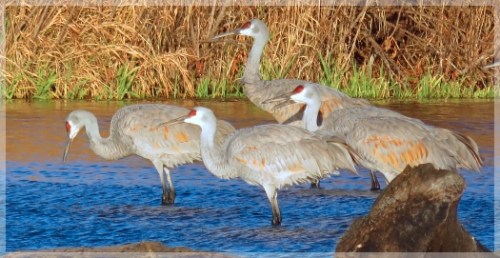
sandhill cranesSo you, too, must keep watch! For you don’t know what day your Lord is coming. [Matthew 24: 42 (NLT)]

Yesterday, when writing about the migratory birds’ staging area near our northern home, I remembered the year they weren’t in a rush to depart. Autumn that year had been unseasonably mild with temperatures hovering in the 60s and we’d returned north in November to celebrate my mother-in-law’s birthday. The day we headed out to the park, however, the weather had taken a sharp turn toward winter. The day’s high of 37° occurred before sunrise and the season’s first snowfall was expected that night. While walking through the park that cold fall day, we were surprised to see hundreds of Sandhill Cranes and Canada Geese still in the marsh. Apparently, the mild fall weather and still plentiful food caused them to recklessly delay their departure south. The marsh soon would freeze and food would be scarce, not just in the park, but all along their migration route. Seemingly oblivious to the danger, the birds were like the people of Noah’s day or the inhabitants of Sodom and Gomorrah—having a rollicking good time right up until disaster rained down on them. By the time they realized what was happening, it was too late! I hoped it wouldn’t be that way with the birds.

Looking at the upheaval of the last two years, many are reaching for their Bibles and wondering if we’re seeing signs of the apocalypse. We read of death by “the sword and famine and disease and wild animals,” in Revelation 6:8. Luke 21:9-10 records Jesus speaking of wars, insurrections, earthquakes, famines, plagues, and “terrifying things.” As much as that sounds like today, it probably sounds a great deal like much of mankind’s troubled history. Our century is not the only one troubled by pandemics, conflict, catastrophe, natural disasters, violence, scarcity, and loss. Jesus, however, said that no one (not even He) knows the day or hour of His return. Nevertheless, just as the sudden drop in temperature and wintery wind warned those birds of winter’s approach, these could be warning signs of things to come and the Bible tells us to be vigilant.

As with the flood and Sodom’s destruction, swift and sudden judgment will accompany Jesus’ return. Jesus compared His second coming to the surprise arrival of a thief in the night and both believers and unbelievers won’t know when that thief will appear. While unbelievers have good reason to fear that day, Christians don’t. To carry the thief metaphor further, we aren’t afraid of the thief because we’re well insured. Our acceptance of Jesus gives us assurance of salvation; our sins are mercifully forgiven and we have everlasting life. We’ve read the book and know how the story ends!

When we returned to the park two days later, the marsh was frozen but the birds were gone. They’d seen the signs and made the right decision; unbelievers should do the same.

Live as if Christ is coming in the next 10 minutes. Plan as if He is not coming for 1,000 years. [Roger Barrier]

Since everything around us is going to be destroyed like this, what holy and godly lives you should live, looking forward to the day of God and hurrying it along. On that day, he will set the heavens on fire, and the elements will melt away in the flames. But we are looking forward to the new heavens and new earth he has promised, a world filled with God’s righteousness. And so, dear friends, while you are waiting for these things to happen, make every effort to be found living peaceful lives that are pure and blameless in his sight. [2 Peter 3:11-14 (NLT)]

Copyright ©2021 jsjdevotions. All rights reserved.

BIRDS OF A FEATHER

clam pass floridaJust as our bodies have many parts and each part has a special function, so it is with Christ’s body. We are many parts of one body, and we all belong to each other. [Romans 12:4-5 (NLT)]

Even though we now live in the land of forever summer, I know autumn is upon us—and not just because nearly everything from lattes, tea, and donuts to English muffins, gelato, and Cheerios comes in pumpkin spice! The migratory birds (both feathered and human) have begun to arrive. Birds of a feather really do flock together as evidenced by the number of brown pelicans and terns gathering by the hundreds on the beach. Soon other birds like belted kingfishers, sandpipers, and grebes will arrive en masse.

Flocks of birds also signaled autumn when we lived in the north—only  they were leaving rather than arriving! A nearby park served as a “staging area” for Canada Geese and Sandhill Cranes, which means that the normal bird population swelled as hundreds of geese and cranes congregated there to gorge themselves in preparation for their challenging flight south. Once they’d eaten their fill, it was a magnificent sight to watch as these beautiful birds took to the sky in unison to continue their journey south.

Without knowing a thing about aerodynamics, wingtip vortices, updrafts, or reducing drag, those birds know enough to conserve their energy by flying in a V-formation that reduces wind resistance and takes advantage of wind currents. The lead bird does most of the work and, when he tires, he moves back and lets others take their turns. The V-formation also allows the birds to see the rest of the flock, preventing them from crashing into one another and enabling them to spot a bird in trouble. It’s been said that when a goose gets injured or falls behind the group, at least two others from the flock will join it. These beautiful creatures instinctively know there is strength in unity and safety in numbers.

As it is for those birds, the journey we are on is not a solo one. As Christians, we also are members of a flock. Unlike the birds, we don’t look like one another or sing the same song, but we all are on a journey that is not meant to be a solo one. Church is more than the place we meet for Sunday services; it’s the Christian’s version of a “staging area.” It’s where we meet others in the flock, gain strength by feeding on God’s word, and help one another as we move forward.

As part of Jesus’ flock, we depend on one another as much as do those migratory birds. We need our flock to reduce the drag when we encounter a head wind, refresh us when we grow tired, urge us on when we lag behind, and lift us when we’ve fallen. We break bread together, share resources and responsibilities, and teach and learn from one another. Our brothers and sisters in Christ not only encourage, comfort, and pray with and for us, but they also hold us accountable for our behavior. Like those migrating birds, we need the flock as much as it needs us.

Some Christians try to go to heaven alone, in solitude. But believers are not compared to bears or lions or other animals that wander alone. Those who belong to Christ are sheep in this respect, that they love to get together. Sheep go in flocks, and so do God’s people. [Charles Spurgeon]

Let us think of ways to motivate one another to acts of love and good works. And let us not neglect our meeting together, as some people do, but encourage one another, especially now that the day of his return is drawing near. [Hebrews 10:24-25 (NLT)]

This makes for harmony among the members, so that all the members care for each other. If one part suffers, all the parts suffer with it, and if one part is honored, all the parts are glad. All of you together are Christ’s body, and each of you is a part of it. [1 Corinthians 12:25-27 (NLT)]

Copyright ©2021 jsjdevotions. All rights reserved.

STATS

Does this sound as if I am trying to win human approval? No indeed! What I want is God’s approval! Am I trying to be popular with people? If I were still trying to do so, I would not be a servant of Christ. [Galatians 1:10 (GNT)]

canna - bandana of the evergladesA pastor friend who’s led dozens of mission trips used to evaluate his mission’s success by the number of new believers gained during the trip. If the latest mission’s altar call stats did not exceed the previous mission’s numbers, he felt it was a failure. Like him, we tend to be number people who measure our success or failure quantitatively. Business success is gauged by the balance sheet, bottom line, and price-earnings ratio; financial success by income, the value of our investment portfolio, and the size of our house or the price of our car. Regardless of the sport, with their assorted BAs, RBIs, Yds, Gs, PPRs, FT%s, and GOAT points, stats seem to evaluate every athlete’s success. Social success is assessed by the number of holiday cards we send or receive, how many “friends” we have on social media, and how many “likes” we got on our latest post. Intellectual success is measured by IQ, SAT, ACT and GPA numbers. A pastor assesses his success by Sunday’s attendance (or the offering), the teacher by the standardized test results of her students, and the author by his book’s ranking on the best seller list. I’m no different; I often check my website’s stats to see the number of followers, visitors, and views.

When we quantitatively assess our lives, it’s way too easy to find people with better numbers than ours. Moreover, when the numbers aren’t stellar, we often think we’re failures. God, however, isn’t an accountant or statistician. He measures success by standards completely different than those of the world. His standards are qualitative—the quality of our obedience, faith, and love.

That pastor friend eventually came to understand that God looks at a mission’s success far differently than man. Regardless of the number of new believers gained, when the pastor obediently follows God’s direction to lead a mission—to spread God’s word and share His love—he has been a good and faithful servant. When we hear God’s call and whole-heartedly respond to the best of our ability, regardless of the statistics, we have not failed. Success is when we go where He sends us and do what He tells us to do.

Let’s stop playing the numbers game and judging ourselves quantitatively by the world’s standards. Rather than comparing our scores to those of other people, there is only one person to whom we should compare ourselves and that is Christ. He sets the standard for our behavior and, while that standard is observable, it is not measurable. We’re successful if the fruit of His Spirit is visible in our lives—if we demonstrate love, joy, peace, patience, goodness, kindness, gentleness, faithfulness, and self-control. In God’s book, we’re successful when we become the sort of people Jesus wants us to be.

We should do what we do in order to gain God’s approval instead of prestige and approval from other human beings. … Are we motivated by the approval of people or the applause of God? [Phil Harper]

You should each judge your own conduct. If it is good, then you can be proud of what you yourself have done, without having to compare it with what someone else has done. For each of you have to carry your own load. [Galatians 6:4-5 (GNT)]

Copyright ©2021 jsjdevotions. All rights reserved.

THE UNFORGIVABLE SIN

So I tell you, every sin and blasphemy can be forgiven—except blasphemy against the Holy Spirit, which will never be forgiven. Anyone who speaks against the Son of Man can be forgiven, but anyone who speaks against the Holy Spirit will never be forgiven, either in this world or in the world to come. [Matthew 12:31-32 (NLT)]

blue jayWhen speaking to the Pharisees, Jesus delivers what could be called the ultimate good news/bad news scenario. The good news is that, no matter how evil, vicious or long-lasting the sin, any sin (even blasphemy) is forgivable. The good news, however, comes with a “but” when Jesus says blasphemy against the Spirit will never be forgiven.

Reading Jesus’ words—words said by the One whose blood was shed so our sins would be forgiven—is perplexing. If Jesus could forgive the many unnamed sins of those he healed, the soldiers who gambled for his clothing at the foot of the cross, and Peter’s three denials, what sin is so great that even His blood would not cover it? What exactly is blasphemy against the Spirit and how does it differ from speaking against the “Son of Man” (who we know to be Jesus)?

This good news/bad news scenario was delivered right after Jesus made it clear that there was no neutral ground when it came to Him—either people were with Jesus on God’s side or without Him on Satan’s side. He was directly speaking to Pharisees—people clearly not on Jesus’s side! They hated Him, were plotting His death, and just had denied proof of Christ’s divinity by attributing His healing miracles to Satan. Theirs wasn’t an act so horrendous that Jesus could not forgive them. Rather, their sin was one of attitude. What was unforgivable was their continual rejection of Jesus and their deliberate choice of Satan over Him.

As shocking as it seems, Jesus even says that blasphemy against Him can be forgiven. The Apostle Paul, for example, freely admitted to blaspheming the name of Christ while persecuting Christians. Yet, he experienced God’s mercy and forgiveness because he did so in ignorance and unbelief. If, however, after encountering the living Jesus on the road to Damascus, being supernaturally blinded, meeting Ananias, and having the scales fall from his eyes so that he knew the truth, Paul had never repented and come to believe in Christ, like the Pharisees, he would have committed the unforgivable sin. It would have become unpardonable blasphemy against the Spirit only if, after seeing the Truth incarnate, Paul continued to disparage, attack, and reject Jesus. Fortunately for us, after seeing the truth, Paul did repent and his “blasphemy” was forgiven.

Even scholars and theologians disagree on the exact meaning of this difficult text and I am neither scholar nor theologian. Nevertheless, the unpardonable sin appears to be what those Pharisees exhibited: a deliberate. obstinate, resolute, and tenacious resistance to the Spirit’s pursuit and voice. Even the demons recognized Jesus as the Son of God but the religious leaders, people who knew the prophecies and witnessed His miracles first-hand, blatantly refused to acknowledge Him. They didn’t even bother to dispute the miracles; they chose instead to dispute the source of Jesus’ power by attributing the works of God to Satan. That was unforgivable.

Some theologians think this warning applies only to those people of the 1st century who, like the Pharisees, actually witnessed the irrefutable proof that Jesus was empowered by the Holy Spirit and then denied the overwhelming evidence of His divinity. Only God knows for sure. The important thing for us to understand is that, like the unbelieving Pharisees, people freely choose how they will spend eternity and, like Paul, no matter how shameful the sin, when we sincerely seek God’s forgiveness through Christ, we can be certain that He will forgive us.

Even though I used to blaspheme the name of Christ. In my insolence, I persecuted his people. But God had mercy on me because I did it in ignorance and unbelief. Oh, how generous and gracious our Lord was! He filled me with the faith and love that come from Christ Jesus. This is a trustworthy saying, and everyone should accept it: “Christ Jesus came into the world to save sinners”—and I am the worst of them all. But God had mercy on me so that Christ Jesus could use me as a prime example of his great patience with even the worst sinners. Then others will realize that they, too, can believe in him and receive eternal life. [1 Timothy 1:13-16 (NLT)]

Copyright ©2021 jsjdevotions. All rights reserved.

STAYING HUMBLE

And all of you, dress yourselves in humility as you relate to one another, for “God opposes the proud but gives grace to the humble.” So humble yourselves under the mighty power of God, and at the right time he will lift you up in honor. [1 Peter 5:5-6 (NLT)]

salt marsh mallowBelieving that God’s spirit would not enter into something flawless, various Native American people intentionally strung a wrong-colored bead (the spirit bead) into an otherwise perfect pattern of beadwork so to create an opening through which God’s spirit could flow. In a similar way, believing that a perfectly woven rug or carpet would be an offense to Allah, followers of Islam would make an intentional small mistake in their weaving. Concerned that a perfect quilt would encourage pride, imperfect squares called humility squares or blocks, are said to have been deliberately placed in quilts by Puritan women as their acknowledgment that only God is perfect.
Whether these intentional errors were done for God as acts of humility, as a way to use miscellaneous beads or scrap fabric, or simply to explain away a mistake, I don’t know. Nevertheless, feeling the need to make a deliberate mistake to keep from perfection seems the height of pride to me. Having done needlepoint, quilting, and other handwork, I can guarantee that mistakes will always creep into anything we make (at least anything I make).

The Greek word most often used in the Bible for sin was harmartia. An archery term, it meant missing the mark—a failure to hit the bull’s eye. Having done a little archery as a girl, I didn’t need to deliberately miss the bull’s eye to remain humble since I frequently missed the target altogether! No matter how hard we try, when it comes to being sinless, we don’t have to concern ourselves with making deliberate errors to avoid pride. None of can be sinless; that was done only once—by Jesus—so there is no need for any of us to insert a “humility square” into our lives. We’ve made enough errors already and more are yet to come.

Humility, however, is a strange thing—the minute you think you have it, you’ve lost it! As C.S. Lewis aptly said in Mere Christianity, “If you think you are not conceited, it means you are very conceited indeed.” True humility isn’t found in in bead work, weaving, or quilting mistakes; it is found in a deep sense of one’s own sinfulness, limitations, and unworthiness in the sight of God. It is found by looking up at Him—His righteousness and holiness—rather than down at our accomplishments or the errors made by others!

Being human, we won’t hit the mark every time. Nevertheless, even though we fail to live up to God’s perfect standard, like the Apostle Paul, we continue to aim for the bull’s eye. There’s no need to be discouraged; we are all works in progress and are forgiven for our errors. We just need to focus on Christ and allow the Holy Spirit to guide our aim.

I don’t mean to say that I have already achieved these things or that I have already reached perfection. But I press on to possess that perfection for which Christ Jesus first possessed me. No, dear brothers and sisters, I have not achieved it, but I focus on this one thing: Forgetting the past and looking forward to what lies ahead, I press on to reach the end of the race and receive the heavenly prize for which God, through Christ Jesus, is calling us. [Philippians 3:12-14 (NLT)]

Copyright ©2021 jsjdevotions. All rights reserved.

SAFETY FEATURES

Do not stifle the Holy Spirit. [1 Thessalonians 5:19 (NLT)]

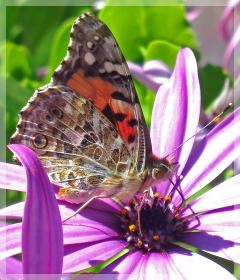
painted lady butterflySince my 18-year-old grand is a new driver, I was surprised when her parents purchased a new car for her. Remembering the many dings, scrapes, and dents our teens left on their cars, I asked why they’d replaced the 15-year-old car on which she learned to drive with a new one; “safety features” was their simple and logical explanation. This new car offers things like forward collision warning, automatic emergency braking, adaptive cruise control, blind spot monitoring, lane departure warnings, lane-keeping assist, backup cameras, active park assist, rear cross traffic alert, and a whole variety of air bags (front, side, seatbelt, knee, foot, and curtain along with rollover sensors to deploy them.) Knowing that accidents happen to even the best drivers, damage to a new car is far more acceptable than any damage done to their daughter!

Although God doesn’t outfit us with safety features to warn and protect us, like any good parent, He wants to safeguard His children. To keep us safe and within His will, He gives us the Holy Spirit as standard equipment once we accept Jesus! Moreover, even though His technology hasn’t changed through the centuries, it remains state of the art.

As much as those various safety features will keep my grand safer, they can’t entirely protect her. Free to ignore their many warnings, she remains vulnerable to her own choices. Whether or not she abides by the speed limit, stops at stop signs, yields the right of way at roundabouts, or signals lane changes is entirely up to her. Like traffic laws, God’s laws set the standard for our behavior and help us know right from wrong. But, just as my grand may be tempted to use her cell phone while driving, our belief in Jesus doesn’t mean we’ll never be tempted to sin. Fallible beings that we are, we’re not capable of perfect obedience. Just as we tend to nudge that speedometer a few miles over the limit, we tend to push the limits when it comes to the rest of our behavior. Moreover, just as my grand may choose to ignore her car’s various warnings, we can choose to turn a deaf ear to the Spirit’s voice. That’s the problem with that pesky thing called free will—we know better but we often do it anyway!

Fortunately, unlike some car safety devices, we can’t disable or turn off the Holy Spirit. As our advocate, comforter, guide, and counselor, He always is present—teaching, guiding, encouraging, warning, and convicting us. Rather than sounding an annoying beep or flashing a warning light, He guides us through our conscience, with that still small voice, and in other subtle ways. His guidance is better than the most sophisticated GPS because He’ll never lead us into sin. May we always remember that true safety isn’t found in car technology or even the absence of danger; it is found in the presence of God!

But when the Father sends the Advocate as my representative—that is, the Holy Spirit—he will teach you everything and will remind you of everything I have told you. [John 14:26 (NLT)]

And do not bring sorrow to God’s Holy Spirit by the way you live. [Ephesians 4:30a (NLT)]

Copyright ©2021 jsjdevotions. All rights reserved.