
Then they took the man who had been blind to the Pharisees, because it was on the Sabbath that Jesus had made the mud and healed him. The Pharisees asked the man all about it. So he told them, “He put the mud over my eyes, and when I washed it away, I could see!” [John 9:13-15 (NLT)]
 It’s easy to assume the Pharisees were irate just because Jesus had worked on the Sabbath but, for these sticklers for the law, it was as much about how He healed the man! Spitting on the ground on the Sabbath was forbidden because plowing was one of the 39 types of work prohibited on the Sabbath! Using their convoluted logic, that meant that digging any hole was prohibited and, when spittle landed on soil, it might cause a small dent in the ground (which would be digging a hole) and dislocate a small amount of dirt (which would be plowing)! Compounding Jesus’ violation of the law by both healing and plowing, He made mud. Kneading, defined as joining small particles into a mass using any liquid, was another of the 39 kinds work prohibited on the Sabbath. Jesus broke this law the moment his spittle wet the dust; the mixing of his spittle and the dirt together to make mud was an additional offense! To them, the restoration of sight meant nothing when compared to His many transgressions of the law!
When Jesus healed a man who’d been lame for thirty-eight years, it also was on the Sabbath. [John 5] Once healed, Jesus specifically told the man to pick up his mat and walk. Carrying anything more than six feet in a public place, however, was prohibited on the Sabbath. When the Jewish leaders accosted the man for carrying a burden, he explained that Jesus told him to do so after healing him! Again, the Pharisees were more concerned about work being done on the Sabbath than the miraculous healing that occurred!
In all, seven Sabbath healings are mentioned in the gospels. Although Jesus healed Peter’s mother-in-law in private, the rest of His Sabbath healings were done right in front of His critics. When He healed the man with the withered hand, the crippled woman, and the man possessed by evil spirits, Jesus was in the synagogue and He was having dinner at the home of a leading Pharisee (possibly a member of the Sanhedrin) when he healed a man suffering from dropsy (edema).
Like His other Sabbath healings, this didn’t appear to be a life-or-death situation and, for all we know, the man was there as a way of entrapping Jesus into another violation of the law. Nevertheless, after asking the Pharisees if it was right to heal on the Sabbath and not receiving an answer, Jesus healed the man and sent him on his way. He then exposed His critics’ hypocrisy by asking which of them wouldn’t rescue his son or cow if they were to fall in a pit? His question exposed their convoluted thinking since rescuing an animal from a pit on the Sabbath was acceptable even to the Pharisees! In fact, a primary principle in Jewish law is preventing tza’ar ba’alei chayim, the suffering of living creatures, and the Talmud specifically permitted rescuing an animal in pain or at risk of death and even permitted moving prohibited objects to relieve their pain. Yet, the Pharisees seemed unwilling to have compassion on their fellow man!
Once again, when it comes to the law, Jesus made it abundantly clear that every other law is subordinate to the greatest one of loving God and loving our neighbor as ourselves. The next time we see someone in need, along with asking, “What would Jesus do?” we might also ask, “What would I want done for me in a similar situation?”
 Last December, after breaching the barrier surrounding the tiger enclosure at our local zoo, a man stuck his hand into the tiger’s cage. A similar incident occurred a few months later at a nearby airboat attraction when a man improperly went through the first enclosure and put his arms into the tiger’s cage. Although both men survived, they suffered serious injuries to their hands and arms. Fences are placed to protect us and keep us from getting too close to danger but you can’t protect people from their own stupidity.
 It’s hard to think of our omnipotent, invincible, and unstoppable God getting tired after a mere six days of work but Scripture tells us He “rested” on the seventh day. The Hebrew word translated as rested, however, is shabath, meaning to stop, cease, or desist. Rather than God resting because He was exhausted; God simply stopped! I suspect it’s because He wanted to enjoy His finished creation. Picture Him sitting in the Almighty’s version of a La-Z-Boy chair, looking out at the magnificence of the universe—breathing in its aromas, tasting its sweetness, hearing its song, and delighting in its beauty.
 We know that four of the disciples were fisherman and one was a despised tax collector but have no idea what careers the others left behind to follow Jesus. If Jesus wasn’t carpentering, the fishermen weren’t fishing, the tax collector wasn’t collecting, and others weren’t doing whatever it was they did, how did these men support themselves? For the most part, they probably depended on the hospitality of strangers or friends like Martha, Mary, and Lazarus but we also know that the disciples were in Sychar purchasing food when Jesus had a conversation with the Samaritan woman at the well. Like any ministry, the group needed money for everyday expenses and Scripture tells us that people like Joanna, Susanna, and Mary Magdalene provided for them out of their resources.
 When Jesus brought Matthew into the inner circles of disciples, it was as shocking as if someone like Billy Graham brought a loan shark, heroin trafficker, money launderer, or embezzler onto his worship team. But, along with his questionable reputation and his devotion to Jesus, Matthew brought a unique set of skills to the Lord and to countless generations of Christ’s followers.
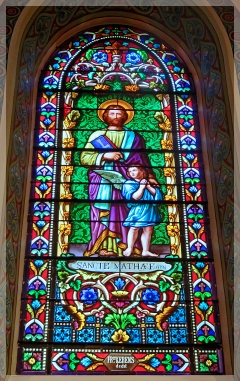 Although Mark and Luke call him Levi, there is no doubt that Levi and Matthew are the same man. He may have had two names, as did John Mark or was known by two different names as were Peter (Simon), Thomas (Didymus), Jude (Thaddeus), and Nathanael (Bartholomew). It simply may be that, like the Apostle Paul (Saul), he was known both by his Greek name of Matthew as well as his Hebrew one of Levi.
 Devotions of the Heart