FROM DEATH TO LIFE

“I am the resurrection and the life,” replied Jesus. “Anyone who believes in me will live, even if they die. And anyone who lives and believes in me will never, ever die.” [John 11: 25-26 (NTE)]
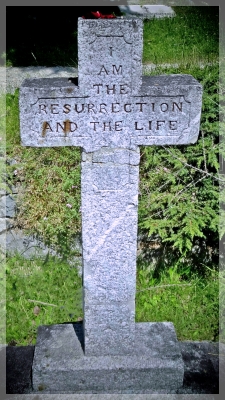
Matterhorn Memorial - Zermatt

Courtesy of technology, we recently attended an Illinois church service while sitting at our computers in Florida. The choir, accompanied by pipe organ and trumpet, began with Jesu, Joy of Man’s Desiring and ended with Joyful, Joyful We Adore Thee. The trumpet’s bright piercing sound and the organ’s lilting accompaniment in the first song and the uplifting words in the final one makes them popular choices for joyful occasions like weddings, Christmas, and Easter. Although we were rejoicing, we weren’t celebrating nuptials, Christ’s birth, or His resurrection. Instead, we were rejoicing in a life well lived and celebrating the life of a friend who recently went home to God.

During the service, several people spoke of this Christian man’s faith, character, modesty, generosity, humility, compassion, honesty, reliability, thoughtfulness, wisdom, and curiosity. A leader both in his community and church, he built consensus rather than caused discord, bore the fruit of the Spirit, and truly lived his life as a follower of Christ. Although he played the trumpet in college, he never blew his own horn or called attention to himself. Nevertheless, he was a shining light in a world filled with darkness. Our lives were blessed by his presence and he will be deeply missed by all who knew him.

As much as his family and friends mourn his absence, the service was one of unparalleled joy because, while here on earth, he followed Jesus with his heart, soul, body, and mind. We could be joyful because we know death is not the end of our lives—just of our lives in these perishable bodies. As Christians, we have hope of something greater that goes far beyond life and death.

In contrast, I can’t feel joy at any funeral or memorial service for a non-believer. While songs may be sung, they’re more likely to be My Way or Over the Rainbow than Abide with Me or It is Well with My Soul. After sharing memories and listing accomplishments, the person giving the eulogy will say reassuring things about the deceased being in a better place, with the angels, or watching over us—none of which are based in reality. Unbelievers are not going home or into the arms of God, they won’t be “looking down” at their loved ones, and there won’t be a happy reunion in heaven with friends and family. The only way an unbeliever lives on is in photographs and people’s memories; sadly, even those will fade and be lost over time. There is little comfort in the passing of a non-believer.

While there are different opinions in Christ’s church about what happens immediately after death, there is unanimity in His church about what eventually happens—we will come face to face with God and our entire lives will be examined. Jesus’ life, death, and resurrection mean that His followers aren’t afraid of God’s judgment on the day. Regardless of our failures and sins, we are recipients of God’s grace and forgiven for our wrongs. Because of God’s mercy and grace, all of His adopted children have a confirmed reservation waiting for them in heaven.

Because the only way to heaven is faith in Jesus and there is no return from the depths of hell, there is no comfort or joy in the passing of a non-believer. On the other hand, in spite of our sorrow, we can rejoice when Christ’s followers depart this world because we know their destination, that our separation is only temporary, and that we will meet again in God’s good time. That’s why, at their passing, we can raise our voices and joyfully sing, “Joyful, joyful, we adore You, God of glory, Lord of love; Hearts unfold like flowers before You, Opening to the sun above.”

Morality may keep you out of jail, but it takes the blood of Jesus Christ to keep you out of hell. [Charles Spurgeon]

I’m telling you the solemn truth: anyone who hears my word, and believes in the one who sent me, has the life of God’s coming age. Such a person won’t come into judgment; they will have passed out of death into life. [John 5:24 (NTE)]

Copyright ©2023 jsjdevotions. All rights reserved.

PRAYERS – Chronicles (Part 2)

Then if my people who are called by my name will humble themselves and pray and seek my face and turn from their wicked ways, I will hear from heaven and will forgive their sins and restore their land. [2 Chronicles 7:14 (NLT)]

Easily missed in Chronicles’ nine chapters of genealogy is Jabez (whose name meant distress or sorrow). Described as more honorable than his brothers, Jabez prayed: “Oh, that you would bless me and expand my territory! Please be with me in all that I do, and keep me from all trouble and pain!” [4:9-10] The Chronicler tells us God granted Jabez’s request and the man whose name meant distress apparently had a trouble-free life!

Those two verses are the only mention of Jabez in the entire Bible yet his short prayer inspired a bestseller in 2000 and countless sermons since. Amazon describes the words of Jabez as “a timeless prayer that produces timely results!” and promises that readers of the book can “discover how they can release God’s miraculous power and experience the blessings God longs to give each of us.” Some people seem to think that the Chronicler tell us about Jabez because he had the right combination of words to guarantee blessings and a trouble-free life. We, however, do Jabez a disservice in assuming he was asking for material blessings like power, land, health, and wealth. He may have been asking God for spiritual blessings—that God to be with him in his words and actions. Rather than expand his land, perhaps this honorable man prayed to enlarge his area of spiritual influence. Rather than avoiding physical pain, he may have prayed to be free of the heartache of seeing others (perhaps his brothers) disobey God.

While we don’t know if Jabez’s prayer was one of self-interest or selflessness, we do wonder why the Chronicler included the words of this historically insignificant man in his genealogy. It is in remembering that Chronicles’ purpose was to remind the exiles of God’s faithfulness that we discover the reason for the prayer’s inclusion. It’s not the words Jabez prayed that were important; it’s that this honorable man actually prayed and that, hearing his prayer, God answered him!

Throughout his account of Judah, the Chronicler continually tells of prayers offered and God’s faithfulness in answering them. He reports that the warriors of Reuben, Gad, and the half-tribe of Manasseh cried out to God for help during battle. Because they trusted Him, God answered their prayer, fought for them, and gave them victory. The Chronicler recounts how God provided battle strategies and victory to David and how He responded to the prayers of other kings like Solomon, Rehoboam, Asa, and Abijah. He tells how Jehoshaphat’s prayer saved him from the Arameans. When Jehoshaphat asked God to save Judah from a trio of enemy armies, God promised they wouldn’t even have to fight because the battle was His! Indeed, as the people sang praises and thanks to God in anticipation of victory, their enemies fought among themselves and none survived. All Judah had to do was collect the plunder. The Chronicler tells us how the prayers of Hezekiah and Isaiah rescued the people of Jerusalem from Assyria. Saying that Hezekiah prospered because “he sought his God wholeheartedly,” he adds that, when the seriously ill king prayed for relief, God healed him. After humbling himself before the Lord, even the evil Manasseh is reported to have had his prayers answered!

The Chronicler told of the answered prayers of Jabez and the many others as a way of urging the post-exilic people of Judah to seek the Lord as previous generations had done. God’s answers to the prayers of their ancestors reassured this new generation that Jehovah was the covenant God of Israel who could be trusted to hear the prayers of His people!

The Chronicler didn’t include the prayer of Jabez because of a “name it and claim it” prosperity theology nor was it included because Jabez’s words released “God’s miraculous power.” The Chronicler included this prayer for the same reason he included all those others. He didn’t believe in the power of a prayer’s words but rather in the power of our God to know our needs, hear our prayers, and answer them, in His timing and way, with blessings and forgiveness!

Give thanks to the Lord and proclaim his greatness. Let the whole world know what he has done. Sing to him; yes, sing his praises. Tell everyone about his wonderful deeds. Exult in his holy name; rejoice, you who worship the Lord. Search for the Lord and for his strength; continually seek him. Remember the wonders he has performed, his miracles, and the rulings he has given, you children of his servant Israel, you descendants of Jacob, his chosen ones. [1 Chronicles 16:8-13 (NLT)]

Copyright ©2023 jsjdevotions. All rights reserved.

TWO VIEWPOINTS – Chronicles (Part 1)

For everything that was written in the past was written to teach us, so that through the endurance taught in the Scriptures and the encouragement they provide we might have hope. [Romans 15:4 (NIV)]

Bryce CanyonWhile both Kings and Chronicles relate the history of the Israelite monarchies and cover much of the same time period, they are quite different because they relate more than events—they relate Israel’s relationship with God. Continuing the nation’s history begun in Samuel, Kings was written for the captives during their exile in Babylon. Completed around 560 BC, the author shuttles between the kings of Israel and Judah until Israel’s captivity. Judah’s history continues to the Babylonian conquest and Jerusalem’s destruction; its history ends with Jehoiachin’s release from prison during captivity. Kings’ purpose was to explain how and why God’s children ended up in exile by showing how their kings failed to follow the law as written in Deuteronomy. They’d built shrines, worshiped in “high places,” made sacrifices away from the temple, defiled the Temple with idols, and rejected God’s prophets while embracing false ones. Reflecting the author’s decidedly negative viewpoint of both kingdoms’ leadership, only four of the thirty-nine kings following Solomon (all from Judah) got good reviews with another five kings getting mixed ones. Of the remainder—all “did what was evil in the Lord’s sight.” The book of Kings clearly answered the people’s question of why they were suffering in exile

In contrast, while roughly covering the same time period as Samuel and Kings, Chronicles was written after Cyrus’ decree and Judah’s return from exile (around 450-430 BC). Because only Judah returned, little is said of the northern kingdom. Since the question of what caused the exile had been answered in Kings, the Chronicler attempted to answer the exiles’ new question: “What now?” This post-exilic generation needed to know if and how they fit into God’s plan.

Seventy years had passed since Judah was taken captive and the returning exiles faced the daunting task of reconstructing both Jerusalem and the Temple, reclaiming the land, and building homes while surrounded by enemies. Many of those returning had never seen, let alone worshiped, in the Temple. Chronicles’ purpose was to encourage and sustain the people in the difficult times ahead as they rebuilt what had been destroyed. By showing them God’s faithfulness in the past, it reassured them of God’s faithfulness in the future. With a decidedly positive outlook, Chronicles taught a new generation about the importance of the Temple, worship that comes from the heart, God’s patience and forgiveness, the need for repentance, and the blessings of obedience. Because they needed to know their connection with the past and where they fit in God’s plan, Chronicles begins with nine chapters of genealogy. Going all the way back to Adam, it linked this post-exilic generation with Abraham and David and God’s promises to them.

Because Kings wanted to show how disobedience brings disaster, it sometimes omitted mentioning some good done by the bad kings, such as the evil Manasseh repenting and returning to God at the end of his life. On the other hand, the Chronicler often reframed Israel’s history in a more positive light by making little or no mention of bad acts like David’s sin of adultery, Absalom’s rebellion, and Solomon’s worship of idols. In spite of their differences in perspective, however, both histories are valid and, rather than contradicting each other, they complement one another. Neither history, however, is complete without the other!

The Hebrew name of the book we call Chronicles was dibre hayyamim meaning “the words (events) of the days (years).” When translated into Greek, it became Paraleipomena meaning “the things omitted (concerning the Kings of Judah).” That name, however, implied that it was little more than an addendum to Samuel and Kings. Even though Jerome renamed it Chronicles (meaning “annals, records, or histories”) in the fourth century, people still dismiss Chronicles as little more than an appendix or condensed version of Kings and scholars agree that Chronicles is the most neglected book in the Bible. Ignoring Chronicles because we read Kings, however, is like skipping John’s gospel because we read Matthew’s! All Scripture is important because all of it is God’s word; let us give each book the attention it deserves. With its emphasis on proper worship, repentance, prayer, and obedience to the Word of God, Chronicles is as relevant today as it was 2,500 years ago.

All Scripture is God-breathed and is useful for teaching, rebuking, correcting and training in righteousness, so that the servant of God may be thoroughly equipped for every good work. [2 Timothy 3:16-17 (NIV)]

 Copyright ©2023 jsjdevotions. All rights reserved.

GETTING RIGHT, RIGHT NOW

Then Jesus turned to the crowd and said, “When you see clouds beginning to form in the west, you say, ‘Here comes a shower.’ And you are right. When the south wind blows, you say, ‘Today will be a scorcher.’ And it is. You fools! You know how to interpret the weather signs of the earth and sky, but you don’t know how to interpret the present times.” [Luke 12:54-59 (NLT)]

After admonishing the crowd surrounding Him for being able to predict the weather but being oblivious to the signs of the arrival of God’s Kingdom, Jesus told a parable about getting right with God before judgment. As He was speaking, he was told about a recent incident in which Pontius Pilate ordered his soldiers to murder some Galileans while they offered their Temple sacrifices. On Monday, in “The Man from Galilee,” I wrote about the stereotypes Judeans had of Galileans; along with thinking them to be uneducated peasants, many Judeans regarded Galileans as trouble-making rebels against Rome. Indeed, Galileans had revolted after Herod the Great was named King, and, in 6 AD, another rebellion was led by Judas of Galilee. Indicating Rome’s expectation of armed resistance from Jesus and his Galilean disciples, a contingent (around 500) of heavily armed soldiers were sent to arrest Him in Gethsemane. Jesus even asked if they thought him a dangerous revolutionary. While turning the other cheek and loving one’s enemies was a revolutionary concept, that was not the kind of revolution people expected from a Galilean.

Understanding the crowd’s bias makes it likely that their specific mention of the murdered men being Galilean indicates their suspicion that the men may have been trouble-makers who deserved their deaths. Perceiving the crowd’s smug viewpoint, Jesus asked whether those Galileans deserved their brutal deaths more than any other Galilean and immediately answered His own question with a firm, “Not at all!” Turning the tables on his questioners, He mentioned a recent disaster that had horrified the nation when eighteen men were crushed to death after a tower they’d been building collapsed on them. He then asked, “Were they the worst sinners in Jerusalem?” before repeating His caution to repent lest His listeners perish as well.

As long as life goes smoothly for us, it’s easy to self-righteously think that those who suffer deserve God’s judgment. After all, that’s what Job’s friends mistakenly thought about his afflictions. When life takes a turn for the worse and we’re on the receiving end of tragedy as it did for Job, that reasoning flies out the window. None of those laborers were any more deserving of their deaths than were the “Galileans.” By the same token, none of them were less deserving of their suffering, even if they all were truly evil people.

Whether the devastation and loss of life from events like Hurricane Ian or the unbearable horror of a school shooting like Uvalde, experiencing tragedy has nothing to do with one’s righteousness. The Book of Job makes it clear that even the most righteous among us have no right to question God. Suffering, disease, and death originate from God’s curse because of that first sin. Even terms like “innocent child” and “good person” are relative terms since we all are sinners and deserving of God’s righteous judgment.

Tragedies show us that life is fragile and that we must get right with God before we die and face judgment. If nothing else, catastrophe and misfortune should drive us to repentance and Jesus warned the crowd to do just that: “Repent of your sins and turn to God.” It is repentance that keeps us from perishing—not from suffering and certainly not from dying—but from perishing!

“Do you think those Galileans were worse sinners than all the other people from Galilee?” Jesus asked. “Is that why they suffered? Not at all! And you will perish, too, unless you repent of your sins and turn to God. And what about the eighteen people who died when the tower in Siloam fell on them? Were they the worst sinners in Jerusalem? No, and I tell you again that unless you repent, you will perish, too.” [Luke 13:2-5 (NLT)]

Copyright ©2023 jsjdevotions. All rights reserved.


THE MAN FROM GALILEE

There was nothing beautiful or majestic about his appearance, nothing to attract us to him. He was despised and rejected—a man of sorrows, acquainted with deepest grief. We turned our backs on him and looked the other way. He was despised, and we did not care. [Isaiah 53:2-3 (NLT)]

poppyBecause we know little about the geography or politics of Jesus’ time, we sometimes miss subtleties in the gospel accounts. We know Jesus was from Galilee but what do we know of Galilee? Located north of Judea with the province of Samaria separating them, Galilee originally was settled by the tribes of Naphtali, Asher, Issachar, and Zebulun—all of whom failed to drive out the Canaanites. King Solomon gave twenty towns in the northern part of Galilee to King Hiram of Tyre either as payment for the cedar, cypress, and gold Hiram provided for the Temple’s construction or as collateral to cover later payments. In any case, Hiram later returned the cities to Solomon who then settled Israelites in them. When the kingdom divided, this region became part of the northern kingdom of Israel.

When Assyria defeated Israel, much of the Jewish population was relocated while those remaining often intermarried with the Gentiles sent there to repopulate the area. By the 7th century BC, the region was known as Galilee with Upper (northern) Galilee known as the “Galilee of the Gentiles.” This was a rich and fertile region and, with the Sea of Galilee being the largest freshwater lake in the area, it was an ideal location for settlements and fishing. After returning from their exile in Babylon, Judean immigrants resettled the region.

By the time of Jesus, Galilee was a heavily populated area. Jesus was raised in Nazareth in Lower Galilee. Most, if not all, of His disciples were from Galilee and He spent much of his ministry preaching around the northern shore of the Sea of Galilee in towns like Capernaum and Bethsaida. It was in Galilee that he turned water into wine, gave the Sermon on the Mount, and performed miracles like feeding the 5,000, healing the centurion’s servant, raising Jairus’ daughter and the widow of Nain’s son, walking on water, and calming a storm.

What we 21st century believers probably don’t know is that, in Jesus’ day, Judeans disparaged Galileans. Even though most Galileans were Jewish, the pureness of their ancestry had been diluted by intermarriage and Judeans considered them of questionable ancestry. The Galilean Aramaic dialect differed enough from Judean Aramaic that Galileans (like New Yorkers) were recognizable by their accents. It was Peter’s accent that identified him as a Galilean when he denied Jesus and it was their distinctive accent that caused Judeans to consider Galileans uneducated. One story in the Babylonian Talmud told of prohibiting them from speaking in the Temple for fear they might mispronounce something and offend God! In Acts 4:32, we find the Council amazed at the confidence with which Peter and John spoke because they were “unlearned and ignorant” men. It was their thick Galilean accents, not their words, that caused the incorrect assumption of ignorance.

Regional prejudices were as prominent in Jesus’ time as they are in ours and Judeans, especially Jerusalemites, viewed Galileans as uncultured peasants. “Galilean” was as derogatory a term as are “redneck” or “hillbilly.” Consider Nathanael’s surprise when Philip told him the Messiah was from Nazareth: “Can anything good thing come from Nazareth?” When Nicodemus dared to defend Jesus by pointing out He deserved a trial, his fellow Pharisees taunted him with their answer: “Are you from Galilee, too? Search the Scriptures and see for yourself—no prophet ever comes from Galilee!” Not only did their scorn prove their bias and prejudice, but it also revealed their own ignorance. The prophet Jonah came from Gath-Hepher, just a few miles north of Nazareth, in Galilee! Their bias also kept them from seeing how Jesus filled Isaiah’s prophecy of a Messiah in Isaiah 9 (repeated in Matthew 4:13-16).

Are we as judgmental as were the Pharisees? Do we make assumptions about groups of people based on pre-existing beliefs about their heritage, race, accent, attire, age, gender, religion, or disability? Many in Judea turned their backs on Jesus and the disciples because all they saw were uneducated peasants who spoke with a Galilean accent! Because of their prejudice, they continued to sit in the darkness in the presence of the Light! Let’s not make a similar mistake!

He went first to Nazareth, then left there and moved to Capernaum, beside the Sea of Galilee, in the region of Zebulun and Naphtali. This fulfilled what God said through the prophet Isaiah:  “In the land of Zebulun and of Naphtali, beside the sea, beyond the Jordan River, in Galilee where so many Gentiles live, the people who sat in darkness have seen a great light. And for those who lived in the land where death casts its shadow, a light has shined.” [Matthew 4:13-16 (NLT)]

Copyright ©2023 jsjdevotions. All rights reserved.

ON WHAT DO WE LEAN?

Trust in the Lord with all your heart and lean not on your own understanding; in all your ways submit to him, and he will make your paths straight. [Proverbs 3:5-6 (NIV)]

pickerel weedWhile pondering an important decision, I realized I was trying to figure it out on my own rather than taking it to God. Relying on my own perception and trusting in my wisdom, however, is what got me into my dilemma in the first place. Based on some of the truly stupid choices I’ve made when leaning on my own understanding, it’s only through God’s grace that my life is not a total disaster.

It all started with Adam and Eve who, after listening to the serpent’s advice, leaned on their own understanding of God’s prohibition about that one tree. Doubting God’s goodness, they thought the fruit would make them as wise as God and foolishly took those bites rather than check with Him. Not trusting God’s promise of descendants to Abraham, Sarah looked to her own solution and gave Hagar to her husband. What part of “Don’t look back or stop anywhere!” did Lot’s wife fail to understand when she looked back at Sodom? It was leaning on their own understanding that made Aaron mold a golden calf and sacrifice burnt offerings to it or Saul spare Agag and take the best of the sheep, goats, cattle, and plunder from the Amalekites. There were grievous consequences to all those decisions to lean on themselves rather than God!

Consider the Israelites who made it through the wilderness from Egypt to Canaan by following God’s plan. Before crossing the Jordan, Moses sent twelve scouts on a reconnaissance mission to determine the lay of the land and the region’s agriculture. They weren’t supposed to assess the people or determine if they would enter Canaan—that was a given because God promised Israel both the land and their victory over its residents. But, when the scouts returned with reports of giants, the Israelites leaned on their own understanding rather than trusting God—an error that cost them forty more wilderness years

Although Israel’s  strength was in the power of their God, David’s logic told him a nation’s strength lay in the size of its army. Ignoring the advice of Joab, he trusted his reasoning more than God and took a census of all who could “handle a sword.” As a result of his foolishness, Israel suffered a plague and 70,000 people died. Although leaning on our own understanding doesn’t necessarily result in tragedy, it frequently does.

When faced with a decision, like David, we consult advisors and friends, or turn to that font of information and misinformation—the Internet. Unfortunately, our human understanding is pitifully limited and our motives often suspect. Writing and debate classes taught me that a case can be made for any stand on an issue—whether it’s the right stand is an entirely different matter! It’s human nature to search deepest for information and advisors supporting our desires and to disregard as faulty anything that doesn’t support our position. Rehoboam did just that when he followed the advice of his greedy friends rather than Mosaic law and the godly advice of his father’s advisors. When he leaned on his own understanding, the kingdom divided.

We see just a portion of what is right in front of us but, in just one glance, God sees the whole picture—the past, present, and future. While our flawed understanding of God and His plan isn’t a requirement for obedience to Him, our trust is! The first part of today’s verse tells us to trust in the Lord—which is what Adam, Eve, and the rest should have done! Rather than lean on our own understanding or that of other flawed humans, we must turn to the true giver of wisdom—God—and His book of wisdom—the Bible.

“I wish I knew what to do!” we exclaim. While I can’t tell anyone what to do, I can tell everyone what not to do—don’t lean on your own understanding!

This foolish plan of God is wiser than the wisest of human plans, and God’s weakness is stronger than the greatest of human strength. [1 Corinthians 1:25 (NLT)]

Copyright ©2023 jsjdevotions. All rights reserved.