LIKE THE HYRAX

There are four things on earth that are small but unusually wise….Hyraxes—they aren’t powerful, but they make their homes among the rocks. [Proverbs 30:24,26 (NLT)] 

High in the mountains live the wild goats, and the rocks form a refuge for the hyraxes. [Psalm 104:18 (NLT)]

Making the point that wisdom is better than strength, the sage Agur spoke of the wisdom of ants, locusts, lizards, and sāphān. Often translated as badgers, rock-badgers, hyraxes, conies, or marmots, the animal’s exact identity is unknown but commentators suspect it to be the Syrian rock hyrax. Looking like a cross between a rabbit, guinea pig, and meerkat, these social animals gather in colonies of up to 80 individuals. Sleeping and eating together, they live in the natural crevices of rocks and boulders or take over the abandoned burrows of other animals.

Although hyraxes are mammals, like reptiles, they rely on ambient warmth to help regulate their body temperature. To warm up in the morning, they spend several hours sunbathing on the rocks together. Once warmed up, they head out to eat a little and then return to rest again on the rocks. If the sun gets too hot, they take their afternoon siesta in the shade.

Since hyraxes spend most of their time sprawled out resting on rocks in full view of any predators, these defenseless critters seem anything but wise. Looks, however, can be deceiving. Hyraxes never venture far from a safe crevice into which they can dash in an instant. Although these vulnerable animals appear to be asleep on the rocks, their eyes are open and, at the first sign of trouble, an alert is sounded.  Within seconds of that alert, these agile and speedy animals will disappear deep into rocky crevices. When hyraxes forage for food, the ever-alert animals form a circle with their heads pointing outward to keep watch for predators. I suspect it was their ability to both detect and escape peril while living openly on dangerous cliffs that caused Agur to call the hyrax “exceedingly wise.”

As a shepherd, David would have been quite familiar with the hyrax. As the likely author of Psalm 104, he even mentioned how the “rocks formed a refuge” for them. Like the hyrax, David and his men found security in the rocks and caves when they were hunted by Saul. The psalmist’s safe concealment in cliffs and caves may be the reason so many psalms refer to the rocks and cliffs as places of refuge. In Psalms alone, we find more than fifteen metaphors of God as a rock serving as the psalmist’s place of safety.

Since we’re not small and vulnerable animals who spend most of their time resting in the sunshine, what are we to make of Agur’s observation and David’s rock metaphors? Even when it looks like they’re asleep, the hyraxes never close their eyes to their enemies—the hungry lion, leopard, hyena, and eagle. Like the hyrax, Christians must be alert to their enemy, Satan—the one who prowls around like a lion looking for someone to devour. [1 Peter 5:8] Despite its vulnerability, the hyrax doesn’t conceal itself in the dark like a mole; neither should Christians. Rather than hide in the dark crevices, hyraxes boldly sunbathe in the open on the rocks because they have a secure refuge in the rocks. As Christians, we can be as bold and open in our faith because we have a secure refuge in our Triune God. Indeed, He is our fortress, deliverer, stronghold, shield, redeemer, and salvation! And, like the hyrax and David, when we’re in jeopardy, we can quickly flee to the Rock! As hymn writer Augustus Toplady wrote, “Rock of Ages, cleft for me, let me hide myself in thee!”

No one is holy like the Lord! There is no one besides you; there is no Rock like our God. [1 Samuel 2:2 (NLT)]

The Lord is my rock, my fortress, and my savior; my God is my rock, in whom I find protection. He is my shield, the power that saves me, and my place of safety. [Psalm 18:2 (NLT)]

But the Lord is my fortress; my God is the mighty rock where I hide. [Psalm 94:22 (NLT)]

He alone is my rock and my salvation, my fortress where I will not be shaken. [Psalm 62:6 (NLT)]

Be my rock of safety where I can always hide. Give the order to save me, for you are my rock and my fortress. [Psalm 71:3 (NLT)]

Copyright ©2024 jsjdevotions. All rights reserved.

LIKE LOCUSTS

The attackers march like warriors and scale city walls like soldiers. Straight forward they march, never breaking rank. They never jostle each other; each moves in exactly the right position. They break through defenses without missing a step. [Joel 2:7-8 (NLT)]

The prophet Joel wrote about God’s coming judgment of Judah but, because there’s disagreement about the date of his prophecy, we aren’t sure if he was describing the approaching Babylonian invasion, God’s final judgment, or both. In any case, the prophet likened the coming army to a swarm of locusts. Like locusts, this invading force would march straight, never break rank or crowd one other, and be unstoppable as they swarmed over the city. Before their arrival, the land would be like the Garden of Eden but, by the time they departed, it would be in utter desolation. Along with Joel, the books of Judges, Jeremiah, Nahum, and Revelation depict enemy hordes as locusts. In Proverbs 30, however, the sage Agur expresses admiration for the “small but wise” locusts because they “march in formation” without a king!

Assuming that Scripture’s words likening locusts to soldiers in a well-organized army were more figurative than scientific, I never gave these grasshopper-like insects much thought. When Charles Spurgeon used them as an example of “how thoroughly the Lord has infused the spirit of order into His universe,” and said, “Locusts always keep their rank, and although their number is legion, they do not crowd upon each other, so as to throw their columns into confusion,” I grew curious.

Normally, locusts are solitary creatures but, when conditions such as flooding or drought cause them to crowd into the same area, physical contact triggers their instinct to become sociable. As they forage for food together, they gather into a swarm of millions. Whether “marching” on land or flying in the air, locusts all go in the same direction and, if the swarm spontaneously changes course, they all switch direction as a group.

Weighing less than a dime, a single locust is hardly worth noticing—an insignificant and unremarkable insect, it’s easily crushed. The locust’s power comes when it joins with others like it. As a swarm, locusts are unstoppable and nearly unbeatable. A single swarm of locusts can number in the trillions, cover hundreds of square miles, move up to 100 miles in a day, and consume over 420 million pounds of vegetation every day!

Sharing a common goal, locusts have learned the best way to achieve it is to act as one. Their singleness of purpose is what makes them unbeatable. They are proof that, when small things come together, they have incredible power. While the cohesiveness of the locusts turns out to be a bad thing for mankind, what if Christ’s church were as unified as these insects? While thinking of the church in terms of locusts isn’t an attractive image, it is a compelling one.

If millions of insects having a brain less than ¼-inch in size can form a united force without having a leader tell them what to do, why can’t Christians? We’re certainly smarter than locusts and we have a king—King Jesus. Under His command, His army of soldiers should be able to gather as one and be a powerful force in this world.

While the locusts’ common enemy is hunger, ours is Satan; one of his favorite strategies is to divide and conquer and he’s done a great job of it! With about 45,000 different Christian denominations worldwide, we’re becoming better known for our scandals, squabbles, splits, and divisions than for our unity, harmony, and cooperation. Christ’s church always will have disagreements but Jesus and the mission He gave us is greater than our disagreements. As part of the same body—the body of Christ—we don’t have to agree on everything to partner with one another. Let us put aside our theological arguments, doctrinal disputes, and cultural biases, along with our different backgrounds, traditions, rituals, and governance to focus on what unites us: our faith in Jesus! Only then will we be able to feed His sheep and “make disciples of all the nations.”

Worldwide evangelism requires the whole church to take the whole gospel to the whole world. [Lausanne Covenant]

“Therefore, go and make disciples of all the nations, baptizing them in the name of the Father and the Son and the Holy Spirit. Teach these new disciples to obey all the commands I have given you. And be sure of this: I am with you always, even to the end of the age.” [Matthew 28:19-20 (NLT)]

Copyright ©2024 jsjdevotions. All rights reserved.

MINDSET

Don’t fret or worry. Instead of worrying, pray. Let petitions and praises shape your worries into prayers, letting God know your concerns. Before you know it, a sense of God’s wholeness, everything coming together for good, will come and settle you down. It’s wonderful what happens when Christ displaces worry at the center of your life. [Philippians 4:6-7 (MSG)]

The real problem of the Christian life comes where people do not usually look for it. It comes the very moment you wake up each morning. All your wishes and hopes for the day rush at you like wild animals. And the first job each morning consists simply in shoving them all back; in listening to that other voice, taking that other point of view, letting that other larger, stronger, quieter life come flowing in. [C.S. Lewis]

The above words are from Mere Christianity by C.S. Lewis. For Lewis, those first moments of wakefulness were the most important ones of the day because they set one’s frame of mind. When God is our first thought of the day, we begin the morning with a sense of peace and power – peace because we know the day is in His hands and power because we know that through Him we can get through anything it throws at us. It’s as if an invisible barrier has been set up between us and the desires, troubles, and cares of the world in which we live.
Unfortunately, some days that barrier doesn’t get erected. When that happens, it’s as if the world uses a battering ram to crash into our thoughts and things like anxiety, anger, annoyance, stress, pain, and fear come stampeding through our minds. For the rest of the day, we struggle to find that peace Jesus promised His followers. When Lewis wrote those words about shoving back our thoughts and ceding our minds to God, he added, “We can only do it for moments at first. But, from those moments, the new sort of life will be spreading through our system: because now we are letting Him work at the right part of us.”

Some sixteen years after writing those words, Lewis truly knew how difficult it was to shove back the world’s thoughts and let God’s voice come flowing into his mind. Once again, his wife Joy was diagnosed with terminal cancer and a second miraculous recovery did not appear to be in God’s plan. When writing to a friend about Joy’s diagnosis, Lewis said the following: “The dreadful thing, as you know, is the waking each morning—the moment at which it all floats back on one.”

Lewis is not the only one to wrestle with turning his first waking moments over to God. Even without the impending death of a spouse, we struggle to keep the challenges of the coming day from assaulting us and stealing our peace. When life goes awry, dark troubling thoughts can bombard our minds at the crack of dawn. Instead of dedicating our thoughts to God and thanking Him for another day, we think things like, “Oh God, not another day like yesterday; not another day of pain and trouble; not another day of bad news. Please God, no more!”

Surely, Abraham woke to dark thoughts the morning he was to sacrifice his beloved Isaac. David, knowing his infant son would die, must have had dark thoughts every morning during the seven days of his boy’s illness. Perhaps even Jesus, knowing what lay ahead for Him, struggled with dark thoughts when he woke that last Thursday morning.

As Lewis so wisely said, “We are Christians, not Stoics.” Anxiety, worry, and even fear are part of being human and yet they sap our strength and undermine our faith. The first moments of our day, however, can make a tremendous difference in our journey. It’s a darn sight easier to erect a dike before the flood, shore up a wall before it starts to cave, and turn the day over to God before its troubles start barging in. We’ll still have the challenges of the day but we’ll have the power and strength to face them. As Lewis discovered, it’s not easy but it’s worth a try!

Summing it all up, friends, I’d say you’ll do best by filling your minds and meditating on things true, noble, reputable, authentic, compelling, gracious—the best, not the worst; the beautiful, not the ugly; things to praise, not things to curse. Put into practice what you learned from me, what you heard and saw and realized. Do that, and God, who makes everything work together, will work you into his most excellent harmonies. [Philippians 4:8-9(MSG)]

Copyright ©2024 jsjdevotions. All rights reserved.

IT’S NOT FAIR

God saved you by his grace when you believed. And you can’t take credit for this; it is a gift from God. Salvation is not a reward for the good things we have done, so none of us can boast about it. [Ephesians 2:8-9 (NLT)]

Many years ago, while my son and his pals were playing baseball in the field next to the Miller house, the ball ended up going through the Miller’s window! When my son returned home, he asked me to call Mrs. Miller and ask for the return of his ball. Once I knew how the ball came to be in her possession, I told him he had to pay for the broken window before getting back his ball. So, for the next few weeks, the boy worked extra chores to pay off his debt.

Some people think of good works like the chores my son did to redeem his baseball. They picture a heavenly bookkeeper with a holy ledger who deposits their good deeds in the credit column and their sins in the debit. Whenever they err, a withdrawal is made from the works side to pay for the sin. It seems like a good plan. After all, my son worked off his debt so why can’t we just work off our sin debt?

If God used a balance scale with good works placed on one tray and sins on the other, how would the weight of good works and sins be determined? Would putting a dollar into the red kettle at Christmas be the same as being a hospice volunteer? Would petty theft weigh the same as grand larceny or adultery as much as mass murder? How many sins would be paid off by a mission trip? What would you need to discharge the sins of deceiving a spouse, gossiping about a neighbor, taking unfair advantage of someone, misappropriating funds, or cheating on your taxes?

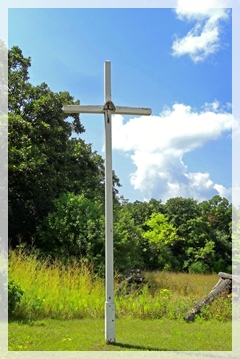
Salvation, however, cannot be earned nor is it for sale. That’s good news for me since I know my sins far outweigh my good works and there’s no way I could do enough to purchase my salvation. Moreover, we can’t stock up good turns, kindness, benevolence, generosity, and service to pay for future sins. Thinking our worth comes from our works undervalues God’s gift of grace because good works aren’t what save us from spiritual bankruptcy! Salvation comes from Jesus alone! He paid our sin debt in full with his blood when He died on the cross.

When my son told me about the mishap at the Millers, he insisted he wasn’t the one who hit the ball that broke their window. Claiming his innocence, he protested paying someone else’s debt. It may not have been fair but it was necessary. Someone had to pay the Millers for their busted window and no one else came forward.

As the sinless Lamb of God, Jesus was far more innocent of any wrongdoing than my son. Nevertheless, He paid both my debt and yours! The only one who was absolutely free of sin deliberately chose to take the full weight of God’s justice for sins He didn’t commit! Jesus paid a debt He didn’t owe because mankind owed a debt that couldn’t be paid! It wasn’t fair, but it was necessary.

The Gospel is good news of mercy to the undeserving. The symbol of the religion of Jesus is the cross, not the scales. [John Stott]

For the wages of sin is death, but the free gift of God is eternal life through Christ Jesus our Lord. [Romans 6:23 (NLT)]

He himself is the sacrifice that atones for our sins—and not only our sins but the sins of all the world. [1 John 2:2 (NLT)]

He personally carried our sins in his body on the cross so that we can be dead to sin and live for what is right. By his wounds you are healed. [1 Peter 2 (NLT)]

Copyright ©2024 jsjdevotions. All rights reserved.

ONCE AND FOR ALL – YOM KIPPUR

He will lay both of his hands on the goat’s head and confess over it all the wickedness, rebellion, and sins of the people of Israel. In this way, he will transfer the people’s sins to the head of the goat. Then a man specially chosen for the task will drive the goat into the wilderness. As the goat goes into the wilderness, it will carry all the people’s sins upon itself into a desolate land. [Leviticus 16:21-22 (NLT)]

While the year is 2024 on most calendars, it is year 5785 on the Hebrew calendar and the tenth day of Tishri begins at sunset tomorrow. For our Jewish brothers and sisters, it will be the Day of Atonement or Yom Kippur. With its themes of atonement and repentance, it the holiest day of the year for a Jew.

The book of Leviticus describes the rituals the Israelites were to perform on this holy day every year. In ancient Israel, this was the only time the high priest could come into the Holy of Holies (the innermost sacred area of the tabernacle or temple) where the Ark of the Covenant was housed. But, before coming into the presence of God and the Ark and beginning the ritual of atonement, he had to ritually cleanse himself from sin by bathing and dressing in spotless plain linen garments. The high priest then atoned for his own sins and those of his family with the sacrifice of a bull.

Two unblemished male goats were taken from the community and lots were cast to determine which goat would be given to the Lord. The first goat was sacrificed and its blood sprinkled on the mercy seat of the Ark. This was the sin offering and made to appease the wrath of God and atone for the sins of the people. Then, having received forgiveness, the second goat was brought before the altar. As a way of transferring the sins of the people to the goat, the priest laid his hands on its head and confessed all the peoples’ sins and transgressions. This goat, the “scapegoat,” was then sent out into the wilderness to carry those sins into the wasteland. In this ancient ritual, the blood of the first goat provided propitiation by appeasing God’s wrath and the second goat provided expiation by atoning for and removing those sins. This atonement ritual was to be repeated year after year.

Without a temple in Jerusalem, there no longer are animal sacrifices or scapegoats. Nevertheless, Jews throughout the world continue to observe this holy day. When a fast day occurs on the Sabbath, it is postponed until Sunday but Yom Kippur is the exception to that rule. Referred to as the Shabbat Shabbaton (the Sabbath of Sabbaths), our observant Jewish friends will fast from all food and drink (including water) from just before sunset Friday until after sunset Saturday. Along with fasting, many Jews will abstain from wearing leather footwear, washing or bathing, applying lotions and creams, or having marital relations. Most of Yom Kippur is spent in the synagogue in intensive prayer, introspection, and the asking of God’s forgiveness for the past year’s sins. The day ends with a single blast of the shofar (ram’s horn trumpet) followed by the proclamation, “Next year in Jerusalem.”

Unlike the yearly sacrifice of goats, the sacrifice of Jesus upon the cross needed to be done only once. Christ was both our sinless high priest and the unblemished sacrifice. When He gave himself up for us, Jesus took God’s wrath upon himself as His blood dripped on the ground beneath Him. When He suffered and died on the cross, Jesus was both the propitiation and expiation of our sins for all time. By dying, this sinless man took on God’s wrath—the wrath we sinners deserved. Rather than take our transgressions into the wilderness, He “removed our sins as far from us as the east is from the west” for all time. [Psalm 103:12] Thank you Jesus!

If you are ready to partake of grace you have not to atone for your sins—you have merely to accept of the atonement. All that you want to do is to cry, “God have mercy upon me,” and you will receive the blessing. [D.L. Moody]

We are made right with God by placing our faith in Jesus Christ. And this is true for everyone who believes, no matter who we are. For everyone has sinned; we all fall short of God’s glorious standard. Yet God, in his grace, freely makes us right in his sight. He did this through Christ Jesus when he freed us from the penalty for our sins. [Romans 3:22-24 (NLT)]

Copyright ©2024 jsjdevotions. All rights reserved.

IMITATION

Be imitators of me, as I am of Christ. [1 Corinthians 11:1 (ESV)]

mockingbirdHearing the bird’s shrill harsh scream, I looked up expecting to see a blue jay. To my surprise, it was a mockingbird. Of all the beautiful songs it can imitate, I wondered why the mockingbird chose the strident call of the jay. Then, remembering how many blue jays inhabit our neighborhood, I realized their raucous “jaaaaay” is what the mockingbird frequently hears so that has become part of his song.

It’s not just mocking birds and parrots who mimic what they hear and see. Years ago, a retired friend told me about spending Christmas with his son’s young family in Minnesota. By December 26, he grew tired of hearing the three youngsters squabble over their new toys and this grandpa decided to enjoy some peace and quiet while shoveling the snow. When his young grandson insisted on helping, he gave the youngster a small child-sized shovel but the boy complained that he wanted the big one. Telling him it would be too heavy, Grandpa refused and started shoveling. When the child kept whining about using the big shovel, my friend used a few ill-chosen words before letting the boy give it a try. Of course, once he started with it, the child cried that it was too heavy. “$@#!&)%!” said Grandpa, “I told you so!” There were a few more profanities when the boy grew bored and started to toss snowballs. Eventually, however, the shoveling was finished. While taking off their coats in the house, the youngster proudly announced to his parents, “We just shoveled the whole $@#!&)% driveway!” You can’t blame him for the bad language; like the mockingbird, he was imitating what he’d heard!

Children never have been very good at listening to and obeying their elders but they are experts at imitating us. It’s been said that we should live in such a way that we wouldn’t be ashamed to sell our parrot to the town gossip (or have our youngsters answer questions like those asked by Art Linkletter in his 1960s show Kids Say the Darndest Things.)

Children mimic more than our words; they model our behavior, as well. For years, the kids and I watched my husband give two hard shakes to the handle after locking the front door to his business. Although he’d turn toward the car, before taking a step, he’d turn back around and give that door handle at least one more hard shake—just to make sure it was good and locked. When we returned north last May, I chuckled as I watched my son do the identical thing after locking the front door of the same business! Both our words and behavior get recycled to the next generation.

Children will imitate both the positive and negative aspects of our behavior. They can learn to be polite, considerate, positive, helpful, truthful, and modest or they can learn to be rude, selfish, negative, uncooperative, deceitful, and arrogant. Do we model the right kind of behavior—not just for youngsters but also everyone we encounter? As Christ’s followers, we should—regardless of how provoked, aggravated, or tired we may be.

My father-in-law, whose given name was Paul, was called “Bill” for most of his 96 years. When asked why, he explained that everyone called him “Bill” because he walked just like a man named Bill. Whose walk do we imitate? To be worthy of the name of “Christian,” we should be imitators of Christ and walk and speak as would He. Do we?

Whoever says he abides in him ought to walk in the same way in which he walked. [1 John 2:6 (ESV)]

Therefore be imitators of God, as beloved children. And walk in love, as Christ loved us and gave himself up for us, a fragrant offering and sacrifice to God.[Ephesians 5:1-2 (ESV)]

Copyright ©2024 jsjdevotions. All rights reserved.