
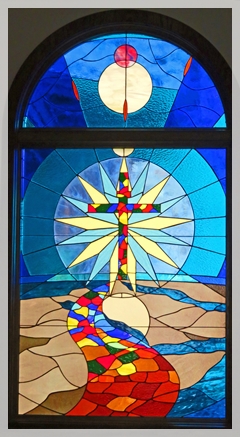
That Sunday evening the disciples were meeting behind locked doors because they were afraid of the Jewish leaders. Suddenly, Jesus was standing there among them! “Peace be with you,” he said. As he spoke, he showed them the wounds in his hands and his side. They were filled with joy when they saw the Lord! [John 20:19-20 (NLT)]
 We’re selling our northern home and, as I packed up assorted family heirlooms, I came across the little sterling silver salt and pepper shakers we used for so many years. I held one in my hand a bit longer than the others; it had distinct teeth marks on it. For reasons that are unknown, my eldest child tried to bite through it. In spite of its obvious imperfection (or, perhaps because of it), the shaker is still beautiful. I’d wondered which child should get these silver pieces but, after remembering their history, I lovingly wrapped them up and placed them in my son’s box. I only hope his family will find the impressions of his baby teeth as beautiful as do I.
As I sorted through other family silver, I came to the sterling candle holders that were a wedding gift to my parents some 82 years ago. Like the salt and pepper set, they show their age with a few dents and scratches. My parent’s marriage, like the candle holders, wasn’t perfect but it endured through every circumstance. I decided to keep the candle sticks with our things as a reminder both to forgive and appreciate the beauty in imperfection.
I thought of Jesus’s scars as I packed up the dented silver. Our resurrected Lord carried the scars from his wounds. Yet, since He could pass through a locked door, He easily could have removed those wounds in his hands and side. Jesus’s scars let the disciples know who He was and our scars are an essential part of our identity, as well.
Like Jesus, we all bear scars, both inside and out. Like my silver, we have dings and dents and are a little (or a whole lot) tarnished. Just as the imperfections on my old silver tell a story, so do our scars. The scar from a C-section tells of blessings received while the scar from a hysterectomy tells of the loss of possibilities. The scars from a burn tell the story of injury and pain while the scars from open heart surgery tell of getting a new lease on life. Some scars, like those left from a divorce, a loved one’s death, or addiction, are invisible but tell their own tale, as well. Scars, dings and dents are simply evidence of things that didn’t defeat us; they are our beautiful trophies of survival and healing. Death did not conquer Jesus and, though God’s grace, life’s challenges cannot conquer us.
My scars remind me that I did indeed survive my deepest wounds. That in itself is an accomplishment. And they bring to mind something else, too. They remind me that the damage life has inflicted on me has, in many places, left me stronger and more resilient. What hurt me in the past has actually made me better equipped to face the present. [Steve Goodier]
 Two days ago, when writing about the prodigal son, I used a scripture verse from Sirach found in the Revised Standard Version Catholic Edition (RSVCE). Also known as Ecclesiasticus, this book of wisdom was written by Jesus, son of Eleazar, son of Sirach, between 200–175 BC and is part of the Apocrypha. Primarily written in the 400 years between Malachi and the announcement of the birth of John the Baptist, the books of the Apocrypha include Sirach, 1 and 2 Esdras, Tobit, Judith, Wisdom of Solomon, Baruch, the Letter of Jeremiah, Prayer of Manasseh, 1 and 2 Maccabees, and additions to the books of Esther and Daniel. While the nation of Israel was familiar with these writings and treated them with respect (which is why I used the verse), they never considered any of them as true books of the Hebrew Bible.
 When the boy we know as “the prodigal son” comes to his senses and returns home, Jesus never says he was repentant; He says the boy was hungry! Moreover, while he knows he’s not worthy to be treated as a son, the boy doesn’t ask to be taken on as a slave; he boldly plans on asking to be hired as a paid servant. Those hearing the story probably were sure the boy was about to be properly punished but Jesus defied convention again. When the father sees his returning son, he runs to him with abandon. Again, cultural norms were flouted. Because running required a man to lift his garment and expose his bare legs, it was considered improper and undignified for a grown man to run. Perhaps Jesus’s listeners excused the man’s unseemly behavior because they thought he was in a rush to rebuke his boy. Expecting him to perform a kezazah ceremony (a shunning ritual in which he’d break a pot and yell that his son was cut off from his people forever), the father breaks all of society’s rules and embraces his boy.
 Through His parables, Jesus related profound spiritual truths in stories that were easily understood and relevant to his listeners. Although Jesus’s original audience often didn’t like His message, they clearly knew what He was saying. Because of the vast cultural differences between our world and 1st century Palestine, I’m not sure we fully appreciate the impact His parables had on the people who first heard them.
 Which can you do without? The right side of your heart or the left? Which blade on the scissors wouldn’t be missed? What is more important? The front wheel or the back one on your bicycle? The gas pedal or the brakes on your car? The right wing or the left of an airplane? Faith or works? Neither! None of these things can operate without the other. We need two blades on the scissors, two wings on the plane and we can’t be Christians without both faith and works.
 While speaking of salvation, our pastor suggested that there are four kinds of people we might find in any church. While sure of their salvation, the people in the first group are not secure in it. It’s not that they’ve lost their salvation; they never had it! Often called nominal or cultural Christians, their faith is in religion rather than Jesus and they mistake sitting in a church pew for having a relationship with God. Thinking they can purchase their ticket on the glory train with money or works, Christianity is an insurance policy for the hereafter rather than anything affecting heart or soul. They don’t understand that looking like a Christ follower, even with impressive God talk and charitable acts, isn’t the same as being one. There is a vast difference between true faith and false professions.
 Devotions of the Heart