THE SINNER’S PRAYER

And Peter said to them, “Repent and be baptized every one of you in the name of Jesus Christ for the forgiveness of your sins, and you will receive the gift of the Holy Spirit.” [Acts 2:38 (ESV)]

purple prairie cloverIn a book about evangelism, the author wrote of bringing a new believer into his office and the two of them saying the “Sinner’s Prayer.” After the new believer repeated the Pastor’s words, he was pronounced saved. While there is no official version of this “sinner’s” prayer, it probably goes something like this: “God, I know that I am a sinner and that I deserve to go to hell. I believe that Jesus Christ died on the cross for my sins. I do now receive Jesus Christ as my personal Lord and Savior. Thank you, Lord, for saving me and forgiving me! Amen.” Many evangelical Christians speak of saying some sort of prayer like this at the moment of conversion. Is a special “Sinner’s Prayer” a requirement for salvation?

If would seem that, if a special prayer were required, we would find it in the Bible. While we find lots of prayers, there doesn’t appear to be a special prayer prerequisite for salvation. Jesus told the sinful woman who kissed and anointed his feet that her faith had saved her, He told the woman with the bleeding disorder that her faith made her well, and He told the blind men that their faith gave them sight. While on the cross, the Lord promised the repentant thief that he’d join the Him in paradise that day. Although they all knew they were sinners, none of them recited a special “sinner’s” prayer!

When the 3,000 were converted at Pentecost, we don’t read of a mass recitation of a specific prayer. Instead, Peter told the people to repent of their sins, turn to God, and be baptized in the name of Jesus for the forgiveness of sins. After hearing the gospel from Philip, the Ethiopian eunuch was baptized and, after speaking with Ananias, Saul regained his sight and was baptized. While Peter preached the gospel to the Roman centurion Cornelius and his Gentile friends, the Holy Spirit descended upon them and they all were baptized. In none of those cases is there mention of a special prayer before conversion, asking for salvation, or taking Jesus as a “personal Lord and Savior.” The people believed, repented, and were baptized. If a special prayer is required for Christ’s salvation, I’m pretty sure it would have been included in Scripture and it isn’t.

Nevertheless, it is Biblical to repentantly pray and ask for forgiveness; what’s not Biblical is to say salvation comes because of a prayer. Salvation comes by God’s grace through faith. We are justified by faith, not by works, and certainly not by words. Even so, there’s nothing inherently wrong with praying some sort of sinner’s prayer at conversion—unless, of course, the person praying isn’t called by the Holy Spirit and genuinely repentant. When empty of faith, that prayer is meaningless and gives the person praying it a false (and dangerous) sense of security. Merely saying a version of the Sinner’s Prayer isn’t like purchasing an insurance policy guaranteeing salvation and eternal life. Even repeating dozens of prayers can’t save us. We’re not saved by the words of a prayer but by the genuine repentance and faith behind the prayer. As Christians, we don’t put our trust in words but in the body and blood of Jesus Christ.

In actuality, since we’re all sinners, every prayer we say is a sinner’s prayer. Nevertheless, our faith, hope, and assurance should not be in the prayers we say but rather in the God who hears those prayers.

For by grace you have been saved through faith. And this is not your own doing; it is the gift of God. [Ephesians 2:8 (ESV)]

Though you have not seen him, you love him. Though you do not now see him, you believe in him and rejoice with joy that is inexpressible and filled with glory, obtaining the outcome of your faith, the salvation of your souls. [1 Peter 1:8-10 (ESV)]

Copyright ©2025 jsjdevotions. All rights reserved.

THE FIRST HYMN

…be filled with the Spirit, addressing one another in psalms and hymns and spiritual songs, singing and making melody to the Lord with your heart, giving thanks always and for everything to God the Father in the name of our Lord Jesus Christ…. [Ephesians 5:18-20 (ESV)]

About midnight Paul and Silas were praying and singing hymns to God, and the prisoners were listening to them, [Acts 16:25 (ESV)]

In the ruins of Oxyrhynchus, Egypt, a scrap of parchment known as P.Oxy. 1786 was discovered in 1918. Only 11-inches long and 2-inches wide, it consists of four lines of text along with musical notations on the back of a grain contract. Found in an ancient garbage dump, it was just one of 500,000 parchments dating from the 1st century BC to the 7th AD. Along with grocery lists, official records, and business contracts, the rubbish heap yielded a play by Sophocles, poetry by Sappho, portions of the Old Testament, fragments of both Matthew’s and Mark’s gospels, and an arrest warrant for a Christian.

While scholars call it P.Oxy. 1786, after hearing the version adapted by Chris Tomlin and Ben Fielding, you probably will know it as “The First Hymn.” Indeed, in a way, it is! Granted, the song sung by Miriam after crossing the Red Sea predates Christ by 1,400 years, the Hebrew Psalms were sung at Temple worship, and Biblical scholars believe passages like Colossians 1:15-20 and 1 Timothy 3:16 were hymns sung by early Christians. Nevertheless, none of those psalms or hymns include musical notations as does P.Oxy. 1786. To date, this scrap of parchment dating from around 260 AD is the oldest piece of Christian music in existence.

Although musicologists and historians have known about P.Oxy. 1786 for over a century, it remained in a sort of academic “no man’s land,” until historian John Dickson took an interest in it. Hoping to bring this obscure little hymn back to life, he reached out to musicians Ben Fielding and Christ Tomlin. The result is a new worship song, “The First Hymn.” Bringing the words of this ancient hymn back to life as a contemporary worship song seems almost sacrilegious until we understand the original music. Musicologists say the hymn used the same melodic structure  used in taverns and on the stage at pagan theaters at the time. Musically, it was a 3rd century version of a Broadway, pop, or contemporary worship song! While the resurrected version doesn’t sound like the original, it has remained true to its purpose—a Christian worship song in the musical style of the day!

This hymn was sung at a time when the Church was confronted both by the pagan gods of the Roman Empire and various heresies regarding the divinity of Jesus and the Trinity. Yet, in its 35 words, it is a bold declaration of Christian faith. Combatting heresies of the day, it clarifies both the divinity of Jesus and the three separate but equal persons of the one triune God. It also makes a not too subtle dig at the Roman god Zeus. While pagans referred to him as the “giver of good gifts,” this hymn calls God the “only giver of all good gifts.” Moreover, by calling the heavens to be silent and the rivers to be still, the hymn showed the power of the one true God!

The 3rd century was a dangerous time for followers of Christ. In 201, Rome made conversion to Christianity a capital offense and, by mid-century, every citizen was required to make a sacrifice to the gods or face death. Found in that same ancient rubbish dump was a formal certificate proving that one local citizen had offered pagan sacrifice in public. Christians who refused were martyred in gruesome ways; if they weren’t crucified or beheaded, they may have been tossed into cauldrons of boiling oil or cast into an arena to be devoured by lions. Nevertheless, this hymn speaks of a God who gives good gifts—not suffering and persecution! This defiant hymn resounds with joy with its words, “Might, praise, and glory forever to our God. The only giver of all good gifts.”

The singing of hymns has a long history in the Christian church. Psalms, a book of songs, is the longest book in the Bible and Scripture makes over four hundred references to singing and fifty direct commands to sing. The last thing Jesus and the disciples did in the upper room His last night was sing a hymn. While in prison, Paul and Silas prayed and sang hymns to God which led to their jailer’s conversion! We find instructions to sing in Psalms, Ephesians, Colossians, and James. In the early second century, the Roman governor Pliny the Younger described the worship practices of Christians who “were in the habit of meeting on a certain fixed day before it was light, when they sang in alternate verses a hymn to Christ, as to a god.” Let us continue to sing the song of the redeemed as boldly as did the persecuted Christians of the early Church. Amen and amen.

Let all be silent: The shining stars not sound forth,
All rushing rivers stilled, As we sing our hymn
To the Father, Son, and Holy Spirit,
As all Powers cry out in answer, “Amen, amen.”
Might, praise, and glory forever to our God.
The only giver of all good gifts. Amen. Amen.
[P.Oxy. 1786 (The First Hymn)]

Let the word of Christ dwell in you richly, teaching and admonishing one another in all wisdom, singing psalms and hymns and spiritual songs, with thankfulness in your hearts to God. [Colossians 3:16 (ESV)]

Copyright ©2025 jsjdevotions. All rights reserved.

THE GOOD SHEPHERD

Truly, truly, I say to you, he who does not enter the sheepfold by the door but climbs in by another way, that man is a thief and a robber. But he who enters by the door is the shepherd of the sheep. To him the gatekeeper opens. The sheep hear his voice, and he calls his own sheep by name and leads them out. [John 10:1-3 ESV)]

Heather Kaufman’s novel Up From Dust  is historical fiction. Based on what Scripture tells us about Martha of Bethany, her sister Mary, and their brother Lazarus, it gives the reader a fictionalized version of their backstories. Kaufman’s extensive research for the novel allowed her to paint a vivid and accurate picture of 1st century life in Judea. Even though the story is a figment of her imagination, it reminded me that the people who spent time with the Lord while He walked on earth were real (and flawed) people like us—each with their own personal history. Ordinary people with parents, friends and, for some, spouses and children, they had jobs, responsibilities, secrets, regrets, and weaknesses. Like us, they were people who worried, disagreed, cried, laughed, loved, rejoiced, and mourned. The only thing that made them different from their neighbors was their love for a man called Jesus!

Kaufman’s novel presents the very real possibility that some of Jesus’ followers may have encountered adversity or intimidation while the Lord was alive. Scripture describes the hostility of the religious leaders toward Jesus (and to Lazarus after being raised from the dead), but I hadn’t paused to consider whether that hostility carried over to others who followed the Lord. Her story reminded me that when Jesus told His followers to bear their own cross and count the cost before following Him [Luke 14:27-28], some may have paid heavily to follow the Lord while He still walked the earth. In the face of opposition and threats, I couldn’t help but wonder how faithful a follower of the rabbi from Nazareth I would have been before the crucifixion and resurrection.

Being a 21st century city dweller, I know little about shepherds or shepherding but one of Kaufman’s fictional characters was Uri, a shepherd. His death gave me greater understanding of Jesus’ references to shepherds, the sheepfold, and the good shepherd who lays down his life for his sheep. During the summer heat, shepherds would move away from the villages and take their flocks to higher ground. With the hills of Judea filled with predators like bears, leopards, wolves, jackals, and hyenas, the flock’s sole protection against death was their shepherd. Armed only with his slingshot and rod, shepherds were all that kept the sheep from death and, sometimes, they died protecting their flock.

While up in the hills, the shepherd would lead his sheep into a natural cave or safe spot carved into the hillside at night. With no gate at the opening, the shepherd acted as the gate and would sleep at the entrance. No sheep could leave and no predator or thief could enter the sheepfold without his knowing.

When the fictional Uri fails to return to Bethany with his flock, another shepherd discovers his mutilated body (as well as the remains of several wolves) outside of the cave he used as a sheepfold. The sheep, however, are found safe inside the cave. Apparently, when a pack of wolves threatened the flock, Uri erected a high barricade of branches covering the mouth of the cave. To prevent the wolves from pushing in the barrier, he built the wall from outside the cave—which left the shepherd out with the wolves! While many shepherds might have abandoned their sheep in the face of such an attack, Uri did not. Like a good shepherd, he chose to give up his life to protect his flock. The man suffered a violent death so his sheep would not! Kaufman’s vivid description helps me consider Jesus’ words about the good shepherd with a 1st century mindset.

Picturing the violent and grisly way Uri died helped me further appreciate the horror of Jesus’ torturous death. The fictional shepherd had nothing to gain and everything to lose when he chose to save his flock by sacrificing his life—the same goes for the Good Shepherd who gave up His life to save us, not from wolves, but from sin. Thank you, Jesus, for being our good shepherd and laying down your life for us!

I am the good shepherd. The good shepherd lays down his life for the sheep. He who is a hired hand and not a shepherd, who does not own the sheep, sees the wolf coming and leaves the sheep and flees, and the wolf snatches them and scatters them. He flees because he is a hired hand and cares nothing for the sheep. I am the good shepherd. I know my own and my own know me, just as the Father knows me and I know the Father; and I lay down my life for the sheep. [John 10:11-15 (ESV)]

Copyright ©2025 jsjdevotions. All rights reserved.

40 DAYS LATER – THE ASCENSION

He was taken up as they were watching, and a cloud took him out of their sight. While he was going, they were gazing into heaven, and suddenly two men in white clothes stood by them. They said, “Men of Galilee, why do you stand looking up into heaven? This same Jesus, who has been taken from you into heaven, will come in the same way that you have seen him going into heaven.” [Acts 1:9-11 (CSB)]

transfigurationThe Resurrection story didn’t end on Easter with Jesus’ appearance to ten disciples, Mary Magdalene, Mary the mother of James and John, Salome, and Joanna, along with Cleopas and another believer who broke bread with Him in Emmaus. Appearing and disappearing at will, Jesus remained on earth for forty days. While He probably appeared other times, Scripture tells us He later appeared to Thomas and the ten others, to seven of the disciples beside the Sea of Galilee, to His half-brother James, to over 500 believers at one time, and to the disciples on his last day with them.

The resurrected Jesus had a body—a body with scars from the crucifixion; one that could walk, talk, eat, touch, and be touched. His body, however, was not like the bodies of Jairus’ daughter, the widow of Nain’s son, or Lazarus. Their resuscitated bodies returned to the earthly bodies they had before death and were subject to weakness, aging, disease, death, and decay. But, when Jesus rose from the grave, He didn’t take back His old vulnerable human body—He took on a transformed and invulnerable body. Although physical, His resurrected body was supernatural, imperishable, and immortal. Sharing the power of God, it never would meet death again.

Although the disciples kept asking Jesus if the time had come for Him to restore the kingdom to Israel, He explained that the timing was not theirs to know. After promising them the power of the Holy Spirit and commissioning them to carry His message into the world, Jesus’ physical time on earth came to an end. On the 40th day after Easter, He disappeared into a cloud and was taken to Heaven. For the disciples who’d been fixated on the restoration of Israel, Jesus’ disappearance was an unexpected event. It’s no wonder they stood gape-mouthed staring into the sky until two angels appeared and promised that He would return in the same way He departed.

Today, some people find it hard to reconcile Jesus’ ascension in Heaven with what we know about the universe and space travel. Did He travel at the speed of light and escape the confines of our universe without benefit of a space suit? Ascending into Heaven, however, does not imply traveling through space to a location far from our world. Just because Heaven is beyond the reach of rockets and telescopes doesn’t mean it is far away or doesn’t exist!

As the abode of a holy and perfect God, Heaven is real and solid and probably closer than we think. A very different kind of world, it is not a geographical or astronomical location within our material universe. Existing in another dimension or on another plane, Heaven is the place where God and the risen Christ dwell. However, even without its navigational coordinates, we can get there because Jesus told us how—He is the way!

On the 40th day after Easter, the disciples watched as Jesus transcended time and space to His rightful place seated at the right hand of God. The angels’ words to the disciples told them the story wasn’t over—Jesus’ incarnation, crucifixion, resurrection, and ascension were just the beginning. The story will come to fruition when Jesus reappears and puts everything right. Until that day comes, let us do as did the disciples—go out and share the Gospel message everywhere.

So the Lord Jesus, after speaking to them, was taken up into heaven and sat down at the right hand of God. And they went out and preached everywhere, while the Lord worked with them and confirmed the word by the accompanying signs. [Mark 16:19-20 (CSB)]

And while he was blessing them, he left them and was carried up into heaven. After worshiping him, they returned to Jerusalem with great joy. And they were continually in the temple praising God. [Luke 24:51-53 (CSB)]

Copyright ©2025 jsjdevotions. All rights reserved.

OUR ROCK AND SALVATION

What sorrow awaits those who look to Egypt for help, trusting their horses, chariots, and charioteers and depending on the strength of human armies instead of looking to the Lord, the Holy One of Israel. [Isaiah 31:1 (NLT)]

Look! Don’t be deceived by appearances – men and things are not what they seem. All who are not on the rock are in the sea! [William Booth]

Built by her husband’s grandfather in the 1920s, my friend’s house was filled with much of the original furniture. Many pieces (like the restored grand piano) were valuable antiques but decades of use had taken their toll on others. Although the beautiful little mahogany side chair looked solid, a note saying “Broken—do not use” rested on it. Pretty as it was, the chair was useless and an invitation to disaster. Should the warning go unnoticed, some unknowing person could end up sprawled on the floor surrounded by splintered wood.
Some people depend on things as fragile as that broken chair—things like wealth, career, appearance, possessions, power, contacts, or fame. While at first glance, they may look solid and dependable, such things can’t be trusted and, like that chair, can shatter and collapse when most needed. Our circumstances can change in an instant and what we depended on yesterday may not be there tomorrow.

The Hebrew Scriptures are filled with stories showing the danger of putting our faith in the wrong things. Rather than relying on the truth of God’s word, Adam and Eve depended on Satan’s lies; after eating the forbidden fruit, they were evicted from Eden. Abraham and Sarah depended on their plan instead of God’s promise to give them a son. Sadly, the Middle East continues to suffer from their foolishness. Having placed faith in his own wisdom, riches, and power rather than the Lord, Solomon’s kingdom was divided after his death.

When Israel’s King Hoshea formed an alliance with Egypt instead of trusting God, he ended up imprisoned, his people in exile, and Samaria in ruins. When Judah trusted Assyria instead of God, they ended up paying tribute to them for 35 years. Slow learners, when they finally rebelled, rather than trusting in God, they appealed to Egypt for military aid. Today’s verse is Isaiah’s warning that Pharaoh was weak and undependable. In the end, it was God, not Egypt, who came to Judah’s rescue. Both the kingdoms of Israel and Judah suffered for their dependence on idols, other nations, and themselves rather than God; we will, too.

Putting our confidence in the weakness of man and the fragility of things rather than the power of God is like trusting a rickety antique chair; as attractive as it appears, it will collapse eventually and we’ll be left to pick up the shattered pieces. As for me, I’d rather depend on a God who is strong, steadfast, and indestructible than on anything or anyone else! Ours is a rock-solid God who won’t fail us, no matter how much weight we place on Him.

On whom or what do you rely? Is it reliable…as reliable as God?

When we dare to depend entirely upon God and do not doubt, the humblest and feeblest agencies will become mighty through God, to the pulling down of strongholds. [A.B. Simpson]

The best-equipped army cannot save a king, nor is great strength enough to save a warrior. Don’t count on your warhorse to give you victory—for all its strength, it cannot save you. [Psalm 33:16-17 (NLT)]

I wait quietly before God, for my victory comes from him. He alone is my rock and my salvation, my fortress where I will never be shaken. [Psalm 62:1-2 (NLT)]

 Copyright ©2025 jsjdevotions. All rights reserved.

BROKEN PROMISES

For we must all appear before the judgment seat of Christ, so that each one may receive what is due for what he has done in the body, whether good or evil. Therefore, knowing the fear of the Lord, we persuade others. But what we are is known to God, and I hope it is known also to your conscience. [2 Corinthians 5:10-11 (ESV)]

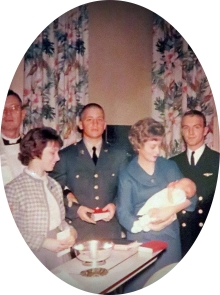
Earlier this week, I wrote about my nephew Johnny’s baptism in my mother’s hospital room. Because she was at death’s door, my brother took emergency leave and he and I served as the baby’s sponsors in Baptism (or Godparents).

As Johnny’s Godmother, I made three promises for him during the service: that he would “renounce the devil and all his works…believe all of the Articles of the Christian Faith and…keep God’s holy will and commandments.” In a perfect world, Johnny would have made those same promises again at his confirmation when he was old enough to personally know Jesus. But the world isn’t perfect; he never came to know Jesus and make those vows for himself.

As his Baptismal sponsor, I promised to make sure Johnny learned the Creed, the Lord’s Prayer, the Ten Commandments, and “all the other things which a Christian ought to know and believe to his soul’s health.” Sometimes promises are easier said than done and I did not keep my vows any better than did my nephew the promises made on his behalf. I can make all sorts of excuses for my failure—I only was 15 when I made those vows, at least 1,500 miles always separated us, and I saw him less than ten times in his 60 years. Nevertheless, I did not try to keep those promises and I will answer to God for my failure.

When I stand at God’s judgment seat, my sins will not be an issue; they already have been forgiven and my ticket to heaven is secure. But I will be asked to give an accounting for what I have done (and failed to do) since becoming a believer. While I kept my nephew in my prayers, I squandered my opportunity, small as it was, to share God’s love and the good news of the Gospel with him. I can’t say that anything I could have done would have made a difference in his troubled life but I should have tried. That weighs heavy on my heart—not because I may miss out on some heavenly reward, but because I missed an opportunity to be a disciple of Christ.

When believers stand before God, we will be judged. Since each of us have been uniquely created and gifted, my evaluation will not be the same as yours; nevertheless, each one of us will give an accounting of ourselves. What did we do with the spiritual light we had, what did we do with the opportunities given to us, and what did we do with the time, talents, and property God entrusted to us?

My nephew is one of the reasons I served our church’s children’s ministry and support both recovery ministries and programs serving the homeless and mentally ill. I suspect I continue writing these devotions as a way of atoning for not keeping the promises to God I made at my mother’s bedside 63 years ago. Older, wiser, and having more light, opportunity, time, and ability, more is expected of me now. While I no longer pray for my nephew, I continue to pray for God’s protection, grace, and mercy on others like him. As for those of us who are Christ followers, I pray that we will make good use of all that God has given us and that through our words and deeds we will live and teach the Creeds, the Lord’s Prayer, the Ten Commandments, and “all the other things which a Christian ought to know and believe to his soul’s health.”

Having gifts that differ according to the grace given to us, let us use them. [Romans 12:6 (ESV)]

Everyone to whom much was given, of him much will be required, and from him to whom they entrusted much, they will demand the more. [Luke 12:48b (ESV)]

Copyright ©2025 jsjdevotions. All rights reserved.