
“I’ve said these things to you,” Jesus went on, “to stop you from being tripped up. They will put you out of the synagogues. In fact, the time is coming when anyone who kills you will suppose that they are in that way offering worship to God. They will do these things because they haven’t known the father, or me. But I have been talking to you about these things so that, when their time comes, you will remember that I told you about them.” [John 16:1-4 (NLT)]
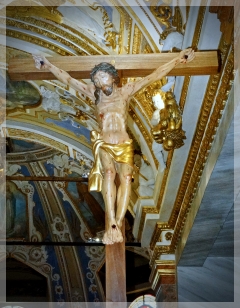 In any cathedral or art museum, we’ll find many pictures of Jesus and even rather graphic depictions of Him on the cross. None of them, however, tell us anything about His appearance because they were created long after His time. Still, in a world where we seem to memorialize everything with pictures, you’d think one of Jesus’ followers would have sketched Him while blessing the children, giving the Sermon on the Mount, or feeding the multitude! 1st century rabbis in Judah, however, vehemently objected to the depiction of human figures because the second commandment prohibited making a “graven image.” With its Jewish roots, this prohibition carried into the early church and inhibited early Christian art.
At first, Jesus was represented indirectly by symbols such as the peacock, lamb, dove, and anchor. One of the most common was the ichthus (fish) because the Greek word served as an acronym “Jesus Christ, Son of God, Savior.” While making the sign of the cross dated from sometime in the second century, because of its connection with the horrific death of criminals, the cross did not became a symbol of Christianity until the 4th century; crucifixes and other depictions of the crucifixion did not occur until the 6th.
One earlier depiction of Jesus’ crucifixion, however, does exist. Crudely scratched into a stone wall, it was discovered in 1857 during an excavation of the Paedagogiumon (a school for the training of slaves) on Rome’s Palatine Hill. Dating from around 200 AD, it shows a man (or boy) worshiping a figure on a cross; the figure, however, has the head of an ass. The inscription reads, “Alexamenos worships his God.” This derisive graffiti gives us an idea of the way early Christians were ridiculed for worshiping a man who had been executed as a criminal.
Along with claims of onolatry (donkey worship), the early Christians had to deal with several other disparaging, malicious, and false accusations such as incest, cannibalism, and drinking the blood of infants. Roman orator Marcus Cornelius Fronto (c. 100-160) wrote that Christians were “initiated by the slaughter and the blood of an infant” and that Christianity was “foolish” because, “they worship a crucified man, and even the instrument itself of his punishment” and “are said to worship the head of an ass.”
This was the world—a world that misunderstood, slandered, ridiculed, hated and persecuted them—of the early Christians. And yet, they proceeded in faith and spread the gospel. I wonder how the 21st century church would do in similar circumstances! As for Alexamenos, the fellow mocked by that ancient graffiti—more graffiti was found on a wall in an adjacent room. In Latin it said, “Alexamenos is faithful.” In the face of opposition, we must be the same!
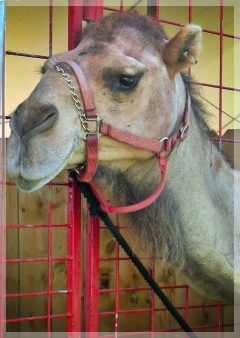 After the rich young ruler departed, Jesus compared the difficulty of a rich man entering heaven to a camel trying to squeeze through the eye of a needle. Because of its impossibility, people find this metaphor troubling. To rationalize it, some scholars speculate that a narrow gate called “The Needle” was located in the wall surrounding Jerusalem. Supposedly used after dark when the main gates were closed, it was so small that a camel had to be unburdened of rider and cargo before getting down on its knees to pass through the gate. They interpret the metaphor as meaning that people must leave behind their baggage, repent, and humble themselves to get through the gate to God’s kingdom. While that’s correct and their explanation makes an excellent Sunday school lesson, no historical or archeological evidence exists that such a gate existed.


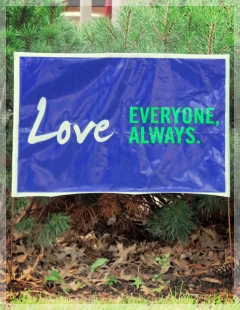 Decades ago, I found an interesting article in a parenting magazine having to do with negative and positive commands. Because our brains tend to best process the end of a sentence rather than its beginning, when a mother says, “Don’t tease your sister,” the child tends to hear “Tease your sister!” Moreover, telling children not to do something requires them to double process. First, they have to figure out what it is they’re not supposed to do and then they have to figure out what it is they’re supposed to do instead! While there are an infinite number of alternatives to not doing something, there is only one alternative when told what to do! Since vague instructions like “Behave!” leave a lot of gray area, a clear course of action should be given.
 Devotions of the Heart