
Though you have not seen him, you love him; though not seeing him now, you believe in him, and you rejoice with inexpressible and glorious joy, because you are receiving the goal of your faith, the salvation of your souls. [1 Peter 1:8-9 (CSB)]
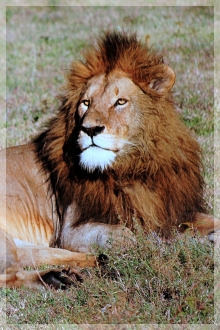
Although C.S. Lewis never intended the seven books in The Chronicles of Narnia series to be allegories, they are filled with Christian imagery and allusions. Having enjoyed reading (and re-reading) the Narnia books, I was pleased when the Pastor opened his sermon on “The Supremacy of Jesus” by quoting from it. In Prince Caspian, after a year’s absence from Narnia, Lucy encounters Aslan the lion (the Christ-like figure in the series) and says, “Aslan, you’re bigger.” The lion replies, “That is because you are older, little one.” When she asks, “Not because you are?” the lion assures her, “I am not.” He then explains, “But every year you grow, you will find me bigger.”
Only a year had passed in Lucy’s world since she last saw Aslan, but 1,300 years had passed in Narnia. Even so, in all that time, Aslan hadn’t gotten larger. As Hebrews 13:8 reminds us, “Jesus Christ is the same yesterday, today, and forever.” Indeed, God is unchangeable in His being, character, will, attributes, power, and promises.
Lucy’s misperception of Aslan’s size is not because she’s another year older or two inches taller. While we tend to think of growing as getting older or larger, growing in the spiritual sense is different. It’s a little like seeing people from a distance. From afar, they seem small but, as we grow closer to them, they seem to enlarge. Once face-to-face, we finally perceive how large they really are! Spiritual growth is coming closer to God so that we perceive how big He is and how small we are. Growth in our spiritual life doesn’t mean there is more of us; if anything, there is less of us and more of God! While God is immutable, our relationship with Him is not.
As we grow and mature spiritually, like Lucy, our perception of God will change proportionally. The more we move toward Him, the larger He becomes! We will come to see both our spiritual brokenness and the greatness of God’s mercy, our sinfulness and His immeasurable holiness, our weakness and His infinite power, our poverty and His limitless grace, our emptiness and His abundant love. As we accept our inadequacy and hopelessness, our small perspective of God changes and we begin to grasp the full extent of God’s wisdom, glory, power, and majesty. Indeed, our God is a big God!
Aslan played a prominent role in the first Narnia book so all four of the children know he exists. Nevertheless, upon their return to Narnia, they don’t see him. But, that doesn’t mean he wasn’t there. Lucy is the only one who finally sees him, perhaps because, unlike her siblings, she was the only one who believed Aslan would help them. For the other three children, Aslan remains invisible until, one by one, like Lucy, they start having faith in him. It’s been said that “seeing is believing.” In this case, it is the believing that allowed for the seeing! I expect that, as their faith increased, like Lucy, each sibling said, “Aslan, you’re bigger!”
And, so it is with Jesus. We must believe in Him to see Him and the more we trust Him, the bigger He gets!
 It’s often said, “Like father, like son,” and that was true of my father-in-law and his sons. Although they weren’t carbon copies of their dad, the boys shared several characteristics with the man who fathered them. In the same way, because God created us in His image, we share some of His characteristics. Of course, there are many important ways we are not like our Creator—He is all-knowing, eternal, all-powerful, and ever-present. Without a physical body, we don’t have things like God’s nose, hair color, or smile. Nevertheless, we do resemble Him in the spiritual, moral, and intellectual attributes of our nature that distinguish us from the rest of the animal world.
 “I’m so busy!” If there’s even a remote possibility that we might be asked to do something we’d rather avoid, we can cut off the request at the pass by starting the conversation with those words. It’s the perfect out. On the other hand, when said to us, we can’t argue with it.
 Just as we must not become stumbling blocks to others on their faith journey, we must be cautious of the stumbling blocks we encounter on ours. The Greek word usually translated as “stumbling block” was skandalon. It originally referred to the stick that served as the trigger for a snare trap but, eventually, scandalon developed two meanings. It was both a snare or trap that catches unsuspecting prey as well as something that trips a person and causes them to stumble and fall—in other words, a stumbling block. In both cases, the purpose of the scandalon is to catch its victim unaware!
 Having witnessed Jesus’ God-like power over nature when He walked on water, the disciples recognized Him as “the Son of God!” [Mat 14:32] Recognizing Jesus’ divinity, however, did not mean they understood He was the Messiah. While Jesus’ power to heal, multiply food, still storms, and walk on water implied a godlike nature, most 1st century Jews didn’t expect the Messiah to be divine. Expecting a righteous judge and a great political and military leader coming from the lineage of David, they assumed he would be a human being. So, when Jesus asked His disciples who people thought He was, they said John the Baptist, Elijah, Jeremiah, or another one of the prophets—godly men who performed miracles, spoke of judgment, and called the people to return to covenant faithfulness.
 Like his cousin Jesus, John’s impending birth was announced by the angel Gabriel, it took God’s intervention to take place, and his name and calling were determined before he was conceived. The angel Gabriel told Zechariah that, “in the spirit and power of Elijah,” John was “to make ready for the Lord a people prepared.” When John was circumcised, Zechariah prophesied that John would “go before the Lord to prepare his ways, to give knowledge of salvation to his people in the forgiveness of their sins.”
 Devotions of the Heart