WAITING IN FAITH – NEON SIGNS

Many plans are in the human heart, but the advice of the Lord will endure. [Proverbs 19:21 (GW)]

A person may plan his own journey, but the Lord directs his steps. [Proverbs 16:9 (GW)]

8-13-15lisa framed-1web (2)
Choices—we all have to make them. In some cases, the correct choice is easy to discern: heaven or hell, life or death, sin or salvation, adultery or faithfulness. Other choices, like American or Provolone, mustard or mayo, whole wheat or rye are unimportant and easy to make. Most decisions, however, fall somewhere in between these extremes: how to finance the house, where to worship, who to hire, what job to take, or which medical treatment to pursue. Wanting to make the best choice, we research options, consult our Bibles, pray, and wait in faith for God to tell us what to do. In spite of all that, there are still times when we can’t discern God’s will. That’s when I ask Him for a neon sign to show me His way.

When my daughter, a dancer, was selecting her college, we couldn’t determine God’s plan and fervently prayed for His guidance. Accepted by several universities, she’d visited them all. While each was good, none seemed quite right. Then the Juilliard School, after seeing her dance, sent her a letter of acceptance without her even making application. This was one option we hadn’t even considered but, since she’d been accepted, we visited New York City to see it first-hand. Once there, our daughter toured the school, spoke with teachers and attended dance classes. Although she was pleased with Juilliard’s dance program, we were hesitant about it being the best choice; this clearly wasn’t the college experience we originally had in mind. “Dear God,” I prayed, “If you’ve shown us your plan, we’ve missed the message. You need to give us a neon sign. What should she do?”

That evening, while walking along Broadway, we passed by the theatre presenting “Cats.” On the spur of the moment, we purchased tickets. Once seated, my husband looked to his left and greeted two young men. By the brightly-colored propeller-topped beanies perched on their heads, it was clear they were tourists. While chatting with them, he learned they were professional dancers visiting from Amsterdam. When asked why they were in New York, they excitedly replied, “New York is the center of the dance world. Anyone who wants to be a dancer has to spend time here!” My daughter and I looked at each other and started to laugh. We’d asked God for a neon sign, but never expected it to be two Dutch dancers with propellers on their heads! That fall, she started at Juilliard.

Did she make the right choice? Was this God’s plan? I think my daughter and I would agree it was. God guided us in a unique and delightfully whimsical manner. Now, some twenty-five years later, whenever we’re facing a dilemma and haven’t been able to discern God’s will, we remember those young men. Along with asking God for a neon sign to guide us, we’ve been known to be on the lookout for a couple of fellows sporting beanies. You never know who God’s messengers might be—He speaks in strange and marvelous ways!

Sometimes God’s ways are mysterious. Sometimes He reveals them bit by bit over long periods of time. Then sometimes they’re just plain bizarre, but immediately clear — picture-perfect. [Cindy McCormick Martinusen]


The Lord says, “I will instruct you. I will teach you the way that you should go. I will advise you as my eyes watch over you. [Psalm 32:8 (GW)]

NO AMNESTY

Have mercy on me, O God, because of your unfailing love. Because of your great compassion, blot out the stain of my sins. Wash me clean from my guilt. Purify me from my sin. For I recognize my rebellion; it haunts me day and night. Against you, and you alone, have I sinned; I have done what is evil in your sight. [Psalm 51:1-4 (NLT)]

8-6-15DSC05651web
Tonight, we’ll experience what’s called a “blue moon,” a somewhat rare occurrence of two full moons in the same month. A few years ago the Chicago Public Library had what they called the “Once in a Blue Moon Amnesty” program. For three weeks, any late fees were waived on all overdue material, no matter how late it was. Apparently, many people prefer keeping their books, magazines and DVDs rather than paying steep fines as a consequence for their late return. The amnesty was offered in hope of getting more than two million dollars’ worth of media back on the shelves. It had been twenty years since the city ran a similar program of reprieve. Avoiding the consequences of our actions, like the Chicago Public Library’s amnesty offer, usually only happens “once in a blue moon!”

David was famous: he was a musician and shepherd, a giant killer and celebrated warrior, a great king and the author of most of the psalms. Nevertheless, he was human and David, like the rest of us, fell into sin. Adultery with Bathsheba was just one of them; he also murdered Bathsheba’s husband Uriah by sending him to his certain death. When David finally confessed his transgressions, the prophet Nathan assured him that they were forgiven. Nathan added that God’s forgiveness didn’t mean David wouldn’t suffer the consequences of his sins: his child by Bathsheba, conceived while she was still married to Uriah, would die. David’s confession and apology to God were not enough to eliminate the consequences of his actions; there was no amnesty for him.

Hopefully, when we wrong others, we confess, apologize and try to make amends. Nevertheless, our confession, someone’s forgiveness, and even restitution won’t free us from consequences. We may still lose respect, a job, a friend or even a marriage. Our actions may lead to a punishment as simple as a traffic ticket or as serious as time in prison. A child may be put in “time out,” a teenager might be grounded and a college student could be put on academic probation. We may receive a poor performance review, not be allowed to participate in an activity, be expelled from school or find a relationship irrevocably destroyed. We could lose money, status or even our family. If we choose to sin, we must be prepared for the consequences of that sin. Amnesty is rarely an option.

We ask God to forgive our sins and he does. We must never forget, however, that God’s promise of forgiveness is not like a “Get Out of Jail Free” card in the game of Monopoly. Neither God’s forgiveness nor the forgiveness of those we’ve wronged will exonerate us from the consequences of our actions in this game of life.

The people of Samaria must bear the consequences of their guilt because they rebelled against their God. [Hosea 13:16a (NLT)]

But they encouraged my people to worship idols, causing Israel to fall into deep sin. So I have taken a solemn oath that they must bear the consequences for their sins, says the Sovereign Lord. [Ezekiel 4:12 (NLT)]

And because you have forgotten me and turned your back on me, this is what the Sovereign Lord says: You must bear the consequences of all your lewdness and prostitution. [Ezekiel 23:35 (NLT)]

SHIFTING THE BLAME

“I don’t deserve to be called your son anymore. Make me one of your hired men.” … Then his son said to him, “Father, I’ve sinned against heaven and you. I don’t deserve to be called your son anymore.” [Luke 15:19,21 (GW)]

The man answered, “That woman, the one you gave me, gave me some fruit from the tree, and I ate it.” [Genesis 3:12 (GW)]

DSC01629awebAfter brazenly demanding his inheritance while his father still lived, the prodigal son quickly wasted it all in a reckless and immoral lifestyle. Realizing the error of his ways, the ashamed and penniless youth swallowed his pride and returned to his father, hoping to be hired on as a servant. His story, one of repentance, forgiveness and redemption, is quite a contrast to that of a young woman whose tale is circulating on the Internet. She recently called into a radio show and told of getting a $90,000 college fund from her grandparents. In three years, however, she managed to blow through all of it—not just on tuition but also on clothing, college breaks and a trip to Europe. Now, having no way to pay her $20,000 senior year’s tuition, she called the show to complain—not about her recklessness and spendthrift ways but about her parents. Although any fifth grader knows enough to divide ninety by four and figure out how much money can be spent each year, she blamed her parents for not teaching her to budget; it was their fault she was broke. The young woman showed no remorse for her actions and refused to accept responsibility for her predicament. The prodigal son worked at a pig farm before returning home and was willing to work as his father’s servant. This young woman’s response to getting a job in the school cafeteria was, “That’s embarrassing.”

I wonder, however, if we’re really all that different from this young woman. Hopefully, we haven’t squandered $90,000 but we’ve all blamed others for our errors, difficulties, and even our sins. It wasn’t just Eve that Adam blamed for the apple incident; he blamed God for giving him the woman in the first place. We’re not much better. In an effort to excuse our actions, we shift the blame to our parents’ divorce, our ex-spouse’s greed, bad genes, the credit card company that shouldn’t have increased our credit, the loan officer who allowed us to refinance, the persuasive salesman, our idiot co-workers, the teacher who can’t teach, the woman who shouldn’t have been so seductive, the husband who shouldn’t have been so busy, the spouse who just didn’t understand, a troubled childhood, the bartender who over-served, and the other guy who made us angry or started the fight! We shift the blame to justify our own bad behavior and, if we show any remorse, it’s only because of the mess in which we find ourselves once we have to face the consequences.

With a repentant heart, the prodigal son took responsibility for his actions and was welcomed into his father’s house. Make no mistake about it, if we don’t accept responsibility for our actions with a humble and repentant heart, our story, unlike that of the prodigal son, will not be one of forgiveness and redemption.

When someone is tempted, he shouldn’t say that God is tempting him. God can’t be tempted by evil, and God doesn’t tempt anyone. Everyone is tempted by his own desires as they lure him away and trap him. Then desire becomes pregnant and gives birth to sin. When sin grows up, it gives birth to death. [James 1:13-15 (GW)]

If we say, “We aren’t sinful” we are deceiving ourselves, and the truth is not in us. God is faithful and reliable. If we confess our sins, he forgives them and cleanses us from everything we’ve done wrong. [1 John 1:8-9 (GW)]

ANOTHER KIND OF SPARK

We can make a large horse go wherever we want by means of a small bit in its mouth. And a small rudder makes a huge ship turn wherever the pilot chooses to go, even though the winds are strong. In the same way, the tongue is a small thing that makes grand speeches. But a tiny spark can set a great forest on fire. And the tongue is a flame of fire. It is a whole world of wickedness, corrupting the entire body. It can set your whole life on fire, for it is set on fire by hell itself. [James 3:3-6 (NLT)]

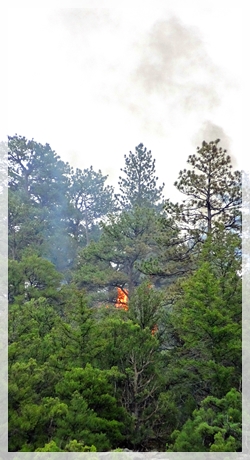
5-16-15DSC09069awebIndeed, the tongue can be a “small thing that makes grand speeches.” Anyone who ever heard Martin Luther King’s “I Have a Dream” speech, John F. Kennedy’s words, “Ask not what your country can do for you…”, or Billy Graham preach knows that tongues can inspire and teach, praise and bless, comfort and pray. Speech, while extremely powerful, can also be incredibly dangerous.

James compares the tongue to a “flame of fire.” Have you even seen television coverage of a forest fire? It’s frightening how one camper’s poorly dowsed fire or a careless hiker’s cigarette can wreak such devastation. Once the fire gets started, it’s nearly impossible to control and its damage can’t be undone. If the wind picks up, the destruction can be enormous. Last year flames came within a few blocks of my son’s house and the barren hillside following the fire was a constant reminder of how close they came to losing their home.

Our words can be as dangerous as a spark in a dry forest. They cannot be taken back once spoken and the damage can be horrendous. Bragging, gossip, exaggeration, flattery, lying, disparagement, and manipulation with our words are all examples of an untamed tongue. Before speaking, we should ask ourselves, “Is it true? Is it kind? Is it necessary?” If in doubt, we should say nothing. Just as a strong wind will fan the fire’s flames, anger can turn a few imprudent words into a raging inferno. Homes and lives can truly be destroyed by the heat of angry words.

Yesterday’s message included Kurt Kaiser’s words “It only takes a spark to get a fire going” in reference to love. It’s important to remember that it only takes a spark from an untamed tongue to get another kind of fire going!

How much more grievous are the consequences of anger than the causes of it. [Marcus Aurelius]

Those who control their tongue will have a long life; opening your mouth can ruin everything. [Proverbs 13:3 (NLT)]

A gentle answer deflects anger, but harsh words make tempers flare. [Proverbs 15:1 (NLT)]

LOCKED DOORS – WHEN HE SAYS “NO”

Who shut the doors to keep the sea in when it broke through and was born, when I made the clouds like a coat for the sea and wrapped it in dark clouds, when I put limits on the sea and put its doors and bars in place, when I said to the sea, “You may come this far, but no farther; this is where your proud waves must stop”? [Job 38:8-11 (NCV)]

7-14-15_5330webWhen the youngest grandchildren visited us in Florida, we were putty in their hands. But, being loving grandparents, we wanted to keep them safe and that meant saying “No!” at times. Among our precautions, the doors to the lanai remained shut and locked to keep the tykes from venturing into the pool without an adult. That’s not to say they didn’t try their level best to thwart our deterrents at every opportunity. They pled with us, made promises they couldn’t keep (“We won’t go near the water”) or resorted to tears. When that didn’t work, they tried to open the doors themselves. We love them too much not to keep them safe and know that certain situations (like toddlers and pools without supervision) require locked doors and firm denials. The little guys, however, simply thought we were being mean keeping them from having their way.

We are God’s children and, like my youngest grands, we often don’t have much common sense when it comes to what we desire. We pray and plead, wheedle and whine for something. When God doesn’t grant our prayers, we often console ourselves by saying that He isn’t denying us; He’s only delaying His affirmative answer. We just need to pray more and try harder to make it happen. Sometimes, however, God’s denials are just that—denials. He may even shut and lock doors to keep us from trying to take matters into our own hands. Just like toddlers, there are times we need doors closed and locks secured for our own protection.

When I look back at some of the things for which I’ve prayed, I can only say “Thank you, God, for blocking my way!” It is only in retrospect, however, that I appreciate God’s denials of my prayers and the ways He deterred me. I clearly had no idea what I was asking for in my prayers, but He did and, in His heavenly wisdom, kept me from making some enormous mistakes simply by obstructing my path. Thank you, God, for loving me enough to say “No!”

After we have made our requests known to Him, our language should be, “Thy will be done.” I would a thousand times rather that Gods’ will should be done than my own. [D. L. Moody]

I say this because I know what I am planning for you,” says the Lord. “I have good plans for you, not plans to hurt you. I will give you hope and a good future. Then you will call my name. You will come to me and pray to me, and I will listen to you. [Jeremiahs 2:11-12 (NCV)]

WEEDS

He [Jesus] answered, “The one who plants the good seeds is the Son of Man. The field is the world. The good seeds are those who belong to the kingdom. The weeds are those who belong to the evil one. The enemy who planted them is the devil.” [Matthew 13: 37-39 (NLT)]

7-1-15thistle (Canadian)-LGenWI572-cropwebI love thistles—when I’m taking their pictures in the woods. I discovered I don’t much care for them when they’re in my garden. But, there they were, along with dandelions, knotweed, clover, sorrel, mint, chives, prickly lettuce and other unidentified weeds in what used to be my rose garden. Months of neglect had taken its toll on our plant beds and only a few pink rose petals were even visible in the tangled mess. At one time, this had been a well-established and properly tended garden, but our more than nine month absence for two years in a row allowed the weeds to prevail.

My husband and I were faced with a dilemma similar to the one God faced with Sodom: in ours, far too many weeds and in His, far too many sinners. Because Abraham pled with God, the righteous Lot and his family were saved from destruction but the rest of the sinful city was destroyed. In the case of our garden, however, the two remaining stunted rose bushes had no one to plead for them and were pulled up along with the weeds. Unlike God, we swept away the innocent with the guilty! After thoroughly removing every plant, we started fresh, only this time with zebra grass that, hopefully, will better survive our neglectful gardening.

As we worked, I thought of Jesus’ parables about the farmers who sowed their seeds. One farmer planted seeds on different kinds of ground. The seeds sown on the quality soil produced a good harvest and represented those who heard and understood God’s word—people of faith. In another parable, Jesus told of a farmer who had planted good seeds in quality soil only to learn that his field had weeds. The weeds, planted by the enemy, were scheduled for future destruction. Looking at my garden, I knew it wasn’t Satan, but rather neglect, that had caused my weeds. It suffered from lack of attention; there had been no cultivating, watering, pruning, fertilizer, or weed pulling.

We can have a firmly established faith but, like our garden, faith can’t be ignored or neglected; it must be nurtured. Without cultivating our faith with church and fellowship, watering it with His word, pruning it with prayer, fertilizing it with service, and vigorous weed pulling with confession and repentance, our faith can’t thrive. The enemy will be able to take over and destroy the garden of our lives. Without consistent care, our faith won’t flourish; it will be weak or die like my roses.

As for me, now that I’m done with the house garden, I plan on doing some serious work in the garden of my faith. I don’t want to give the enemy a foothold and end up being swept away with the wicked or burnt with the weeds. How about you? Do you have any gardening that needs to be done?

The Lord remained with Abraham. Abraham approached him and said, “Will you sweep away both the righteous and the wicked? [Genesis 18:22b-23 (NLT)]

When the ground soaks up the falling rain and bears a good crop for the farmer, it has God’s blessing. But if a field bears thorns and thistles, it is useless. The farmer will soon condemn that field and burn it. [Hebrews 6:7-8 (NLT)]