
Woe to you, scribes and Pharisees, hypocrites! You clean the outside of the cup and dish, but inside they are full of greed and self-indulgence. Blind Pharisee! First clean the inside of the cup, so that the outside of it may also become clean. [Matthew 23:25-26 (CSB)]
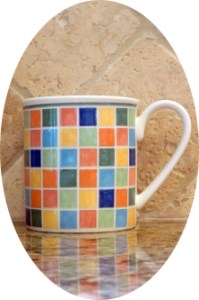 When I put my mug under the hot water tap, I saw the stain. Fresh out of the dishwasher, the mug was clean on the outside but had a dark tea stain inside. As I applied some elbow grease and Bon Ami, I thought of Jesus’ criticism of the Pharisees. Like my mug, their exterior looked spotless but their interior was soiled. Unlike my tea-stained mug, however, it would take more than scouring powder to correct their problem. Rather than stained by tea tannins, the Pharisees were tainted by a host of sins starting with hypocrisy and moving right through to pride, judgment, self-righteousness, and more.
More interested in their external righteousness than God’s holiness, the Pharisees developed ways of appearing godly without being godly. Conspicuous in their strict adherence to both the oral and written law, they made a show of their piety. With their focus on external purity and cleanliness, like my mug, they looked good on the outside. But, as we know, looks can be deceiving! Appearing to be godly isn’t the same as having God in our hearts!
While scouring the mug, I wondered if I, like the Pharisees of old, had some internal stains that needed removing. Is there a disconnect between my head and heart—a discrepancy between my external behavior and my internal thoughts and motives? Am I seeking to glorify God with my words and actions or am I pursuing the approval and admiration of people? Could I be I more interested in looking good than being and doing good?
For that matter, am I ever easily offended or overly critical of others in small matters? Do I nitpick about things of no consequence, assume the worst about other people, or pass judgment on them? Have I been known to profess knowledge of God’s law without practicing obedience to it? Do I ever justify my behavior while condemning the same thing in others or think of myself as more devout or virtuous than someone else? Are there times I boast of my accomplishments or diminish those of others? Like the Pharisees, could I be spiritually blind when it comes to my faults but the possessor of 20/20 vision when it comes to the faults of others?
Guilty as charged; my head and heart are not always on the same page. I’m as stained on the inside as were the Pharisees. Clearly, the Spirit and I have some work to do that has nothing to do with scouring powder!
Just because we’re not ancient Pharisees who enlarged the phylacteries on their arms, lengthened the tassels on their robes, and stopped in the middle of the road to make a show of bowing low during their prayers doesn’t mean we’re not like them. The weeks of Lent are a good time to take a hard look at the inside of our cups (not the ones we use for coffee and tea) and do some serious scrubbing! For the Pharisees of yesterday and today, godliness, like beauty, is only skin deep. True godliness, however, should go through and through into our innermost being.
Sometimes we emulate the Pharisees more than we imitate Christ. [R.C. Sproul]
A Pharisee is hard on others and easy on himself, but a spiritual man is easy on others and hard on himself. [A.W. Tozer]
 We tend to think of fasting during Lent as abstaining from certain foods, drinks, or activities. Several years ago, however, I was asked, “What if you fasted regret? What if your friends fasted comparison? What would be the fruit of fasting stinginess?” Those questions proposed an entirely different kind of fast than refraining from sweets or social media. In truth, fasting from things like self-righteousness, discontent, and criticism is probably harder (and more meaningful) than giving up energy drinks or dining out.
 Psalm 119, the longest of the psalms, is a song in praise of the Word of God. Since we don’t read this psalm in its original Hebrew, we fail to appreciate its intricate construction. Each of its twenty-two sections begin with a letter of the Hebrew alphabet in sequence. Each of the eight verses in those twenty-two sections begin with the letter that introduced it. For example, the first word of the first section begins with alef, as do the next seven verses. In the second section, every line begins with beth. The psalm continues that way up to the 22nd (and last) section where every line begins with the final letter of the Hebrew alphabet, tav.
  Most of us breeze through (or skip altogether) the Bible’s genealogies. Nevertheless, when genealogy and all those “begats” seem so important in Scripture, what explanation is there for the difference between the genealogies of Jesus found in Luke and Matthew? Because Jews were meticulous about recording genealogies, it’s inconceivable to have two conflicting yet correct lists of Jesus’ lineage.
 The tradition of New Year’s resolutions goes back over 4,000 years to the ancient Babylonians (whose new year began in mid-March with the spring equinox). During their 12-day celebration called Akitu, they either crowned a new king or reaffirmed their loyalty to the old one. To ensure the gods’ favor, they promised to return borrowed items and pledged the repayment of all their debts.
 Tomorrow, December 6, is the Feast of St. Nicholas (or Sinterklass). Although it is difficult to know fact from fiction, we do know that St. Nicholas was born around 270 AD in Patara, a city in Lycia (modern day Turkey). The son of wealthy and devout parents, it was his uncle, the Bishop of Patara, who took charge of his spiritual life. Nicholas became the Bishop of Myra in Turkey, quite likely attended the council of Nicaea, spent seven years imprisoned under Diocletian Persecution, and died on December 6, around 343 AD. While we don’t know much about the man, he must have had a great impact on the early Christian church because, by 450 AD, churches in Asia Minor and Greece were named in his honor and, by the mid-6th century, the Emperor Justinian dedicated a church to him in Constantinople.
 Devotions of the Heart