Then God said, “Let there be light,” and there was light. … Then the Lord God formed the man from the dust of the ground. He breathed the breath of life into the man’s nostrils, and the man became a living person. [Genesis 1:3. 2:7 (NLT)]
Years ago, The Jerusalem Post published a joke about human arrogance. After considering all of humanity’s scientific progress, a group of scientists decided that God no longer was necessary. The chief scientist explained to God that man’s ability to clone people, manipulate atoms, build molecules, fly through space, create body parts with 3-D printers, and perform other miraculous feats meant God was unneeded and could be replaced by man. After patiently listening to the scientist, God suggested a human-making contest with only one rule: “We have to do it just like I did in the Bible.” Saying that was easy, the arrogant scientist bent over to pick up a handful of dust. “Put that down!” said God, while adding, “To do it my way, you have to make your own dust!”
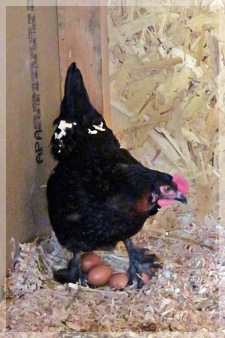
Our vacation home in Idaho came complete with chickens and hen house. Every morning, the littlest grands would trek out to the hen house, check for eggs, and return with the makings of an omelet. I was relieved they never asked the age-old unanswerable question of “Which came first, the chicken or the egg?” We need a chicken (actually two) to have a fertilized egg but we need a fertilized egg to make a chicken. This seemingly futile question has been discussed for thousands of years. The Greek philosopher Aristotle considered it but evaded the answer by saying that both egg and chicken went infinitely backwards and always existed. The oldest fossilized eggs are 190 million years old and the oldest fossilized birds are only 150 million years old so paleontologists might say the egg came first. A strict reading of Genesis, however, would lead us to conclude that the chicken came first because animals appeared on the 5th day of creation. It’s a silly question but people ask it because they want to understand how something can come from nothing.
When making the children’s omelets, we still needed the raw ingredients. Along with the eggs that came from chickens (that came from eggs), we needed butter and cheese from cows, salt from the sea, pepper from the drupe of a pepper plant (Piper nigrum}, and green peppers and onions that came from seeds sown by a farmer, as well as a frying pan, whisk, spatula, and gas stove. Although my seamstress friend creates stunning clothing, she needs the silk from the silkworm (that came from an egg) or the cotton from the cotton bush (that came from a seed) to do so. My wood-working friend creates beautiful furniture but he can’t do it without the wood that comes from an oak tree that comes from an acorn that originally came from the oak! This begs the question, “Which came first, the oak or the acorn?” As the arrogant scientist learned, mankind can’t create something from nothing!
God, however, created everything from nothing. He had no eggs for the chickens, acorns for the oaks, seeds for the apple trees, or pollen for the flowers. He had no hydrogen or oxygen for water and no sodium or chloride to add to the water for the sea! Simply put, God spoke all creation into existence. That’s a rather unsatisfactory answer for those who want a technical explanation but the Bible is a book of theology that tells us the who and not a book of science that tells us how. We’re not about to get any more details as to how chaos turned to order, a void came to be filled, and nothing became something. Whether it was the chicken or its egg that came first will always be a conundrum.