WHAT VALUE A LIFE?

And do not fear those who kill the body but cannot kill the soul. Rather fear him who can destroy both soul and body in hell. Are not two sparrows sold for a penny? And not one of them will fall to the ground apart from your Father. But even the hairs of your head are all numbered. Fear not, therefore; you are of more value than many sparrows. [Matthew 10:28-31 (ESV)]

sparrowAs the economy tanks and COVID-19 spreads, we hear economists and politicians speak of making a cost-benefit analysis to determine the cost of a prolonged shutdown of business and industry with millions out of work versus the cost of hundreds of thousands (or millions) of people dying. How do we put a price tag on life, especially if the life is ours or that of someone we know and love?

By reducing the human body into its basic elements, DataGenetics concluded that the grand total of materials in a typical human body is a meager $160. I suppose that means the larger the body, the more valuable it is. FinanceDegreeCenter found that all our body’s organs (hair, blood, bone marrow, heart, liver, kidneys, etc.) could be worth up to $45 million when sold on the black market. That value, however, would depend on our nationality, health, blood type, age, and the purchaser’s urgency of need. According to the New York Times, the Environmental Protection Agency values a life at $9.5 million, which is their benchmark for determining whether to clean up a toxic waste site.

Does our value change with age? Is a baby’s life more worthy of saving than that of a seventy-year-old? During the George W. Bush administration, the lives of people over 70 were valued at 67% that of younger people when calculating the cost-benefit of regulating soot emissions from power plants. Although AARP’s backlash put an end to that model, could appraising all ages equally devalue the lives of young people? Along with considering the deceased’s age, juries in wrongful death law suits consider things like income, quality of life, and earning potential. Their valuations can range from several hundred thousand dollars to several million.

How can any society assess the trade-off between economic well-being and anyone’s life? What is the value of one person? What is an acceptable number of fatalities? Yet, when we look at the dire economic consequences of a total shut-down, we find economists warning that making people poorer (with the resulting loss of food, shelter, essential services, mental health, medical care, opportunities, and sanitation) also has severe health consequences for the entire nation.

I’m neither economist nor politician and I can’t imagine doing a cost-benefit analysis between lives lost and a tanked economy. I’m thankful that the tough choices they are facing are not mine to make. Let us continue to lift in prayer our nation’s leaders and policy makers so that they will be guided by God’s wisdom in making the difficult decisions necessary in the days ahead. Although we hope that medical research and decisive government action will quickly put an end to this crisis, our ultimate hope lies in God.

As for any person’s value—all I know is that, from conception to death, the life of each and every person is cherished by God. He doesn’t value us by size, health, race, nationality, age, works, sex, income, potential, or even religion. Having formed us and breathed His life into us, God values each one of us as if we were His only child. We are so precious to Him that Jesus suffered and died for us—not for our economy but for our salvation! Every life is worthy of the salvation offered by Jesus—even that of a repentant thief who had but a few hours left to live as he hung on a cross beside Jesus.

Because of God’s enormous love for us, let us face today, tomorrow, and all of the days to follow with faith, hope, and love!

What is your only hope in life and death?
That I am not my own, but belong with body and soul, both in life and in death, to my faithful Saviour Jesus Christ. He has fully paid for all my sins with his precious blood, and has set me free from all the power of the devil. He also preserves me in such a way that without the will of my heavenly Father not a hair can fall from my head; indeed, all things must work together for my salvation. Therefore, by his Holy Spirit he also assures me of eternal life and makes me heartily willing and ready from now on to live for him. [Heidelberg Catechism]

For God so loved the world, that he gave his only Son, that whoever believes in him should not perish but have eternal life. [John 3:16 (ESV)]

Copyright ©2020 jsjdevotions. All rights reserved.

FOR SUCH A TIME AS THIS

Who knows if perhaps you were made queen for just such a time as this?” [Esther 4:14b (NLT)]

balloon over serengettiAlthough the book of Esther never mentions God by name, His fingerprints are found throughout the story as it illustrates God’s providence in human affairs. The Jews were in captivity in Persia and the Persian King had banished the queen. Along with all the other beautiful virgins in the land, the young Jewess Esther is taken to the King’s harem. She finds favor with the king and is declared queen while the evil Haman plots the massacre of every Jew. When Esther’s cousin Mordecai requests her help in begging for the king’s mercy, she hesitates out of fear. Reminding Esther that she isn’t exempt from Haman’s evil plot, Mordecai asks, “Who knows if perhaps you were made queen for just such a time as this?”
I thought of Haman’s question as churches around the world struggle to provide worship and study opportunities during this crisis. By the time our church, Coastal Fellowship Church, was a year old, we’d developed a free App providing more than calendar, prayer requests, devotions and online giving. Through strategic partnerships, it provided preschool video Bible adventures and material from the Bible Project that now includes videos on reading Scripture, the Bible’s books from Genesis through Revelation, wisdom topics, and a word study. More recent offerings include a number of short videos showing where sports and faith connect and two series from Dave Ramsey’s Financial Peace University.

At the time, I’m sure people wondered why a church like ours – brand new, without a building, with minimal financial support, and a small congregation of mostly senior citizens (some of whom still use flip phones) – became so committed to 21st century technology and developing an App. Our pastor felt God’s call to do an App and, as he led, the congregation, without clearly understanding its importance, followed in obedience to God’s urging. If anyone wondered why we did it, the last few weeks gave us the answer. Rephrasing Mordecai’s words, “Who knows if the App was developed for just such a time as this!”

We didn’t know over a year ago that online resources and platforms would be essential to serving the Church during this global pandemic. Distanced geographically, we remain connected by faith. We are a global church serving a global God and the App allows us to do just that!

The technical expertise acquired while creating the App enabled us to stream services within a few days’ time and develop a permanent platform for services and Bible study by the second week. Because the App received 30 awards for everything from logo to video and animation, it’s had international exposure; available on several platforms, there have been 40,000 downloads from all over the world. The strategic partnerships that started with the App led to more partnerships, including one with N. T. Wright, and expanded our offerings to better serve the global community. Our first Sunday service was viewed by people throughout the world with 2,182 viewings in the first week! What’s really important is that 88% of those viewers watched the entire service! (I’m not sure 88% of a congregation stays awake during a live sermon!)

As mortals, we don’t know God’s long range plans; even if we did, we wouldn’t understand them. Joseph didn’t understand why he ended up a slave in Egypt until he saved his entire family from famine. Moses didn’t know why he was raised by Pharaoh’s daughter until God spoke to him from a burning bush. David didn’t know why he kept doing target practice with his sling until he came face to face with Goliath. Esther didn’t understand why she became queen until she saved an entire nation and I never knew that sending a daily Bible verse to a few women would morph into a daily devotional. Even though we don’t see God’s vision, like Abraham, we follow His lead. Once we get wherever God has taken us, we’ll know why we’re there. God will tell us, “For just such a time as this!”

It was by faith that Abraham obeyed when God called him to leave home and go to another land that God would give him as his inheritance. He went without knowing where he was going. [Hebrews 11:18 (NLT)]

“My thoughts are nothing like your thoughts,” says the Lord. “And my ways are far beyond anything you could imagine. For just as the heavens are higher than the earth, so my ways are higher than your ways and my thoughts higher than your thoughts.” [Isaiah 55:8-9 (NLT)]

Copyright ©2020 jsjdevotions. All rights reserved.

PICTURING HIM

My soul thirsts for God, for the living God. When may I come to see God’s face? [Psalm 42:2 (GW)]

But you can’t see my face, because no one may see me and live. [Exodus 33:20 (GW)]

“He’s not at all what I expected!” I said after seeing a well-known radio personality in person. Nowhere near as attractive, suave and elegant as he’d sounded on the air, he was much better in my mind’s eye. Older, heavier, less stylish and bald, I was disappointed. The imagined was so much better than the reality.

Do you ever try to visualize God? Would he look like George Burns, the kindly white-haired old man in the movie Oh, God? whose first words to John Denver’s character were, “Eh, not what you expected?” He certainly wasn’t! Maybe God would sound and look more like Morgan Freeman in Bruce Almighty and appear in an elegant white suit. Perhaps He’d be more like David Strathairn in Interview with God, who, in true rabbinic fashion, answered questions with questions of his own during three interviews. In The Shack, God was portrayed by Octavia Spencer, a heavy-set soft-spoken African-American woman who went by the name of “Papa.” Of course, none of these characterizations come anywhere close to personifying God.

Nevertheless, even though we know God is spirit and without a physical body, we continue trying to visualize Him. Even the most creative mind is incapable of clearly picturing a God, unrestrained by time or space, who can be everywhere at all times: a God who sees, hears and knows all, not just in the present, but in the past and future as well. Our limited imaginations can’t come close to comprehending such an unlimited being who always has been, is now, and forevermore will be. The enormity and power of God is incomprehensible. I’m overwhelmed even thinking about it. That, however, is what I think God wants: for us to be awed and overcome by His amazing presence.

Even though God walked on earth for thirty-three years, we have no physical description of Him and Scripture used few adjectives. While John, Peter and James saw Jesus’ face shine like the sun and His clothes become white during the Transfiguration, they had but a glimpse of His great God glory! Since Judas had to point out Jesus to the soldiers in the garden, when living as a man, Jesus must have looked quite similar to every other Jewish Galilean.

Fortunately, while we may not know exactly what God looks like, we can know Him. Scripture tells us what He was like and, even though we can’t see Him, we know He is there. Moreover, when we eventually do come face to face with our Heavenly Father, we won’t be disappointed (as I was with that radio personality). It’s a guarantee; the reality will be far better than anything we possibly could imagine.

The throne of God and the lamb will be in the city. His servants will worship him and see his face. His name will be on their foreheads. There will be no more night, and they will not need any light from lamps or the sun because the Lord God will shine on them. They will rule as kings forever and ever. [Revelation 22:3b-5 (GW)]

Copyright ©2020 jsjdevotions. All rights reserved.

A NEW NORMAL

My dear family, when you find yourselves tumbling into various trials and tribulations, learn to look at it with complete joy, because you know that, when your faith is put to the test, what comes out is patience. What’s more, you must let patience have its complete effect, so that you may be complete and whole, not falling short in anything. [James 1:2-4 (NTE)]

hoary comma anglewing butterflyBy the end of the phone call, tears were rolling down my cheeks; yet another loved one is seriously ill. Given my age and that of my friends, I shouldn’t be surprised; we are nearing our expiration dates so receiving news of someone’s illness or death is becoming my new normal.
As I added this new name to my lengthy prayer list, I considered the new normal for those on it: chemo, radiation, weekly blood work, reconstructive surgery, chronic pain, widowhood, Parkinson’s, financial troubles, Alzheimer’s, the challenges of staying sober, and the demands of 24/7 care giving. Their normal certainly isn’t one they would have chosen deliberately.

Then I thought about the new normal to which all of us are adjusting because of COVID-19: social distancing, elbow bumps and toe taps, streaming church services, travel restrictions, hand sanitizers and bleach wipes, phone calls and emails instead of meeting over coffee, broken supply chains, cancellations, working from home, lay-offs, school closings and on-line classes, along with hoarding, shortages, and price gouging! None of us are immune to COVID-19 and many of the people I know and love will be touched by it. Things will get worse before they get better and there will be more tears before this ends.

COVID-19 has disrupted all of our lives and, while we have little control over the virus, we do have control over navigating our new normal. The eight bottles of tequila in one woman’s cart told me how she’s planning on doing it! Three women in Australia got into a brawl over a cart of toilet paper while, in Italy, a man’s inadvertent brush against another erupted into a fist fight that ended only when the police and an ambulance arrived. Don’t let that be us! While we can’t discount the threat, our new normal must not be one of anger, violence, alcohol, fear, complaint, drugs, denial, depression, paranoia, panic, or anxiety.

Let us remember that we have a God who loves us. Life isn’t perfect, but it hasn’t been perfect since Eden! Nevertheless, life is doable, not on our strength, but through God’s power. Coronavirus (like pain, disappointment and loss) is just another one of those unwelcome gifts that come with life in a fallen world. Like Job, we will never know the “Why” of it but, as Christ followers, we know in whose hands we rest.

Jesus told us trouble was inevitable; no one gets a free pass. Nevertheless, a pastor friend often says, “It’s all good.” In itself, COVID-19 isn’t good any more than are cancer or the death of a child. Nevertheless, it’s “all good” because God, in His infinite wisdom and love, will bring good out of it. We may not see it, we don’t always like it, and rarely do we understand it, but it is all for good. While we may have tears, R.C. Sproul reminds us, “For believers, there are no tragedies!”

Because of Christ, we have victory over sin and Satan; Romans 8:28 assures us that we also have victory over our circumstances. Let us stand on God’s promises and boldly navigate the next several weeks while praising, thanking, praying, walking in faith, and bringing light into the darkness (while frequently washing our hands)! Let the joy of the Lord be our strength in this new normal.

We know, in fact, that God works all things together for good to those who love him, who are called according to his purpose. [Romans 8:28 (NTE)]

For this reason we don’t lose heart. Even if our outer humanity is decaying, our inner humanity is being renewed day by day. This slight momentary trouble of ours is working to produce a weight of glory, passing and surpassing everything, lasting for ever; for we don’t look at the things that can be seen, but at the things that can’t be seen. After all, the things you can see are here today and gone tomorrow; but the things you can’t see are everlasting. [2 Corinthians 4:16-18 (NTE)]

Copyright ©2020 jsjdevotions. All rights reserved.

COWBOY OR SHEPHERD?

The Lord is my shepherd; I have all that I need. [Psalm 23:1 (NLT)]

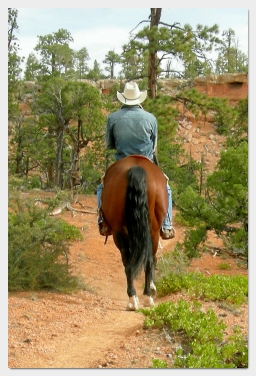
cowboy - Losee Canyon - BryceIn A Gentle Thunder, author Max Lucado compares the hero of the Bible, the shepherd, with the hero of the American west, the cowboy. They both herd livestock, their home is the range, and they sleep under the stars. The difference, says Lucado, is that the shepherd knows and loves his sheep because he leads them to be shorn. The cowboy, however, doesn’t get attached to his cattle because he’s leading them to slaughter! While several cowboys drive a herd of cattle and know one another’s names, just one shepherd leads a flock of sheep and it is their names that he knows!

Lucado’s comparison got me thinking about the cowboy heroes of my youth: Marshalls Matt Dillon and Wyatt Earp, widower Lucas McCain (the Rifleman), gunfighter-for-hire Paladin, and the Lone Ranger with his trusty sidekick Tonto. They were larger than life heroes. Along with being excellent shots, they lived by a strict moral code, fought for law and order, and only used their fists or weapons in the cause of justice. I seriously doubt those cowboys bore much resemblance to the real thing.

The masked Lone Ranger stands out in my memory. He and Tonto rode through the West, doing good deeds and fighting evil. The stories were formulaic and, when the townspeople were in dire straits, our heroes would save the day. With the “William Tell Overture” playing in the background, they would ride into town, guns blazing, and rescue the good citizens from the forces of evil. Then without waiting for thanks, they’d ride off into the sunset with Rossini’s music in the background. We’d hear the Lone Ranger call, “Hi-yo, Silver” and someone would ask, “Who was that masked man?”

We no longer face the challenges of frontier life: desperadoes, stagecoach robberies, cattle rustling, hijacked stage coaches, gunfights, claim jumping, or evil land barons. Nevertheless, we need to be rescued from more realistic problems: fear, worry, poor choices, illness, anger, broken marriages, estranged families, doubt, indebtedness, addiction, disabilities, loss, and the challenges of care giving. Sadly, no cowboy in a white hat is going to ride to our rescue and the solution won’t occur in a thirty-minute time slot. Nevertheless, sometimes we seem to think Jesus will do just that (only without the silver bullets and white hat).

Fortunately, as Lucado points out in his book, we don’t have a cowboy; we have a shepherd. Unlike the Lone Ranger, He doesn’t travel around until He comes upon someone in trouble and, unlike Paladin, we don’t have to hire Him. Moreover, He never rides off into the sunset after helping us. Like a good shepherd, Jesus is always with each and every one of us. Being the sheep of His pasture, however, doesn’t mean we won’t encounter predators, pests, harsh environment, storms, or sickness. We’ll occasionally stumble, wander off, or be tempted by poisonous weeds. Having a shepherd means that we’re never alone in those trials. We don’t need to wait for a hero to save the day because our savior is in the day with us! The few times the Lone Ranger was caught, he never was unmasked and no one except Tonto knew his identity. As Christians, however, we know the identity of our shepherd. If we truly follow Him, we’ll never need a cowboy to save the day.

We need a shepherd. We don’t need a cowboy to herd us; we need a shepherd to care for us and to guide us. He’s not a cowboy, and we aren’t cattle. He doesn’t brand us, and we’re not on the way to the market. He guides, feeds, and anoints. And Word has it that he won’t quit until we reach the homeland. [Max Lucado]

I am the good shepherd; I know my own sheep, and they know me, just as my Father knows me and I know the Father. So I sacrifice my life for the sheep. [John 10:14-15 (NLT)]

Once you were like sheep who wandered away. But now you have turned to your Shepherd, the Guardian of your souls. [1 Peter 2:24-25 (NLT)]

Copyright ©2020 jsjdevotions. All rights reserved.

WITH AUTHORITY

When Jesus finished these words, the crowds were astonished at his teaching, for he taught them as one having authority, and not as their scribes. [Matthew 7:28-29 (NABRE)]

water liliesWhen Jesus finished the Sermon on the Mount, the crowds were astounded at his teaching because, unlike the scribes and Pharisees, He taught with “authority.” When the people wondered at Jesus’ authority, they weren’t referring to His ability to speak confidently and persuasively. The Greek word translated as “authority” was exousia which meant power or right; the people wondered at Jesus’ authorization to say the things He said. Rather than teach on their own authority, most rabbis taught on the authority of earlier sages. The Moody Bible Commentary depicts them as virtual “walking footnotes” who merely cited famous teachers and repeated what had been said before by others.

While it’s usually translated as “Verily” or “Truly, I say to you,” Jesus often began His teaching with the words, “Amen, I say to you.” Meaning “truly” or “certainly,” the word “amen” was used at the end of a prayer to confirm its words. It also was said when affirming a pledge; saying “amen” at the end of an oath made the vow valid and binding. By saying, “amen” before He spoke, Jesus was guaranteeing the truth of His words: His distinctive power and right. In effect, Jesus was announcing, “I say this to you indisputably, unequivocally, and with the fullest authority.”

A perfect example of Jesus’ claim of authority is found in His lesson about building on a solid foundation (written about yesterday). His simile echoed one used by many Jewish rabbis but with one very important difference. In the rabbis’ version, the solid foundation was to be the Torah; in Jesus’ version, the unshakable foundation was His word! His audience must have been shocked by those words; it’s no wonder they marveled at the authority He claimed.

When we look at the authority with which Jesus taught and acted, we can see why the priests, teachers and elders felt their position threatened. When they demanded to know by whose authority Jesus acted and spoke, they weren’t interested in an answer; they just wanted to trick Him into saying something that would label Him as an eccentric fanatic or a blasphemer. Like a true rabbi, Jesus answered their question with one of His own and asked where John the Baptist got his authority. Instead of backing Jesus into a corner, He’d backed them into one. If they said John had no authority, the people would be angry and, if they said John’s authority was from God, they’d have to answer for not believing and supporting the Baptizer. When they refused to answer, so did Jesus.

It had been a long dry spell for the people of Palestine; before John, the last time God spoke was through the prophet Malachi more than 400 years earlier. When Jesus spoke, the people were again hearing the Word of God! The difference was that John and the other prophets knew they were mere messengers; the words they spoke were not their own. When Jesus spoke, he wasn’t God’s messenger; He was God’s Son. Jesus didn’t just have authority; He was the incarnate Authority of God!

Amen, amen, I say to you, whoever hears my word and believes in the one who sent me has eternal life and will not come to condemnation, but has passed from death to life. [John 5:24 (NABRE)]

Copyright ©2020 jsjdevotions. All rights reserved.