
 I will never again curse the ground because of the human race, even though everything they think or imagine is bent toward evil from childhood. I will never again destroy all living things. As long as the earth remains, there will be planting and harvest, cold and heat, summer and winter, day and night. [Genesis 8:21-22 (NLT)]
Tears are the material out of which heaven weaves its brightest rainbow. [F.B. Meyer]
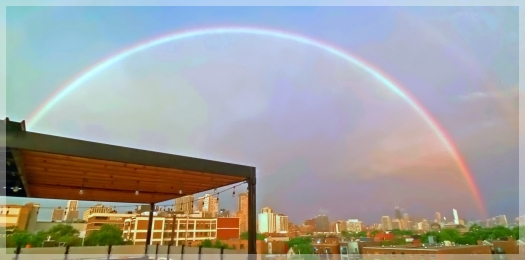
With everyone stuck inside because of the rain, the day had been challenging as my son and his wife tried to get in eight hours of Zoom meetings, conference calls, report writing and computer programming while keeping their two youngsters busy (and relatively quiet). The rain finally stopped shortly before dusk and, when my grand ran out onto the rooftop deck to celebrate her freedom, she stopped in amazement. There, above the city, a city plagued not just by COVID-19 but also by gang violence, shootings, racism, rioting, and poverty, was a beautiful ray of hope: a double rainbow.
Rainbows are among my favorite things. The glory of the Lord “looked like a rainbow shining in the clouds on a rainy day,” to Ezekiel and John described the Lord’s glory circling Him like a rainbow and glowing like an emerald in Revelation. The rainbow shows us God’s light in the darkness of our troubled world and is probably the closest thing we have to seeing His radiance while we’re on this side of the grass.
Scripture’s first mention of a rainbow is in Genesis 9. Once the floodwaters had receded and the earth was dry enough, God told Noah to leave the ark and release all of the animals. Even though God knew mankind’s heart was still inclined toward evil, He gave us another chance with His promises to never again destroy every living thing by flood and that the normal cycles of nature would continue as long as the earth existed. The rainbow provided Noah and future generations with a sign of God’s covenant.
After a rain storm, with its clouds, thunder, and lightning, we frequently are blessed with a rainbow: a beautiful reminder of God’s love, mercy and faithfulness. It reminds us of both God’s grace and our sinfulness; after all, it was mankind’s sin that caused the flood in the first place! Rather than saving us by putting us on an ark of cypress wood, God saved us by putting Jesus on a cross. The rainbow reminds us of our redemption and salvation; because of Jesus, we have an opportunity for a new beginning. God packed a whole lot of supernatural meaning into a natural phenomenon when He hung the rainbow in the sky!
Before Noah and his family left that ark, they’d been in close quarters with one another and all of those animals for a year. If we think sheltering in place is challenging, imagine doing it with four families and an enormous menagerie but without the internet, Amazon, Netflix or Door Dash. Today’s bad news, like rain, keeps showering down and we’re in a season that seems to have no end. The storm clouds of life can obscure God’s presence but, when we remember that He is in the storm with us, we might just see a rainbow! Like my grand, I love seeing rainbows; they remind me that God is faithful to His promises for “all generations to come.”
And when it rains on your parade, look up rather than down. Without the rain, there would be no rainbow. [G.K. Chesterton]
 People often argue against God’s existence because of evil and suffering. With so much that is wrong in the world, they question how there could there be a god. Christian apologist C.S. Lewis was once an atheist who reasoned that such a cruel and unjust world proved the absence of God until he questioned where he got the idea of what was good or evil, just or unjust. He realized that something cannot be wrong or evil unless there is standard for what is right or good. In a universe with no God, there would be no standard for justice or injustice, good or evil, right or wrong: simply personal preferences. That standard, Lewis realized, is rooted in God. As a result, the very argument he used against God’s existence provided Lewis with proof of His presence!
 I used the NTE version of today’s verse because it better captures the original meaning with the words “turn inside out.” Usually translated as change, turn, or convert, the original Greek was strephō which meant more than a slight change of direction. It meant being turned (even from one thing into another) which requires submission. Far more than a mental acknowledgment or intellectual assent to certain ideas, it’s a turning of one’s whole life and person toward God. The kind of conversion or turning meant in strephō is like having one’s life turned inside out.
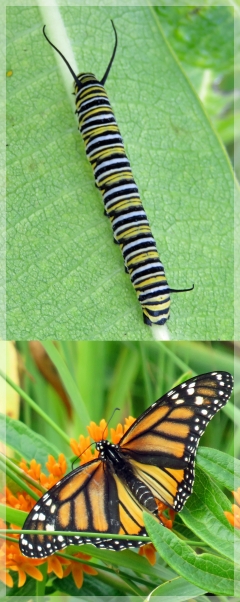 Death is the consequence of sin—of living in a fallen world—but Jesus promised that all believers have eternal life. In the Apostles’ Creed, we affirm our belief in this “life everlasting.” Eternal life, life in perpetuity, life forever and ever: how can that be? For centuries thousands of inventors have attempted to make a perpetual motion machine that will run indefinitely with no input of energy and have failed every time. Apparently perpetual motion violates the first and second laws of thermodynamics. If perpetual motion is an impossibility, perpetual life seems improbable, as well. It seems to violate all sorts of natural laws let alone human logic. God, however, isn’t limited by thermodynamics, any other law of nature, or human understanding; after all, He’s the author of them all!
 Devotions of the Heart