WHAT REASON? (Part 1)

If you obey my decrees and my regulations, you will find life through them. I am the Lord. [Leviticus 18:5 (NLT)]

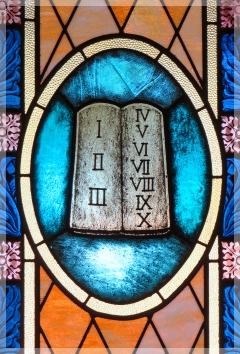
Ten COmmandments windowThe Ten Commandments are the foundation of both Jewish and Christian principles, conduct, and accountability, but they are just ten of the 613 mitzvot or commandments given to the Jewish people. In light of the big ten, many of those commands, such as using accurate scales and weights and fulfilling our promises make perfect sense as do prohibitions about speaking derogatorily of others or standing idly by if another person’s life is in danger. Moreover, laws regarding boundary markers, evidence, assessing property damages, and not perverting justice or accepting bribes certainly were necessary in a new nation. Some laws, like the ones regarding latrine placement, covering excrement, and making a guard rail around a flat roof seem reasonable from a health and safety viewpoint. Other laws may have served as a way to separate the Jews from their pagan neighbors. Perhaps it was because the Hittites, Elamites, and Sumerians were clean-shaven and the Egyptians often were clean shaven or had shaped goatees that Jewish men were not to trim the hair on their temples or shape their beards. Many laws, such as the intricate laws of sacrifice, the blue tassels on hems, reciting the Shema twice a day, and saying a blessing after meals, were related to worship and God.

Many of those laws, however, seem inexplicable. What, for example, makes land animals that don’t chew the cud and have completely split hooves (like the pig) unacceptable food? Why eat only fish with fins and scales but no shellfish or mollusks? If locusts can be eaten, why not ants? Why can’t linen be woven with wool? Why can’t a Nazarite eat grapes or raisins or cut his hair and why did every sacrifice require salt?

As I looked through these ancient laws and tried to understand God’s reasoning behind them, I missed the point. The first rule God made was the simple one he gave to Adam and Eve: don’t eat from that tree. Although He warned that death would be the result of disobedience, God didn’t explain His reasons for the prohibition because obedience to God isn’t supposed depend upon human reasoning. If we have to understand before we obey, rather than obedience, it becomes agreement and dependent on us! God, however, doesn’t require our understanding or agreement; He requires our obedience.

Abraham didn’t know where he was going when he packed up his family nor did he question God’s reasoning when he placed his son on a sacrificial altar. Building an enormous ark on dry land probably made no sense to Noah, wearing out his troops by marching around Jericho for a week seemed a questionable battle plan to Joshua, and Mary didn’t understand God’s reasoning behind her pregnancy; nevertheless, they all obeyed without understanding.

Obedience shows reliance and trust—an acceptance that God knows more than we can ever know or understand—that God is God and we are not! I don’t know God’s reasoning behind those mitzvot nor do I need to. It’s enough that God made them and expected the Israelites to abide by them. The only thing we must understand about God’s commands is that they are divinely decreed and, as such, are to be unquestionably obeyed. Rather than leading us away from God’s blessings, obedience will lead us to them.

Loving God means keeping his commandments, and his commandments are not burdensome. [1 John 5:3 (NLT)]

Trust in the Lord with all your heart; do not depend on your own understanding.  Seek his will in all you do, and he will show you which path to take. [Proverbs 3:5-6 (NLT)]

Copyright ©2021 jsjdevotions. All rights reserved.

RENDER UNTO GOD (PART 2)

The point is this: whoever sows sparingly will also reap sparingly, and whoever sows bountifully will also reap bountifully. Each one must give as he has decided in his heart, not reluctantly or under compulsion, for God loves a cheerful giver. And God is able to make all grace abound to you, so that having all sufficiency in all things at all times, you may abound in every good work. [2 Corinthians 9:6-8 (ESV)]

Yesterday was tax day: the day we rendered unto Washington what is theirs. In case we weren’t sure how much that was, we had 1099s, W-2s, 1040s, TurboTax, various receipts, H & R Block, and accountants to help us figure it out. Since Jesus told us to give God what is His, how much is that? God doesn’t send out W-2s listing our year’s many blessings, supply us with 1040s to fill out, or give us deductions for medical expenses, charitable donations, mortgage interest, property taxes, or gambling losses. Rather than a CPA or the IRS, we need to consult our Bibles for the answer to that question.

“Tithe” is an Old Testament term for the 10% gifts the Israelites were required to pay to support the Levites, provide for the Temple, and relieve the poor. A series of complicated rules regarding which tithes were made in what year and the amount tithed ended up making the tithe more like 23.3%. Although the New Testament never commands (or even recommends) a tithing system, Christians often refer to a tithe (or 10% of one’s earnings) as being the right donation to the church. In reality, for some, 10% would be unwise and for others, 10% is hardly enough!

Rather than a fixed percentage, the New Testament calls us to give regularly, according to our means, generously and joyously (even sacrificially at times), and out of love for God and others. While this requirement is vague about the actual amount, it actually is stricter than a fixed 10% because it is a matter of obedience and trust. What we give is a matter of prayer. It is an issue between God and us and we must be willing to give whatever it is He asks—be it time, talents, or finances—in the amount he desires.

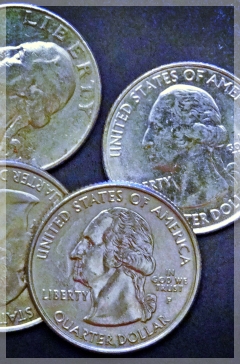
Because Caesar’s image was on the coin, it belonged to him. Let’s not forget that we are made in God’s image and it is His face that is stamped upon us. We belong to Him and whatever we give to God already is His. We simply are returning it to the rightful owner. Moreover, the list of what we should render unto God goes far beyond money. We should give Him our worship, service, obedience, praise, love, respect, gratitude, and fidelity. In short, we owe Him everything and not just on Sundays—we owe Him everything all of the time.

As John Wesley said, the question isn’t “how much of my money will I give to God, but, how much of God’s money will I keep for myself?” Although there is no need to worry about a letter from God questioning our deductions or demanding an audit, we must remember that one day we will be called in for an accounting of how we used His gifts.

Come, you who are blessed by my Father, inherit the kingdom prepared for you from the foundation of the world. For I was hungry and you gave me food, I was thirsty and you gave me drink, I was a stranger and you welcomed me, I was naked and you clothed me, I was sick and you visited me, I was in prison and you came to me. [Matthew 25:34-36 (ESV)]

Do not be conformed to this world, but be transformed by the renewal of your mind, that by testing you may discern what is the will of God, what is good and acceptable and perfect. [Romans 12: 2 (ESV)]

Copyright ©2021 jsjdevotions. All rights reserved.

RENDERING UNTO CAESAR (Part 1)

And Jesus said to them, “Whose likeness and inscription is this?” They said, “Caesar’s.” Then he said to them, “Therefore render to Caesar the things that are Caesar’s, and to God the things that are God’s.” When they heard it, they marveled. And they left him and went away. [Matthew 22:20-22 (ESV)]

The Pharisees and Herodians set out to trap Jesus into saying something that would offend either the people or Rome. By prefacing their question with flattery about His impartiality and integrity, they pressured Him into giving an answer to their politically charged question—was it right to pay taxes to Caesar. The tax about which they were asking was the tributum capitis, a sort of head tax that had to be paid by every male over fourteen and every female over twelve. Already heavily taxed by Rome, this tax was especially hated by the Judeans because they saw it as a symbol of their servitude and submission to their foreign rulers. 

Jesus’ questioners were sure they’d backed Him into a corner where He’d offend people regardless of His answer. If He said to pay taxes to Caesar, He would be denying God’s sovereign reign over Israel, supporting the hated Roman rulers, and alienating his fellow Jews. On the other hand, if He said not to pay taxes, Jesus would offend Rome and lay himself open to a charge of treason. Requesting to see a denarius, Jesus exposed his questioners’ hypocrisy when they had one. No truly devout Jew would carry a Roman coin with its idolatrous portrait of Tiberius Caesar and inscription that called him the “son of the divine Augustus.” Instead of falling into their trap, Jesus then employed a typical rabbinical technique by answering their question with one of his own. He asked whose picture was on the coin. They had to admit it was the emperor’s. Since, in the ancient world, an image on an object indicated ownership, it clearly belonged to Caesar. “Therefore,” said Jesus, “render to Caesar the things that are Caesar’s, and to God the things that are God’s.” Caught in their own trap, they didn’t yet understand that we can’t outsmart God!

On the surface, Jesus’ answer points out the obligations of dual citizenship—that obligations to both government and God must be fulfilled. Like Jesus’ questioners, we have a dual citizenship and, as citizens of both the Kingdom of God and our nation, we must fulfill our obligations to both. We are to render to whatever Caesar is in power that which is his without turning from our obligations to God. Hidden in Jesus’ answer, however, is the idea that Caesar is only entitled to what is his; he cannot claim what belongs to God! In both Jewish and Christian theology, however, God has dominion and authority over everything. In short, all things belong to God!

Nevertheless, when loyalty to government is not incompatible with loyalty to God, it appears that support of the state is part of being obedient to the Lord. Like it or not, today is tax day and, unless you filed for an extension, today is the last day to do your rendering unto Washington!

For because of this you also pay taxes, for the authorities are ministers of God, attending to this very thing. Pay to all what is owed to them: taxes to whom taxes are owed, revenue to whom revenue is owed, respect to whom respect is owed, honor to whom honor is owed. [Romans 13:6-7 (ESV)]

Copyright ©2021 jsjdevotions. All rights reserved.

THE GRAY AREA (Lies – Part 2)

Therefore, the proud may not stand in your presence, for you hate all who do evil. You will destroy those who tell lies. The Lord detests murderers and deceivers. [Psalm 5:5-6 (NLT)]

gray catbirdYesterday, when writing about notable liars in Scripture, I thought of other less commendable circumstances when people lied. When David was on the run from Saul, he arrived in the town of Nob and visited Ahimelech, the high priest. Although his purpose was to obtain food for his men and a weapon for himself, David blatantly lied and said he was there on a private matter for the king and lied again to explain being weaponless. Ahimelech, who didn’t know of the rift between Saul and David, gave David bread for his men along with Goliath’s sword.

While the lies told by Rahab, the midwives, and Elisha can be justified, David’s lies can’t and Scripture gives us no reason to think Ahimelech was an adversary. Rather than taking the easy way through deception, David should have trusted God, explained the situation honestly, and left it up to Ahimelech as to whether or not he would help.

David probably thought his deception harmless but it wasn’t! Saul’s chief herdsman, Doeg the Edomite, heard the exchange and reported it to the king. Misconstruing the priest’s aid to David as treason, Saul ordered the death of all the priests in Nob. Obliging the king, Doeg killed 85 priests and slaughtered everyone in their families. When David learned of the massacre, he regretted his action and learned a valuable but costly lesson about honesty and integrity.

Although the Doeg never lied, he failed to tell the whole truth. When reporting the priest’s aid to David, he neglected to mention that David lied to the priest. When Ahimelech tried to explain that he had no knowledge of any plot against Saul, Doeg had a second opportunity to clarify the situation, but he didn’t and his half-truth was as sinful as any lie!

Like Doeg, Samuel also told a half-truth. Although his real purpose was to anoint a new king when he arrived in Bethlehem, he said he came to offer a sacrifice. While misleading, his answer was truthful since he’d brought a heifer with him and did have a feast. The difference between his half-truth and Doeg’s was that God instructed the prophet to answer that way!

Nevertheless, people played fast and loose with the truth several times in 1 Samuel. Saul lied to Samuel about obeying the Lord’s command to completely destroy the Amalekites and all they owned when he only destroyed what was of little or no value. After planning a ruse to test Saul’s intentions toward David, Jonathon lied to his father about David’s whereabouts. Michal helped David escape from Saul’s men by making it look like her husband was asleep in his bed. When her subterfuge was discovered, she falsely claimed that David had threatened to kill her if she hadn’t helped. Twice, David deceived King Achish and the Philistines: first, by feigning madness and later by making the Philistines think him an ally who was raiding the Jerahmeelites and Judeans when he really was raiding non-Israelite allies to the Philistines. Saul later deceived the Witch of Endor about his identity.

Some of these lies and half-truths seem justified while others do not. Some seem incredibly self-serving and some served others. While some situations seem clear cut, many others aren’t. Is there a gray area between absolute and complete truth and outright deception? How do we know what is right? Let us continue to look to Scripture for our answer.

Whoever desires to love life and see good days, let him keep his tongue from evil and his lips from speaking deceit; let him turn away from evil and do good; let him seek peace and pursue it. [1 Peter 3:10-11 (ESV)]

Copyright ©2021 jsjdevotions. All rights reserved.

BEING A SLAVE

This letter is from Paul and Timothy, slaves of Christ Jesus. I am writing to all of God’s holy people in Philippi who belong to Christ Jesus, including the church leaders and deacons. [Philippians 1:1 (NLT)]

great blue heronRather than introduce himself as an apostle, Paul often identified himself as a slave of Christ Jesus. In the New Testament, the Greek word doúlos is often translated as servant or bondservant but it clearly meant slave. Of course, with our 21st century mindset, we find the word “slave” abhorrent, especially when applied to us! The word’s use by Jesus and the epistle writers, however, was never an endorsement of involuntary servitude or thinking of people as chattel. Used as a metaphor, doúlos was an honorable word that applied to believers who, as devoted followers of Jesus, willingly lived under His authority.

Slavery was deeply rooted in the economy and social structure of the Roman Empire. With more than half the population either enslaved or having been slaves at one time, 1st century listeners and readers would have understood the metaphor in a far different way than we do today. Slavery could be voluntary and people often sold themselves into slavery to pay debts or simply because life as a slave was better than struggling to exist on one’s own. Hebrew Scripture even made provisions for an Israelite to sell himself (or a child) to pay off a debt. The law of manumission, however, allowed a slave to be freed once the debt was paid. As objectionable as the concept of slavery is to us, it was an everyday reality in the ancient world.

Rather than being repulsed at the concept of being a slave, let’s look at what Christian slavery means. Before becoming believers, we were slaves to sin. Jesus paid a ransom to God—one that freed us from sin, death, and hell. Rather than purchasing our freedom with silver or gold, it was purchased with His blood. Instead of becoming a slave to the redeemer who paid our financial debts (as would happen in the 1st century), we become slaves to the One who redeemed us by paying the price for our sins. In his use of the word doúlos in his letter to the Philippians, Paul is acknowledging that he and Timothy had been purchased with Christ’s blood and, as His slaves, they surrendered their will, time and interests to Him. Completely devoted to their Master—Jesus Christ—they were obedient to Him and subject to His command.

Belonging to his master, the slave has no time, will or life of his own and is totally dependent upon his master for his welfare. He is to be unquestioningly loyal and obedient and is obligated to do his master’s bidding with no regard to his own well-being. If that master were a man, such a situation would be horrendous. When the master is God—the One who made us and loves us as His own children—it is a good thing!

No Christian belongs to himself—we belong to our Redeemer. As His slaves, we choose to willingly live under Christ’s authority. We’ve been told that no one can serve two masters so we have a simple choice: be a slave to sin or a slave to Christ. Which will it be?

Now you are free from your slavery to sin, and you have become slaves to righteous living. … Previously, you let yourselves be slaves to impurity and lawlessness, which led ever deeper into sin. Now you must give yourselves to be slaves to righteous living so that you will become holy. … But now you are free from the power of sin and have become slaves of God. Now you do those things that lead to holiness and result in eternal life. For the wages of sin is death, but the free gift of God is eternal life through Christ Jesus our Lord. [Romans 6:18,19b, 22-23 (NLT)]

Copyright ©2021 jsjdevotions. All rights reserved.

CASTING CARES

Cast your cares on the Lord and he will sustain you; he will never let the righteous be shaken. [Psalm 55:22 (NIV)]

Cast all your anxiety on him because he cares for you. [1 Peter 5:7 (NIV)]

yampa river fishingEven though I’m not an angler, whenever I read about casting my cares, I picture using a fly rod and casting my concerns out into the river so the fast moving water can carry them away to God. When we lived in the mountains, one of our favorite walking trails ran alongside the Yampa River and we often paused to watch as the fishermen (and women) cast their lines into the water. Fly fishing is all about the art of casting and a bit like poetry in motion. It was fascinating to watch an angler flick the rod back and forth, gradually increasing the speed of the motion, before finally casting the line forward so the fly would land in the perfect spot. Masquerading as a water insect, the fly is made of things like fur, feathers, fabric and tinsel and secured to a hook. Rather than purchasing flies, many fishermen spend hours tying their own flies. Not wanting to lose either fly or fish in the river, anglers use at least five different knots to securely connect the reel to the backing, fly line, leader, and tippet before finally tying on the fly.

There is an art to fly casting and fly fishermen spend years perfecting their technique, especially since no one cast is ideal for every situation. Christians, however, aren’t casting flies—they’re casting things like fear, problems, anxiety, and worry—the cares every believer faces in this fallen world. While there’s no special technique to casting those cares, like fly fishing, it’s often easier said than done. Just as a fly fisherman may labor over tying his flies and fret about choosing the perfect ones for the day’s conditions, we often spend a great deal of time focusing on our worries rather than casting them into God’s river. Just as the fisherman ties those five knots to keep from losing his fly, we tie ourselves up in knots when we’re reluctant to give up our cares to God!

The anglers casting their lines in the river want to catch and land a fish but, when we cast our cares, we want to bring in an empty line. They catch, we release! Our cares are not for God to take away from us but for us to release to Him. Because the flies on the end of a fishing line are nearly weightless and our cares often seem as heavy as boulders, casting cares seems harder than casting a fly in the river. Nevertheless, it can be done and is far more rewarding than a trophy-sized trout.

Fishermen go to the river with an empty creel and hope to return home with a full one but we go to God with a creel full of cares so we’ll end up with an empty one. Our creels may be empty but we’ll be filled with the peace of God!

He that takes his cares on himself loads himself in vain with an uneasy burden. I will cast my cares on God; he has bidden me; they cannot burden him. [Joseph Hall]

Peace I leave with you; my peace I give you. I do not give to you as the world gives. Do not let your hearts be troubled and do not be afraid. [John 14:27 (NIV)]

Do not be anxious about anything, but in every situation, by prayer and petition, with thanksgiving, present your requests to God. And the peace of God, which transcends all understanding, will guard your hearts and your minds in Christ Jesus. [Philippians 4:6-7 (NIV)] 

Copyright ©2021 jsjdevotions. All rights reserved.