DON’T KILL THE MESSENGER

These people are stubborn rebels who refuse to pay attention to the Lord’s instructions. They tell the seers, “Stop seeing visions!” They tell the prophets, “Don’t tell us what is right. Tell us nice things. Tell us lies. Forget all this gloom. Get off your narrow path. Stop telling us about your ‘Holy One of Israel.’” [Isaiah 30 9b-11 (NLT)]

fireweedBeing a prophet was a calling from the Lord and probably an unwelcome one at that. Amos, a businessman from Tekoa in Judah, was minding his own business when God called on him. He probably would have preferred tending his sheep and cultivating his fig trees to pronouncing judgment upon the Israel, Judah, and other nations. Nevertheless, this layman accepted God’s call and denounced the nations’ sins with brutal frankness. It was at the height of Israel’s prosperity that he prophesied their end by singing a funeral song for the northern kingdom. Needless to say, the words of a Judean pronouncing judgment upon Israel were not welcomed. Even though Amaziah ordered him back to Judah, Amos continued to give God’s message to the people.

It never seemed to go well for God’s prophets. Having infuriated the priests by going to the Temple to rebuke the people for their idolatry and falseness, Jeremiah was banned from the Temple even though he was the son of a priest. Seeing him as a traitor and conspirator, the priests plotted his death and Jeremiah was arrested, beaten, imprisoned, and thrown into a cistern to die. Although he was rescued from the cistern, he later was forcibly taken by rebels to Egypt and church tradition holds that he was stoned to death there.

It didn’t go any better for the rest of God’s prophets. Blaming Elisha for his troubles, the king of Aram wanted him beheaded and Elijah spent much of his time fleeing from the wrath of Jezebel and Ahab. Micaiah was tossed into prison for predicting Israel’s defeat and Ahab’s death, Daniel was thrown into a lion’s den, John the Baptist was beheaded and, according to rabbinical tradition, King Manasseh executed Isaiah by having him sawn in half! If the prophets weren’t losing their lives, they were running for them!

These prophets were unpopular because they fearlessly told the truth instead of what the people wanted to hear. They revealed the people’s sins and warned of their consequences. Sent to confront rather than comfort, their messages often were unwelcome and ignored. What those who persecuted them failed to realize is that, while they may have silenced the men’s voices temporarily, the truth of their messages didn’t disappear!

Let’s face it—reproach, sacrifice, and repentance are never popular messages. Not everything we read in the Bible or hear from the pulpit is going to be comforting and cheerful; it does, however, need to be heard. Not everything the Holy Spirit tells us is going to be approving, but it will be edifying. Not everything God instructs us to do will be easy, but it will be worthwhile. Not everything said by our brothers and sisters in Christ will be appreciated, but it will be honest. God gives warnings so we won’t have to suffer his wrath. Rather than ignoring, persecuting, or killing God’s messengers, we’re better off listening to them and heeding their words.
This is the reply of the Holy One of Israel: “Because you despise what I tell you and trust instead in oppression and lies, calamity will come upon you suddenly—like a bulging wall that bursts and falls. In an instant it will collapse and come crashing down. [Isaiah 30:12-13 (NLT)]

Copyright ©2022 jsjdevotions. All rights reserved.

CUSTARD PIES

Consider it pure joy, my brothers and sisters, whenever you face trials of many kinds, because you know that the testing of your faith produces perseverance. Let perseverance finish its work so that you may be mature and complete, not lacking anything. [James 1:2-4 (NIV)

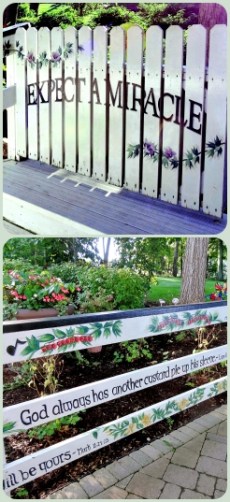
When we lived in the north, we often walked a public path that meandered along the shoreline of a nearby lake. Running through both public and private properties, it crossed the front lawns of historic lakefront estates and stunning homes with beautifully landscaped yards and gardens. One such home placed a lakeside bench for tired walkers that said, “Sit-Pray-Mediate-Enjoy” under a sign that read, “You can trust me. Love, God.” A delightful white fence delineated their private property from the public path. Decorated with whimsey, “Expect a Miracle” was the message on the gate and assorted Bible verses and words of wisdom were painted on the fence’s horizontal slats.

I laughed at actress Lynn Redgrave’s observation that, “God always has another custard pie up his sleeve.” Having grown up watching the Three Stooges, Laurel and Hardy, and Soupy Sales, I knew exactly what she meant! Custard pies are the unplanned quirky episodes of life—the glitches, bugs, hitches, curve balls, obstructions, setbacks, and snags that seem to arise when we least expect them. While they’re not necessarily earth-shattering or tragic, they upset the apple cart of our lives and can throw us off our game!

Sometimes those custard pies come at us the way candy on a conveyor belt did in an old I Love Lucy episode called “Job Switching.”  Working in a candy factory, Lucy and Ethel’s job seemed simple enough: wrap candies as they came down the line. All went well until the line sped up and the candies came faster and faster. Knowing they’d be fired if any unwrapped candy reached the packing room, the women frantically grabbed the candies off the belt and ended up stuffing them in their mouths, hats, and blouses. “I think we’re fighting a losing game,” admitted Lucy.

Most of us can handle one or two custard pies at a time but, when they come flying at us as fast as the candy came to Lucy and Ethel, we feel like we’re playing a losing game and our faith is challenged! As Ms. Redgrave said, it does seem like God has an endless supply of custard pies up his sleeve. For many of us, the last twenty months have been a speeding conveyor belt of those pies and, with months of disappointments, complications, delays, and uncertainty, little went according to our expectations or plans. Before God tosses another pie my way, I wish He’d give me a warning so I could duck!

Nevertheless, as Christians, we know that those pies are part of God’s greater plan for us. Life is unpredictable at best and we need to accept its capriciousness with proper perspective, a positive outlook, a sense of humor, and faith in the One who is in charge. In the meantime, I’ll follow the advice painted by that home owner. Knowing that God loves me, I’ll trust in Him and expect a miracle (or two). I’ll sit, pray, meditate, and enjoy what God has put before me—even if it’s another custard pie!

Challenges are what make life interesting; overcoming them is what makes life meaningful. [Joshua J. Marine]

Though the fig tree does not bud and there are no grapes on the vines, though the olive crop fails and the fields produce no food, though there are no sheep in the pen and no cattle in the stalls, yet I will rejoice in the Lord, I will be joyful in God my Savior. [Habakkuk 3:17-18 (NIV)]

Copyright ©2021 jsjdevotions. All rights reserved.

ASK, SEEK, KNOCK

Ask and it will be given to you; seek and you will find; knock and the door will be opened to you. [Matthew 7:7 (NIV)]

Ask, seek, and knock—three easy instructions. Ask. Ask as if we mean it, as if we truly care about the answer. Ask as if we believe we’re being heard. Ask with the hunger of a beggar begging bread. Ask with the fervor of someone sinking in quicksand pleading for help. Ask with the thirst of a dying man in the desert requesting water. Ask as if our very lives depend on the answer. Ask.

Seek. Seek as if we were searching for something of value—not a cursory look as if we’d lost a button or dropped a paper clip. Seek as we would for a lost wedding ring, wallet, or child. Seek as we would for an exit from a burning building. Seek by adding efforts to our prayers; after all, we can’t ask God for a harvest without first planting the seeds. Seek as if we care, as if our very lives depended on finding it. Seek.

Knock. Knock as if we truly wanted to enter. Knock with confidence—not shyly as if we don’t know whose door we’re at or timidly as if we’re not sure we’re welcome. Knock and keep knocking as if we desperately need the door to be answered, as if our very lives depended on it. Knock.

We have a promise—God’s promise—and we must ask, seek, and knock as if we believe that promise! Where there is a praying heart, He promises we’ll find a listening God—a God who loves us as a father loves a child. Like a good parent, however, no matter how fervently we ask, how diligently we seek nor how hard we knock, He won’t give us stones or snakes or anything bad for us. While there will be no money for drugs when we need rehab, no car when a bicycle will do, no escape from facing consequences, and even no healing when God’s presence in our pain is enough, there will be mercy, peace, grace, patience, wisdom, strength against sin, and understanding. Rather than sell, loan or rent us His gifts, He gives them to us because He loves us! Trust His promise to generously give good things to those who ask, seek, and knock.

For everyone who asks receives; the one who seeks finds; and to the one who knocks, the door will be opened. Which of you, if your son asks for bread, will give him a stone? Or if he asks for a fish, will give him a snake? If you, then, though you are evil, know how to give good gifts to your children, how much more will your Father in heaven give good gifts to those who ask him! [Matthew 7:8-11 (NIV)]

Copyright ©2020 jsjdevotions. All rights reserved.

NO WON’TS ALLOWED

Will any one of you who has a servant plowing or keeping sheep say to him when he has come in from the field, “Come at once and recline at table”? Will he not rather say to him, “Prepare supper for me, and dress properly, and serve me while I eat and drink, and afterward you will eat and drink”? Does he thank the servant because he did what was commanded? So you also, when you have done all that you were commanded, say, “We are unworthy servants; we have only done what was our duty.” [Luke 17:7-10 (ESV)]

black-crowned night heronWhen she lived in Florida, my mother-in-law hired a woman to do the cleaning. In spite of representing herself as a “cleaning service,” this woman had a long list of “won’ts”—won’t do windows, mirrors, get on step ladders, move furniture, or bend over to wipe the baseboards, etc. Nevertheless, she always had a long list of complaints and financial needs that she was more than willing to share.

I wonder if that’s how we are in our relationship with God. Instead of being a willing servant who snaps to attention when his master calls and does what is asked, we have a list of “won’ts”—won’t obey, give, forgive, love, go where Gods sends us, or inconvenience ourselves. Nevertheless, in spite of our unwillingness to do for Him, we always have a long list of things we want from Him or complaints about the blessings we’ve already received.

Thinking we have a master probably makes us uncomfortable; we don’t want to think we’re subservient to anything or anyone. Instead of a master/servant relationship with our Lord, we’d prefer having a giver/receiver relationship with Him. Rather than serving Him, we’d prefer Him serving us and, as our generous benefactor, He continually would bestow gifts and blessings on us. When we think of God as our father, we’d prefer an indulgent father who’s long on generosity and short on discipline rather than one who expects obedience from His children. We’re happy to think of God as a protector shielding us from harm, a heavenly bail bondsman bailing us out of problems, or a pleasant and undemanding friend, but not so thrilled about having a master. While we’d prefer God being a trusted advisor whose advice we would follow if we liked it, He’s more of a dictator (albeit a benevolent one) whose word is law and whose plan is to be followed (like it or not)!

Make no mistake about it—God is more than a provider, parent, defender, rescuer, comrade, or counselor. God is our master and we are His servants. Rather than serving God with a list of “won’ts,” let us approach our master with the willing, eager, and obedient heart of a servant. Unlike that house cleaner, rather than serving for a reward of some kind (and complaining all the while), good servants whole-heartedly and joyfully serve God because they know, love, and trust Him. The central theme of Scripture is servanthood; may we always serve as did Jesus—the greatest servant of all.

Do nothing from selfish ambition or conceit, but in humility count others more significant than yourselves. Let each of you look not only to his own interests, but also to the interests of others. Have this mind among yourselves, which is yours in Christ Jesus, who, though he was in the form of God, did not count equality with God a thing to be grasped, but emptied himself, by taking the form of a servant, being born in the likeness of men. And being found in human form, he humbled himself by becoming obedient to the point of death, even death on a cross. [Philippians 2:3-8 (ESV)]

Copyright ©2021 jsjdevotions. All rights reserved.

GOD DOESN’T COUNT

But don’t just listen to God’s word. You must do what it says. Otherwise, you are only fooling yourselves. For if you listen to the word and don’t obey, it is like glancing at your face in a mirror. You see yourself, walk away, and forget what you look like. [James 1:22-24 (NLT)]

Physostegia virginiana - obedient plantFriends recently watched their young grandson while his parents enjoyed a much needed “adults only” vacation. Accustomed to the permissive parenting of today, the youngster wasn’t overly familiar with obedience. One of the first things he learned during his visit was that, “Grandpa doesn’t count.” Apparently, his parents give him a count of three (or more) to decide whether or not to obey them; Grandpa, however, did not!

The youngster could have learned about obedience from one of summer’s wildflowers: the Physostegia virginiana. Better known as the obedient plant, when an individual flower is lightly pushed in a direction, it doesn’t wait for a count of three before immediately responding to that touch and turning that way. It really is an obedient flower and a beautiful one at that.

While obedience is not a well-liked or widespread concept nowadays, my Bible has 518 specific references to man’s obedience or disobedience, so it appears that obedience is important to God. In fact, it appears to be a mandatory part of our lives. Abraham’s life is a lesson in immediate obedience. When God told him to pack up his family and move to a place he’d never known, the 75-year-old didn’t ask for a map and travel plan; he obeyed without question or delay. When God told Abraham that all the males in his household (along with all of his male descendants) had to be circumcised, Abraham didn’t question God’s command and every man was circumcised that very day. Circumcision was known among the people of that region so Abraham’s unquestioning obedience is easier to understand than his unhesitating obedience when God told him to sacrifice his precious son Isaac. Rather than doubt God’s wisdom, negotiate, or delay, Abraham and Isaac set out for the mountains the very next morning. Abraham continued to obey right up to the moment he held the knife to his son’s neck and the angel of the Lord intervened. That’s obedience!

Sadly, when it comes to whole-hearted obedience to God, we’re less like Abraham and far more like the Israelites who frequently delayed and disobeyed. When they balked at entering Canaan, their disobedience questioned both God’s authority and His power to defeat their enemies. Although they eventually obeyed and entered Canaan, their delayed obedience cost all the adults (except Joshua and Caleb) their lives. Delayed obedience is no different than disobedience and always comes at a cost!

As Christians, we don’t get to delay our obedience to God until a more convenient time or He’s counted to three! If He doesn’t tell us to do something in a specific timeframe, God means right now—not when we get around to it or feel like doing so. Our immediate obedience to Him proves our love and demonstrates our faith. Like disobedience, delayed obedience is an insult to God because it tells Him we don’t trust His plan or that we have better things to do!

Like that little boy, we’d prefer thinking that we are the ones in control, but we aren’t! Grandpa was in charge of his grand and God is in charge of us. We are to submit to God as readily as we expect a four-year-old to submit to us. Like that willful little boy, we need to emulate the obedient plant and follow God’s nudge immediately, willingly, and beautifully. Remember, Grandpa doesn’t count and neither does God!

The bottom line is the Christian faith is obedience and most people don’t even like the word. [Charles Stanley]

So why do you keep calling me “Lord, Lord!’ when you don’t do what I say? I will show you what it’s like when someone comes to me, listens to my teaching, and then follows it. It is like a person building a house who digs deep and lays the foundation on solid rock. When the floodwaters rise and break against that house, it stands firm because it is well built. But anyone who hears and doesn’t obey is like a person who builds a house right on the ground, without a foundation. When the floods sweep down against that house, it will collapse into a heap of ruins.” [Luke 6:47-49 (NLT)]

Copyright ©2021 jsjdevotions. All rights reserved.

YESTERDAY, TODAY AND TOMORROW

Lord, I trust in you. You are my God. My life is in your hands. [Psalm 31:14-15a (ERV)]

Going by the popular name of “Yesterday, Today and Tomorrow,” the Brunfelsia is one of my favorite Florida flowers. Three colors of pansy-like fragrant flowers can be seen on the one plant at the same time: the deep purple of the new flower, the pale lavender that appears shortly thereafter, and the pure white just before the flower falls off. Although we get to see what this flower looked like yesterday, looks like today and will look like tomorrow, we don’t get to see the past, present and future of our lives all at once. God, however can.

This lovely flower was brought to mind last week when I had my yearly exam at the dermatologist’s. In honor of Thanksgiving, one wall of the waiting room displayed brown, orange, red, and yellow construction paper leaves scattered under a banner that asked, “For what are you thankful?” While reminiscent of an elementary school classroom bulletin board, the answers written on those leaves by both patients and staff weren’t like those of the average grade-schooler who knows little of things like death, biopsies, addiction, loneliness, strokes, cancer, conflict, bankruptcy, job loss, homelessness, violence, or struggle. While a fourth-grader might have written her dog’s name on a leaf, only a mature adult would have said, “I’m thankful for the troubled times because, without them, I wouldn’t be the person I am today!”

Indeed, I can’t say I was thankful for my troubles when they occurred but, like that person, I am thankful for what God did with them in my life. The hurdles, pain, injury, loss, and trouble that seemed so random and senseless at the time make sense in retrospect. I can see how God brought those difficult yesterdays together to bring me to a better and more beautiful today and how today’s challenges will lead me into an even more amazing tomorrow. Having no crystal ball to see how it all will come together at some point in the future, however, we simply must trust God with our tomorrows and settle on only seeing the past, present, and future at one time in the lovely flowers of the Brunfelsia.

Another name for the Brunfelsia is “Kiss Me Quick Before I Fade,” but I tend to think of it as the Carpe Diem flower. The phrase comes from the Roman poet Horace and was part of his injunction to “carpe diem quam minimum credula postero” meaning “pluck the day, trusting as little as possible in the next one.” Horace, who died in 8 BC, was a pagan but, had he been born at a later date and become a follower of Jesus, the poet could have trusted in his tomorrows because he would have known they were in God’s hands.

As for me, while thanking God for the blessings of yesterday (even though I didn’t appreciate many of them at the time), I will pluck this day with enthusiasm and joy while trusting God with the next one. He planted us right here and at this time for a reason and He will faithfully cultivate, prune, water, and nurture us. Trusting that God knows what He’s doing, what He wants for us, where He’s taking us, and how He will get us there, let us release to Him all of our yesterdays, todays, and tomorrows.

God promises a safe landing but not a calm passage. [Bulgarian Proverb]

The Lord guides our steps, and we never know where he will lead us. [Proverbs 20:24 (ERV)]

So I saw that the best thing people can do is to enjoy what they do, because that is all they have. Besides, no one can help another person see what will happen in the future. [Ecclesiastes 3:22 (ERV)]

Copyright ©2020 jsjdevotions. All rights reserved.