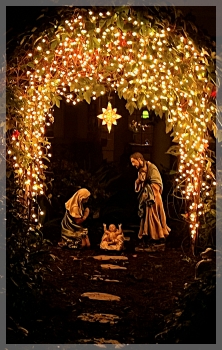
“HALLELUJAH” RATHER THAN “HUMBUG”

The Spirit of the Sovereign Lord is upon me, for the Lord has anointed me to bring good news to the poor. He has sent me to comfort the brokenhearted and to proclaim that captives will be released and prisoners will be freed. He has sent me to tell those who mourn that the time of the Lord’s favor has come, and with it, the day of God’s anger against their enemies. [Isaiah 61:1-2 (NLT)]


Unfortunately, much of our Advent season is not spent joyfully looking forward to celebrating the birth of the Christ child. In hope of finding the perfect gift for everyone on our list, we pore over catalogues and search for sales and coupons. Either we fight for parking spots at the mall and spend hours standing in line or spend those hours sitting at the computer while shopping on line! We then fret and fuss over wrapping those gifts, mailing packages and Christmas cards, hosting and attending parties, baking cookies, making travel arrangements, decorating the house, preparing holiday dinners, and paying the ever-mounting bills. When we say, “Merry Christmas!” we might find ourselves mumbling a Scrooge-like “Bah! Humbug” under our breath! Instead of looking forward to Christmas with anticipation, there are times we can’t wait until it’s all over and done.

Dr. Seuss’ Grinch eventually realized Christmas really has nothing to do with all those trappings; I wonder why we have so much trouble remembering that same thing. Christmas isn’t about gifts, parties, cards, peppermint bark, decorations, or the “roast beast feast.” Jesus with His message of love, redemption, forgiveness, and salvation is the only reason for the season! Mary didn’t send out 100 birth announcements or bake dozens of cookies and the stable that housed the Holy Family wasn’t decorated with wreaths, ribbons, holly, or tinsel. God took care of the only decoration with a bright star and a heavenly chorus announced the birth. Shepherds were the first holiday guests and they didn’t expect gingerbread cookies or care about the stable’s decor or cleanliness. The Magi’s Christmas presents were odd gifts for an infant and probably arrived two years late.

Today, consider pausing from all your preparations to re-read Zechariah’s prophecy of a Savior who would redeem His people and the beautiful story of His birth in Luke 1 and 2. Tonight, take a drive and look at the Christmas lights festooned around your town; let them remind you of Isaiah’s promise; “The people who walk in darkness will see a great light … For a child is born to us.” Then let us joyfully raise our voices in a “Hallelujah!” instead of “Humbug!”

And the Grinch, with his Grinch-feet ice cold in the snow, stood puzzling and puzzling, how could it be so? It came without ribbons. It came without tags. It came without packages, boxes or bags. And he puzzled and puzzled ’till his puzzler was sore. Then the Grinch thought of something he hadn’t before. What if Christmas, he thought, doesn’t come from a store. What if Christmas, perhaps, means a little bit more. [From “How the Grinch Stole Christmas” by Dr. Seuss]

The people who walk in darkness will see a great light. For those who live in a land of deep darkness, a light will shine … For a child is born to us, a son is given to us. The government will rest on his shoulders. And he will be called: Wonderful Counselor, Mighty God, Everlasting Father, Prince of Peace. [Isaiah 9:2,6 (NLT)]

Copyright ©2024 jsjdevotions. All rights reserved.


READY OR NOT…

For you know quite well that the day of the Lord’s return will come unexpectedly, like a thief in the night. When people are saying, “Everything is peaceful and secure,” then disaster will fall on them as suddenly as a pregnant woman’s labor pains begin. And there will be no escape. But you aren’t in the dark about these things, dear brothers and sisters, and you won’t be surprised when the day of the Lord comes like a thief. [1 Thessalonians 5:1-4 (NLT)]

For Christians, the four weeks before Christmas are the season of Advent: a season as much about preparing for Christ’s second coming as it is about preparing to celebrate His first. Having recently purchased a baby gift, I couldn’t help but see similarities between the way expectant parents prepare for the advent (coming) of their new baby and we prepare for the advent (coming) of Christ.

Wanting to give her baby the best possible start, the mother-to-be is cautious about what goes into her body. She adds pre-natal vitamins, stops drinking alcohol, gives up junk food, and shuns risky foods like sushi, alfalfa sprouts, and brie. In the same way, as we prepare for Christ’s coming, we should take these weeks to improve what we put into our minds—the things we listen to, read, watch, and stream. Are they as worthless as junk food’s empty calories or as unsafe as smoking or drinking unpasteurized cider are for the expectant mother and baby she carries?

In preparation for their baby’s arrival, the expectant mom and dad eagerly read all about child care and attend birthing, parenting, and infant CPR classes. We should be as intent on learning about Jesus as new parents are about babies. Advent is a good time to start!

Knowing that life will be different once their baby comes, the soon-to-be parents give serious thought to their priorities and the sacrifices to be made. Midnight feedings will replace date nights, designer handbags are swapped for a diaper bag, and a full night’s sleep will become a thing of the past. Carpets will be cleaned, the office or extra bedroom becomes the nursery, while cabinets, corners, and sockets are baby-proofed.

The four weeks of Advent are the time for Christ’s followers to prepare room in our hearts for Him. As we prepare for the coming of the Christ child, like expectant parents, we might reflect on any changes or sacrifices that we should make so Christ can make His home with us. Rather than baby-proofing, do we need to do a little sin-proofing? As we clean house in preparation for the holidays, we might want to clean our hearts of things like greed, pride, or resentment so there’s room for the King.

Once they know a baby is coming, I doubt that a day passes without the parents-to-be thinking about its arrival. Advent should be a season when Christ is first and foremost in our minds, as well. Just as a woman in her 40th week of pregnancy yearns for her baby’s arrival, we yearn for Jesus to arrive and straighten out the mess we’ve made of His world.

The expectant parents have a good idea of when their baby will come and, while we know when Christmas will arrive, only God knows the date of Christ’s second coming. Nevertheless, Jesus told us that, like labor pains, there would be signs—things like wars, famines, earthquakes, persecution, conflict, economic turmoil, and deception. Considering today’s news, it’s not surprising that 39% of Americans (and 47% of American Christians) think we are in the end times right now. Then again, chaos and trouble are not unique to the 21st century. The early church thought Jesus would return and usher in God’s Kingdom in their lifetimes and I suspect Christians throughout the centuries have thought they were living in the end times. We don’t know if we’re living in the last days but, like those soon-to-be-parents, we know for sure that He will arrive whether we’re ready or not!

The immense step from the Babe at Bethlehem to the living, reigning triumphant Lord Jesus, returning to earth for His own people – that is the glorious truth proclaimed throughout Scripture. As the bells ring out the joys of Christmas, may we also be alert for the final trumpet that will announce His return, when we shall always be with Him. [Alan Redpath]

However, no one knows the day or hour when these things will happen, not even the angels in heaven or the Son himself. Only the Father knows. … You also must be ready all the time, for the Son of Man will come when least expected. [Matthew 24:36, 44 (NLT)]

Copyright ©2024 jsjdevotions. All rights reserved.

THANK YOU NOTES

Give thanks to the Lord, for he is good! His faithful love endures forever. [Psalm 107:1 (NLT)]

It’s one thing to be grateful. It’s another to give thanks. Gratitude is what you feel. Thanksgiving is what you do. [Tim Keller]

wild turkeyWhen I was a girl (back in the days of pen, paper, and postage stamps), my mother insisted that I write a “thank you” note for any gifts I received. Whether my birthday or Christmas, I was not allowed to enjoy any gifts until the necessary notes had been written. Moreover, each note had to be personal. I couldn’t just write a quick generic, “Thank you for the nice present.” I had to say something specific about the gift and, if it was money, I had to say how I planned on using it. Even if the present was something I really didn’t like or want (and we’ve all had those kinds of gifts), I had to express gratitude. My mother reminded me that, while I might not value the gift, someone else’s time, thought, love, and money had gone into getting it for me. Therefore, I should take the time to properly acknowledge and show my appreciation for the giver’s generosity. Her “thank you” note rule also applied whenever someone did something special for me. If a family took me to an event or I’d spent the night at a friend’s house, a note of thanks had to be written.

Eventually, once I was old enough to buy the gifts, host the guests, and do the good turns and favors, I appreciated the time, energy, money, thought, and love that goes into those things. My mind set changed from “I have to write a note” to “I want to write a note.” Rather than an obligation, thanking someone became a privilege.

Whenever I get a note of thanks, I relish it, especially when it’s from a grand. Misspellings or poor penmanship don’t matter to me; I love knowing that they (and their parents) appreciate the gift and the love that came with it. Unfortunately, nowadays, people rarely write “thank you” notes or even send “thank you” emails. We seem to take people, their gifts, and kindness to us, quite for granted.

As rare as hand-written notes are today, how much rarer is it for us to remember to send our thanks regularly to our Father in Heaven? What if we couldn’t play with our toys, enjoy our health, use our talents, spend our money, live in our homes, hug our family, eat our food, use our intellect, or accept God’s grace until we had properly thanked him? The fourth Thursday in November may be our national day of thanksgiving, but every day should be a day of giving thanks. That means seriously thinking about our many blessings, specifying the gifts for which we are grateful, and then actually giving God our thanks and praise.

Later today, when you take that walk in a vain attempt to work off the extra 2,000 or more calories you consumed at dinner, try listing your blessings and offering your thanks as you walk. Chances are that you’ll still be thanking God for His gifts by the time you return home.

Silent gratitude isn’t very much use to anyone. [Gertrude Stein]

Enter his gates with thanksgiving; go into his courts with praise. Give thanks to him and praise his name. For the Lord is good. His unfailing love continues forever, and his faithfulness continues to each generation. [Psalm 100:4-5 (NLT)]

Copyright ©2024 jsjdevotions. All rights reserved.

GRACE NOTES

Let the heavens be glad, and the earth rejoice! Let the sea and everything in it shout his praise! Let the fields and their crops burst out with joy! Let the trees of the forest sing for joy. [Psalm 96:11-12 (NLT)]

clouded sulphur butterfly - asterIn Letters to Malcom, C. S. Lewis wrote, “We, or at least I, shall not be able to adore God on the highest occasions if we have learned no habit of doing so on the lowest. … Any patch of sunlight in a wood will show you something about the sun which you could never get from reading books on astronomy. These pure and spontaneous pleasures are ‘patches of Godlight’ in the woods of our experience.”

What Lewis called “patches of Godlight,” I think of as God’s grace notes. In music, a grace note is played with a light quick motion that immediately leads to the principle and stressed note. Unnecessary for the melody and so brief they don’t alter the tempo, grace notes merely enrich the music by adding a small embellishment. Like the musical grace note and Lewis’s “patches of Godlight,” God’s grace notes aren’t necessary; nevertheless, they enhance our lives. They’re subtle reminders that God is present and loves us enough to embellish the day with a little something extra.

Unlike Kodak moments, Godlight and grace notes are not meant to be saved. They’re rarely repeated and we can’t predict when a “patch of Godlight” will shine into our lives or a grace note will play. While waiting at a red light, I glanced at the grassy median to my left where small yellow flowers appeared to be dancing in the air. Although hundreds of dainty Sulphur butterflies were flitting to and fro just a few inches above the yellow wireweed in the grass, it looked like the flowers’ petals had escaped from their stems and the field was bursting with joy! Did God arrange that revelry in yellow just for me? Probably not, but it felt like He did and my day changed for the better because of it.

After noticing that others at that light seemed oblivious to the butterfly frolic, I wondered how many of God’s grace notes I’ve missed because I wasn’t looking or listening. As the prophet Elijah learned, God doesn’t necessarily reveal Himself in spectacular displays of things like lightning, wind, thunder, and fire. Our infinitely creative God whispers through the ordinary as well—with things as mundane as yellow butterflies, a child’s laughter, the aroma of jasmine, a finch on the windowsill, a song on the radio, seeing a young couple caress or an old couple walk hand in hand, a shooting star, a stranger’s smile, or a patch of sunlight while walking through the woods. Although God personalizes His grace notes for each one of us, we need to slow down and be mindful enough to recognize and appreciate them.

There is an old Hindi poem, translated by Ravindra Kumar Karnani, in which a child asks God to reveal Himself. God responds with a meadowlark’s song, then the roar of thunder, followed by a star, and the birth of a baby. In her ignorance, however, the child doesn’t recognize any of God’s answers. Finally, in desperation, she cries, “Touch me God, and let me know you are here!” But, when God touches the child, she brushes off the butterfly and walks away disappointed. It occurs to me that we are not much different from her. May we never thoughtlessly brush away one of God’s gentle kisses, fail to notice His grace notes, or miss appreciating a small patch of Godlight!

Are we paying attention to the everyday moments of our lives and seeing God in them, or are we living in such a chaotic frenzy that we hope we’ll have time to look for the presence and mystery of God later, when we have more time – say, when the degree is finished, the kids have moved out, this project is completed, or we retire? [Dean Nelson]

For ever since the world was created, people have seen the earth and sky. Through everything God made, they can clearly see his invisible qualities—his eternal power and divine nature. [Romans 1:20 (NLT)]

Copyright ©2024 jsjdevotions. All rights reserved.

SUPPORTING ROLES

And what more should I say? For time would fail me to tell of Gideon, Barak, Samson, Jephthah, of David and Samuel and the prophets, who through faith conquered kingdoms, administered justice, obtained promises, shut the mouths of lions, quenched the power of fire, escaped the edge of the sword, were made strong out of weakness, became mighty in war, put foreign armies to flight. [Hebrews 11:32-34 (NTFE)]

pipevine swallowtail butterflyHebrews 11 lists the great examples of faith found in the Hebrew Scriptures. Every story, however, has a supporting cast and, while we may not remember or even know their names, they played an important role in everyone’s story. We know Moses is one of those heroes of faith but what of the midwives Shiphrah and Puah? If they hadn’t defied Pharaoh’s orders to kill newborn Hebrew boys, Moses wouldn’t have lived long enough to be found by Pharaoh’s daughter let alone lead Israel to the Promised Land!

We know the promised Messiah was to come from David’s line but that line nearly became extinct in 841 BC when Judah’s king Ahaziah died and his mother, Athaliah, seized the throne for herself. To secure her position, the queen mother murdered Ahaziah’s children (her grandchildren) and the rest of the royal family! The Davidic line remained only because Athaliah’s sister, Jehosheba, rescued Ahaziah’s infant son Joash. At great risk, she kept the boy hidden for six years until the time was right for him to be named king.

We recall the names of Esther and her uncle Mordecai but probably not that of Hegai, the eunuch in charge of the king’s harem. Without his coaching and assistance, Esther never would have captured the heart of Xerxes, become queen, and been able to save the Hebrew nation from extinction. We revere the name of David but probably don’t know the names of his thirty-seven “mighty men” listed in 2 Samuel 23. We know of Jeremiah but not Ebed-melech, the court official who risked his life to rescue the prophet from the cistern where he had been left to die.

What of those heroes of faith whose names we don’t know—people like the slave girl who told Naaman about the Samarian prophet who could heal him of leprosy? It was her testimony that introduced the Syrian warrior to the one true God of Israel. What of the king’s cup-bearer who told Pharaoh that Joseph could interpret his dream? Without his action, the story of Israel could have ended in Genesis! We only know her as the widow of Zarephath but this nameless woman fed Elijah the last of her oil and bread during a time of famine. We know Gideon but not the names of his 300 valiant men who bravely fought 135,000 Midianites. When outnumbered by 450 to 1, most soldiers would have fled, but those nameless men belong in the “Hall of Faith” along with Gideon!

The New Testament is not without its unnamed heroes of faith—consider the boy who gave his lunch, the widow who gave her two mites, and the four friends so committed to the paralytic’s healing they cut a hole in the roof and lowered him down to the Lord! What of the nameless shepherds and Magi who worshipped the newborn king? We don’t know the names of the woman at the well, the hemorrhaging woman, the Ethiopian eunuch, the repentant thief on the cross, or the Syrophoenician woman who was determined to have Jesus heal her daughter, but they were just as much heroes of faith as were Moses and Abraham.

Every story, play, or movie has both major roles and a supporting cast. While we may have the lead role in our own personal story, we are just supporting actors in the Kingdom’s story. Nevertheless, we are as essential to God’s scenario as were Shiphrah and Puah, Gideon’s 300 and David’s 37, the woman at the well, and those four faithful friends! For the most part, those supporting actors didn’t even know their own importance; nevertheless, acting in faith, they simply followed God’s direction. Let us take the small (but essential) roles God has given us and play them as well as all the unsung heroes of faith did!

There are no small roles, only small actors. [Konstantin Stanislavski]

Therefore, since we are surrounded by so great a cloud of witnesses, let us also lay aside every weight and the sin that clings so closely, and let us run with perseverance the race that is set before us, looking to Jesus, the pioneer and perfecter of faith, who for the sake of the joy that was set before him endured the cross, disregarding its shame, and has taken his seat at the right hand of the throne of God. [Hebrews 12:1-2 (NTFE)]

 Copyright ©2024 jsjdevotions. All rights reserved.

OUTSIDE THE LINES

Don’t copy the behavior and customs of this world, but let God transform you into a new person by changing the way you think. Then you will learn to know God’s will for you, which is good and pleasing and perfect. [Romans 12:2 (NLT)]

Several years ago, I purchased a beautifully drawn coloring book featuring scenes from the Colorado mountain town that had been part of our lives for thirty-five years. Since it was a gift for one of my grands, I asked the artist to sign the book. She added these words to her signature: “Don’t be afraid to color outside the lines!” Was the artist’s advice limited to her book or was it about something more?

“Coloring inside the lines” has come to mean thinking or acting within the generally accepted guidelines. It’s staying within your comfort zone by doing what’s safe—the way it’s always been done. Creating a new and better picture, however, requires coloring outside the lines! Although it can get a little messy, coloring outside the lines means thinking outside the box, seeing new possibilities, stepping out of the norm, using different colors, and drawing new lines. It must be willing to get uncomfortable. Doing God’s work often requires coloring or living outside the lines draw by society!

The unconventional John the Baptist lived outside the lines. A Nazarite from birth, he was an ascetic who practiced self-denial, wore a rough robe of camel’s hair with a leather belt, and ate locusts and honey. Not one to play it safe, he called the Pharisees and Sadducees a “brood of snakes!” and dared to call King Herod and his wife adulterers! Nevertheless, it was by coloring outside the lines that the Baptizer fulfilled God’s purpose to be the voice in the wilderness that prepared the way for Jesus.

Elisha lived outside the lines when he left his prosperous farm and team of oxen to become Elijah’s successor—an odd choice his family and neighbors probably didn’t understand. The young shepherd boy David stepped outside the lines when he dared to take on Goliath—something none of Saul’s seasoned soldiers had attempted. Abigail went outside the lines when she kept David from taking vengeance on her foolish husband as did Rahab when she helped the Israelites. Joseph colored outside the lines when he remained with the pregnant Mary rather than breaking their engagement. Mary of Bethany went outside the lines when she sat with the men rather than help in the kitchen and again when she anointed Jesus with expensive perfume. Peter colored outside the lines when he stepped out of the Jewish code of ritual purity and ate with the Gentile Cornelius as did Paul when he insisted Gentiles didn’t need to become circumcised.

Coloring outside the lines is what we do when we allow God to take control of our lives; it’s leaving your livelihood and tax booth as did Matthew or stepping out of the boat onto the water as did Peter. Staying inside the lines is failing to trust God enough to answer His call and follow His lead. Staying inside the lines is what the Pharisees did. It’s being more concerned about what others think than what God says; it’s being more concerned about how we appear than who we really are.

Coloring outside the lines is refusing to compromise our faith; it is obeying God before man. The artist’s advice to my grand applies to us all: “Don’t be afraid to color outside the lines!” Let’s not be afraid to live outside the lines—honestly, boldly, creatively, faithfully, and joyfully—fulfilling God’s purpose and trusting in His promises.

For God has said, “I will never fail you. I will never abandon you.” So we can say with confidence, “The Lord is my helper, so I will have no fear. What can mere people do to me?” [Hebrews 13:5b-6 (NLT)]

Copyright ©2023 jsjdevotions. All rights reserved.