
Do you not know that in a race all the runners run, but only one receives the prize? So run that you may obtain it. Every athlete exercises self-control in all things. They do it to receive a perishable wreath, but we an imperishable. So I do not run aimlessly; I do not box as one beating the air. But I discipline my body and keep it under control, lest after preaching to others I myself should be disqualified. [1 Corinthians 9:24-26 (ESV)]
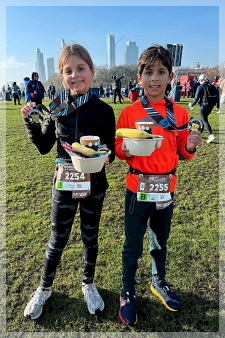 Like their parents, my youngest grands like to race and recently did this year’s 5K “Hot Chocolate” run. When Paul referred to running, he wasn’t referring to fun runs like theirs or a marathon like the one their parents ran nor were his boxing and wrestling references to the sports we know today. His allusions were to the Panhellenic games and Olympics which were well known throughout the Roman Empire in his day.
The modern Olympics are a secular event but the ancient Olympics were as much a religious festival as a sporting one. Held to honor Zeus, cheating was an offense to the gods and breaking any rule was a sacrilege. The athletes (along with their brothers, fathers, trainers, and judges) vowed before an enormous statue of Zeus that they’d observed all the rules of training for at least ten straight months and would use no unfair means to win. Just as those athletes did not want to dishonor Zeus, Paul did not want to dishonor Jesus with his “race” and he wrote of conducting himself honorably so he wasn’t disqualified.
Paul’s mention of self-control takes on deeper meaning when we consider the athletes’ rigorous training and the discipline and self-denial required to maintain their strict diet and demanding physical regimen for ten straight months. Some athletes even remained celibate during training. If they are going to finish their race, Christ’s followers need that same level of self-discipline, diligence, obedience, effort, focus, and full commitment to God and His kingdom but for a lifetime rather than ten months! Ancient athletes competed in the nude and barefoot on a sand surface. Even though we run our faith race in clothing, let’s remember that we are completely naked before God and nothing is hidden from Him!
The marathon is a modern Olympic event and the ancient foot races were much shorter, ranging from about 210 yards (the length of the stadium) to 2.8 miles (less than a 5K run). Such short races meant there was little chance to catch up if one fell behind. Since any race longer than the length of the stadium meant runners had to make a sharp 180-degree turn around a post, no runner wanted to be caught in the pack when making that turn! Runners had to start strong and push forward with all their might. While our faith race lasts longer, Christians need to strain forward and press on with that same intensity if we hope to reach our goal.
In a special race called the hoplitodromos, men ran from a quarter to a half mile while wearing a soldier’s helmet, shield, and greaves which meant carrying an additional 17 to 30 pounds. Depending on the race’s length, runners made one to three sharp turns and they often fell when their shields got entangled at the post. Knowing about the hoplitodromos gives deeper meaning to the admonition in Hebrews 12 to “lay aside every weight” slowing us down.
The brutal combat sports had no rest periods, water breaks, or time limits and bouts could last hours. Fighters risked injury, disfigurement, and even death. Other than biting, eye gouging, or attacking the genitals, just about everything else was allowed. With no holds barred and no weight classes, a wrestling match usually ended with broken bones. Boxers wore just a pad of leather over their knuckles and a man could be hit when down. The winner wasn’t determined by points or decision but by the complete submission or incapacitation of his opponent. When Paul referred to boxing, his readers knew that the fighter who shied away from his opponent or punched at air would not survive!
Testing an athlete’s ability to endure pain as much as his fighting skill, the pankration combined wrestling and boxing. In this brutal bloody contest, even groin kicks and hits were allowed. When Paul wrote of wrestling against the forces of evil or fighting the good fight of faith, he wasn’t talking about fighting under the Queensbury rules. He was speaking of a no-holds-barred-knock-down-drag-out brawl in harsh conditions—a battle that ended only when the opponent—Satan—was defeated!
With no teams, weak athletes couldn’t be carried to victory by stronger members of the team. Even though Christians collectively are the Church and the body of Christ, each person is responsible for running their individual race and fighting their individual battles. In the end, like the ancient Olympic athletes, we alone are responsible for how we run the race and fight the fight.
Even though my grands weren’t the first to cross the finish line in their recent 5K, they received medals along with a huge cup of cocoa, a banana, Rice Krispie treats, chocolate dip and a cookie (along with a hoodie)—which is more than the ancient Olympic athletes got! Back then, there was only one winner in each event and all he received at Olympia was a crown of olive leaves. For the chance to get one of those perishable crowns, athletes spent nearly a year training for a race less than the one my grands ran or for a fight that probably left them injured or disfigured. Only victors were honored by their home cities. As for the others—regardless of how honorably they competed, they returned home with their heads hanging in disgrace.
As Christians, no matter how slowly we run or often we stumble and regardless of how battered we get or frequently we’re knocked to the ground, if we are still running the race and fighting the fight until our dying breath, we will have won! Instead of being called up to the judge’s seat to receive a perishable crown of leaves, we will be called up to receive an imperishable crown of righteousness from the Lord Himself! Rather than returning to our hometowns with heads hanging in shame because we weren’t the strongest or fastest, we will go to our heavenly home as victors in Christ!
 Last October, we went north to watch our son and daughter-in-law run the Chicago Marathon. This 26.2-mile race passes through 29 Chicago neighborhoods and the city’s streets were lined with spectators ringing bells, beating drums, holding signs, cheering, and applauding as the runners ran past. Like us, some were there to cheer on specific runners but many were there to encourage all who were running. When we saw Sam and Nina, they were nine miles into their run and had stripped off the jackets, gloves, and hats they’d been wearing earlier that morning. The whole scene reminded me of today’s verse from Hebrews in which the author likens Christian living to running a race with endurance.
 Like Christians, Hindus believe that, when the body dies, the soul does not. Unlike Christians, however, Hindus believe that, after death, the soul lives on in an astral body until it is reborn in another physical body. This cycle is continually repeated until the soul reaches a certain state of perfection (moksha) and is released from the bondage of birth and death. At that time, like a drop of water that eventually merges into the ocean, the soul will finally merge into God and become one with its creator. Of course, once absorbed by the sea, the drop would cease to exist.
 While walking in the Botanical Gardens, I left my husband on a bench by the lake while I went back to get a few more photos of the plumeria. After getting my last shot, I returned to find him gazing out at the water. When I disturbed his reverie with a touch on the shoulder, he looked up and said, “I was just enjoying Him!” I knew exactly who he meant.
 Effortlessly skimming over the water, the bird occasionally dipped its bill into the water before gracefully rising, circling the pond, and returning to skim along the water again. Even though I’d never seen one inland, the bird’s large bill, distinctive black and white coloring, and unique flight identified it as a black skimmer. Although skimmers usually spend their lives around sandy beaches and coastal islands, sometimes they feed in inland lakes during nesting season and I was thrilled to watch several skimming over our lake just before sunrise.
 While editing photos, I came to one of a pipevine swallowtail. Seeing it on my computer rather than the camera’s viewfinder, I realized it had seen far better days. Its once beautiful wings were tattered and torn, only one “tail” remained, an antenna was missing, and, with many of its scales gone, its wings were more translucent than iridescent blue. Perhaps it had a close call with a predator, the wind had tossed it around, or it simply was old. In any case, it was damaged goods and no longer beautiful.
