LAMB SELECTION DAY – Palm Sunday

Rejoice, O people of Zion! Shout in triumph, O people of Jerusalem! Look, your king is coming to you. He is righteous and victorious, yet he is humble, riding on a donkey—riding on a donkey’s colt. I will remove the battle chariots from Israel and the warhorses from Jerusalem. I will destroy all the weapons used in battle, and your king will bring peace to the nations. His realm will stretch from sea to sea and from the Euphrates River to the ends of the earth. [Zechariah 9:9-10 (NLT)]

lambAs one of three pilgrimage feasts requiring every Jewish man’s attendance in Jerusalem, Jesus and the disciples joined other pilgrims on their journey toward the city for the Passover celebration. By the time they passed through Jericho (where He healed the blind Bartimaeus and ate dinner with Zacchaeus), a large crowd was following Jesus. It was on a Sunday that He and His disciples left Bethany for the two-mile walk into Jerusalem. The roads would have been crowded as pilgrims streamed into the city in preparation for the festival. Having heard of Jesus’ miracles and the way He brought Lazarus out of the grave, many of those in the streets were anxious to see Him. ”Could this be the long-awaited Messiah?” they wondered.

Although Jesus seemed to have walked everywhere, when He was less than a mile from the city, He sent two disciples to fetch a donkey’s colt that would be waiting for them. When Jesus deliberately rode that colt into Jerusalem, He was presenting Himself as Israel’s promised king. The animal’s significance was not lost on the people and their questions about His identity were answered. Solomon rode a donkey when he was presented to Israel as David’s rightful heir and successor and Zechariah prophesied that the promised Davidic king—the Messiah—would come on a donkey, as well! Thinking this king would save them from Rome, rather than Satan, people called out “Hosanna,” a combination of two Hebrew words, yasha (meaning save) and na (meaning now). Although Jesus brought salvation, it wasn’t from Rome!

Believing Jesus was the promised heir to David’s throne, the people recited from Psalm 118: “Blessings on the one who comes in the name of the Lord! Hail to the King of Israel.” Traditionally, people honored a new king by throwing their coats where he would sit or walk and palm branches were considered symbols of joy, victory, and triumph. The crowd’s reaction to seeing Jesus on the colt was to cut palm branches from the trees and to lay both palms and their coats across the road in Jesus’ path. Others, thinking they were celebrating victory over Rome, waved branches of palms as He passed. They didn’t know the victory they were celebrating was Christ’s victory over sin and death!

While Jesus was entering Jerusalem from the east, it’s likely that Pontius Pilate (governor of Judea) was entering the city from the west and King Herod from the north. In contrast to Jesus’ humble but joyous procession, their entrances would have been solemn and regal. Jesus rode a donkey and was accompanied by twelve disciples. Pilate and Herod would have ridden in chariots and been accompanied by legions of soldiers and warhorses. Jesus and his followers were weaponless but the soldiers wore armor and carried swords. While the procession from the east was led by the Prince of Peace, the processions of Herod and Pilate, men known for their violence and cruelty, would have been a show of force to quell any thoughts of a rebellion during the Passover.

Of course, only Jesus knew that the crowd exclaiming, “Hail to the king!” would soon turn on Him—that the cries of blessings upon Him would become shouts to crucify Him! Only He knew that His royal welcome would end with His dying a criminal’s death on a cross. It wouldn’t be until after His resurrection that His Jewish followers would understand the full significance of His entry into Jerusalem on that Sunday, the 10th day of Nisan.

According to Exodus 12, the 10th of Nisan was the specific day on which people were to select their Passover lamb (a male without any defect or blemish). The family was to keep the lamb until twilight on the 14th day when it would be killed and eaten. Jesus, the Lamb of God, entered Jerusalem on Lamb Selection Day. When He and His disciples ate their Passover meal that Thursday evening, Jesus broke the bread and gave it to His disciples saying, “This is my body.” He then passed the cup saying, “This is my blood.” It wasn’t until later that the disciples understood the full meaning of Christ’s words. While they may have consumed leg of lamb that night as they commemorated Israel’s deliverance from bondage to Egypt, the bread and wine made it clear that the sinless Jesus was the true Passover lamb. He was the perfect sacrifice who would deliver all who believed in Him from their bondage to sin!

On the night when he was betrayed, the Lord Jesus took some bread and gave thanks to God for it. Then he broke it in pieces and said, “This is my body, which is given for you. Do this in remembrance of me.” In the same way, he took the cup of wine after supper, saying, “This cup is the new covenant between God and his people—an agreement confirmed with my blood. Do this in remembrance of me as often as you drink it.” For every time you eat this bread and drink this cup, you are announcing the Lord’s death until he comes again. [1 Corinthians 11:23-26 (NLT)]

Copyright ©2023 jsjdevotions. All rights reserved.

DAILY BREAD (BEGGARS CAN’T BE CHOOSERS)

Give us this day our daily bread… Look at the birds of the air: they neither sow nor reap nor gather into barns, and yet your heavenly Father feeds them. Are you not of more value than they? [Matthew 6:11,26 (RSV)]

A pastor friend told me about returning from a service project with some of his SK8 church youth including Brian, a young man new to the faith. When they stopped for lunch at a taco stand, a street person asked Brian for money. Trying to do what Jesus would want done, the new Christian offered to buy the hard-up man a burrito. It was when Brian ordered two bean burritos that his dining guest loudly complained, “I ain’t eatin’ no $%2#!* bean burrito—I want a steak one!” Brian had little money to spare but, since the man was getting vociferous, he ordered the steak burrito for his guest and a bean one for himself. Apparently, the vagrant wasn’t familiar with the proverbs about beggars not being choosers, half a loaf being better than none, and not looking a gift horse in the mouth!
When I came across a cartoon done by Mark Lynch about Jesus feeding the multitude, I remembered my pastor friend’s story. In Lynch’s cartoon, Jesus is standing in front of a large group. Behind Him are piles of loaves and fish. With the caption “IF IT HAD BEEN TODAY,” the various speech balloons show members of the crowd asking if the fish contains mercury and if there’s a vegan option. Others want to know if the bread is gluten-free, baked locally, or has nuts. Another one complains, “I’m lactose intolerant.” While it is just a comic, I think Lynch isn’t far off. Human nature being what it is, the day Jesus fed a multitude of hungry people, I suspect there were some who grumbled about the lack of things like honey, olives, grapes or figs. Perhaps others asked, “Is this the best He can do?”

Shortly after teaching us to pray, “Give us this day our daily bread,” Jesus reassured us that, since God cares for the birds, He surely will care for us. His miracle of feeding the multitude shows us that God cares for His people. God, however, isn’t like Burger King and never promised us, “Have it your way!” He certainly never told us (as the hamburger chain now does), “You Rule.”

God is concerned about meeting our necessities but, like the homeless man and the comic’s multitude, our vision of a necessity often differs from His. Our daily bread probably isn’t brioche, a gluten-free all-natural blueberry muffin, a $10 loaf of artisanal sourdough from the farmer’s market, or even that $3.79 orange scone from Panera. It definitely isn’t the Gold Leaf Bread from Algatocin, Spain, that’s made with 250 mg of gold dust! It may not even be a whole loaf and it probably won’t include extras like Nutella, honey, fruit preserves, pate or avocado spread. Daily bread is what’s necessary and nothing more—anything else is like frosting on a cake or peanut butter on toast!

“We are beggars; this is true,” was written on a scrap of paper found in Martin Luther’s pocket when he died. How easily we forget that. In truth, we are not that different from the panhandler at the taco stand or Lynch’s multitude gathered on a hillside—more often than not we are unappreciative of the gifts we’re given. Perhaps, after asking God for our daily bread, we might want to add another prayer: “Help me recognize my needs and appreciate your provision.” With thanksgiving, let us reach out and gladly accept God’s love, forgiveness, mercy, Holy Spirit, and daily provision on His terms, not ours. Let us remember that beggars can’t be choosers.

And my God will supply every need of yours according to his riches in glory in Christ Jesus. [Philippians 4:19 (RSV)]

Copyright ©2023 jsjdevotions. All rights reserved.

FROM DEATH TO LIFE

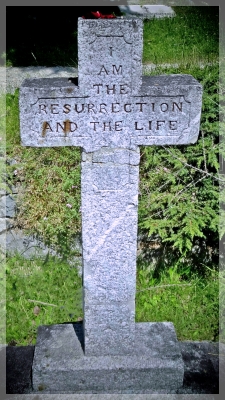
“I am the resurrection and the life,” replied Jesus. “Anyone who believes in me will live, even if they die. And anyone who lives and believes in me will never, ever die.” [John 11: 25-26 (NTE)]

Matterhorn Memorial - Zermatt

Courtesy of technology, we recently attended an Illinois church service while sitting at our computers in Florida. The choir, accompanied by pipe organ and trumpet, began with Jesu, Joy of Man’s Desiring and ended with Joyful, Joyful We Adore Thee. The trumpet’s bright piercing sound and the organ’s lilting accompaniment in the first song and the uplifting words in the final one makes them popular choices for joyful occasions like weddings, Christmas, and Easter. Although we were rejoicing, we weren’t celebrating nuptials, Christ’s birth, or His resurrection. Instead, we were rejoicing in a life well lived and celebrating the life of a friend who recently went home to God.

During the service, several people spoke of this Christian man’s faith, character, modesty, generosity, humility, compassion, honesty, reliability, thoughtfulness, wisdom, and curiosity. A leader both in his community and church, he built consensus rather than caused discord, bore the fruit of the Spirit, and truly lived his life as a follower of Christ. Although he played the trumpet in college, he never blew his own horn or called attention to himself. Nevertheless, he was a shining light in a world filled with darkness. Our lives were blessed by his presence and he will be deeply missed by all who knew him.

As much as his family and friends mourn his absence, the service was one of unparalleled joy because, while here on earth, he followed Jesus with his heart, soul, body, and mind. We could be joyful because we know death is not the end of our lives—just of our lives in these perishable bodies. As Christians, we have hope of something greater that goes far beyond life and death.

In contrast, I can’t feel joy at any funeral or memorial service for a non-believer. While songs may be sung, they’re more likely to be My Way or Over the Rainbow than Abide with Me or It is Well with My Soul. After sharing memories and listing accomplishments, the person giving the eulogy will say reassuring things about the deceased being in a better place, with the angels, or watching over us—none of which are based in reality. Unbelievers are not going home or into the arms of God, they won’t be “looking down” at their loved ones, and there won’t be a happy reunion in heaven with friends and family. The only way an unbeliever lives on is in photographs and people’s memories; sadly, even those will fade and be lost over time. There is little comfort in the passing of a non-believer.

While there are different opinions in Christ’s church about what happens immediately after death, there is unanimity in His church about what eventually happens—we will come face to face with God and our entire lives will be examined. Jesus’ life, death, and resurrection mean that His followers aren’t afraid of God’s judgment on the day. Regardless of our failures and sins, we are recipients of God’s grace and forgiven for our wrongs. Because of God’s mercy and grace, all of His adopted children have a confirmed reservation waiting for them in heaven.

Because the only way to heaven is faith in Jesus and there is no return from the depths of hell, there is no comfort or joy in the passing of a non-believer. On the other hand, in spite of our sorrow, we can rejoice when Christ’s followers depart this world because we know their destination, that our separation is only temporary, and that we will meet again in God’s good time. That’s why, at their passing, we can raise our voices and joyfully sing, “Joyful, joyful, we adore You, God of glory, Lord of love; Hearts unfold like flowers before You, Opening to the sun above.”

Morality may keep you out of jail, but it takes the blood of Jesus Christ to keep you out of hell. [Charles Spurgeon]

I’m telling you the solemn truth: anyone who hears my word, and believes in the one who sent me, has the life of God’s coming age. Such a person won’t come into judgment; they will have passed out of death into life. [John 5:24 (NTE)]

Copyright ©2023 jsjdevotions. All rights reserved.

REMEMBERING

Let all that I am praise the Lord; with my whole heart, I will praise his holy name. Let all that I am praise the Lord; may I never forget the good things he does for me. [Psalm 103:1-2 (NLT)]


Any other Thanksgiving, we would have travelled to be with family or entertained friends and family here but my recent surgery meant neither of those options were feasible, so it was just the two of us. Thanksgiving, of course, really isn’t about a bountiful feast of turkey and the trimmings or even about family and friends (although it’s a blessing when we can share it with them). Thanksgiving simply is about giving thanks—and we can do that regardless of where we are, what we’re eating, or who we’re with!

My husband and I spent most of the day looking through old photo albums. Having been married over 55 years, there were decades of memories packed into those old pictures and, with every memory, came a reason to be thankful. From pictures of our first date to our family gathering this year, we had countless reasons for gratitude. We were most grateful for the many years we had with his parents (who lived to 96 and 102) and the years we continue to enjoy with our children and grands; many are not so blessed. Pictures of every holiday and celebration seemed to include our family around a table laden with food and we thanked God that we never went hungry or homeless. Seeing photos of friends who became family, many of whom are gone, made us thankful that God brought them into our lives. As we recalled the trips we took, the places we visited, the houses we owned, the amazing people we met, and the adventures we had, we were filled with gratitude for those opportunities. Red-letter days like graduations, birthdays, baptisms, weddings, and anniversaries were memorialized in photos and we were thankful for the arrival of so many milestones. There also were countless photos of unremarkable times—everything from playing euchre with Grandpa, carving pumpkins for Halloween, walking in the woods with a little one, grilling burgers, and playing house with the grands to snow ball fights, baking cookies, shooting hoops, children running under the sprinkler, and enjoying s’more around the campfire. In retrospect, those ordinary moments were extraordinary and we were thankful for each one!

Of course, we laughed at many of the outfits, hairdos, silly expressions, and crazy situations we saw in those photos. When we weren’t laughing, there were sweet tears of nostalgia leaking from our eyes. All in all, our quiet day of Thanksgiving was a joyful day of giving thanks as we remembered how blessed we have been every moment of every day of our lives. Granted, we didn’t have any photos memorializing the tears, anguish, pain, affliction, hospitalizations, and grief of over 55 years. Nevertheless, evidence that God’s powerful hand was with us in both the good times and bad was in those pictures. They gave witness to answered prayers of things like healing, sobriety, health, achievement, provision, forgiveness, restored relationships, safety, protection, guidance, and success—and we gave thanks.

God told the Israelites to remember His word and commandments, His judgement, the ways He dealt with sin, and the way He tested them while safely leading them through the wilderness. God also told the Israelites to remember His goodness, all He did for them, His wondrous works, and His abundant provision! Yet, when it came time to claim Canaan—a land where they’d eat crops they hadn’t planted and live in cities they hadn’t built—the Israelites forgot God’s wondrous ways, grew fearful, and wanted to return to slavery in Egypt!

It’s in remembering God’s past faithfulness and bountiful provision that we learn to trust God with our unknown futures. Remembering God’s many blessings also leads to thanksgiving and it is the act of giving thanks that leads to us to joy. Indeed, in spite of missing our loved ones, our quiet Thanksgiving was one of the most joyful holidays we’ve experienced!

This way of seeing our Father in everything makes life one long thanksgiving and gives a rest of heart, and, more than that, a gayety of spirit, that is unspeakable. [Hannah Whitall Smith]

But watch out! Be careful never to forget what you yourself have seen. Do not let these memories escape from your mind as long as you live! And be sure to pass them on to your children and grandchildren. [Deuteronomy 4:9 (NLT)]

Copyright ©2022 jsjdevotions. All rights reserved.

AT ALL TIMES, IN ALL CIRCUMSTANCES (Thanksgiving Day)

Praise the Lord! I will thank the Lord with all my heart as I meet with his godly people. How amazing are the deeds of the Lord! All who delight in him should ponder them. Everything he does reveals his glory and majesty. His righteousness never fails. [Psalm 111:1-3 (NLT)]

Great Blue Heron
As we gathered for worship that Saturday night, it was just ten days after Hurricane Ian devastated our part of Florida and the mood was somber at best. Many of the regulars were missing and, for every story of hope, there were two more of unspeakable pain and unbelievable loss. Nevertheless, the pastor announced the theme of our service was gratitude and we began our worship singing Now Thank We All Our God, a hymn more associated with Thanksgiving Day than natural disasters. Indeed, as we thanked God “with heart and hands and voices,” my husband and I were thankful; for us, Ian was little more than an inconvenience in our lives. Most people, however, were not so blessed and I wondered how thankful they were.

The gratitude theme continued in the day’s Scripture starting with Psalm 111 and the words, “Praise the Lord,” followed by the miraculous healing of Naaman, the master’s lavish grace and mercy seen in the Parable of the Vineyard Workers, and Jesus’ healing of ten lepers, a story familiar to most of us. Although ten lepers were healed, only one returned to thank Jesus. Naturally, we laud the example of the one who expressed his gratitude and find fault with the nine who didn’t. Nevertheless, as soon as the ten saw their clean skin, there’s no doubt they all were incredibly thankful. As lepers, they’d been pariahs from society and literally untouchable but Jesus gave them a new lease on life. Although only one returned to express his gratitude, can we honestly fault the other nine? The lepers were desperate to return to their families, friends, homes, and trades but that couldn’t happen until the priests declared them clean! Like children who want to play with their new toys before thanking the grandma who gave them their presents, they were so focused on reclaiming their lives that they lost sight of the One who restored them!

Are we that much different from those nine? Do we ever get so caught up in the here and now— hurrying hither and yon, coping with our challenges, pursuing our goals, attempting to make do with what seems like not enough, dealing with difficult situations and even more difficult people—that we fail to express gratitude to the Giver of All Gifts? Do we let life’s trials or tasks keep us from giving thanks?

I’m reminded of a story told by Ann Voskamp in her book, One Thousand Gifts. As a farmer’s wife and mother of six (now seven) children (all of them homeschooled), she clearly knows the chaos, turmoil, and busyness of everyday life that so often overwhelms us and takes our focus off God. One morning, she unknowingly stepped into a war zone between siblings and the boys she loves behaved in a distinctly unlovable way. A tossed piece of toast became the proverbial straw that broke this mother’s back and, as she slammed her hands on the table, the exasperated woman asked herself, “How do I see grace, give thanks, find joy in this sin-stinking place?”

Remembering how Jesus gave thanks that night in the upper room, she took a deep breath and, focusing on God, gave thanks out loud. She thanked the Lord for her boys, toast, the hope of forgiveness, and for being a God who wouldn’t leave any of them in their ugly mess. Like the one leper who returned to thank Jesus, she paused in the midst of all that was happening and offered thanks to the Giver of all things who was there with her in that kitchen.

Whether we’re dealing with a child’s temper tantrum, undergoing chemo, straining to make ends meet, burying a loved one, laboring in the kitchen to get the turkey on the table, tarping a leaky roof, or shoveling mud out of a flooded house, we must never be too busy, too intent on our task, too angry, too tired, too broken-hearted, too exhausted, or too focused on our circumstances to turn to God and express our gratitude for His blessings! The only way any of us can see grace, give thanks, or find joy in this “sin-stinking place” of hurricanes, war, rage, disease, and loss is with the eyes of gratitude. Even in the worst of circumstances, there always is something or someone for which to be grateful.

Nothing comes close to God’s gifts of unconditional love, forgiveness, salvation, and eternal life and there is no way we can thank Him enough for those gifts. Thanksgiving shouldn’t be limited to the fourth Thursday in November; regardless of the circumstances, every moment of each day should be one of gratitude and giving thanks!

Enter his gates with thanksgiving; go into his courts with praise. Give thanks to him and praise his name.  For the Lord is good.  His unfailing love continues forever, and his faithfulness continues to each generation. [Psalm 100:4-5 (NLT)]

Copyright ©2022 jsjdevotions. All rights reserved.

HIDDEN BLESSINGS

And we know that God causes everything to work together for the good of those who love God and are called according to his purpose for them. [Romans 8:28 (NLT)]

great blue heronAs Christians, we know everything that touches us has first passed through our sovereign (and loving) God’s hands. While it is our faith in Him that enables us to accept difficult (even tragic) events, acceptance is easier said than done. Along with faith, Pollyanna, the fictional heroine in Eleanor Porter’s book by the same name, found that the correct mind set helped.

When Pollyanna was disappointed to find crutches instead of the doll she wanted in the package sent by the Ladies Aid Society, her missionary father taught her the “glad game.” Telling her to look at the good side of things, he pointed out they could be glad because she didn’t need the crutches! Pollyanna continued to play the glad game until she was sorely tested by paralysis. Admitting the game wasn’t as much fun to play when it got so challenging, she eventually found some good in her plight—she still had her legs! Indeed, the “glad game” is much harder when the issues are greater; nevertheless, it is a game worth playing.

At the age of 96, my lively and alert father-in-law died, but not of natural causes; he died within an hour of being in a car accident. As my mother-in-law rehabbed in a nursing home from the same accident, I was shocked when she said, “I’m so glad he went that way!” Fortunately, she explained, “He would have hated being in a place like this.” While I would have preferred God taking Grandpa while he napped in his easy chair, she had a point. Like a cat with nine lives, he had several amazing recoveries from earlier strokes and other health problems and still had a good quality of life. In reality, however, he was just a fall or another stroke away from becoming an infirm resident in a nursing home. This energetic and active man of faith was ready for his heavenly home and would have hated waiting for his departure as an invalid. Rather than being angry at the driver who caused the accident, I joined my mother-in-law in the glad game and chose to look at that accident as one of God’s blessings in disguise.

Sometimes, it takes time and the gift of hindsight before we recognize hidden blessings. I was fifteen and the only child still at home when my mother died within a few months of her cancer diagnosis. My emotionally detached and workaholic father was left with a teenager he barely knew while I was left with a man who was more a presence than a parent to me. He knew next to nothing about parenting and I resented his coldness and dogmatic ways. In an odd way, as much as we both mourned my mother, we were blessed by her absence because her death threw us together in a way that demanded change. Out of necessity, he gradually became a loving father and a far better man while the angry troubled teen I was became a loving responsible daughter and a far more compassionate woman. My father died less than five years later but several more years passed before I became aware of my older siblings’ continued resentment, anger, and bitterness toward him. It was only then that I realized how my mother’s death was a blessing in disguise because it gave my father and me an opportunity to build a relationship and to change for the better.

God often conceals blessings in our challenges, disappointments, and heartbreak; it is our task to seek them out. Playing our own version of the “glad game” by looking for God’s loving hand in our lives is the way we can have joy, not in spite of our troubles and sorrow, but because of them.

Always be joyful. Never stop praying. Be thankful in all circumstances, for this is God’s will for you who belong to Christ Jesus. [1 Thessalonians 5:16-18 (NLT)]

Copyright ©2022 jsjdevotions. All rights reserved.