THE FIRST HYMN

…be filled with the Spirit, addressing one another in psalms and hymns and spiritual songs, singing and making melody to the Lord with your heart, giving thanks always and for everything to God the Father in the name of our Lord Jesus Christ…. [Ephesians 5:18-20 (ESV)]

About midnight Paul and Silas were praying and singing hymns to God, and the prisoners were listening to them, [Acts 16:25 (ESV)]

In the ruins of Oxyrhynchus, Egypt, a scrap of parchment known as P.Oxy. 1786 was discovered in 1918. Only 11-inches long and 2-inches wide, it consists of four lines of text along with musical notations on the back of a grain contract. Found in an ancient garbage dump, it was just one of 500,000 parchments dating from the 1st century BC to the 7th AD. Along with grocery lists, official records, and business contracts, the rubbish heap yielded a play by Sophocles, poetry by Sappho, portions of the Old Testament, fragments of both Matthew’s and Mark’s gospels, and an arrest warrant for a Christian.

While scholars call it P.Oxy. 1786, after hearing the version adapted by Chris Tomlin and Ben Fielding, you probably will know it as “The First Hymn.” Indeed, in a way, it is! Granted, the song sung by Miriam after crossing the Red Sea predates Christ by 1,400 years, the Hebrew Psalms were sung at Temple worship, and Biblical scholars believe passages like Colossians 1:15-20 and 1 Timothy 3:16 were hymns sung by early Christians. Nevertheless, none of those psalms or hymns include musical notations as does P.Oxy. 1786. To date, this scrap of parchment dating from around 260 AD is the oldest piece of Christian music in existence.

Although musicologists and historians have known about P.Oxy. 1786 for over a century, it remained in a sort of academic “no man’s land,” until historian John Dickson took an interest in it. Hoping to bring this obscure little hymn back to life, he reached out to musicians Ben Fielding and Christ Tomlin. The result is a new worship song, “The First Hymn.” Bringing the words of this ancient hymn back to life as a contemporary worship song seems almost sacrilegious until we understand the original music. Musicologists say the hymn used the same melodic structure  used in taverns and on the stage at pagan theaters at the time. Musically, it was a 3rd century version of a Broadway, pop, or contemporary worship song! While the resurrected version doesn’t sound like the original, it has remained true to its purpose—a Christian worship song in the musical style of the day!

This hymn was sung at a time when the Church was confronted both by the pagan gods of the Roman Empire and various heresies regarding the divinity of Jesus and the Trinity. Yet, in its 35 words, it is a bold declaration of Christian faith. Combatting heresies of the day, it clarifies both the divinity of Jesus and the three separate but equal persons of the one triune God. It also makes a not too subtle dig at the Roman god Zeus. While pagans referred to him as the “giver of good gifts,” this hymn calls God the “only giver of all good gifts.” Moreover, by calling the heavens to be silent and the rivers to be still, the hymn showed the power of the one true God!

The 3rd century was a dangerous time for followers of Christ. In 201, Rome made conversion to Christianity a capital offense and, by mid-century, every citizen was required to make a sacrifice to the gods or face death. Found in that same ancient rubbish dump was a formal certificate proving that one local citizen had offered pagan sacrifice in public. Christians who refused were martyred in gruesome ways; if they weren’t crucified or beheaded, they may have been tossed into cauldrons of boiling oil or cast into an arena to be devoured by lions. Nevertheless, this hymn speaks of a God who gives good gifts—not suffering and persecution! This defiant hymn resounds with joy with its words, “Might, praise, and glory forever to our God. The only giver of all good gifts.”

The singing of hymns has a long history in the Christian church. Psalms, a book of songs, is the longest book in the Bible and Scripture makes over four hundred references to singing and fifty direct commands to sing. The last thing Jesus and the disciples did in the upper room His last night was sing a hymn. While in prison, Paul and Silas prayed and sang hymns to God which led to their jailer’s conversion! We find instructions to sing in Psalms, Ephesians, Colossians, and James. In the early second century, the Roman governor Pliny the Younger described the worship practices of Christians who “were in the habit of meeting on a certain fixed day before it was light, when they sang in alternate verses a hymn to Christ, as to a god.” Let us continue to sing the song of the redeemed as boldly as did the persecuted Christians of the early Church. Amen and amen.

Let all be silent: The shining stars not sound forth,
All rushing rivers stilled, As we sing our hymn
To the Father, Son, and Holy Spirit,
As all Powers cry out in answer, “Amen, amen.”
Might, praise, and glory forever to our God.
The only giver of all good gifts. Amen. Amen.
[P.Oxy. 1786 (The First Hymn)]

Let the word of Christ dwell in you richly, teaching and admonishing one another in all wisdom, singing psalms and hymns and spiritual songs, with thankfulness in your hearts to God. [Colossians 3:16 (ESV)]

Copyright ©2025 jsjdevotions. All rights reserved.

ORGANIZING PRAYERS

I urge you, first of all, to pray for all people. Ask God to help them; intercede on their behalf, and give thanks for them. [1 Timothy 2:1 (NLT)]

While there are no hard and fast rules about prayer except to believe in it and do it, some people use acronyms to help organize their prayers. The PRAY method stands for Praise, Repent, Ask, and Yield while the ACTS method formats prayer into Admiration (praise), Confession, Thanksgiving, and Supplication (asking God for what is needed). A TACOS prayer structure is Thanks, Adoration (or Applause), Confession, Others, and Self. Rather than an acronym, I was taught “The Hand of Prayer” as a girl. Beginning with the thumb, the order was Praise, Thanksgiving, Confession, Intercession (prayer for others), and Petition (prayer for oneself).

Regardless of how we do it, we should remember that only after we’ve put God first in our prayers, are we to pray for others and ourselves. I, for one, admit that I often speed through praise and thanks along with confession and repentance to get right to the asking. Worse, I find that my personal petitions frequently preempt and outweigh my intercessory prayers.

There is nothing wrong with praying for ourselves. In the Lord’s Prayer, we were taught to ask for our daily needs, forgiveness of sins, and deliverance from temptation. The Psalms are filled with pleas for God to intervene in the psalmists’ lives. Hannah, Jabez, David, Paul and even Jesus prayed for themselves. Praying for ourselves brings us into an intimate relationship with God and invites His blessings into our lives. The problem arises when we come to God just for those blessings without acknowledging Him or praying for others. Remembering our “God blesses” for others didn’t end with adulthood!

Before he became Pope Francis, Cardinal Bergoglio is said to have created the “Five Finger” prayer approach to help little ones remember their many “God blesses.” His method helps us remember to offer our prayers for others, as well. Because it’s nearest to the body when hands are folded in prayer, the thumb reminds us to pray for the people who are nearest and dearest—our family and friends. The index or pointing finger is a reminder to pray for those people (e.g. teachers, counselors, doctors, and pastors) who point us in the right direction. As the strongest and tallest, the middle finger is a prompt to pray for those in power and authority (even the ones with whom we disagree). Because it is the weakest digit with the least amount of dexterity, the fourth (or ring) finger reminds us to pray for the weak and powerless (e.g. the homeless, vulnerable, impoverished, and suffering). It is only when we get to the pinky that we pray for ourselves and our own needs. That little finger is a vivid reminder of how small we are in relation to God and how small our needs are in relation to the needs of others.

It is both a responsibility and a privilege to lift others’ needs to God in prayer. Abraham interceded for the people of Sodom, Job for his friends, Moses for the Israelites, the early church for the imprisoned Peter, Daniel for his captive nation, Paul for the readers of his letters, and Jesus for His disciples. John Calvin said, “To make intercession for men is the most powerful and practical way in which we can express our love for them.” When we pray with our five fingers, we have four fingers reminding us to do just that!

We are never more like Christ than in prayers of intercession. [Austin Phelps]

Pray in the Spirit at all times and on every occasion. Stay alert and be persistent in your prayers for all believers everywhere. [Ephesians 6:18 (NLT)]

Share each other’s burdens, and in this way obey the law of Christ. [Galatians 6:2 (NLT)]

Copyright ©2025 jsjdevotions. All rights reserved.

PROOF

Seeing their faith, Jesus told the paralytic, “Son, your sins are forgiven.” But some of the scribes were sitting there, questioning in their hearts: “Why does he speak like this? He’s blaspheming! Who can forgive sins but God alone?” [Mark 2:5-7 (CSB)]

white campionBy forgiving people’s sins, Jesus was placing Himself in the role of God because only God can forgive sins. Had Jesus not been God, it would have been blasphemy. When He raised the dead, multiplied food, stilled storms, and healed incurable diseases, Jesus was doing other things that only God could do. His incredible claim that He could bring Himself back from the dead, something only God could do, was another way Jesus claimed His divinity. The undeniable proof of His claim came Easter morning when Jesus demonstrated power over both life and death. The tomb was empty and people saw the risen Christ—they heard Him speak, watched Him eat, saw His wounds, and touched Him. The forty days the resurrected Jesus remained on earth, however, is about more than proof of his claim to be God; it’s about proof of our relationship to God.
Let’s return to the disciples in that locked room Easter morning. The man they thought was going to redeem Israel was dead and His body was missing. Were they any less confused, disappointed, frightened, or troubled by those events than the two Christ followers returning to Emmaus that day? Not only were the disciples perplexed, they probably were guilt-ridden, as well. Peter, John, and James had failed to stay awake and pray with Jesus in Gethsemane and Mark tells us they all deserted Him that night. After promising he’d never deny Jesus, Peter did just that three times! Jesus’ closest companions were nowhere to be found the following day when the crowd shouted “Crucify Him!” and it was a stranger who carried His cross. The only disciple at the crucifixion was John. Rather than any of the disciples, it was Joseph of Arimathea and Nicodemus who boldly risked their positions in the high council to see that Jesus got a proper burial.

When Jesus appeared to His disciples on Easter, thinking Him a ghost, they were startled and frightened. Once they knew it was the Lord, I’m not so sure they stopped being afraid of Him. But, instead of a reprimand for their doubt, Jesus simply showed them His hands and feet. Rather than shaming them for their cowardice, He spoke of forgiveness. While they may have anticipated a rebuke for their incomprehension and confusion, Jesus patiently explained the Scriptures’ prophecies and how He fulfilled them. When He appeared to Thomas, rather than scolding the doubter, Jesus told him to believe and offered proof. When Jesus appeared to the seven beside the Sea of Galilee, He didn’t admonish them for returning to their livelihood. Instead, He provided them with an enormous catch and made breakfast! Rather than confront Peter about his betrayal, Jesus restored their relationship and spoke to him of love. We know the Lord also spent time with his family but, rather than exacting retribution from the ones who thought him a religious fanatic, He forgave them; His half-brothers (two of which wrote epistles) joined His followers. Moreover, when Jesus finally ascended into Heaven, He didn’t leave His followers alone; He gave them His Holy Spirit!

The Resurrection tells us that Jesus defeated sin, Satan, and death and proves that He was God. The forty days the resurrected Christ spent on earth, however, tells us that the God who lived as a man for over thirty years was like the man who died and rose as God. It demonstrates that He was as gentle, patient, loving, and forgiving after the resurrection as He was before. He calmed the disciples’ fears, answered their questions, eased their doubts, knew their concerns, forgave their failures, and loved each one of them. A God of relationship, Jesus continues to know, see, hear, love, and forgive us today.

What was from the beginning, what we have heard, what we have seen with our eyes, what we have observed and have touched with our hands, concerning the word of life—that life was revealed, and we have seen it and we testify and declare to you the eternal life that was with the Father and was revealed to us—what we have seen and heard we also declare to you, so that you may also have fellowship with us; and indeed our fellowship is with the Father and with his Son, Jesus Christ. [1 John 1:1-3 (CSB)]

And we have seen and we testify that the Father has sent his Son as the world’s Savior. Whoever confesses that Jesus is the Son of God—God remains in him and he in God. And we have come to know and to believe the love that God has for us. [1 John 4:14-16]

Copyright ©2025 jsjdevotions. All rights reserved.

ON MARCH 25 (Part 1)

So the Word became human and made his home among us. He was full of unfailing love and faithfulness. And we have seen his glory, the glory of the Father’s one and only Son. [John 1:14 (NLT)]

If we were living in England or any of its colonies between 1155 and 1752, today would be New Year’s Eve. Back then, the British Isles used the Julian calendar. Named after Julius Caesar, the calendar year originally began January 1. After the fall of the Roman Empire, however, the new year’s onset gradually changed to the first day of spring. While starting a new year in the dead of winter seemed counter-intuitive, beginning it on March 25, the date of both the spring equinox and the Christian Feast of the Annunciation of Christ’s Birth, seemed a more logical way to start the year.

The Julian calendar, however, miscalculated the adjustments needed for leap years as well as the date of the spring equinox. Wanting Christians to celebrate Easter on the correct date, Pope Gregory instituted a new liturgical calendar with a better way of calculating leap years in 1582. Called the Gregorian calendar, January 1 was set as the beginning of the year. While March 25 no longer marked the equinox, it remained the date of the Annunciation. Although much of Roman Catholic Europe adopted Gregory’s calendar, Protestant England resisted and continued to follow the Julian calendar until finally adopting the Gregorian one in 1752.

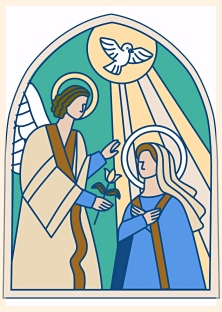
While no longer New Year’s Day, for those in liturgical churches, tomorrow (March 25) is known as the Annunciation of our Lord. Commemorating the angel Gabriel’s visit to the Virgin Mary, it is a celebration as much Protestant as it is Roman Catholic. The Annunciation was celebrated as far back as the fourth or fifth century and its March date was set in the seventh.

Let’s not forget that the story of Jesus didn’t begin in Bethlehem; it began in Nazareth nine months prior to that night. It was when Mary became pregnant that God became incarnate—a human being made of flesh and blood. Granted, He was only two cells fused together at first. Nevertheless, that zygote had everything in it to become the man Jesus. It divided again and again, the embryo grew, the cells began to differentiate, and the fetus developed everything needed to live outside His mother. Since sin-filled man was incapable of going to God, on that day, our perfect God came to us. Fully God and fully man—that baby boy forming in Mary’s womb was the promised Messiah and savior of mankind!

While Jesus’ incarnation is the core of our Christianity, it is difficult to understand and, for some people, impossible to believe. Nevertheless, the God who spoke the world into creation, created night and day, scattered the stars through the sky, filled the oceans with water, and populated the earth with living plants and animals could certainly manage to plant a fetus in a womb without going through the ordinary steps. When Mary assented to God’s will, Jesus was conceived through the power of the Holy Spirit!

Of course, since we really don’t know when Jesus’ birth took place, we don’t know the date of His conception. Nevertheless, having grown up in a liturgical church, I find a richness and strength in remembering and celebrating events in the life of Christ (even if the dates are wrong). Luke’s gospel account of Gabriel’s visit to Mary seems more appropriate in this spring season of new beginnings and fresh starts than in winter, a time of dormancy. On what I hope to be a beautiful spring day for you, please take the time to read the account of this blessed miracle found in Luke 1:28-36. Remember to thank God for His entry into the world as a man so that He could save humanity.

Jesus Christ became Incarnate for one purpose, to make a way back to God that man might stand before Him as He was created to do, the friend and lover of God Himself. [Oswald Chambers]

Without question, this is the great mystery of our faith: Christ was revealed in a human body and vindicated by the Spirit. He was seen by angels and announced to the nations. He was believed in throughout the world and taken to heaven in glory. [1 Timothy 3:16 (NLT)]

Copyright ©2025 jsjdevotions. All rights reserved.

FASTING ALLELUIA

Hallelujah! Give thanks to the Lord, for he is good; his faithful love endures forever. [Psalm 106:1 (CSB)]

Hallelujah! Give praise, servants of the Lord; praise the name of the Lord. [Psalm 113:1 (CSB)]

low bindweed“Alleluia” (or “Hallelujah”), like “Amen,” is a word familiar throughout Christendom. Meaning “Praise the Lord,” it is the transliteration of the Hebrew hallel, meaning to shine, be boastful, praise, or rejoice and Yah, an abbreviated form of the name of the Lord: YHWH (Yahweh/Jehovah). Although two distinct words, they were consistently written as one (halleluyah).  In the Old Testament, this extraordinary word occurs only in Psalms. Usually found at the beginning, halleluyah was an imperative call to praise or boast in the Lord—a call to shine a light upon Him! Whether we spell this beautiful word the Latin way as “alleluia” or the Greek way as “hallelujah,” the meaning is the same. Many modern translations simply translate it as “Praise the Lord!”

On the Sunday prior to Ash Wednesday, the pastor at our liturgical church selected “All Creatures of our God and King” for the opening hymn at worship. As we sang its many alleluias, I knew we wouldn’t be singing any more of them until Easter. When our pastor was a girl, on the Sunday before Lent, the church’s children would process into the sanctuary carrying a banner with the word “Alleluia” on it. After being folded and placed in a box under the cross, that word and banner wouldn’t reappear until Easter morning. Although we don’t physically put away or “bury” any alleluias at our church, she continues the ancient tradition by eliminating them during Lent.

As a way of highlighting the solemnity of Lent, the “putting away” or depositio (meaning burial) of the alleluia goes back to medieval times. Choir boys would process into church with crosses, candles, and holy water while carrying a casket containing an “Alleluia” banner. The coffin was then buried in the garden until it was unearthed during the Easter vigil. In Paris, a straw figure bearing an “Alleluia” of gold letters was carried out and burned in the churchyard. After the Reformation, many Protestants continued the tradition of eliminating alleluias during the somber penitential season of Lent.

One modern writer compared putting away our alleluias during Lent to putting away all our Christmas decorations in January. If we had the tree, nativities, and wreaths out all year long, they’d lose their significance. Commonplace rather than special, they’d be ignored and unappreciated. Because we put them away in January, they’re treasured when we bring them out again in Advent! Without any alleluias during Lent, we appreciate them even more on Easter morning as we praise the Lord with every “Alleluia” in “Christ the Lord is Risen Today.”

While many hymns include “alleluia” or “hallelujah,” it occurs in only four New Testament verses, all in Revelation 19, when a heavenly chorus sings “Hallelujah!” at the marriage supper of the Lamb. While Lent is a time to focus on recognizing our sin and need for salvation, fasting from alleluias for seven weeks reminds us that our story is not yet complete. The day will come when Christ returns and God’s victory is completed. When that happens, we will be part of that heavenly chorus and praise the Lord while singing “Hallelujah!”

The greatest adventure in life—knowing God—begins at the Cross of Christ and ends with a “Hallelujah!” [David Jeremiah]

Then I heard something like the voice of a vast multitude, like the sound of cascading waters, and like the rumbling of loud thunder, saying, Hallelujah, because our Lord God, the Almighty, reigns! [Revelation 19:6 (CSB)]

Copyright ©2025 jsjdevotions. All rights reserved.

HOW DO WE DO IT?

Speak to each other in psalms and hymns and spiritual songs, singing and chanting in your heart to the Lord, always giving thanks for everything to God the father in the name of our Lord Jesus the Messiah. [Ephesians 5:19-20 NTE)]

lotus flowerJoe Btfsplk was a character in Al Capp’s Lil’ Abner comic strip. With a last name that sounds likes what’s known as a “raspberry” or “Bronx cheer,” the poor man had a dark cloud of perpetual bad luck hanging over his head. Btfsplk no longer appears in the comics but I think his dark cloud of misfortune has settled over the head of a dear friend I’ll call JB (in honor of Capp’s luckless character). Since JB’s retirement, if something could go wrong, it has and, as soon as one challenge resolves, another one appears. When I saw the photos from his most recent mishap, JB looked as if he’d been tossed around in a giant rock tumbler filled with broken glass and boulders.

I later learned that one of his wounds became infected (meaning a hospital stay) and, upon his release, JB fell and suffered a ruptured Achilles tendon! A modern-day Job, the poor guy can’t catch a break!

JB, like Job, could be described as an honorable and upright person who fears God. Fortunately, JB doesn’t have a group of friends (like Job’s) who blame his misfortunes on his unrepented sins. Nevertheless, like Job, JB probably wants to know the why of his continual trials. But, as a Bible-reading Christ follower who’s read the book of Job, JB understands that only our sovereign God knows why life unfolds as it does.

Paul’s words to the Ephesians were to always give “thanks for everything to God the Father” but, when considering JB’s trials, I wonder how it can be done. Were I under the dark cloud that seems to plague him with an unending downpour of challenges, I wonder if I could give thanks for it all. While giving thanks in some or most things is doable, the Greek word Paul used was pas which meant the entirety—every kind of circumstance. Rather than just the good or even tolerable stuff of life, we are to give thanks for the whole shebang (trials and all)!

It’s not as if Paul said those words flippantly. Like JB, his life was filled with trials and adversity. He suffered through more than his share of floggings, beatings, shipwrecks, imprisonment, persecution, physical infirmity, and pain. Giving thanks in such ordeals and trouble seems impossible until we look at Paul’s words leading up to today’s verses in which he said to “be filled with the Spirit!” [5:18] He also called on the power of the Spirit with his closing words to the Ephesians: “Just this: be strong in the Lord, and in the strength of his power.” [6:10] He told Philippians something similar: “I have strength for everything in the one who gives me power.” [4:13]

On our own, we might be able to put on a good front—grit our teeth, “grin and bear it,” or wear a martyr’s face while grumbling inside—but we need the power of the Holy Spirit to have a heart that is thankful to God in all things. It is by the Spirit’s power that we can focus on God, on His love, wisdom, and many blessings so that, knowing that He sees the future while we see only the present, we can submit to His sovereign plan with thanks and even joy.

I don’t think Paul’s words mean we have to be happy every time we end up in the ER, are diagnosed with cancer, or lose a loved one. The many psalms of lament show us that grief, anguish, and pain can coexist with gratitude. Rather than denying our pain, sorrow, or suffering, giving thanks during our trials reminds us that beauty, joy, and good still exist in spite of them. We can move from lament to gratitude because there always is something for which we can be thankful in every situation—even if it’s only that whatever happened wasn’t worse! We know that God is present and that He will strengthen, comfort, protect, and guide us through the dark storms of life and, for that, we can be thankful.

Admittedly, being thankful in all circumstances is not easy. Even famed evangelist Charles Spurgeon struggled. “I have not always found it easy to practice this duty; this I confess to my shame,” said the man known as the ‘Prince of Preachers.’ “When suffering extreme pain some time ago,” continued Spurgeon, “a brother in Christ said to me, ‘Have you thanked God for this?’ I replied that I desired to be patient, and would be thankful to recover. ‘But,’ said he, ‘in everything give thanks, not after it is over, but while you are still in it, and perhaps when you are enabled to give thanks for the severe pain, it will cease.’ I believe that there was much force in that good advice.” Indeed, there is!

Always celebrate, never stop praying; in everything be thankful (this is God’s will for you in the Messiah Jesus). [1 Thessalonians 5:16-18 NTE)]

Copyright ©2025 jsjdevotions. All rights reserved.