
For the Lord is a great God, a great King above all gods. He holds in his hands the depths of the earth and the mightiest mountains. The sea belongs to him, for he made it. His hands formed the dry land, too. [Psalm 95:3-6 (NLT)]
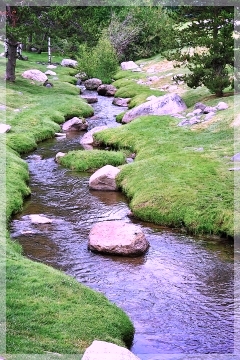 “The heavens proclaim the glory of God. The skies display his craftsmanship,” said the Psalmist. [19:1] It’s not just the heavens, however, that declare God’s glorious existence. Something as lowly as soil or as ordinary as water testify to His magnitude, creativity, skill, wisdom, and attention to detail, as well!
Unless we encounter an earthworm or beetle while digging in the garden, we probably think of soil as lifeless when, in actuality, it’s a dynamic living ecosystem. One handful of productive soil contains about 100 billion microorganisms of bacteria made up of about 10,000 different species. In that same handful of dirt are 100 meters of fungal cells of some 500 species of fungi, along with 20 million protozoa, 100,000 nematodes (unsegmented round worms) and 50,000 arthropods (like centipedes and microscopic mites), along with any earthworms and algae that may have tagged along. There are more living organisms in a handful of soil than there are human beings on our planet!
As small as all those microorganisms are, consider that one drop of water (.05mL) contains 1.67 sextillion molecules of H2O (that’s 21 zeroes). Smaller than those molecules are the more than 5 sextillion atoms of hydrogen and oxygen in those molecules! If we were counting the molecules of H2O in just ten drops of water (.17 oz.), we’d need 210 zeros (a quantity outnumbering the stars in the universe and all the organisms in the soil combined)! We really shouldn’t be surprised; after all, this is the same God who glued those beautiful microscopic scales on a butterfly’s wings (600 per square millimeter), dropped miniscule pollen grains (.006 mm) in the forget-me-not, and packed 100 billion neurons in the human brain.
We stand in awe at the enormity of the Grand Canyon, the striking colors of Yellowstone’s Grand Prismatic Spring, the red and orange hoodoos of Bryce Canyon, or the flood of water surging over Niagara Falls (757,500 gallons per second) without giving a thought to the atoms that make up every drop of that water or the microscopic life existing in the world beneath our feet. The heavens may declare His glory and existence but so does the rest of His magnificent creation!
All things bright and beautiful, All creatures great and small,
All things wise and wonderful: The Lord God made them all.
He gave us eyes to see them, And lips that we might tell
How great is God Almighty, Who has made all things well.
[Cecil F. Alexander]
 Writing about pesky mosquitoes yesterday reminded me of a story told by Corrie ten Boom in her book The Hiding Place. As part of the Dutch resistance during World War II, Corrie’s family harbored Jews and others hunted by the Gestapo in their home. After being betrayed by a Dutch informant, the ten Boom family was arrested and imprisoned. Corrie and her sister Betsie ended up in the Ravensbrück concentration camp. That first night, as they shared a bed in the crowded barracks, Corrie discovered their bedding was infested with fleas. Betsie reminded her sister of the Scripture passage they’d read that morning from 1 Thessalonians: “Give thanks in all circumstances.” As they began praying, Betsie listed the things for which they could give thanks, such as their remaining together and having smuggled a Bible into the barracks. But, when she mentioned the fleas, Corrie’s response was, “There’s no way even God can make me grateful for a flea.” Betsie explained that the verse said all circumstances and not just the pleasant ones, so Corrie reluctantly joined her in a prayer of thanksgiving that even included the fleas.
 God saw all that he had made, and it was very good. [Genesis 1:31a (NIV)]
 You know the generous grace of our Lord Jesus Christ. Though he was rich, yet for your sakes he became poor, so that by his poverty he could make you rich. [2 Corinthians 8:9 (NLT)]
 While the Jews to whom Jesus was speaking were thinking of political freedom and enslavement to people, Jesus was speaking of spiritual freedom and the enslavement of people to sin. Yet, even then, the Jews were wrong. They’d forgotten about being Pharaoh’s slaves in Egypt; being captives of the Moabites, Canaanites, Philistines, Midianites, Mesopotamians, and Ammonites during the time of the Judges; their Babylonian exile; Persian rule; Alexander the Great; the Ptolemies and Seleucids; and Rome’s occupation of their homeland. They hadn’t had freedom from foreign domination for centuries. Jesus’ answer, however, made it clear that He was speaking of spiritual freedom. His listeners’ hope for spiritual freedom wouldn’t be found in their ancestry; it would be found in Him—He was the Son who could set them free.
 A friend once asked her mother which of her children was the favorite. I can’t imagine making such a query, wanting to hear the answer, or how I’d respond to the same question. Since I can’t even pick my favorite color, I certainly couldn’t pick my favorite child. Is it the one with the over-the-top personality who not only could sell ice cubes to Eskimos but convince them to double their order because of a possible shortage? Is my favorite the adventurous one with the wonderfully quirky sense of humor and a mind that puts Wikipedia to shame? Is my favorite the thoughtful child—the one whose faith, strength, and patience rival that of Job? If they were beverages, one child would be a doppio espresso; another spiced chai with ginger, cardamom, allspice, cinnamon and cloves; while the third would be calming chamomile tea with a touch of honey. Like those beverages, each of my children is interesting, pleasant, and delightfully unique. One challenged me, one grieved me, and one worried me. Do I love them less because of that? Absolutely not! While I love them equally, because they have been blessed with different personalities and abilities, I don’t always treat them the same. Nevertheless, I love all three of them, just each in their own special way!
 Devotions of the Heart