
How happy is the one who does not walk in the advice of the wicked or stand in the pathway with sinners or sit in the company of mockers! Instead, his delight is in the Lord’s instruction, and he meditates on it day and night. He is like a tree planted beside flowing streams that bears its fruit in its season, and its leaf does not wither. Whatever he does prospers. [Psalm 1:1-3 (CSB]
 When we celebrate St. Patrick’s Day tomorrow, I suspect the revered bishop who brought Christianity to Ireland in the 5th century wouldn’t recognize this day in his honor. Originally a religious feast, it’s now a day for parades, sales, “Kiss Me I’m Irish” t-shirts, corned beef and cabbage, music, dancing, and lots of green (including hair, cookies, the Chicago River, milk shakes, and kegs of beer). St. Patrick, however, would recognize the common symbol of the day: the shamrock. Of course, to Patrick, the shamrock, with its three leaflets bound by a common stem, was a metaphor for the Holy Trinity. The shamrock’s three leaflets also came to symbolize faith, hope, and love.
“The luck of the Irish” may trace back to the thousands of superstitions in Irish folklore. (Getting married in May is bad luck but seeing a white horse in the morning is good!) The “lucky” four-leaf clover has its origins in ancient Celtic folklore. Irish and Celtic myths and legends also tell of fairies (Aes Sídhe) and pesky goblins (Púca) who were known to hand out both good and bad luck to humans. Nevertheless, it’s hard to see how a people who were invaded by Vikings, suppressed at the hand of England, suffered mass starvation during the Irish Potato Famine, failed at every revolution, and were treated like third class citizens upon their arrival in the U.S. could be called “lucky.”
According to Edwin T. O’Donnell of Holy Cross College, “the luck of the Irish” originally was a derogatory phrase here in the United States. During the silver and gold rush days of the 19th century, some of the most successful miners were Irish or Irish/American. Saying a miner’s success was “just the luck of the Irish” meant that it was mere happenstance and had nothing to do with the hours of drudgery the miner endured, the danger he faced, the sacrifices he made, the loneliness he suffered, or his skill with a pick and shovel.
Anne, a woman in my Bible study, mentioned her daughter’s recent school assignment. The girl and her parents were to paste pictures of the things that made them lucky on a large green construction paper shamrock. A woman of faith, Anne didn’t want to be one of those parents who make a mountain out of every molehill encountered in public school. Nevertheless, she credits God (not luck) with her family’s blessings, so she and her daughter pondered how to proceed with the assignment in a way that honors God. They pasted photos of their family on their “Lucky Family” shamrock and then wrote these words: “No luck involved! We are blessed by the grace of God to be a happy family!”
Attributing their happy family to luck would be as insulting to God as saying the success of a miner who’d struggled in difficult circumstances to stake his claim was just “the luck of the Irish.” Nevertheless, that construction paper shamrock with its three leaves also symbolizes what enables Anne’s family to live with joy, peace, forgiveness, and confidence: the Father, Son and Holy Spirit who govern and fill their lives. Moreover, the happiness of her family has to do with their faith, hope, and love (both for God and for one another). There was no “lucky” fourth leaflet on their shamrock because luck has nothing to do with it; God, however, does!
Don’t be deceived, my dear brothers and sisters. Every good and perfect gift is from above, coming down from the Father of lights, who does not change like shifting shadows. [James 1:16-17 (CSB)]
Copyright ©2026 jsjdevotions. All rights reserved.
 Every year a friend sends me a bayberry candle to burn on New Year’s Eve. Legend has it that lighting a bayberry candle when the first star appears, burning it past midnight into the new year, and letting it burn all the way down will bring good luck, wealth, and prosperity to a home. We can’t stay awake past midnight and allowing an unattended candle to burn down to its socket seems more a guarantee of fire and disaster than good luck. Nevertheless, in honor of our friend, we light our candle every New Year’s Eve and extinguish it shortly after the new year begins in Greenland (three time zones east).
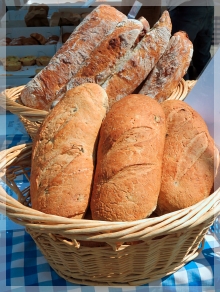 In all probability, you’re not having more than 5,000 guests for dinner today and they won’t be dining al fresco on a hillside. Nevertheless, John’s description of that miraculous meal sounds a bit like Thanksgiving dinner at any number of homes today. There will be lots of people and more than enough to eat but, instead of all the leftovers being gathered in baskets, we’ll pack them into storage containers made by Rubbermaid, Glad, Tupperware, and Pyrex.
 The early Christians often marked anniversaries of the martyrdom of Christ’s followers. By the fourth century, however, there’d been so many martyrs that there weren’t enough days to honor them all and the idea of one feast day honoring all the martyrs began. In 609, Pope Boniface IV established an All Saints’ Day in May. After Christianity came to Ireland, however, the Roman church attached the Feast of All Saints to the pagan holiday of Samhain (a celebration of the end of the harvest and precursor to Halloween). In 847, Pope Gregory IV formally rebranded this pagan Celtic festival as All Saints Day. Saturday, November 1, is All Saints’ Day and, regardless of your denomination, it remains a day to commemorate all of the saints, not as determined by any Pope, but as defined in the Bible.
 I began my prayer with the words of John Baille found in A Diary of Private Prayer. He opened the prayer by praising the “Lord and Maker of all things” for things like “the life that stirs within me” and “the bright and beautiful world around me.” But it was the inclusion of “all you have given me to fill my hours of leisure…music and books and good company and all the harmless and delightful pleasures” that gave me pause. How often do we offer praise and thanksgiving for “leisure” and the “delightful pleasures” of life? Do we regularly praise and thank Him for the taste of strawberries, the scent of lilacs, the joy of making love, napping in a hammock on a summer day, enjoying a latte and a fresh-baked almond croissant, completing a sudoku or crossword puzzle, a good workout at the gym, a game of mahjong or golf with friends, snuggling on the sofa with the cat, eating s’mores around a campfire, playing Crazy 8’s or Uno with the kids, binge watching Netflix on a rainy day, or warm apple pie with vanilla ice cream? Each of us has our favorite leisure activities and sources of pleasure and yet pleasure is not one of the words typically associated with Christian belief. In fact, many consider pleasures to be the devil’s tool used to keep us from a godly life!
 This proverb about iron sharpening iron reminds me of Sunday dinners when I was a girl. After the roast beef was placed in front of my father, he picked up the carving knife and a steel rod. With dramatic flair, he would run the knife back and forth against the steel before carving the meat. For the perfect slice of beef, he used iron to “sharpen” iron.
 Devotions of the Heart