
Dear friends, do you think you’ll get anywhere in this if you learn all the right words but never do anything? Does merely talking about faith indicate that a person really has it? For instance, you come upon an old friend dressed in rags and half-starved and say, “Good morning, friend! Be clothed in Christ! Be filled with the Holy Spirit!” and walk off without providing so much as a coat or a cup of soup—where does that get you? Isn’t it obvious that God-talk without God-acts is outrageous nonsense? [James 2:14-17 (MSG)]
 Which can you do without? The right side of your heart or the left? Which blade on the scissors wouldn’t be missed? What is more important? The front wheel or the back one on your bicycle? The gas pedal or the brakes on your car? The right wing or the left of an airplane? Faith or works? Neither! None of these things can operate without the other. We need two blades on the scissors, two wings on the plane and we can’t be Christians without both faith and works.
We sometimes use the word “Christian” simply as an adjective to describe good, generous, moral or loving behavior. I have Jewish, Muslim and non-believer friends who easily could be described with those same adjectives. Good works alone cannot be used to define Christianity. On the other hand, I know people who say they believe in Jesus and call themselves “Christian” who appear to be sorely lacking in the good, generous, moral and love departments. So simply saying we have “faith” in Christ doesn’t seem to define Christianity either.
Our faith makes us Christians but that faith is far more than intellectual belief. Because the Holy Spirit comes along with faith, our faith is God at work in us. True faith changes our hearts, minds and souls. Since the Holy Spirit can’t help but do good works, if we have faith, neither can we!
Works follow from faith and yet faith, without works, cannot be faith. We can neither think our way nor can we work our way into heaven but, by the grace of God, with faith, we will live our way there!
Faith without works is like a bird without wings; though she may hop with her companions on earth, yet she will never fly with them to heaven. [Francis Beaumont]
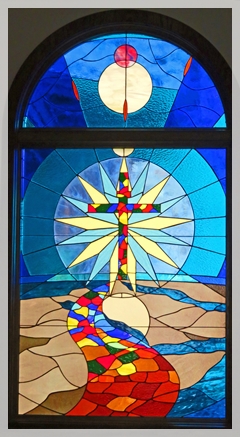 While speaking of salvation, our pastor suggested that there are four kinds of people we might find in any church. While sure of their salvation, the people in the first group are not secure in it. It’s not that they’ve lost their salvation; they never had it! Often called nominal or cultural Christians, their faith is in religion rather than Jesus and they mistake sitting in a church pew for having a relationship with God. Thinking they can purchase their ticket on the glory train with money or works, Christianity is an insurance policy for the hereafter rather than anything affecting heart or soul. They don’t understand that looking like a Christ follower, even with impressive God talk and charitable acts, isn’t the same as being one. There is a vast difference between true faith and false professions.
 To impress their students with the importance of commas, English teachers often tell an unsubstantiated story about Maria Fyodorovna, the wife of Tsar Alexander III of Russia. Alexander, a harsh and repressive ruler, had exiled a suspected anarchist to imprisonment and death by writing these words on his warrant: “Pardon impossible, to be sent to Siberia.” Coming across the document, the Tsarina seized the opportunity to save the life of an unknown prisoner and quickly scratched out the comma. She re-inserted it so that the warrant read: “Pardon, impossible to send to Siberia.” With the comma’s transposition, the prisoner’s death warrant became his pardon.
 Don’t long for “the good old days.” This is not wise. [Ecclesiastes 7:10 (NLT)]
 I started Sunday morning with Psalm 139—a beautiful reminder that God was with us at our conception, is with us now, and will be with us at our end. “Thank you for making me so wonderfully complex! Your workmanship is marvelous,” read the psalm. Those words reminded me of Joey. Chinese by birth, born without hands, and abandoned by his mother, he was adopted by an American family. In spite of his many visible and hidden challenges, Joey was a cheerful little guy until entering junior high school, encountering bullies, and asking the inevitable questions that come with adolescence. In spite of being part of a loving family, he feels he failed the birth family who discarded him like a piece of trash and, rather than feeling wonderfully made, Joey asks why God made him the way He did.
 Jesus clearly promises forgiveness of our sins but some people treat this gift as little more than a Monopoly game’s “Get Out of Jail Free” card. The pilgrims Honest and Great Heart meet such a person in John Bunyan’s The Pilgrim’s Progress. Motivated by God’s promise of “eternal security,” Mr. Selfwill feels free to live any way he wants. Since David committed adultery, Rahab lied, and Jacob deceived, he believes he can do those things, as well. He thinks anyone who believes that Jesus has forgiven his sins has the freedom to sin willfully as long as he has some virtues to go along with his sins. Assuming his good deeds cancel out his bad ones, Selfwill deliberately sins.
 Devotions of the Heart