
But the Lord said to Samuel, “Don’t judge by his appearance or height, for I have rejected him. The Lord doesn’t see things the way you see them. People judge by outward appearance, but the Lord looks at the heart.” [1 Samuel 16:7 (NLT)]
 After God rejected Saul as king, He sent Samuel to the home of Jesse, telling him that one of Jesse’s sons had been selected as the next king. Samuel was sure he’d found the new king after taking one look at Eliab, Jesse’s eldest boy. Like Saul, Eliab must have been tall, muscular, and handsome, but mere good looks hadn’t served the people well with Saul. Telling Samuel not to judge by outward appearances, God said that He judges by what’s in the heart. In Samuel’s day, only God could see into the heart; that’s not so today!
I recently had an echocardiogram. During this test, high-frequency sound waves, combined with Doppler ultrasound and color Doppler, provided images of my heart’s chambers, valves, and blood flow. The cardiologist then evaluated the size, structure, movement, and strength of my heart to detect any damage, defects or disease. Nevertheless, in spite of being able to actually observe the way my heart functions, she couldn’t see into my heart any better than did Samuel into either Saul’s or Eliab’s.
Although the cardiologist’s report gave the exact dimensions and thickness of each part of my heart, she really doesn’t know if I am big or small hearted, or if my heart is pure, true, honest, compassionate, meek, wise, joyful, willing or good. Although the cardiologist knows my blood flow velocity and cardiac output, she doesn’t know if my heart is hard, cold, haughty, deceitful, broken, bitter, rebellious, stubborn, wicked, heavy, or in need of cleansing. While her conclusion was that, in spite of a few abnormalities, my heart is fine, God is the only one who can truly evaluate it. Moreover, it is He, not a cardiologist, who determines whether or not anyone needs a whole new heart!
As used in Scripture, the heart is the origin of our behavior, expressions and words: our soul or essence. The center of our physical and spiritual life, it does more than pump blood. Holding our beliefs and faith, it is the source of our imagination, inclinations, affections, intentions, desires, ideas, passions, morals, concerns, purposes and will. No matter how skilled the sonographer, how sophisticated his equipment, or how knowledgeable the cardiologist, an echocardiogram can’t show any of that!
Having read my echo report, I know what the cardiologist saw when looking into my heart. The more important report, of course, is what God sees when he looks there. Is it just fine or is there some work that needs to be done?
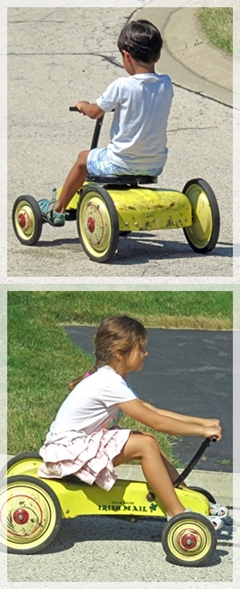 The thing I’ll miss most when we move to southwest Florida permanently is easy access to my grandchildren. This summer I’ve relished watching the little guys frolic in the sprinkler, race their scooters down the sidewalk, climb the monkey bars, decorate the driveway with colored chalk, and play bags with their cousins. They insisted on helping in the kitchen, offered to set the table, listened intently to every story read to them, and never tired of endless games of Crazy-Eights and Kings’ Corners. Their squeals of delight at the holiday fireworks and when they mastered riding the Irish Mail (where they pumped with their arms and steered with their feet) were music to my ears. They asked endless questions and pondered every answer. Wanting to please us, they even were obedient. Seeing their unbridled enthusiasm, energy, and desire both to learn and please, I wondered why I wasn’t like that. After all, God wants us to be like children.
 I showed the antique dealer the old silver tray we’d found at an antique store many years ago. Having just read Stephanie Kallo’s novel Broken for You, I’d been drawn to it. Hers was a story of secrets and redemption that told of how two women salvaged their brokenness, first by smashing priceless antique porcelain pieces that had been stolen from Jews during the Holocaust, and then by repurposing the fragments into beautiful mosaics. The novel was an homage to the beauty of broken people and broken things. The tray’s handle had been damaged and soldered back on and I imagine much of the silver plate had worn off its top. It was, however, a thing of beauty because it had been artistically covered with broken pieces of antique painted china. The dealer told me that artists often come into her shop looking for chipped pieces of decorative porcelain. Because they plan on breaking it to use in jewelry or mosaics like my tray, they don’t mind chips or cracks.
 After driving out an evil spirit from a man in Capernaum, Jesus went to the home of Andrew and Peter. When He learned that Peter’s mother-in-law was sick with a fever, Jesus went to her bedside, took her hand, helped her up, and the fever was gone. Having shown his authority over both demon possession and physical disease that day, reports of His ability circulated throughout town. That evening, a crowd gathered wanting to be healed by Jesus.
 When writing about Elisha, the widow, and the oil, I thought the first conversation between the prophet and distraught woman worth a deeper look. From their exchange, it is clear that the prophet either knew or knew of the widow’s husband. One of Elisha’s followers, the widow reminds the prophet of how much her husband revered and feared the Lord.
 Which can you do without? The right side of your heart or the left? Which blade on the scissors wouldn’t be missed? What is more important? The front wheel or the back one on your bicycle? The gas pedal or the brakes on your car? The right wing or the left of an airplane? Faith or works? Neither! None of these things can operate without the other. We need two blades on the scissors, two wings on the plane and we can’t be Christians without both faith and works.
 Devotions of the Heart