LAZARUS AND THE RICH MAN (Part 1 – Luke 16:19-31)

And he will answer, “I tell you the truth, when you refused to help the least of these my brothers and sisters, you were refusing to help me.” And they will go away into eternal punishment, but the righteous will go into eternal life.” [Matthew 25:45-46 (NLT)]

purple prairie cloverWere I not a believer, I don’t think I’d find the concept of eternal life very comforting. While Jesus made it clear there is an afterlife, He also spoke of the destinations awaiting us in that afterlife. In the gospel of Luke, we find Him telling the parable of the rich man and the beggar named Lazarus. [16:19-31] Indifferent to the plight of the destitute and diseased Lazarus, the rich man lived a life of indulgence and luxury while Lazarus lay outside his gate, hoping for just a few scraps from the rich man’s table.

When Lazarus dies, angels carry him to the bosom of Abraham. The presence of both angels and Abraham told Jesus’s audience that Lazarus was in Heaven. Being in Abraham’s bosom refers to the Jewish custom of reclining on couches while dining (which brought the head of one man almost into the bosom of the one sitting beside him). From this description, Jesus’ listeners also knew that Lazarus was sitting at Abraham’s side, in a place of honor, at a banquet in Paradise. In contrast, when the rich man dies, he is sent to Hades, the realm of the dead. Jesus’ mention of it being a place of torment and flames, however, implies the rich man is in what Jewish tradition called Gehenna, a place of fiery torment and punishment. This parable makes clear that there are two destinations awaiting us when we die and one is far nicer than the other.

Still thinking that he’s in a position to call the shots and give orders, the rich man calls to Abraham, telling him to have pity and send Lazarus over with some water to relieve his agony (something he’d refused to do for the beggar). Explaining that there is a great chasm between the two places and that no one can traverse the span in either direction, Abraham reminds him that he had his reward during his lifetime. This parable leads us to the conclusion that, once we reach the end of the line here, we will not be getting a second chance to make things right in the hereafter. The impassable abyss means our first destination after death will be our final one!

Realizing that his behavior in life determined his hereafter, the rich man asks Abraham to send Lazarus back to warn his brothers about his fate. Abraham replies that they’ve already been warned in Scripture. When the rich man insists that his brothers will repent and change their ways if someone returns from the dead, Abraham answers that even someone returning from the dead couldn’t convince them. It’s ironic that when Mary and Martha’s brother Lazarus returned from death, rather than believe him, the Pharisees planned to kill him!

While the rich man could not warn his brothers about the consequences of their behavior, Jesus warns us with the rich man’s story. Hell is a real place and, after death, the unrighteous are eternally separated from God in a place of torment. There are eternal consequences to our choices and, if we prefer not to have God in our lives on earth, He will accommodate us in eternity, as well.

It is better to beg bread on earth than water in hell. [Dwight Moody]

And anyone who believes in God’s Son has eternal life. Anyone who doesn’t obey the Son will never experience eternal life but remains under God’s angry judgment. [John 3:36 (NLT)]

Copyright ©2020 jsjdevotions. All rights reserved.

EVERYONE IS SPECIAL

How precious are your thoughts about me, O God. They cannot be numbered! I can’t even count them; they outnumber the grains of sand! And when I wake up, you are still with me! [Psalm 139:17-18 (NLT)]

white ibisWhen speaking of the late director Mike Nichols, actress Anjelica Huston said, “He had that incredible capacity for friendship that makes you think you’re absolutely unique, that nobody matters to him the same way that you do.” Huston’s words were extraordinarily high praise for a friend and probably something we’d all like to have said about us. I wondered if I make every person who passes through my life feel extraordinary and valued. After coming up short on that one, I wondered if I have friends about whom I could say that same thing. While some come very near, there is only one who has the capacity to make each and every person feel unique and that he or she is most important person to Him; that, of course, is our good friend Jesus!

Psalm 139 is one of my favorites and the majority of it is an intensely personal song of praise in which David affirms God’s active involvement in every moment of his life. From the instant of his conception, God was there, forming him or, as The Message  translates, sculpting him, “from nothing into something.” God’s eyes remained on David and He knew his every idea and action. God’s thoughts about David were so numerous they were impossible to count. If God knew David that well, it would seem that He knows all of us that well. Indeed, God cherishes and loves each one of us as if we were His only child! He would join Fred Rogers in singing: “You’re special to me. You are the only one like you…You are special.”

While we never have come face-to-face with God, the Psalmist’s words tell us that He sees the unique beauty in each one of us. Moreover, when we look at Jesus in the gospels, we see how God behaved while walking on earth. Even without knowing Jesus’s true identity, everyone who came in contact with Him would have experienced His incredible capacity for friendship. Each person would have felt unique, special, and precious in His presence. Jesus didn’t see the sores on the lepers, the mental illness of Mary Magdalene, the uncleanness of the bleeding woman or the shame of the adulterous one. He didn’t see the filth of the beggar, the dishonesty of Zacchaeus, or the immorality of the woman at the well; he saw their pain—their innermost being. Instead of seeing a skeptic, He saw Nathanael’s integrity; instead of seeing a fisherman, He saw Peter’s ability to lead; instead of seeing a Pharisee, He saw Saul’s love of God. Jesus saw beautiful extraordinary individuals, each of whom was precious in His sight.

When writing his gospel, the Apostle John referred to himself as “the disciple Jesus loved.” I think each disciple would have described himself that same way. Without a doubt, Jesus had an even greater capacity for friendship than did Mike Nichols. Everyone whose life He touched felt absolutely special. Each knew that no one else mattered to Jesus in quite the same way than did they. This is the God who formed us, knows the number of hairs on our heads, and has etched our names into the palms of His hands and He is our friend!

As disciples of Jesus, we are to be His hands and feet. To truly do that, we must look at people through eyes like His: eyes that see beyond what is right in front of us—eyes that see the essence and uniqueness of our neighbor. And we must love him or her as we love ourselves: with a heart that sings, “You are my friend. You’re special to me.”

I no longer call you slaves, because a master doesn’t confide in his slaves. Now you are my friends, since I have told you everything the Father told me. You didn’t choose me. I chose you. I appointed you to go and produce lasting fruit, so that the Father will give you whatever you ask for, using my name. [John 15:15-16 (NLT)]

Copyright ©2020 jsjdevotions. All rights reserved.

THE RECORDS COMMITTEE

Not everyone who says to me, “Lord, Lord,” will enter the kingdom of heaven, but only the one who does the will of my Father who is in heaven. Many will say to me on that day, “Lord, Lord, did we not prophesy in your name and in your name drive out demons and in your name perform many miracles?” Then I will tell them plainly, “I never knew you. Away from me, you evildoers!” [Matthew 7:21-23 (NIV)]

blue flag irisDozens of birders have been gathering at the local bird sanctuary to catch a glimpse of a Hammond’s flycatcher. Since these birds look similar to other flycatchers, prefer the mountains to lowlands, and are rarely found within 1,000 miles of Florida, the bird in question could be an imposter. It’s just another little grey bird to me but, to birders, its identification is important. Although they’ll report their sightings to the Florida Ornithological Society, just looking like a Hammond’s isn’t enough. When the Society’s Records Committee meets in August, they will evaluate the submitted sketches, photographs, videos, recordings and detailed accounts of the bird’s behavior along with reports of the surroundings, sky conditions, temperature, and times when the bird was spotted to determine whether it truly is a Hammond’s.
While the FOS Records Committee will be looking for evidence to authenticate whether the bird in question is a true Hammond’s, there is no official committee to authenticate Christians. If a Records Committee were to determine whether or not we’re true followers of Christ, calling ourselves Christian, sitting in a pew on Sundays, and occasionally reading the Bible wouldn’t be enough evidence. After all, I could put on a lab coat, sit in the hospital, regularly consult WebMD, and call myself “Doctor” but I wouldn’t be a physician! The Records Committee for Christ would look for the traits of a Christian described throughout the Gospel and Epistles. They’d start with love and then look for evidence of things like obedience, service, forgiveness, selflessness, humility, faithfulness, truth, compassion, joy, peace, restraint, gentleness, patience, kindness, devotion, and virtue. These, like nesting in high conifers and catching insects on the fly, are the behaviors that would be used to identify a true Christian from an imposter. Jesus said, “By their fruit you will recognize them,” [Matthew 7:20] and it would be by our fruit that a Records Committee would know us.

The Hammond’s flycatcher is named in honor of William Alexander Hammond, an enthusiastic birder who was the Surgeon General of the US Army (1862-1864). Of course, that grey bird doesn’t care if it’s called a Hammond’s or even a flycatcher; it knows who and what he is. I’m not so sure we’re that honest with ourselves! Do we truly know who and what we are? Would anybody else? Our name is in honor of Jesus; “Christian” means “follower of Christ” or “miniature replication of Christ.” Do our thoughts, actions and speech look anything like His? It will be Jesus rather than a Records Committee who makes that final determination. Will He recognize us?

And this is my prayer: that your love may abound more and more in knowledge and depth of insight,  so that you may be able to discern what is best and may be pure and blameless for the day of Christ,  filled with the fruit of righteousness that comes through Jesus Christ—to the glory and praise of God. [Philippians 1:9-11 (NIV)]

Copyright ©2020 jsjdevotions. All rights reserved.

WE’VE BEEN WARNED

So you, too, must keep watch! For you don’t know what day your Lord is coming. Understand this: If a homeowner knew exactly when a burglar was coming, he would keep watch and not permit his house to be broken into. You also must be ready all the time, for the Son of Man will come when least expected. [Matthew 24:42-44 (NLT)]

He will come again to judge the living and the dead. [The Apostles’ Creed]

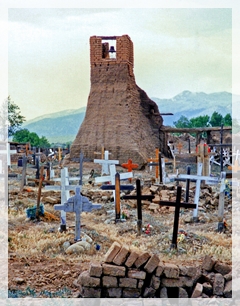
Taos NM In an attempt to avoid the day’s heat, I went walking immediately after breakfast, leaving the bed unmade and the dishes on the counter. Thinking I would tend to the bedroom and kitchen later in the day, I cleaned the lanai when I returned home. Just as I was finishing up, the gate house called: I had unexpected guests! One of my visitors is a “neatnik” and nothing about me or the house (except for the lanai) was neat or clean. In the few minutes between the gate’s call and their arrival, I managed to pull up the bedspread, throw the dishes in the sink, wipe the counter, slip on a fresh t-shirt, put on lipstick and don a baseball cap. I was thankful for the advance call that gave me just enough time to make things semi-presentable.

At least I had a few minutes warning to straighten up; we won’t get that much time when it really matters! The day of Christ’s second coming will be sudden and unexpected, with no cautionary alarms. While there will be signs, many people won’t understand them and most won’t heed them. There will be no call from the gatehouse asking if we want to give Him entry! We’ve been amply forewarned in Scripture; let’s not plan on an extra five minutes to clean up our act!

Putting aside the question of Judgment Day, how prepared are we for our own last day here on earth? Some of us may linger under Hospice care and be painfully aware of death’s imminence, but many will get little or no warning. Tornadoes hit, aneurysms burst, cars run red lights, and a heart attack can turn a wife into a widow within minutes. Even those with health issues often ignore the inevitability of death and many seniors act as if they’re immortal. They have no wills, powers of attorney, or advance healthcare directives and refuse to discuss funeral plans or decide which grand might like a special piece of jewelry. “There’s time enough for that later,” they say. The clock is ticking; how much warning do any of us need?

There are, however, far more important decisions than what songs will be sung at our funeral or who will get our things—decisions that need to be made now. Are we followers of Christ or not? When our final day comes, we won’t get an opportunity to discuss the options or make things right. When that last day arrives, there may be no warning: no opportunity for frenzied prayers and last minute repentance. We shouldn’t wait until the eleventh hour to choose God; after all, we could die at 10:30!

One of two things you must do; you must either receive Him or reject Him. You receive Him here and He will receive you there; you reject Him here and He will reject you there. [D.L. Moody]

None of us can hold back our spirit from departing. None of us has the power to prevent the day of our death. There is no escaping that obligation, that dark battle. And in the face of death, wickedness will certainly not rescue the wicked. [Ecclesiastes 8:8 (NLT)]

Copyright ©2020 jsjdevotions. All rights reserved.

THE RICH YOUNG MAN

The disciples were astounded. “Then who in the world can be saved?” they asked. Jesus looked at them intently and said, “Humanly speaking, it is impossible. But not with God. Everything is possible with God.” [Mark 10:26-27 (NLT)]

great blue heronThe book of Daniel makes reference to the resurrection of both the wicked and righteous, with the destiny of the one being shame and disgrace and the other being everlasting life. By the time of Jesus, many Jews believed in some sort of eternal life and that it would come by obedience to the Law. Matthew, Mark, and Luke tell of the rich young man who asked Jesus what good deed he must do to have eternal life. He wanted Jesus to check his resume of good works and, if found lacking, to give him a task that would assure his immortality.

Before answering, Jesus clarified that goodness only comes from God rather than things or actions and then told the man to keep the commandments. As if some were more important than others, the man asked which ones. After listing several commandments dealing with man’s relationship with man, Jesus summarized with the command to love your neighbor as yourself. The man proudly responded that he obeyed them all. Had he been truly honest about himself, he would have admitted his inability to keep the law perfectly and acknowledged that he couldn’t attain eternal life on his own merit. But, sure his ticket to eternity was safe in hand, the man asked what else he should do. When Jesus told him what needed to be done to be “perfect,” He didn’t mean faultless; the Greek word translated as “perfect” means goal or end. So, to achieve or perfect his goal of eternal life, Jesus told him to sell all of his possessions, give the money to the poor, and follow Him. Hearing this, the rich young man departed. In spite of his claims, he clearly didn’t love his neighbor as himself.

At first, it seems odd that Jesus didn’t mention the first four commandments—the ones having to do with man’s relationship to God. But Jesus could see into the man’s heart and knew the man loved his wealth far more than God or his neighbor. So, after he claimed to love his neighbor, Jesus asked him to put his money where his mouth was by giving his wealth to his neighbor!

That Jesus gave the rich man a requirement wasn’t unusual for a rabbi. When prospective students came to study with rabbis, the teachers often gave them a condition as a way of weeding out those students who really weren’t serious. The young man, however, hadn’t come to our Lord to learn; he’d come to be commended for his righteousness!

When people read this story, they often fear that it means Christians must live a life of poverty, but Jesus wasn’t setting financial requirements for salvation. His demand merely revealed what was in that rich man’s heart. He loved himself and his possessions far more than God or his neighbor. Although this encounter demonstrates the implications of discipleship, it never demands that we sell our possessions or live a life of asceticism. Jesus wasn’t teaching salvation through philanthropy; He was demanding that God be first place in our hearts.

Obedience to the commandments does not qualify any of us for eternal life; there is nothing we can do to merit the gift of salvation and eternal life. That only comes by grace through faith. Nevertheless, obedience to the commandments—loving God and loving our neighbor—is evidence of our faith. Is there something more important to you than loving God? What would Jesus ask you to relinquish? Do you love Him enough to do it?

Jesus replied, “‘You must love the Lord your God with all your heart, all your soul, and all your mind.’ This is the first and greatest commandment. A second is equally important: ‘Love your neighbor as yourself.’ The entire law and all the demands of the prophets are based on these two commandments.” [Matthew 22:37-39 (NLT)]

Copyright ©2020 jsjdevotions. All rights reserved.


THE VIRTUE FARM

But I did find this: God created people to be virtuous, but they have each turned to follow their own downward path. [Ecclesiastes 7:29 (NLT)]

When living in rural Illinois, I loved walking along the country roads, passing by fields of soy beans and corn, and seeing the horses, cows, goats, and sheep grazing in the fields. Virtue was a common name in the community and I often passed by the Virtue Farm. Thinking Virtue a noble name, I wondered if the Virtue family lived up to its promise of good character and moral excellence.

After Pope Gregory listed what came to be known as the seven deadly sins in 590 AD, he also listed seven virtues considered fundamental to Christian ethics: prudence (care and moderation with money), temperance (moderation in needed things and abstinence from unneeded ones), fortitude (never giving up), justice (being fair and equitable with others), faith, hope, and love. While it’s easy to recognize those last three virtues as coming from the Apostle Paul, the Pope’s list isn’t explicitly Biblical and the first four come from the Greek philosophers. When Peter listed the attributes of a Christian’s character, he included faith, moral excellence, knowledge, self-control, patient endurance, godliness, brotherly affection, and love for everyone. [2 Peter 1:5-7] Paul listed the fruit of the spirit in Galatians as love, joy, peace, patience, kindness, goodness, faithfulness, gentleness and self-control [5:22-23]. Looking at all of these lists, we can get a good idea of what qualities determine virtue. Unfortunately, we seem to have lowered the bar a bit since the time of Aristotle, Peter, Paul, and Pope Gregory. Nowadays, someone usually is considered of good character if they’re honest (most of the time), work hard, and don’t cheat on their spouse. While that’s a start, it hardly defines moral excellence.

With virtue in short supply these days, it would be nice if the Virtue Farm actually planted and harvested virtue as they do beans and corn. Of course, once it got to market, would there be any buyers? From what I see in the media, people aren’t much interested in things like chastity, modesty, self-respect, or fairness and good sportsmanship. Words like temperance, industry, and thrift are rarely used and the qualities of humility, courtesy, and self-control aren’t held in high regard.

We’re not born with virtue; it’s not like the blue eyes or musical talent we might have at birth. Moreover, virtue doesn’t grow on trees and can’t be purchased at the local farmers’ market or grocery. Virtue is something we choose; while the Holy Spirit provides us with His fruit, it is up to us to develop those virtues into good habits. While the Virtue Farm continues planting soy beans and corn, we must cultivate the seeds of virtue in our own lives. The Apostle Peter assures us that it can be done: “By his divine power, God has given us everything we need for living a godly life.” [2 Peter 1:3]

Father, we are faced with moral choices every day. Teach us with your word, guide us by your example, and strengthen us with your Holy Spirit so that we always choose the virtuous path.

Throw off your old sinful nature and your former way of life, which is corrupted by lust and deception. Instead, let the Spirit renew your thoughts and attitudes. Put on your new nature, created to be like God—truly righteous and holy. [Ephesians 4:22-24 (NLT)] 

Copyright ©2020 jsjdevotions. All rights reserved.