CHARM BRACELETS

Joshua erected a monument at The Gilgal, using the twelve stones that they had taken from the Jordan. And then he told the People of Israel, “In the days to come, when your children ask their fathers, ‘What are these stones doing here?’ tell your children this: ‘Israel crossed over this Jordan on dry ground.’” [Joshua 4:20-22 (MSG)]
Zion 041webIn a television ad for a popular brand of charm bracelet, two couples meet and then go their separate ways. One wife proceeds to tell her spouse all about the other couple: the number and sexes of their children, where they’ve vacationed, and their interests. When her husband asks how she got that much info from a brief greeting, she smugly replies that the bracelet told it all. My granddaughter has one of those bracelets and, when gift-giving occasions occur, I enjoy looking at the charms and trying to decide if there are any that commemorate a special event or accomplishment of that year. I wonder if, many years in the future, she will look at the bracelet and fondly recall her riding lessons, theater classes, trip to China or the grandparents who gave her the charms.

Jacob placed a stone pillar to mark the place where God spoke to him, Joshua erected a monument of stones so the Israelites would remember that the river stopped flowing so the Ark could pass through it, and Samuel used a boulder to mark the spot where God gave victory over the Philistines. I’m not sure placing stones and monuments is that easy or practical today; perhaps all we need are some charms. They wouldn’t be made of silver and semi-precious stones nor would they be worn on our wrists or around our necks. They would be made of memories and kept in our hearts. The charms would remind us of those special moments when God revealed His divine presence in our lives. Yes, I know he’s always been there and always will be, but we’ve all had extraordinary times when we truly felt God’s special touch. The charms would commemorate the times we experienced miracles, the moments we had tangible evidence of God’s help or provision, and the supposedly chance conversations that put us on the right path. The charms would bring to mind the times we received His guidance, wisdom, or strength and those instances we knew without a doubt that God was there with us, holding us in His loving arms. Every time we doubted, every time we felt lost or alone, every time we were afraid or felt unworthy, incapable, abandoned, or lost, we could take out a few charms to remind us of God’s loving provision. Looking at them and remembering those times, we would again have confidence and our faith would be renewed.

What occasions would be commemorated on your bracelet?
Samuel took a single rock and set it upright between Mizpah and Shen. He named it “Ebenezer” (Rock of Help), saying, “This marks the place where God helped us.” [1 Samuel 7:12 (MSG)]

WHY DO I DO IT?

Anyone who calls upon the name of the Lord will be saved. But how shall they ask him to save them unless they believe in him? And how can they believe in him if they have never heard about him? And how can they hear about him unless someone tells them? [Romans 10:13-14 (TLB)]

I’d been asked to answer why Jesus moved me to write a Christian daily devotional. There certainly are times I ask myself that same question. I wondered how to reply to that query as I walked the swamp/bird sanctuary this morning.

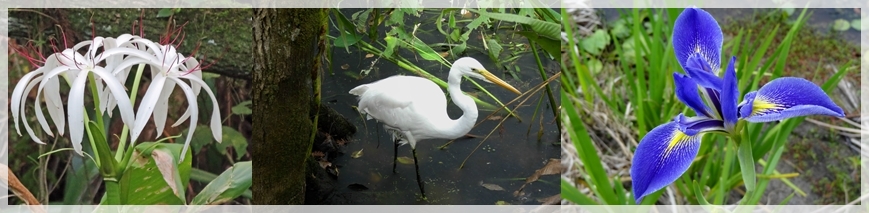
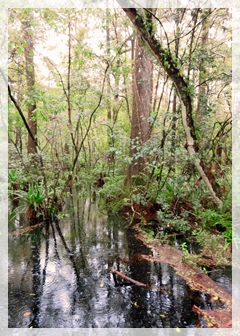
corkscrew swamp sanctuaryOriginally a city girl, I never would have expected spending at least one day a week on this boardwalk in the midst of water, ferns, cypress, herons, hawks, spiders and gators. A private person, I would never have expected to share my faith journey so publicly either. While contemplating why I do it, I started taking pictures of the swamp. I silently complained that, no matter how many shots I take, I’ve never managed to capture the beauty, mystery and sense of peace I find in this strange place. Neither words nor photos can capture why I love it so—and yet I continue to try. I will admit that I didn’t love it at first. We first visited out of curiosity but became intrigued enough to come again and again and learn more about it. Now, whenever we have visitors, the swamp is a “must do” activity. Being so familiar with it, we can show them where the deer might be found, the gator family lives, the scarlet hibiscus and blue flag iris hide, the baby owls roost, and the woodpeckers nest—all of which we missed on our earlier visits. We can explain how the strangler fig grows, about the cypress knees, which wading bird they’re seeing, and what the seemingly dead resurrection fern will look like after a rain—none of which we knew when we first visited. We didn’t love the swamp at first but, as we came to know it, we grew to love it and want to share that love with others.

So, what compels me to post a Christian devotion five times a week? Just as I want to share my love of the swamp with our guests, even though I’m neither botanist nor zoologist, God has somehow tasked me with the sharing of my love of Jesus with strangers, even though I’m neither theologian nor minister! He’s given me the desire to share my faith and my failings, the peace of God and the struggles of a follower, the comfort of His presence and the guidance of His word so that others can experience the peace, love and joy that comes from a relationship with Jesus and reading the Bible.

My words and photos can’t do justice to the swamp so, if you’re ever in Southwest Florida, be sure to spend some time at Corkscrew Swamp Sanctuary. You’ve just got to experience it for yourself. The words of my devotions can’t do justice to God, either. My prayer is that people will find them interesting enough to encourage them to delve into God’s word for themselves and take their own journey of faith. You’ve got to experience God firsthand and, as we found with the swamp, once you know Him, you’ll love Him. Unlike our favorite swamp, however, there’s no admission fee.

A true faith in Jesus Christ will not suffer us to be idle. No, it is an active, lively, restless principle; it fills the heart, so that it cannot be easy till it is doing something for Jesus Christ. [George Whitefield]

When the Council saw the boldness of Peter and John and could see that they were obviously uneducated non-professionals, they were amazed and realized what being with Jesus had done for them! … [Peter and John replied] “We cannot stop telling about the wonderful things we saw Jesus do and heard him say.” [Acts 4:13, 20 (TLB)]

For just preaching the Gospel isn’t any special credit to me—I couldn’t keep from preaching it if I wanted to. I would be utterly miserable. Woe unto me if I don’t. If I were volunteering my services of my own free will, then the Lord would give me a special reward; but that is not the situation, for God has picked me out and given me this sacred trust, and I have no choice. [1 Corinthians 9:16-17 (TLB)]  

swamp lily-great egret-blue flag iris

SEEING THE SUNRISE

Don’t be afraid, for I am with you. Don’t be discouraged, for I am your God. I will strengthen you and help you. I will hold you up with my victorious right hand. [Isaiah 41:10 (NLT)]

And I am convinced that nothing can ever separate us from God’s love. Neither death nor life, neither angels nor demons, neither our fears for today nor our worries about tomorrow—not even the powers of hell can separate us from God’s love. [Romans 8:38 (NLT)]

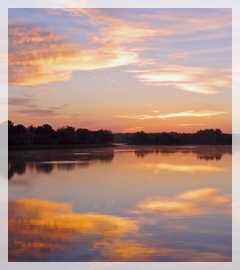
morning dawn Since it was hot and rain had been promised later in the day, I went out walking in the wee small hours of the morning. The few street lights and full moon illuminated my way as God and I had our morning chat. My mind, however, wandered from comforting prayer to worrisome thoughts. We just had our annual physicals and, as often happens with people our age, something suspicious was found. Another test was done, the results are in and a specialist needs to be seen. In all likelihood, it is just a minor health issue, but my mind kept wandering into the area of “what if?” and the various dark scenarios that went along with the question.

Having just completed a couple of devotions on worry and fear for future postings, my own words convicted me of lack of faith. In spite of my well-meaning sincere writing, I allowed worry and fear to creep into my thoughts that morning. There are many ways the enemy tempts us—and it often has nothing to do with the obvious sins of greed, pride, lust, or envy. He subtly sneaks into our thoughts when we’re more concerned about tomorrow than trusting God to get us through today. Living in the land of “what if?” makes us vulnerable to his attacks of doubt, fear and worry.

Whether a minor medical issue (which it quite likely is) or a major medical problem, worry and fear won’t change it. I can’t alter the past nor can I influence the future diagnosis. I remembered that when God brought his people to the Red Sea, He provided them with a way to get across it; He will continue to do so for us today. If He doesn’t part the waters, He’ll provide a boat, give us the material for a bridge, or teach us to swim. Moreover, what we fear could be the sea just as easily can be a shallow puddle through which we can easily walk.

I looked up at the full moon as it was dipping to the west; at the same time, the morning light from the east began to paint the sky pink. For a brief moment, I could see both yesterday’s moon and tomorrow’s rising sun. While I can’t change yesterday and have no control over tomorrow, I do have control over my thoughts of this day. Seeing last night depart in the west and a new morning rise from the east, I chose to trust and have faith for today.

Worry and reasoning are two of Satan’s most successful tools. He’ll get us started with one negative thought and then sit back and watch us finish ourselves off. [Joyce Meyer]

You will keep in perfect peace all who trust in you, all whose thoughts are fixed on you! [Isaiah 26:3 (NLT)]

TUMBLEWEEDS

Russian thistle (tumbleweed)-Kodachrome Basin State Park,UT 009-cropwebThe Lord says: Cursed is the man who puts his trust in mortal man and turns his heart away from God. He is like a stunted shrub in the desert, with no hope for the future; he lives on the salt-encrusted plains in the barren wilderness; good times pass him by forever. But blessed is the man who trusts in the Lord and has made the Lord his hope and confidence. He is like a tree planted along a riverbank, with its roots reaching deep into the water—a tree not bothered by the heat nor worried by long months of drought. Its leaves stay green, and it goes right on producing all its luscious fruit. [Jeremiah 17:5-8 (TLB)]

The stunted shrub about which Jeremiah speaks is much like the tumbleweed. If you haven’t seen it in real life, you’ve probably seen it blowing across the desert in movies. The tumbleweed is actually the Russian thistle, a common western weed, and has a pretty little flower. Once mature and dry, however, the entire plant separates from the root; shaped like a ball, it looks like the dead shrub’s skeleton. In the western states, you can see tumbleweeds as small as soccer balls or as large as a Smart Car in ditches or tumbling along the desolate landscape.

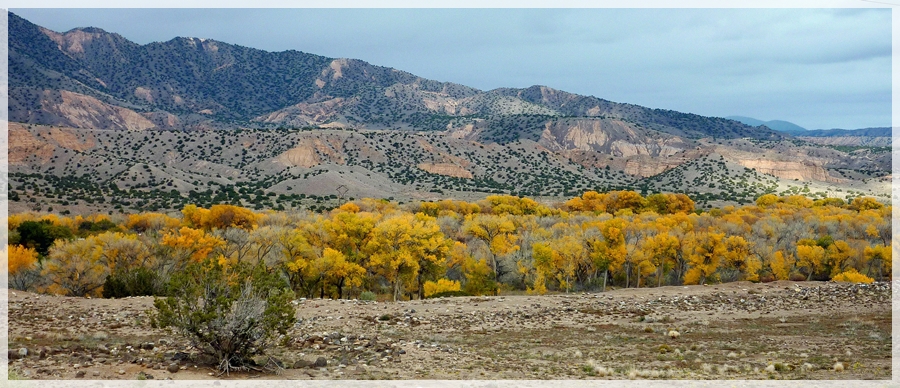
On the other hand, cottonwoods are hardy trees. Much like the ones mentioned in Jeremiah, they put their roots down near rivers, lakes, and irrigation ditches throughout the southwest. Large trees, they have been known to grow up to eighty feet tall with trunks over five feet wide. Because they grow on the water’s edge, they typically survive prairie fires and can live over one hundred years. The hardy Rio Grande cottonwood even flourishes in New Mexico’s White Sands National Monument, an environment too harsh for most plants. In an area of scorching heat, scant rainfall, relentless winds, poor soil and blowing sand, the cottonwood survives because its roots are planted firmly down into the life-giving water hidden beneath the sand.

Do we want to live as a tumbleweed, dry and rootless in a barren land, with no hope for the future? That is what it will be like if we put our trust in our own strength or that of other people. Or do we want to be like the cottonwood, with deep roots, able to withstand fire, heat, wind and drought? If we put our trust in the Lord, we will never be alone and we’ll be able to survive, perhaps even thrive, in the most stressful of situations.

They shall neither hunger nor thirst; the searing sun and scorching desert winds will not reach them anymore. For the Lord in his mercy will lead them beside the cool waters. [Isaiah 49:10 (TLB)]

And now just as you trusted Christ to save you, trust him, too, for each day’s problems; live in vital union with him. Let your roots grow down into him and draw up nourishment from him. See that you go on growing in the Lord, and become strong and vigorous in the truth you were taught. Let your lives overflow with joy and thanksgiving for all he has done. [Colossians 2:6-7 (TLB)]
cottonwoods (NM) -cropaweb

ON A NEED TO KNOW BASIS

I also saw something else here on earth: The fastest runner does not always win the race, the strongest soldier does not always win the battle, the wisest does not always have food, the smartest does not always become wealthy, and the talented one does not always receive praise. Time and chance happen to everyone. [Ecclesiastes 9:11 (NCV)]

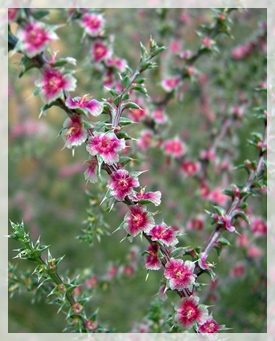
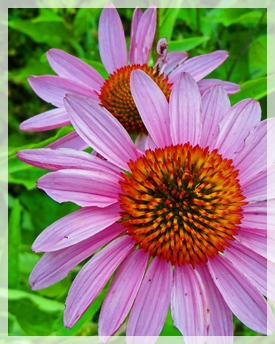
purple coneflower - MHSP087webSometimes, in the hope of protecting the integrity of secret or sensitive information, access to information is limited to a “need to know” basis. Of course, WikiLeaks and a variety of journalists have proven that there’s little that is ever truly confidential. The HIPA Act and all of those forms we sign when visiting a doctor are supposed to keep our medical information private and on a “need to know” basis. Having just learned that my medical insurance records have been hacked, it seems that a “need to know” status isn’t much of a safeguard to one’s privacy. In spite of all sorts of precautions, hackers, whistle blowers, and informants manage to access and leak information whether we need to know it or not!

There are times we think God is keeping certain information from us that we have a need to know. We want to know the answers to “Why?” Why did he get Alzheimer’s? Why did she go into a coma? Why did this child get leukemia? Why does my child have Down’s syndrome? Why the tornado? Why didn’t the driver stop? Why can’t I have children? Why was he at the wrong place at the wrong time? Why is her child in the gifted class when mine struggles to keep up? Why didn’t she listen? Why did he kill himself? Why is there so much hate and hurt? Why did so many die in such a senseless act of terrorism? Why couldn’t you save them? Why do bad things happen to good people? Why?

I freely admit that any sermons I’ve heard that tried to answer those questions failed miserably; they left me dissatisfied and empty. The short answer, of course, is readily available in Genesis: bad things happen because man sinned. That answer, however, is anything but satisfactory. The only sermons that ever made sense were the ones conceding that, while we’re in this world, there never will be an acceptable explanation for why bad things happen.

The answers to the cries of “Why?” are on a “need to know” basis. We’ll only know the facts we need to know at the time we need to know them. If we truly needed to know, God would tell us; but we don’t, so He won’t. It’s in God’s job description to know the answers to those questions; it’s not in ours. Our job description simply requires us to trust in Him and in His plan. It appears that the angels are all rather content with their positions so we shouldn’t count on them leaking any privileged information our way. We just have to accept that when, and if, we ever need to know why, God will supply a satisfactory answer. We don’t need to know why; we just need to know Him!

You are only human, and human beings have no right to question God. An object should not ask the person who made it, “Why did you make me like this?” The potter can make anything he wants to make. He can use the same clay to make one thing for special use and another thing for daily use. [Romans 9:20-21 (NCV)]

We know that in everything God works for the good of those who love him. [Romans 8:28a (NCV)]

MAKE THE MOST OF IT

81975web
After looking at the way things are on this earth, here’s what I’ve decided is the best way to live: Take care of yourself, have a good time, and make the most of whatever job you have for as long as God gives you life. And that’s about it. That’s the human lot. Yes, we should make the most of what God gives, both the bounty and the capacity to enjoy it, accepting what’s given and delighting in the work. It’s God’s gift! God deals out joy in the present, the now. It’s useless to brood over how long we might live. [Ecclesiastes 5:18-20 (MSG)]

Lord, where did the years go? It seems like it was just last month that I complained about the fingerprints on the windows and mud on the floor; now I can go weeks without washing the windows or mopping the entry. I protested to my children about the noise and now our house is silent. I was just complaining img109webabout my teen-agers and now they’re adults with teens and pre-teens of their own! It feels like just yesterday that we were grousing about work and now we’re complaining about how busy we are in retirement.

Lord, thank you for this day. Don’t let us waste a single moment of it in complaint. While some seasons of life may be more challenging than others, show us how to appreciate each and every one of them.

It’s only when we truly know and understand that we have a limited time on earth – and that we have no way of knowing when our time is up – that we will begin to live each day to the fullest, as if it was the only one we had. [Elizabeth Kübler Ross]

Oh, how sweet the light of day, And how wonderful to live in the sunshine! Even if you live a long time, don’t take a single day for granted. Take delight in each light-filled hour, remembering that there will also be many dark days And that most of what comes your way is smoke. [Ecclesiastes 11:7-8 (MSG)]