
And I am certain that God, who began the good work within you, will continue his work until it is finally finished on the day when Christ Jesus returns. [Philippians 1:6 (NLT)]
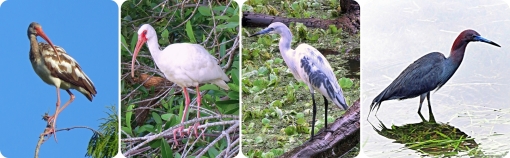 Whenever I see immature white ibis or blue herons, I recall a picture that hung in my daughter’s bedroom. Beneath a drawing of a little girl in a pink dress were the words, “Be patient; God isn’t finished with me yet!” These birds, however, don’t need a sign to tell us that God isn’t finished with them; their varicolored plumage makes that abundantly clear. You see, for their first few years, they look like a work in progress. Instead of being born white, the newly hatched white ibis chicks start out grey but quickly turn dark brown. As they mature, the young birds become a haphazard patchwork of brown and white. By the end of their second year, they’re mostly white but it’s not until the end of their third year that they finally molt the last of their brown feathers. Unlike the ibis, the little blue herons start out pure white. Were it not for their greyish-green legs and bill, they look more like snowy egrets than blue herons for much of their first year. They turn into a patchwork of blue and white as they gradually molt into the dark slate-blue plumage of an adult by the end of their second year.
Today, I thought of those words about patience and being unfinished after berating myself for making a foolish and avoidable mistake. I spoke to myself in a way I’d never (or hardly ever) use with anyone else and called myself something that I wouldn’t call others (at least not out loud). Sometimes, it’s easier to be patient with a child than it is with ourselves. Perhaps, we need to remember that God isn’t finished with us, either!
Even though it may be less obvious, I’m as unfinished as an immature ibis or little blue heron! The birds, however, don’t have to make any effort for their colors to change—that automatically comes with time. For us, it’s a bit different. When God brought us from death into life in Christ, He loved us with all of our imperfections and faults. Nevertheless, just as He doesn’t leave those birds looking half-done, He’s not about to leave us the flawed way we began. Our sanctification began at the moment of salvation but it didn’t end there. No matter how old we are, God continues to give us opportunities to learn and grow. He expects us to actively strive for holiness and obedience so that, through the power of the Holy Spirit, we can become more and more like Jesus. Unlike the birds, however, we remain works in progress until our last day on earth. Remembering that we still are mid-design and won’t always get it right, let us be patient with ourselves until that day comes.
The Christian life requires hard work. Our sanctification is a process wherein we are co-workers with God. We have the promise of God’s assistance in our labor, but His divine help does not annul our responsibility to work. [R. C. Sproul]
 An old Chinese parable tells of a poor farmer whose only horse runs away. His friends commiserate over his bad luck and ask how he’ll plow his field. The farmer answers, “Who knows? We shall see.” Two days later, the horse returns along with several wild horses. When the farmer’s friends congratulate him on the good fortune of now having a stable full of horses, the farmer replies, “Who knows? We shall see.” The following week, while trying to tame the horses, the farmer’s son breaks his leg in three places. The farmer’s friends offer condolences and wonder how he’ll get his work done with his son unable to walk and help. The farmer answers, “Who knows? We shall see.” When a war breaks out, the emperor’s men arrive and conscript all the young men in the village. With his leg in a cast and needing crutches, the farmer’s son is considered unfit for battle and remains in the village. As his neighbors watch their sons leave home, they congratulate the farmer on his stroke of luck. He replies, “Who knows? We shall see.” Although the son’s leg eventually heals, he has a bad limp. The farmer’s neighbors express their sympathy for such trouble. “Who knows? We shall see,” he again replies. By the time the war is over, all of the village’s boys have died in battle but, with his several horses and a son now able to help, the farmer can plow several fields and has grown wealthy. When the villagers congratulate him on his good fortune, the farmer replies, “Who knows? We shall see.”
 Yesterday, when writing about the adulterous woman, I wondered what became of the stones that had been gathered in anticipation of stoning her. We know the Pharisees were quick to condemn people for the smallest infraction of the Law. Did they drop those stones in the road or did they put them in the pockets of their robes for another time when they could catch someone else sinning?
 Simon, Simon, Satan has asked to sift each of you like wheat. But I have pleaded in prayer for you, Simon, that your faith should not fail. So when you have repented and turned to me again, strengthen your brothers. [Luke 22:31-32 (NLT)]
 Walking along the shoreline, I was surprised to see a baby opossum on the beach. A man with a large bucket was trying to scoop him up to return him to the safety of the mangroves but the little guy would have none of it. Lost and in danger of dying of thirst or becoming dinner for an osprey or eagle, I’m sure he thought he was on a wonderful adventure. Meanwhile, his mother was probably frantically searching the mangroves for her wayward child.
 Devotions of the Heart