
Therefore, as you received Christ Jesus the Lord, so walk in him, rooted and built up in him and established in the faith, just as you were taught, abounding in thanksgiving. [Colossians 2:6-7 (ESV)]
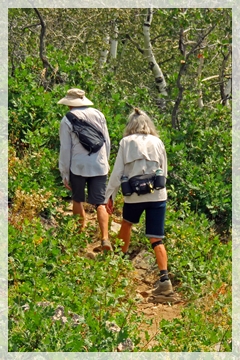 While visiting family in California, I joined my daughter-in-law and her walking group on their morning hike. The leader advised us that it was about a six mile walk—what she didn’t mention was it was all uphill for the first three plus miles. Although we started off together, the group quickly fragmented. The leader and some exceptionally fit and fast walkers were in the lead. I was in the middle group; unfamiliar with the area, I was not about to lose sight of our leader and risk getting lost. Behind us was another group and, bringing up the rear, were three stragglers who abandoned us within the first twenty minutes. After an hour of walking uphill, we finally reached level ground and heaved sighs of relief. The dozen remaining walkers stopped briefly while our leader explained the rest of the course—about a mile more of climbing before starting the descent back to the parking lot. At that point, mutiny occurred and more than half the group decided to take an easier and mostly downhill route back. Used to the flatlands of southwest Florida, I was happy to join my daughter-in-law in her desertion.
While not everyone in the hiking group chose to walk that day, Christians are expected to walk with Jesus every day. Just thinking about Him or praying is not enough—walking implies action. We’re to show up every morning for our walk, rain or shine. On my recent hike, only a few kept pace with the leader. When we walk with Jesus, however, there’s no lagging behind; we keep His pace. In fact, we walk in His footsteps—not behind him, not around him and certainly not ahead of him. Although some people deserted our group as soon as it became difficult, walking in Jesus means we don’t quit when faced with challenges. When Jesus takes us on a difficult uphill route, we’re not allowed to rebel when we disagree with His plans. Jesus told the disciples it wouldn’t be easy but, like our hiking leader, He rarely explains His entire plan. That’s why it’s so important to walk with him; if we lag behind or barge ahead on our own, we’ll lose sight of Him and get hopelessly lost.
Walking in Jesus doesn’t mean occasionally getting together for a stroll or that we’ll meet Him if and when our paths happen to cross. It doesn’t mean we just wave and call out casual greeting when we feel like it and it certainly doesn’t mean we get to quit when the going gets tough. Walking in Him is a 24/7 lifetime commitment.
Unlike our walking leader, who planned the same route and established the same pace for fifteen different women of varying ages and abilities, Jesus designs a route and sets a pace that is uniquely designed for each one of us. We’ll never be alone and, while the path may be challenging, it will always be doable—but only if we walk in Him.
 Patience may be one of the fruits of the Spirit but there appears to be a shortage of it in my life’s orchard. Paul tells us that hardships teach us patience and patience develops strength of character but I imagine most of us are impatient to see all of that character building come to an end. Moses must have grown impatient leading the Israelites all those years, yet consider the patience God had during those same forty years as He dealt with His children’s disobedience, ingratitude and complaints. In fact, consider how patient God has been with mankind since the beginning of time. We err and stray, forget and disobey, ignore, defy and even deny Him, yet He still hasn’t given up on us. Mercifully, we have a God who loves us and, as Paul tells us, love is patient and kind. Remembering that the measure we use to give will be used to measure what we receive, we must be patient with others if we want God to be patient with us.
 I have a small wooden box on my desk—my “God box.” It’s where I literally give my concerns to God; right now there are three items in it. The first is a photograph of a little girl. It is my grand, a sweet child with three congenital heart defects—none of which is going to disappear and all of which promise more trouble in the future. She also has learning issues—none of which will dissipate and all of which will cause more difficulty as she progresses into higher grades. The second item is a medallion from a sobriety program. It represents several people I love who have battled alcoholism or addiction—a battle they will continue to fight daily for the rest of their lives. The third item is a laminated card on which is written Reinhold Niebuhr’s Serenity Prayer. That one is for me.
 Ralph Waldo Emerson said, “Life is a journey, not a destination;” I thought of that quote when reading an article about a local man who attempted an unsupported solo ski trek from the edge of the Antarctic to the South Pole. This experienced adventurer spent several years preparing for the expedition and rigorously testing his equipment. With extras of nearly everything, he was sure he’d planned for every eventuality. What he hadn’t anticipated was encountering one of the worst summers the Antarctic has experienced, an issue with a ski that caused him constant soreness in his right foot, and a cracked teapot! The teapot (the lone one he had) was the only way he could melt snow and, without it, he’d have no water. Reluctantly, he asked a support plane to airdrop a new pot and, in spite of his best intentions, the trek changed from unsupported to supported. Then, a combination of wind and foot pain took their toll. Although he’d planned on making ten to twelve miles a day, no matter how hard he pushed himself, he averaged only eight and his supplies dwindled. After over 300 miles and thirty-six days alone on the ice, he approached an area where a plane could safely land. If he continued at his pace, he would definitely need more supplies. Moreover, there was an excellent chance that, if and when he arrived at the South Pole, extraction planes would no longer be flying. Although he’d have bragging rights for attaining his goal, penguins could be the only ones who’d ever hear his boasting. Weighing his options, he decided it was time to leave. “For me, turning back is never the wrong decision,” he said.
 Devotions of the Heart