
O Lord, God of my salvation, I cry out to you by day. I come to you at night. Now hear my prayer; listen to my cry. For my life is full of troubles, and death draws near. [Psalm 88:1-3 (NLT)]
 I woke to yet another cold dreary winter day. Troubled by a variety of concerns and hoping to improve my glum mood, I turned to Psalms. Unfortunately, I made a bad choice in Psalm 88. Written by Heman the Ezrahite, I saw that originally it was to be sung to the tune “The Suffering of Affliction” (which should have been my clue to read no further).
During David’s time, Heman was one of three chief Levites appointed to conduct music in the tabernacle (the equivalent of today’s worship leader). Perhaps he wrote this psalm to console David in his sorrow after the loss of his son but there seems to be nothing consoling about it. The speaker’s life is full of troubles; he considers himself a lost cause and as good as dead. Repulsive and depressed, he’s been forgotten by his friends, feels God’s anger, and asks God why he’s been rejected. Typically, psalms of lament eventually turn from despair to hope and from misery to confidence but there’s not even a glimmer of hope in this one! “Darkness is my closest friend,” are the psalmist’s final words. Although the RSV Bible subtitles the psalm a “Prayer for Help in Despondency,” a far better title would be “Job’s Lament!”
Later that morning, we attended worship at our northern church. The service, an Advent tradition there, was a celebration of the beautiful music of the Christmas season. As I listened to the words of the carols, my spirits lifted. Unlike Heman, this was a worship leader who knew what songs would help the despondent.
With my improved outlook, I thought back to that mournful psalm and realized that, as miserable and depressed as the psalmist was, he hadn’t given up on God. His words were honest—he was wretched and desolate—and yet he knew God heard his complaint. Even though he felt abandoned, he continued to pray which means he knew he hadn’t been forsaken. In fact, knowing his words were not falling on deaf ears, he vowed to continue his prayers. He knew that tears and prayers go together—that his troubles were a reason to talk with God rather than a reason to stop praying
It was the words of John 3:16 that made me finally understand that the sorrowful psalm and the joyful carols were telling me the same thing. No matter how wretched we feel, no matter how distressing our situation, no matter how severe our suffering, we are loved. Unfortunately, faith is no protection from trouble and sometimes we will sink in sorrow. Nevertheless, like the psalmist, we can remain earnest in prayer. Knowing that God loved us enough to give us His only son, we can know He loves us enough to hear our prayers. Even when we feel abandoned, God is with us; Immanuel is His name.
Those who are in trouble of mind may sing this psalm [Psalm 88] feelingly; those that are not ought to sing it thankfully, blessing God that it is not their case. [Matthew Henry]
For this is how God loved the world: He gave his one and only Son, so that everyone who believes in him will not perish but have eternal life. [John 3:16 (NLT)]
Copyright ©2017 jsjdevotions. All rights reserved.
 When asked about her boys, a friend used to answer, “They’re doing their own thing.” Years later, I learned “their own thing” meant they were breaking her mama’s heart with their addictions and run-ins with the law. Because she kept her pain concealed, she carried the weight of that burden alone for many years. We often hear similar answers when we ask someone how they’re doing— brusque responses like, “I’m fine,” “It’s taken care of,” or “We don’t need a thing.” Maybe everything really is hunky dory but those answers are often used when life has gone seriously awry and things are anything but fine. Those vague but terse responses are conversation stoppers. Even best friends, who suspect something is amiss, won’t pry and the subject is politely changed.
 Most of us think of sloth as laziness: a dislike of work or any physical exertion. Having watched the local zoo’s sloth in action (or, rather, inaction), I think the sluggish animal is appropriately named. Spiritual sloth, however, is far different than being a couch potato. Originally, the sin of sloth was two sins: sadness and acedia. Compiled by Evagrius of Ponticus, a 4th century monk, these two “capitals sins” were part of a list of eight he believed to the greatest threats to devout monasticism.
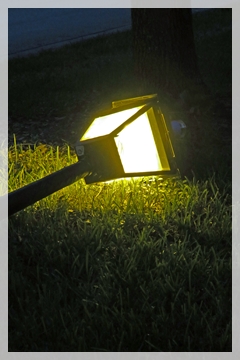 To avoid the southwest Florida heat, I waited until dusk to take my walk. Thanks to Hurricane Irma, most of the street lamps in my neighborhood don’t work. For a light to function, electrical energy has to be converted into light energy and both a source of electricity and a working connection are needed. For many of the lights, the connection was broken when blowing debris shattered their bulbs. For others, Irma’s 150 mph winds broke the connection when it blew off their tops, wrapped their poles around trees, or knocked them to the ground. Without a connection to their source of power, those street lights are useless—they’re just a tangle of wires and a pile of glass, plastic and metal. Even though they don’t work, people have been cautioned to remember that their exposed wires are live. It’s not the electricity that is missing; it’s the connection that is inoperative. Two poles, however, were down but not out. Even though they’d been flattened by the storm, neither wires nor bulb had broken. In spite of the storm’s violence, they remained connected and were beacons in the night’s darkness.
 As I viewed the picturesque waterfall, the tremendous amount of water pouring over the rock, and the deep gorge formed by the glacial river, I thought of H. Jackson Brown’s quote: “In the confrontation between the stream and the rock, the stream always wins, not through strength but by perseverance.” Thinking it a good start for a devotion about patience and determination, I looked forward to writing it when I got home. Having been out of town thirty out of the last seventy days, however, I’ve been playing “catch-up” since returning from Canada. Domestic chores, family obligations, paper work, commitments, appointments, assorted health issues, and then my mother-in-law’s hospitalization have eaten away at me and I’m physically and emotionally exhausted. Today, during prayers, it occurred to me that something else is as persistent (and effective) as that rushing water—Satan! While the enemy enjoys throwing major disasters our way, as he did with Job, he also likes to peck at us like a troublesome woodpecker or whittle away at us as water does to rock. Through persistence, water defeats rock; like that persistent water, the enemy is determined to defeat us.
 Devotions of the Heart