IDOLS

You shall have no other gods before me. [Exodus 20:3 (RSV)]

You shall make for yourselves no idols and erect no graven image or pillar, and you shall not set up a figured stone in your land, to bow down to them; for I am the Lord your God. [Leviticus 26:1 (RSV)]

6-18-15IMG_1012webWhile Moses was on the mountain receiving the Ten Commandments from God, the Israelites grew restless and impatient with his long absence. Faith in both God and Moses flew out the window (or tents, in this case) and the people convinced Aaron they needed an idol who could lead them in their journey to the Promised Land. Gold earrings were gathered, melted down, and molded into the shape of a calf. As soon as the Israelites saw the image, they proclaimed it to be the God that led them out of Egypt. It was easier to believe in a piece of gold they could see than a real god they couldn’t. As usually happens with disobedience and idolatry, immorality soon followed. In spite of the many miracles God had already performed that allowed them to leave Egyptian captivity, the Israelites chose their golden calf over the true giver of gifts.

Like the Israelites, we often forget our blessings and the one responsible for those blessings. While we may not deify a golden calf, in spite of God’s command, we often worship other gods. Many of us tend to be more concerned about wealth, appearances, or fame than we are about God; that’s worshipping an idol. When we care more about obtaining or maintaining our possessions than we care about God, that’s worshipping an idol. When we give more attention to ourselves and our interests than we do to God, we are worshipping idols. When our standard of living is more important than our standard of giving, we are worshipping idols. These may not be graven images and we may not be worshipping them at an altar, nonetheless, they are idols. The Lord God is the only one to whom we should bow down and the only one to whom we should look up to with adoration.

When you cry out, let your collection of idols deliver you! The wind will carry them off, a breath will take them away. But he who takes refuge in me shall possess the land, and shall inherit my holy mountain. [Isaiah 57:13 (RSV)]

For great is the Lord, and greatly to be praised, and he is to be held in awe above all gods. For all the gods of the peoples are idols; but the Lord made the heavens. Honor and majesty are before him; strength and joy are in his place. [1 Chronicles 16:25-27 (RSV)]

ANOTHER KIND OF SPARK

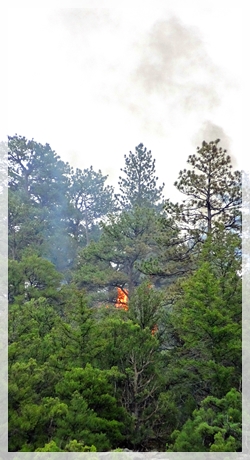
We can make a large horse go wherever we want by means of a small bit in its mouth. And a small rudder makes a huge ship turn wherever the pilot chooses to go, even though the winds are strong. In the same way, the tongue is a small thing that makes grand speeches. But a tiny spark can set a great forest on fire. And the tongue is a flame of fire. It is a whole world of wickedness, corrupting the entire body. It can set your whole life on fire, for it is set on fire by hell itself. [James 3:3-6 (NLT)]

5-16-15DSC09069awebIndeed, the tongue can be a “small thing that makes grand speeches.” Anyone who ever heard Martin Luther King’s “I Have a Dream” speech, John F. Kennedy’s words, “Ask not what your country can do for you…”, or Billy Graham preach knows that tongues can inspire and teach, praise and bless, comfort and pray. Speech, while extremely powerful, can also be incredibly dangerous.

James compares the tongue to a “flame of fire.” Have you even seen television coverage of a forest fire? It’s frightening how one camper’s poorly dowsed fire or a careless hiker’s cigarette can wreak such devastation. Once the fire gets started, it’s nearly impossible to control and its damage can’t be undone. If the wind picks up, the destruction can be enormous. Last year flames came within a few blocks of my son’s house and the barren hillside following the fire was a constant reminder of how close they came to losing their home.

Our words can be as dangerous as a spark in a dry forest. They cannot be taken back once spoken and the damage can be horrendous. Bragging, gossip, exaggeration, flattery, lying, disparagement, and manipulation with our words are all examples of an untamed tongue. Before speaking, we should ask ourselves, “Is it true? Is it kind? Is it necessary?” If in doubt, we should say nothing. Just as a strong wind will fan the fire’s flames, anger can turn a few imprudent words into a raging inferno. Homes and lives can truly be destroyed by the heat of angry words.

Yesterday’s message included Kurt Kaiser’s words “It only takes a spark to get a fire going” in reference to love. It’s important to remember that it only takes a spark from an untamed tongue to get another kind of fire going!

How much more grievous are the consequences of anger than the causes of it. [Marcus Aurelius]

Those who control their tongue will have a long life; opening your mouth can ruin everything. [Proverbs 13:3 (NLT)]

A gentle answer deflects anger, but harsh words make tempers flare. [Proverbs 15:1 (NLT)]

LOCKED DOORS – WHEN HE SAYS “NO”

Who shut the doors to keep the sea in when it broke through and was born, when I made the clouds like a coat for the sea and wrapped it in dark clouds, when I put limits on the sea and put its doors and bars in place, when I said to the sea, “You may come this far, but no farther; this is where your proud waves must stop”? [Job 38:8-11 (NCV)]

7-14-15_5330webWhen the youngest grandchildren visited us in Florida, we were putty in their hands. But, being loving grandparents, we wanted to keep them safe and that meant saying “No!” at times. Among our precautions, the doors to the lanai remained shut and locked to keep the tykes from venturing into the pool without an adult. That’s not to say they didn’t try their level best to thwart our deterrents at every opportunity. They pled with us, made promises they couldn’t keep (“We won’t go near the water”) or resorted to tears. When that didn’t work, they tried to open the doors themselves. We love them too much not to keep them safe and know that certain situations (like toddlers and pools without supervision) require locked doors and firm denials. The little guys, however, simply thought we were being mean keeping them from having their way.

We are God’s children and, like my youngest grands, we often don’t have much common sense when it comes to what we desire. We pray and plead, wheedle and whine for something. When God doesn’t grant our prayers, we often console ourselves by saying that He isn’t denying us; He’s only delaying His affirmative answer. We just need to pray more and try harder to make it happen. Sometimes, however, God’s denials are just that—denials. He may even shut and lock doors to keep us from trying to take matters into our own hands. Just like toddlers, there are times we need doors closed and locks secured for our own protection.

When I look back at some of the things for which I’ve prayed, I can only say “Thank you, God, for blocking my way!” It is only in retrospect, however, that I appreciate God’s denials of my prayers and the ways He deterred me. I clearly had no idea what I was asking for in my prayers, but He did and, in His heavenly wisdom, kept me from making some enormous mistakes simply by obstructing my path. Thank you, God, for loving me enough to say “No!”

After we have made our requests known to Him, our language should be, “Thy will be done.” I would a thousand times rather that Gods’ will should be done than my own. [D. L. Moody]

I say this because I know what I am planning for you,” says the Lord. “I have good plans for you, not plans to hurt you. I will give you hope and a good future. Then you will call my name. You will come to me and pray to me, and I will listen to you. [Jeremiahs 2:11-12 (NCV)]

IGNORING THEIR CRIES

So it came to pass, when Joseph had come to his brothers, that they stripped Joseph of his tunic, the tunic of many colors that was on him. Then they took him and cast him into a pit. And the pit was empty; there was no water in it. And they sat down to eat a meal. [Genesis 37:23-25a (NKJV)]

7-11-15zionPresChurch-SchapvilleIL68web
Recently, in our nation’s capital, four people were murdered and their home set ablaze. It was DNA left on a pizza crust that quickly led police to the alleged killer. While this was an astounding piece of detective work, what astonishes me most is that, while holding four people hostage, four people likely pleading desperately for their lives, someone could calmly eat a pizza. How could anyone have an appetite while plotting murder? Yet, someone did and he’s not alone; that’s exactly what Joseph’s brothers did.

You remember Joseph, the favored son of Jacob, the handsome one with the coat of many colors. When his jealous brothers conspired to kill him, Reuben (thinking he might rescue his younger brother later) suggested they throw him into a dry cistern and leave him to the mercy of the elements. After tossing Joseph like a piece of garbage into a pit, the brothers all sat down to eat. Boys being boys, perhaps Joseph thought it was just a brotherly prank and his siblings would soon let him out of the well. “Come on guys, I’m hungry and thirsty. Help me up so I can have some lunch. I’ll even share my coat with you!” But, when he heard his brothers discuss selling him into slavery to some Ishmaelite traders, it began to dawn on him that he was in serious trouble and they weren’t joking. Can you imagine the cries of the terrified youth once he realized what was happening and the danger of his situation? While Joseph pled for his life, his brothers ignored his cries and enjoyed their meal. Can you imagine how he must have begged for their mercy, much as the DC family probably begged for their lives? Unlike the pizza eating criminal, Joseph’s brothers didn’t plan an outright murder; they were going to leave that to the slave traders. But, like that killer in DC, they knew their victim’s anguish and refused to hear his cries.

While we’re not likely to invade a home and kill its occupants or throw someone into a pit and sell him into slavery, we’re not all that different from Joseph’s brothers and the suspected murderer in DC. We may not be plotting murder and mayhem, but we do ignore the desperate cries of those in need and, by ignoring their cries, condemn them to lives of misery or death. While calmly enjoying meals in the comfort of our homes, do we turn a deaf ear to the voices of the hungry? Do we turn our backs on our less fortunate brothers and sisters—the poor, homeless, sick, or victimized? This morning I saw a sign on a church that read, “Be the Church—Fight for the Powerless.” We can’t do that if we ignore their cries!

We must never minimize the suffering of another. Scripture’s mandate to us is, “Weep with them that weep.” [Billy Graham]

Then they said to one another, “We are truly guilty concerning our brother, for we saw the anguish of his soul when he pleaded with us, and we would not hear; therefore this distress has come upon us.” [Genesis 42:21(NKJV)]

And just as you want men to do to you, you also do to them likewise. [Luke 6:31 (NKJV)]

WICKEDNESS BRINGS PUNISHMENT

DSC02558-Bern (Cathedral-Munster-Last Judgement)3-cropWEB

“The Last Judgment” – Munster Cathedral, Bern, Switzerland


Yahweh! The Lord! The God of compassion and mercy! I am slow to anger and filled with unfailing love and faithfulness. I lavish unfailing love to a thousand generations. I forgive iniquity, rebellion and sin. But I do not excuse the guilty. [Exodus 43:6-7 (NLT)]

If asked to draw a picture of God, many would probably draw a pleasant old gentleman with a gentle smile. Looking a bit like Santa Claus, he’d be dressed in a long white robe instead of a fur-trimmed red coat and hat. This kind-looking grandfatherly man would be seated on a throne with several little children in his lap. Reading the Old Testament, however, makes one rethink this picture. While we meet a loving and forgiving God, we also encounter a judgmental and destructive God: a God who sends plagues to his people, destroys whole towns, and sends his people into slavery. This is not the “warm and fuzzy” God about whom we want to think. He’s certainly not the good-natured God of my Sunday school classes.

It certainly is more comforting for us to think of God as loving and merciful and, indeed, He is. But, as the Old Testament reminds us and the New Testament warns us, God can get angry with his people. He hates sin and he is ready to hand out punishment to those who defy him. Fortunately, we also have a loving and forgiving Heavenly Father who hasn’t lost faith in his children. He saved Noah and his family from the flood. He rescued Lot and his family from the destruction of Sodom and Gomorrah. He saved Jonah from the whale after Jonah said he’d obey God’s directions. After telling Nineveh they would be destroyed in forty days, God relented when they repented their sinful ways. After punishing the Israelites for their disobedience, God finally led them to the Promised Land. Later, He rescued them from their exile in Babylon. Although we continually disappoint God with our disobedience, He mercifully gave us his only son as a sacrifice for our sins.

The righteous character of God includes both his anger and judgment along with his love and mercy. It is not enough to read and hear only God’s comforting words. We must remember that His justice goes hand in hand with His love.

Your wickedness will bring its own punishment. Your turning from me will shame you. You will see what an evil, bitter thing it is to abandon the Lord your God and not to fear him. I, the Lord, the Lord of Heaven’s Armies, have spoken! [Jeremiah 2:19 (NLT)]

THE BURNING BUSH

Now I am going to send you to Pharaoh, to demand that he let you lead my people out of Egypt. “But I’m not the person for a job like that!” Moses exclaimed. [Exodus 3:10-11 (TLB)]

flame vine - NBG925-cropweb

Flame Vine

Things were going well for Moses in Midian: he was happily married, with a family and tending his father-in-law’s sheep. Then God interrupted his comfortable life with a burning bush and a major task: free the Israelites. Moses reacted the way most of us would by questioning God. Who am I to do this? Who do I say sent me? What if they don’t believe me? He then told God he simply wasn’t up to the task. God, not one to be thwarted, responded to all off Moses’ concerns. He would be with him, provide the words, the proof, and even Aaron to do the talking. In short, God promised to provide and Moses obeyed.

God sends all of us burning bush moments that interrupt our comfortable lives. While not history-making assignments like freeing people from slavery, they are, nevertheless, important to the people involved. A few years ago I had a burning bush moment and, like Moses, I questioned God about my ability to respond.

My mother-in-law had suffered a mild heart attack and we were in a treatment room in the local ER. Resting comfortably, she’d been diagnosed and treatment had started. We were simply waiting with her for a hospital room to become available. Suddenly, a young man on a gurney was wheeled past our room. Surrounded by paramedics, an automated CPR machine was pumping on his chest. As doctors and nurses sped past, I said a quick prayer for him. Not much later, I saw a young woman being consoled by a nurse. There was no doubt in my mind that this woman had been married to the man brought in by the EMTs. Clearly, the outcome had not been good; while she’d started the day as a wife, she would be ending it as a widow. This tearful woman was being given papers, directions and some small solace before the nurse turned away. It was a busy night in the ER and other patients called. This was my burning bush moment. Alone in her grief, did she need someone to be with her?

Like Moses, I had questions and excuses. I’m not a grief counselor, what would I say? What if she rebuffed my offer? What if she’s not Christian? Would I have to drive her home? If so, how and when would I get back to the hospital? What if I got sucked into all sorts of family drama? Unlike Moses, however, I didn’t trust God’s provision. In fact, I didn’t even listen for His answers to my questions. While busy thinking about me and pondering various difficult scenarios in my mind, the opportunity passed. When next I looked, the woman was gone.

Unsure of what to do and hesitant to get involved, I should have prayed for God’s guidance. Instead of thinking of all the reasons I wasn’t qualified, I should have trusted His provision. I may have been told to mind my own business or been slightly inconvenienced. I’m a big girl and I could have handled that. Like Moses, I didn’t know what I’d say. It probably wasn’t relevant Bible verses, however, that this woman needed. She just needed God’s love and compassion and I have plenty of that. I could have offered a little help, prayers, sympathy and a shoulder on which she could cry.

Without a doubt, there will be other burning bush moments in my life. I pray that I will respond with an open and trusting heart the next time that happens. Keep your eyes open; there may be a burning bush in your path today. How will you respond?

Among the early difficulties of our early ministry, my brother Charles often said, “If the Lord would give me wings, I’d fly.” I used to answer, “If God bids me fly, I will trust Him for the wings.” [John Wesley]

Help me to do your will, for you are my God. Lead me in good paths, for your Spirit is good. [Psalm 143:10 (TLB)]