LOOKS ARE DECEIVING!

tussock mother caterpillar

Stay in control of yourselves; stay awake. Your enemy, the devil, is stalking around like a roaring lion, looking for someone to devour. [1 Peter 5:8 (NTE)]

When we took a photo safari in Tanzania several years ago, bathrooms were in short supply and the gentlemen occasionally would step out of the Land Rovers to “check the tires.”  The guides, however, always cautiously chose the “tire-checking” locations and only stopped in the middle of the road in open areas. While there was little privacy, predators had no place in which to hide and any that approached could be seen from a distance. After all, no one wanted to be surprised by a lion while answering nature’s call. Since Satan sometimes skulks around like a hungry lion, it is wise to remember the guides’ advice: never linger where lions (or other predators) may be lurking.

Satan, however, isn’t always as obvious as a prowling lion. Sometimes, he’s more like a snake hidden in the grass waiting for us to approach. Since deceit is the most powerful weapon in his arsenal, we can be sure he won’t be wearing a sign that says, “Danger – Don’t touch!”  In fact, unlike a lion or snake, he may look innocent and rather appealing, like the harmless looking caterpillar I saw while walking in the swamp. Bearing a slight resemblance to a piece of novelty or “eyelash” yarn, it was a pretty little creepy-crawly with delicate tufts of hair. Looking so soft, I was tempted to lightly bush my finger over it. Fortunately, I’d just seen a sign warning of poisonous caterpillars and, suspecting that little guy was not as innocent as it seemed, I kept my hands to myself. The cute critter tuned out to be a tussock moth caterpillar and even a light touch of its soft looking bristles will feel like being pricked by fiberglass! In fact, some species can leave a persistent and painful rash.

We must never forget that Satan is cunning, powerful, resourceful and persistent. Sometimes, like a hungry lion, he actively hunts and we can see him coming from a distance. On the other hand, like a poison caterpillar that looks inviting and innocent, he sometimes lays in wait for us where we’d least expect to find trouble. Either way, we need to be constantly alert. While it may announce itself with a roar, more often than not, temptation looks as harmless as a fuzzy caterpillar. Don’t venture too close!

There is a precipice near every man’s foot, and a snare in every man’s path. … There is a lure for every bird, a bait for every fish. … Watch constantly against those things which are thought to be no temptations. The most poisonous serpents are found where the sweetest flowers grow. [Charles Spurgeon]

Rather, each person is tested when they are dragged off and enticed by their own desires. [James 1:14 (NTE)]

Watch and pray so that you don’t get pulled down into the time of testing. The spirit is eager, but the body is weak. [Matthew 26:41 (NTE)]

Copyright ©2020 jsjdevotions. All rights reserved.

SEEING THE WHOLE THING

Every Scripture passage is inspired by God. All of them are useful for teaching, pointing out errors, correcting people, and training them for a life that has God’s approval. [2 Timothy 3:16 (GW)]

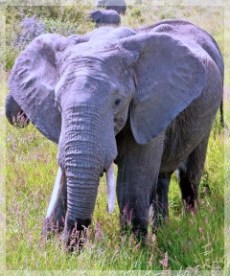
ELEPHANT - SERENGETIThe story is told of four blind men who, while walking together, collided with an elephant. The one who bumped into the elephant’s trunk concluded they’d run into a giant hose. The second man, feeling the elephant’s huge ear, disagreed and said it was an enormous fan. As he pulled on the tail, the third man assumed that it was a heavy rope. The fourth blind man, feeling the thick leg, pronounced them all to be wrong and declared they’d encountered a tree. Because none of them felt the entire animal, all of them were incorrect.


Jesus doesn‘t want His followers groping in the dark; He wants followers who can recognize Him. He doesn’t want faith that can’t see; he wants faith that comes from seeing the truth. Blind faith can’t answer the question, “Why do you believe?” nor can it stand firm when challenged. It can’t explain, “How do you know Jesus is the Son of God?” or “What makes you think the Bible is true?” Uninformed faith certainly can’t respond to difficult questions about evil, condemnation, redemption, and salvation. Blind faith can’t answer, “What would Jesus do?” if it doesn’t know what He said or did. It certainly can’t share the Gospel if it doesn’t know what the good news really says! Undiscerning faith can’t stand strong when Satan instills doubts nor can it recognize false teachings. Faith requires trust but how can we trust when we’re unsure of what and why we believe? Reason and intellect are not abandoned when we accept Christ; reason and intellect are what show us the truth of God’s way.

Without reading the Bible, we are like the blind men with the elephant. Depending entirely on what they felt at the time, they drew incorrect conclusions and missed the enormity of what was right in front of them. Let us never forget that the entire Bible is “God breathed” and not just our favorite verses. Without reading the whole thing, however, it’s easy to misunderstand what is right in front of us or to focus only on the concepts we like, such as love, mercy and God’s forgiveness, instead of other more demanding concepts, like sacrifice, humility, self-denial and obedience.

It has often been said that, “Knowledge is power.” Indeed, Biblical knowledge is powerful, but not because it gives us brute force. Biblical knowledge gives us the power to understand our lives as they relate to God’s plan, to discriminate between right and wrong, to resist evil and make the correct choices. It gives us the power to know our Lord, to share God’s word and, most of all, to stand strong in our faith.

Father, open our eyes and minds so that we grow in our knowledge of you. Let your truth grip our hearts and strengthen our faith.

We must not select a few favorite Bible passages to the exclusion of others. Nothing less than a whole Bible can make a whole Christian. [A.W. Tozer]

So Jesus said to those Jews who believed in him, “If you live by what I say, you are truly my disciples. You will know the truth, and the truth will set you free.” [John 8:31-32 (GW)]

But dedicate your lives to Christ as Lord. Always be ready to defend your confidence in God when anyone asks you to explain it. However, make your defense with gentleness and respect. [1 Peter 3:15 (GW)]

Copyright ©2020 jsjdevotions. All rights reserved.

RULES

This is what the Lord has commanded: A man who makes a vow to the Lord or makes a pledge under oath must never break it. He must do exactly what he said he would do. [Numbers 30:1-2 (NLT)]

“What sorrow awaits you teachers of religious law and you Pharisees. …For you say that it means nothing to swear ‘by God’s Temple,’ but that it is binding to swear ‘by the gold in the Temple.’” [Matthew 23, 15-16 (NLT)

water lily

As any parent of a teenager knows, it’s impossible to have enough rules to cover all the ways your child can err. Schemers that they are, they’ll always find a way around restrictions. When I attended boarding school, for example, several of us girls had our ears pierced by a fellow student (an aspiring physician). We knew that neither school nor parents would endorse numbing our ears with icicles and piercing them with a sewing needle and dental floss but, without a specific rule against it, we pierced them anyway. Because it was the school’s second year, the administration hadn’t anticipated all the ways we teens could misbehave and our student handbook was only one page. Now, 57 years later, that handbook is 33 pages long and covers such things as body piercings and tattoos, drones, room searches, recording devices, prohibited clothing, subwoofers, a roommate’s rights, and unauthorized access to the school’s computer system. I imagine next year’s handbook will be even longer and reflect yet another way its students have managed to flout authority.

Of course, it’s not just teenagers who assume that, if something isn’t specifically prohibited, it must be allowed. No matter their age, people will try to find a way around every inconvenient or bothersome rule. For example, God made it clear that a vow made before Him was binding. Keeping promises, however, can prove problematic and, through a convoluted re-interpretation of the law, the Pharisees of Jesus’ time created a loophole. If one swore by the gold on the altar, the promise was binding. But, if one swore only by the altar or temple, it was like crossing your fingers and the promise could be broken with impunity: a promise was only a promise if it was expedient.

We girls knew we shouldn’t have pierced our ears that way, the Pharisees knew that God meant for all promises to be kept, and today’s students shouldn’t need a specific rule stating that roommates must be spoken to in a respectful manner. While there were plenty of laws in the Old Testament, Jesus boiled them all down to two simple ones: love God and love our neighbor. In a perfect world these would be the only laws necessary. The world, however, isn’t perfect which is why we still have regulations and school handbooks.

Just because something is legal doesn’t necessarily make it right and just because something isn’t specifically prohibited doesn’t mean it should be done. Jesus lived by one law: the law of love. Regardless of the rules, like Him, we must let the two-fold commandment of loving God and loving our neighbor guide us in everything we do.

Owe nothing to anyone—except for your obligation to love one another. If you love your neighbor, you will fulfill the requirements of God’s law. For the commandments say, “You must not commit adultery. You must not murder. You must not steal. You must not covet.” These—and other such commandments—are summed up in this one commandment: “Love your neighbor as yourself.” Love does no wrong to others, so love fulfills the requirements of God’s law. [Romans 13:8-10 (NLT)]

Copyright ©2020 jsjdevotions. All rights reserved.

THE INVISIBLE FENCE

Cling to your faith in Christ, and keep your conscience clear. For some people have deliberately violated their consciences; as a result, their faith has been shipwrecked. [1 Timothy 1:19 (NLT)]

african irisThe barking dog came charging down the driveway toward me before skidding to a halt. “Thank you, God, for invisible fences,” was my relieved thought. Unwilling to cross that invisible barrier, the fiercely barking dog followed me from his yard while keeping his distance. A bed of beautiful African iris was between us and I debated about stepping closer to get a photo of their blossoms. While the threat of his collar deterred the dog as long as I remained where I was, I wasn’t sure what he’d do if I ventured any closer. My stepping on his turf could have proven too much temptation for the fellow and he may have been willing to take the punishment for a chance to show me who was boss. My flower picture could wait until another day.

Life would be so much easier if I had an invisible fence. No, I don’t have a dog; the fence would be for me. It would warn me when I got too close to sin and give me a shock if I dared cross the line into sinfulness. When talk veered toward gossip, I’d hear a little buzzing sound; if I continued the conversation, I’d get a zap! The same thing would happen whenever pride reared its ugly head or when tempted to be selfish, deceitful or envious. I’m a quick learner; I imagine my behavior would improve quickly if I got an unpleasant buzz or a little shock every time I started to step across the line into sin!

Actually, I do have an invisible fence, only it’s called a conscience and it’s my built-in ability to know right from wrong. A gift from God, it is His voice planted within my heart. Unfortunately, just like an angry dog with an invisible fence, when sorely tempted, I’m capable of ignoring my conscience. Moreover, just as the battery in the dog’s collar can weaken or die, my conscience isn’t entirely reliable. It tends to be stronger when others are present, weaker when I’m alone and can even atrophy from lack of use. That’s why I like having the Holy Spirit at my side—He operates at full strength all of the time. Even when my conscience fails me, He is sure to convict me when my behavior doesn’t glorify Jesus—He might even give me a spiritual zap!

The paradoxical and tragic situation of man is that his conscience is weakest when he needs it most. [Erich Fromm]

God knows what each one of us is dealing with. He knows our pressures. He knows our conflicts. And He has made a provision for each and every one of them. That provision is Himself in the person of the Holy Spirit, indwelling us and empowering us to respond rightly. [Kay Arthur]

So I say, let the Holy Spirit guide your lives. Then you won’t be doing what your sinful nature craves. The sinful nature wants to do evil, which is just the opposite of what the Spirit wants. And the Spirit gives us desires that are the opposite of what the sinful nature desires. [Galatians 5:16-17a (NLT)]

Copyright ©2020 jsjdevotions. All rights reserved.

FEED THEM

When you produce much fruit, you are my true disciples. This brings great glory to my Father. [John 15:8 (NLT)]

He said, “Lord, you know everything. You know that I love you.” Jesus said, “Then feed my sheep. [John 21:17 (NLT)]

squirrelJohn 21 records Jesus telling Peter to feed His flock three times. The word translated as “feed” in verse 16 is poimaino which refers to the entire process of tending the sheep: feeding, leading, guarding, doctoring, and bringing them into the sheep fold. Although the food of which Jesus is speaking appears to be the word of God, in verses 15 and 17 the word translated as “feed” is bosko, which exclusively meant to feed. Jesus gave Peter these instructions immediately after He’d fed the disciples a breakfast of grilled fish and bread. Could He also have been speaking of providing actual food?

The people of Palestine were spiritually hungry for the message of the gospel but, on at least two occasions, they listened to Jesus so long that they were physically hungry, as well. In those instances, when Jesus told His disciples to feed the people, He meant to give them something to eat! Sometimes, feeding His flock is as simple as that.

Stately oaks line the streets in our community. Since autumn is acorn season, I’ve been thinking of Jesus’s command to bear fruit. Acorns are the fruit of the oak and come from the tiny flowers the trees produce in the spring. Within each acorn is a seed with the potential of becoming another oak tree. It’s been a good year for acorns and, if those oaks were followers of Jesus, our Lord would be pleased at the abundance of fruit they produced.

Next spring, any acorns cached away by an absent-minded squirrel or chipmunk could send up shoots, become seedlings, and eventually grow into trees capable of producing more fruit. Oak seedlings in our community, however, don’t stand a chance since the landscapers will pull them up or mow them down. Even though our acorns won’t grow into trees, they’re much appreciated by the squirrels, rabbits, ducks, crows, jays and woodpeckers who feast on them. The animals often congregate in the middle of the streets to take advantage of the nut-cracking capabilities of car, truck, and bike tires. If those oaks were believers, even without producing more of their kind, I still think our Lord would be pleased by them because they are feeding the hungry!

I apologize for mixing metaphors in my examples. If we bear fruit, as do the oaks, sometimes the seeds in our fruit will take root and grow and, if we tend the flock as a good shepherd, sometimes, the flock will increase. But, other times, like the oaks in our community or the disciples as they passed out loaves and fish, we simply provide physical nourishment for His flock.

This pandemic has exacerbated the inequalities and vulnerabilities suffered by many throughout the world. As the economy spirals downward, the number of hungry rises. The United Nations has warned of “multiple famines of biblical proportions” resulting from COVID-19. They anticipate the number of people in crisis level hunger rising to 270 million by the end of the year (an 82% increase since 2019) and warn that more people may die of coronavirus-driven hunger than those who will die from the virus itself!

Like the oaks, let us be generous with our fruit and, as the shepherds of His sheep, let us feed His flock.

But Jesus said, “You feed them.” [Mark 6:37 (NLT)]

Yes, just as you can identify a tree by its fruit, so you can identify people by their actions. [Matthew 7:20 (NLT)]

Copyright ©2020 jsjdevotions. All rights reserved.

HALT

Jesus replied, “I am the bread of life. Whoever comes to me will never be hungry again. Whoever believes in me will never be thirsty.” [John 6:35 (NLT)]

chicoryAlthough they were twins, Esau and Jacob were as different from one another as oil and water. Esau, the first born, was impulsive. An outdoorsman and hunter, he was his father’s favorite. Jacob was the quiet (and cunning) stay-at-home mama’s boy. Esau would have watched the Outdoor and Sportsman Channels while Jacob would have watched Food Network and HGTV.

Returning exhausted from one of his adventures and claiming he was starved, Esau asked for some of Jacob’s stew. Exploiting his brother’s hunger, Jacob offered to trade the stew for Esau’s birthright. The stew must have smelled delicious because Esau, who should have been outraged at the idea, accepted his brother’s offer. Foolishly, he relinquished his double share of their inheritance along with all the privileges and responsibilities due the eldest son simply to gratify his hunger.

Esau’s story reminds me of the acronym HALT which stands for hungry-angry-lonely-tired. Halt is what we should do before making a decision if we’re feeling any of those things! Esau was both tired and hungry when he made that life-altering decision. Granted, Jacob’s insistence on making a bargain before feeding his own brother was both sly and selfish of him. Still, the fault for that decision falls solely on the shoulders of Esau.

Esau wasn’t starving; his empty stomach may have been growling but he wasn’t malnourished or wasting away. Nevertheless, he was far more interested in immediately gratifying his hunger with a bowl of lentil stew than the ramifications of his choice. Like Esau, when we’re hungry, angry, lonely, or tired, we look to quickly meeting our needs without thinking about the consequences. In short, we’re blind to the enemy’s tactics and vulnerable to sin.

Our hunger may simply be for food, as it was for Esau, but it also can be for things like money, fame, attention, understanding, or acceptance. Simon the Sorcerer, for example, was so hungry for the power and authority of the Holy Spirit that he tried to buy it from Peter and John.

The time to make decisions is not when our emotions are on high alert. Acting in anger is dangerous and can lead to name calling, broken relationships, criticism, belittling, destruction, and even violence. Anger is what caused Moses to rashly smash stone tablets that had been written on by the hand of God! When insulted by Nabal, an enraged David immediately set out to kill every man in Nabal’s household. Fortunately, Abigail stepped in, pled for mercy, and cooler heads prevailed.

Making decisions when we’re lonely isn’t a good idea either. Feeling abandoned and alone, Elijah wanted to lie down and die. Being lonely, however, doesn’t necessarily mean being alone. We can feel isolated and disconnected even when surrounded by plenty of people. Perhaps, in spite of his wives and concubines, it was that sort of loneliness that caused David to desire Bathsheba. Halting helps us remember that God always is with us.

Being tired can be physical exhaustion, as it was with Esau, but it also can be a sense of being overwhelmed and drained. For forty years, Moses faithfully led the Israelites but it was his weariness and exasperation at their constant rebellion that caused him to disobey God and strike the rock at Kadesh. Sadly, his impulsive act meant the weary man never entered the Promised Land.

It’s been said that the difference between school and life is that, in school, you’re taught a lesson and then take a test but, in life, you’re given a test that teaches you a lesson! Let us learn the lesson about halting without having to make a mistake like Esau’s. As the old saying goes, “act in haste, repent in leisure.” Poor decisions come when we’re hungry, angry, lonely or tired. When you’re in one of those situations, halt and pray instead!

We are pressed on every side by troubles, but we are not crushed. We are perplexed, but not driven to despair. We are hunted down, but never abandoned by God. We get knocked down, but we are not destroyed. [2 Corinthians 4:8-9 (NLT)]

Be still in the presence of the Lord, and wait patiently for him to act. Don’t worry about evil people who prosper or fret about their wicked schemes. [Psalm 37:7 (NLT)]

Copyright ©2020 jsjdevotions. All rights reserved.