BURNING COALS (Matthew 5:38-48 – Part 2)

Repay no one evil for evil, but give thought to do what is honorable in the sight of all. If possible, so far as it depends on you, live peaceably with all. Beloved, never avenge yourselves, but leave it to the wrath of God, for it is written, “Vengeance is mine, I will repay, says the Lord.” To the contrary, “if your enemy is hungry, feed him; if he is thirsty, give him something to drink; for by so doing you will heap burning coals on his head.” Do not be overcome by evil, but overcome evil with good. [Romans 12:17-21 (ESV)]

When Paul addressed a Christian’s relationship with his enemies, he said never to return evil for evil and to act honorably so we don’t reflect badly on the Gospel. Paul qualified his direction to live in peace with all by adding, “if possible, so far as it depends on you.” While some people don’t want to live in peace, as Christians, we must refuse to instigate, escalate, or participate in conflict. Since peace-loving people who won’t return evil with more of the same tend to be the sort of people who are taken advantage of, Paul then addresses the issue of revenge. Quoting Deuteronomy 32:25, he makes it clear that we are not to retaliate; vengeance is solely God’s department, not ours.

Telling us not to allow evil to overcome us but to overcome evil by doing good, Paul says our sincere kindness to an enemy is the way to do that. Moreover, by doing so, we’ll “heap burning coals on his head.” While this quote from Proverbs 25:21-22 actually sounds a little vengeful, those burning coals probably refer to an ancient Egyptian practice in which a person’s regret or repentance was demonstrated by carrying a pan filled with burning coals on his head.

In theory, our unexpected and sincere kindness will cause hot coals of shame and guilt in the wrong-doers’ conscience far more effectively than would hostility or spite. What those burning coals aren’t is a back-handed form of revenge—counterfeit kindness used to irritate, manipulate, or publicly humiliate them or a way to get in the last word. They’re certainly not a reason to gloat in self-righteousness. Our genuine kindness is the way to facilitate regret and repentance in the evil doers—whether or not they repent, however, is their choice. Nevertheless, as Christians, we must do our part.

As an illustration of this concept, Chinese evangelist Watchman Nee told a story about two Christian brothers who had a rice paddy located on top of a hill. Each morning, they drew water, climbed up the hill, and irrigated their rice paddy. One morning, they found their paddy dry but the neighbor’s paddy, just downhill from theirs, quite wet. While they were sleeping, he’d dug a hole in their irrigation channel and stolen their water. Rather than retaliate, they filled their paddy again but the same thing happened for several days. When they confided to a church elder that they didn’t have the sense of peace they expected from walking in obedience to God, the brothers were told they hadn’t done enough. The elder told them to fill their neighbor’s paddy with water before filling theirs. Strangely, as they did so, the brothers began to sense the peace they desired and, while continuing to water both paddies, they grew more joyful as they worked. The neighbor who’d stolen their water finally came to them, apologized, and said, “If this is Christianity, I want to hear about it.” Their kindness heaped burning coals on their neighbor’s head and he repented!

Simply not retaliating wasn’t enough for the brothers and it’s not enough for us. When someone slaps us, Jesus expects more from us than just silently walking away; He calls us to love and pray for our enemy. We are to go the extra mile by feeding him when he is hungry, giving him water when he thirsts, and even watering his rice paddy when he’s stolen our water! Admittedly, that’s not always easy; it certainly isn’t our natural response. Can we do it perfectly? Probably not, but we can try!

The world’s philosophy leads people to expect retaliation when they have wronged another. To receive kindness, to see love when it seems uncalled for, can melt the hardest heart. [Expositor’s Bible Commentary]

You have heard that it was said, “You shall love your neighbor and hate your enemy.” But I say to you, Love your enemies and pray for those who persecute you, so that you may be sons of your Father who is in heaven. For he makes his sun rise on the evil and on the good, and sends rain on the just and on the unjust. For if you love those who love you, what reward do you have? Do not even the tax collectors do the same? [Matthew 5:43-46 (ESV)]

Copyright ©2021 jsjdevotions. All rights reserved.

THE OTHER CHEEK (Matthew 5:38-48 – Part 1)

You have heard the law that says the punishment must match the injury: “An eye for an eye, and a tooth for a tooth.” But I say, do not resist an evil person! If someone slaps you on the right cheek, offer the other cheek also. [Matthew 5:38-39 (NLT)]

catWhen Jesus said to turn the other cheek, was he teaching total nonresistance in every circumstance? Are Christians to be doormats to be walked all over? Was he telling the battered wife to remain a punching bag to her abusive husband, the father not to defend his family in a home invasion, the teacher not to protect his students from a crazed shooter, or the girl being molested not to fight back? Having nothing to do with pacifism, Jesus’ words don’t mean we ever should place ourselves or others in danger nor did He say we shouldn’t resist the forces of evil. Using an easily understood example (at least for a 1st century person in Judah), Jesus made it clear that He was speaking about our reaction to personal insults. Rather than not resisting evil, we are not to resist an evil person by seeking retaliation.

To Jesus’ listeners, a slap on the right cheek wasn’t the start of a physical altercation like a punch in the stomach. Not intended to cause physical harm, a slap on the right cheek was meant to disgrace and humiliate. A challenge to one’s honor, it was the most disrespectful and belittling thing one person could do to another. Most people are right-handed and, normally, would slap someone else’s left cheek. When Jesus specified the “right cheek,” He was describing a back-handed slap which, according to rabbinic law, was twice as offensive as being smacked with a flat hand. It was so insulting that the striker could be taken to court and fined. In actuality, it might have been easier for Jesus’ listeners to ignore a gut punch than this slap of contempt and disrespect! When Jesus tells us to turn the other cheek, He’s telling us that it’s better to be insulted twice than to retaliate with a return slap or by taking the matter to court!

Since we don’t go around slapping people’s cheeks to insult them, what does this mean to us? Perhaps it’s as simple as refusing to play the petty game of “tit for tat.”  Regretfully, as mean-spirited as it is, we’ve all played it. It’s things like deciding I’m not going to return his call because he didn’t return mine, I’m going to be late today since she kept me waiting last week, I’m unfriending them because they didn’t include me in their plans, my dogs can poop in his yard since his dog pooped on my lawn, I’m turning up my music since the neighbor’s music is too loud, I’m ignoring her birthday to pay her back for forgetting mine, or I’m not going to let the car merge because the driver cut me off!

Whether it’s rudeness, spite, malice, slight, or contempt, when we return like for like, this old nursery rhyme best says what happens next: “Tit for tat, Butter for fat; If you kill my dog, I’ll kill your cat.” We  foolishly think we’re evening the score and punishing the other person, but we’re not. Returning tit for tat simply raises the stakes and escalates the battle. Let us remember that, by refusing to react, the nasty game is over!

In this day and age, people have endless opportunities to degrade, insult, offend, mock, and slight one another. While we have no way to control what other people do or say, the Holy Spirit provides us with the power to control our reaction—to turn the other cheek. As Jesus’ peaceful soldiers, we can claim victory by not fighting at all!

In taking revenge, a man is but even with his enemy; but in passing it over, he is superior. [Francis Bacon]

Don’t repay evil for evil. Don’t retaliate with insults when people insult you. Instead, pay them back with a blessing. That is what God has called you to do, and he will grant you his blessing. [1 Peter 3:9 (NLT)]

Copyright ©2021 jsjdevotions. All rights reserved.


YOUR KINGDOM COME

This, then, is how you should pray: “Our Father in heaven, hallowed be your name, your kingdom come, your will be done, on earth as it is in heaven.” [Matthew 6:9-10 (NIV)]

Remember that the same Christ who tells us to say, “Give us this day our daily bread,” had first given us this petition, “Hallowed be Thy name; Thy kingdom come; Thy will be done in earth as it is in heaven.” Let not your prayers be all concerning your own sins, your own wants, your own imperfections, your own trials, but let them climb the starry ladder, and get up to Christ Himself, and then, as you draw nigh to the blood-sprinkled mercy-seat, offer this prayer continually, “Lord, extend the kingdom of Thy dear Son.” [Charles Spurgeon]

sunflowerIt wasn’t until I read Charles Spurgeon’s paraphrase of “Your kingdom come,” as “Lord, extend the kingdom of Thy dear Son,” that I truly gave serious thought to what it means to pray, “Your (or “Thy”) kingdom come.” Although we say it every time we say the Lord’s Prayer, what exactly do those three words mean? After all, that was God Himself giving His disciples a guideline to prayer and there certainly couldn’t be a better teacher! Since there are over seventy references to the Kingdom of God in the New Testament and this petition immediately follows praising God’s name in Jesus’ prayer, the coming of God’s Kingdom clearly was important to Him.
Jesus’ life, death, and resurrection opened the doors to God’s Kingdom. Yet, it is only when Jesus comes again at the end of the age that God’s Kingdom will reign with power and authority. While this petition is for the fulfillment of the Kingdom with Christ’s return, it is much more than that. As we pray for the coming of Jesus in the future, these three words also are a petition for the expansion of God’s Kingdom in the present. They are a prayer that the gospel message will be preached to and accepted by all so that the whole world will be made Christ’s Kingdom and filled with His glory. We’re asking God to reveal Himself in such a way that His kingdom is visible here on earth and that He will open the hearts of those we encounter and to whom we witness.

Praying that God’s Kingdom will come is also an acknowledgement that He is our sovereign king and the ruler of our lives. Even though the Kingdom will not be complete until the second coming of Christ, we can experience it today. This leads into  the next petition of “Your will be done,” in which we ask Him to enable us to do what is pleasing to Him. May we be genuine, faithful, obedient, and capable servants of His Kingdom!

Although my lips frequently speak the words, ”Your Kingdom come,” until considering Spurgeon’s words, I barely understood their magnitude. In my personal prayers, I have neglected praying for the coming of God’s Kingdom—the day when Jesus will return and all things will be restored. Although I remember to pray for pastors, missions, and missionaries, the expansion of God’s Kingdom here and now and the role I should play in that expansion has never been on the top of my prayer list either.

If the coming of His Kingdom is God’s priority, perhaps it should be ours as well. Moreover, we should prove the truth of our prayers by putting our words into Kingdom-promoting action. Let us be like the Apostle Paul who, “proclaimed the kingdom of God and taught about the Lord Jesus Christ—with all boldness and without hindrance!” [Acts 28:31]

We therefore pray that God would exert his power, both by the Word and by the Spirit, that the whole world may willingly submit to him. [John Calvin]

Once, on being asked by the Pharisees when the kingdom of God would come, Jesus replied, “The coming of the kingdom of God is not something that can be observed,  nor will people say, ‘Here it is,’ or ‘There it is,’ because the kingdom of God is in your midst.” [Luke 17:20-21 (NIV)]

Copyright ©2021 jsjdevotions. All rights reserved.

BUYING A FIELD

See how the siege ramps have been built against the city walls! Through war, famine, and disease, the city will be handed over to the Babylonians, who will conquer it. Everything has happened just as you said.  And yet O Sovereign LORD, you have told me to buy the field—paying good money for it before these witnesses—even though the city will soon be handed over to the Babylonians. Then this message came to Jeremiah from the Lord: “I am the Lord, the God of all the peoples of the world. Is anything too hard for me? [Jeremiah 32:24-27 (NLT)]

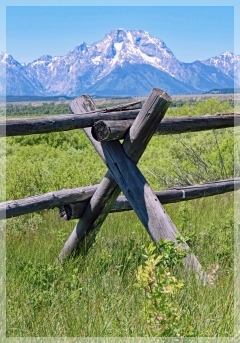
grand tetons - jackson holeUnder siege for nearly a year, Jerusalem was surrounded by the Babylonians, and Judah’s future looked grim. Whether it was poverty or the desire to get rid of property that soon would be worthless once Babylon invaded, Hanamel decided to sell his land in Anathoth, about three miles from Jerusalem. Under Israelite law, property was supposed to stay within a family and so Hanamel offered it to his cousin, the prophet Jeremiah.

Since Anathoth already was under Babylonian control, Hanamel’s real estate deal would be like being offered property in Kabul, Afghanistan. While real estate often is considered a good investment, purchasing property in an active war zone or occupied territory is not. Nevertheless, even though Jeremiah was imprisoned in the palace courtyard and the nation’s defeat was inevitable, God instructed him to become the property’s redeemer by purchasing his cousin’s land.

Having prophesied the fall of Judah, the destruction of Jerusalem, Zedekiah’s imprisonment, and the Jews’ captivity, Jeremiah knew how worthless the land was. Although he lawfully could refuse to purchase it, the prophet paid his cousin 17 shekels (about 18-months’ wages) for the land which, considering the circumstances, seems a sizeable sum for land he’d never live to enjoy. Assuring his scribe Baruch that the worthless land again would have value, he told him to take the deeds, place them in a clay jar (the ancient version of a safety deposit box), and preserve them in a safe place, The prophet then passed along God’s hopeful words to all those who witnessed the transaction in the courtyard: “Someday people will again own property here in this land and will buy and sell houses and vineyards and fields.”

Along with his prophecies of Jerusalem’s ruin, Judah’s defeat, and the people’s captivity, Jeremiah had prophesied God’s eventual restoration of the people to their land. He didn’t buy the land because Judah wouldn’t be conquered; he purchased it because it would! The prophet was putting his money where his mouth was. His purchase of a worthless piece of acreage was an act of faith. It was a sign of hope for the future by the man who’d prophesied doom and gloom—a powerful demonstration of his belief in God’s promise that the land would again have value and belong to the Jews.

If we want to see the fulfillment of God’s promises to us, like Jeremiah, we must be obedient to God’s commands, no matter how difficult, confusing, or absurd they seem to be. In the face of obstacles, hardship, or overwhelming odds, we must demonstrate our faith and hope in God because faith and obedience go hand in hand. If we say we believe His promises, we must act as if we truly do! May we always remember that nothing is too hard for the Lord!

I will certainly bring my people back again from all the countries where I will scatter them in my fury. I will bring them back to this very city and let them live in peace and safety. They will be my people, and I will be their God. And I will give them one heart and one purpose: to worship me forever, for their own good and for the good of all their descendants. And I will make an everlasting covenant with them: I will never stop doing good for them. I will put a desire in their hearts to worship me, and they will never leave me. I will find joy doing good for them and will faithfully and wholeheartedly replant them in this land. [Jeremiah 32:37-41 (NLT)]

Copyright ©2021 jsjdevotions. All rights reserved.

THE APOLOGY

He is so rich in kindness and grace that he purchased our freedom with the blood of his Son and forgave our sins. He has showered his kindness on us, along with all wisdom and understanding. [Ephesians 1:7 (NLT)]

Well then, should we keep on sinning so that God can show us more and more of his wonderful grace? Of course not! Since we have died to sin, how can we continue to live in it? [Romans 6:1-2 (NLT)]

golden mantled ground squirrelI’m not sure if Hammie MacPherson, the mischievous little boy mentioned in yesterday’s devotion, ever made his annoying noise again but, in another “Baby Blues” comic by Kirkman and Scott, he tells his mother, “I’m sorry and I promise it will never happen again.” When she asks what he’s done, he says he doesn’t yet know. “It’s still early,” he adds, “so I thought I’d get the apology out of the way first.”

Contemplating the day’s mischief, Hammie apologized in advance. I’m not so sure our forgiving God welcomes that approach to forgiveness. After all, an apology is merely an excuse. The word “apology” comes from the Greek apologia, meaning a speech in one’s defense. The original English sense of the word “apology” was self-justification. Most definitely, either in advance or after the fact, God is not interested in any defense of our indefensible actions.

Granted, Christ died for all of our sins—past, present, and future—but I’m pretty sure God’s promise of forgiveness doesn’t give us free rein to do as we please. Although Christ’s sacrifice paid our debt, we haven’t been given carte blanche to deliberately live sinfully. God’s forgiveness involves repentance on our part and genuine repentance includes not just a confession of wrongdoing but also a willingness to make things right and to do better in the future. Confessing our unnamed sins in advance of their commission indicates neither remorse nor repentance.

When the comic strip’s Hammie does something naughty, as he surely will, his loving mother will forgive him. His disobedience, however, will disappoint her, incur her anger, and cause him to be disciplined (the “or else” in yesterday’s message). When we accepted Christ, we may have been declared righteous but we still have a long way to go before we act righteously. Like the little boy, we continue to go astray. Fortunately, our salvation is secure in Christ and our sins have been forgiven in advance. Nevertheless, we must remember that they truly grieve God. With our sins, we risk both God’s divine displeasure and discipline. I doubt that apologizing in advance for willful disobedience will be successful in the MacPherson house; I know it won’t work in God’s!

If we claim we have no sin, we are only fooling ourselves and not living in the truth. But if we confess our sins to him, he is faithful and just to forgive us our sins and to cleanse us from all wickedness. [1 John 1:8-9 (NLT)]

Copyright ©2021 jsjdevotions. All rights reserved.

CRUEL WORDS

I call on the Lord in my distress, and he answers me. Save me, Lord, from lying lips and from deceitful tongues. [Psalm 120:1-2 (NIV)]

canna - bandana of the evergladesFeeling wounded by an unwarranted condemnation, I was struggling with forgiving what to me were slanderous words. The peace that accompanies true forgiveness eluded me as the memory of the accusation haunted me. In comparison to the betrayals, deception, and abuse I’ve managed to forgive in my 74 years, this barely qualified as a misdemeanor. Nevertheless, my integrity had been called into question. Wounded in a way I never expected, I struggled to forgive.

I kept scratching at those hurtful words the way a child does a mosquito bite and, every time I did, it just got worse. Granted, there are far worse things than a false accusation but, sometimes, it’s the little things that are hardest to forgive. That my accuser hadn’t apologized helped fuel my resentment. Bringing my problem to God, I asked why I couldn’t let this slight go. Why was I allowing someone else to make me miserable over what really wasn’t worth losing sleep over?

As I prayed about it, God brought me to Charles Spurgeon’s commentary on Psalm 120 and his words about slander: “Those who have felt the edge of a cruel tongue know assuredly that it is sharper than the sword.” Aimed at our sense of honor, slurs and disparagement can be shot privately, polished up, and delivered with subtlety; nevertheless, they are tipped with poison. “We could ward off the strokes of a cutlass, but we have no shield against a liar’s tongue,” continued the famed 19th century preacher.

Pointing out that stirring up the allegation only makes it spread, Spurgeon continued: “Silence to man and prayer to God are the best cures for the evil of slander.” The Apostle Paul tells us that, “When we are cursed, we bless; when we are persecuted, we endure it; when we are slandered, we answer kindly.” [1 Cor. 4:12-13] Heeding the words of both Charles Spurgeon and Paul, I chose silence and prayer. My best response to the attack was quiet integrity rather than any of the sharp retorts filling my mind because the only One who needed to know the truth about me already did!

As for that missing apology—when Jesus told Peter to forgive seventy times seven times, He never set an apology as a prerequisite! As Christians, we are to have forgiving hearts, regardless of the circumstances. We must forgive with as much grace as God has forgiven us! We can’t do so on our own power but we can with God’s! As I resolved to be a peacemaker, God empowered me to forgive the offender.

When we are slandered it is a joy that the Lord knows us, and cannot be made to doubt our uprightness: he will not hear the lie against us, but he will hear our prayer against the lie. [Charles Spurgeon]

Blessed are the peacemakers, for they will be called children of God. Blessed are those who are persecuted because of righteousness, for theirs is the kingdom of heaven. Blessed are you when people insult you, persecute you and falsely say all kinds of evil against you because of me. [Matthew 5:9-11 (NIV)]

Copyright ©2021 jsjdevotions. All rights reserved.