
But when the teachers of religious law who were Pharisees saw him eating with tax collectors and other sinners, they asked his disciples, “Why does he eat with such scum?” When Jesus heard this, he told them, “Healthy people don’t need a doctor—sick people do. I have come to call not those who think they are righteous, but those who know they are sinners.” [Mark 2:16-18 (NLT)]
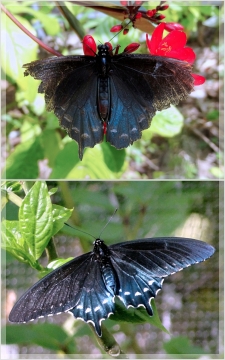 While editing photos, I came to one of a pipevine swallowtail. Seeing it on my computer rather than the camera’s viewfinder, I realized it had seen far better days. Its once beautiful wings were tattered and torn, only one “tail” remained, an antenna was missing, and, with many of its scales gone, its wings were more translucent than iridescent blue. Perhaps it had a close call with a predator, the wind had tossed it around, or it simply was old. In any case, it was damaged goods and no longer beautiful.
We tend to discard broken things, battered items, and damaged goods without giving them a second thought and I was ready to delete the less than perfect butterfly. What if God tossed us away because of our imperfections, scars, and defects? What if He stopped caring for us because we were scratched, broken, dented, or wearing out? Unlike the butterfly, it’s not birds, hail, or blowing twigs that leave us ragged and torn; its things like illness and injury, betrayal, loss, dysfunctional families, abuse, mental illness, broken relationships, addiction, financial crises, and sin. Even though the resulting damage isn’t always visible, we’re marred with pain, shame, regret, rejection, disappointment, disgrace, anger, apathy, loneliness, and fear. No one gets through life without getting a few bumps and bruises along the way and we all are damaged goods. Our scuff marks, scars, and brokenness may not be as obvious as the butterfly’s; nevertheless, they are there.
Jesus came for the less than perfect. Think of the people he loved, touched, healed, welcomed, and forgave. Sinners all, they included hated Samaritans and disparaged Gentiles, pariahs like lepers and the bleeding woman, the blind and crippled, an adulterous woman, some traitorous taxmen, political zealots, people with sordid pasts, the demon-possessed, a repentant thief, a prostitute, the disciple who denied Him, the one who doubted Him, and even the one He knew would betray Him! Jesus didn’t come for the perfect; He came for the defeated, damaged, disheartened, and sinful. While the butterfly’s wings will never heal, Jesus can heal the brokenness in our hearts and souls.
Originally, I hadn’t detected the butterfly’s damaged state because it flitted about so quickly that I barely had time to focus before it flew off to another flower. While it may have been damaged, that pipevine certainly wasn’t defeated. In God’s wisdom, He made butterflies more resilient than they appear. While the loss of an antenna means they have some trouble navigating, the loss of scales changes their aerodynamics, and the loss of much of their wings makes flight slower and more demanding, butterflies can thrive and survive, as that battered pipevine proved! It never allowed its tattered wings to deter it from making the most of the sunny day or the remaining days God allotted it. Instead of hiding under a leaf feeling sorry for itself and complaining about the unfairness of life, it was dancing in the flowers and sipping sweet nectar! Rather than being deleted, it belonged in a butterfly hall of fame.
Now, whenever I come across a damaged butterfly, I’m reminded that God loves all of His beautiful children, imperfect and broken creatures that we are. No matter how flawed, He will never discard us or toss us in the trash heap! God made us even more resilient than a fragile butterfly. Because of His power, we never need surrender to life’s challenges. We may be battered by this world but, because God’s grace is more than sufficient, we can carry on. If tattered wings can carry a battered butterfly through the flowers, we know that God can carry us through anything.
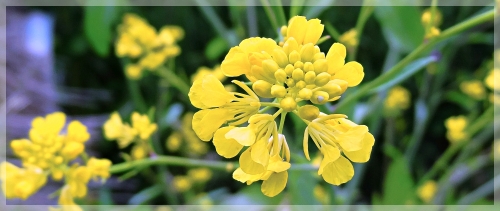
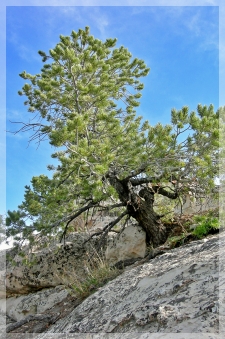 The Synoptic gospels (Matthew, Mark, and Luke) all repeat Jesus’ parable of the Sower and the Soils. As the farmer sows his seeds, some lands on the packed soil along the footpath. The birds steal the seeds so nothing takes root. Some seeds land on a thin layer of dirt over underlying rock. Although the seeds quickly sprout, without deep roots, they wither and die. Other seeds land among the thistles and thorns. Although they take root, the fast-growing weeds crowd them out. Only the seeds that fall on fertile soil take firm root, grow into maturity, and bear fruit. Rather than teaching Agriculture 101, by comparing those soils to the various ways God’s message is received, Jesus was teaching about evangelism.
 As we continued our brief study on prayer, one person shared that his prayer frequently is for patience. Agreeing, I admitted often praying, “Lord, please give me patience…and give it to me now!” While patience is a fruit of the Spirit, I have a problem getting it to grow in the garden of my life.
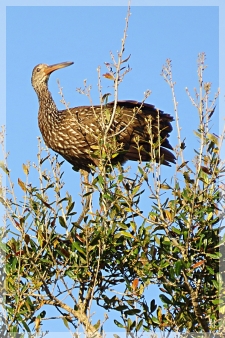 Looking like a cross between a heron and an ibis, the limpkin (Aramus guarauna) is common along Florida’s fresh water canals, wetlands, and swamps. While they’re lovely to look at, they’re not lovely to hear. Often referred to as the wailing or crying bird, limpkins have a loud piercing “banshee” scream that usually is heard at night, dawn, and dusk. During courtship, a male limpkin makes repetitive long, loud, rattling calls while a female replies with slightly lower (but still disturbing) screams.
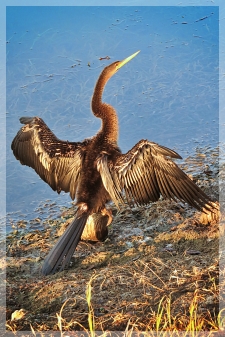 Anhingas are among my favorites of our lake’s birds. Unlike most birds, their bones are heavy and dense and, rather than waders like the herons and egrets or paddlers like the ducks, they are deep-diving swimmers. Lacking the oil glands that waterproof the feathers of other water birds, anhingas (and their cormorant cousins) become water-logged in the water. While making it difficult to remain afloat, that allows them to dive up to sixty feet deep, swim underwater for several hundred feet, and stay underwater for more than a minute. Eventually, however, the birds become so heavy they will sink unless they return to land to dry their feathers.
 Devotions of the Heart