
Bel and Nebo, the gods of Babylon, bow as they are lowered to the ground. They are being hauled away on ox carts. The poor beasts stagger under the weight. Both the idols and their owners are bowed down. The gods cannot protect the people, and the people cannot protect the gods. They go off into captivity together. [Isaiah 46:1-2 (NLT)]
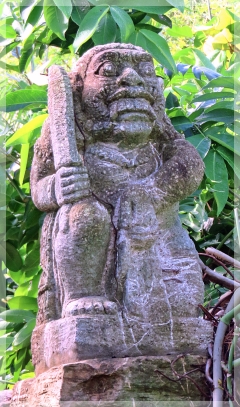 The Israelites were surrounded by various pagan peoples who worshipped foreign deities. Baal ruled over Canaan and Phoenicia, Chemosh over Moab, and Marduk/Bel and Nebo over Babylonia. The Philistines’ had Dagon and the Ammonites worshipped Molech. These gods usually had a domain over which they ruled. For example, Baal’s domain was rain, storms, and the harvest. Moab’s Chemosh presided over war and mountains. As patron deity of Babylon, Marduk/Bel was supposed to protect the city and rule over storms while Nebo’s purview was wisdom and science. The Philistines’ chief god Dagon presided over death, the afterlife, war, and agriculture while Ammon’s Molech reigned over the underworld, which may explain his association with child sacrifice in the Old Testament.
In spite of their reputed special powers, those pagan gods were nothing more than powerless idols who had to be carried around on ox carts and would be taken captive along with their worshippers! Marduk/Bel couldn’t protect Babylon from Cyrus or Alexander the Great and Baal, the god of rain and storms, couldn’t even make it rain after Elijah called for a drought or muster up a bolt of lightning to ignite a fire! In contrast, upon Elijah’s prayer, the God of Israel immediately flashed down flames and turned water-soaked wood into an inferno.
Perhaps, the ultimate test of any god is prophecy because only a true God can know all that has gone before and all that is yet to come. In Isaiah 41, the Lord called out those false gods because they couldn’t prophesy when He, the God of Israel, could! It wasn’t just His prophet Isaiah who accurately forecast the future; many others did as well. For example, Jeremiah accurately foretold Jerusalem’s destruction, King Jehoiakim’s death and the end of his line, Babylon’s fall, the length of captivity, and the exiles’ return to Judah. When interpreting Nebuchadnezzar’s dream, Daniel accurately foretold the different empires in historical progression—from Babylonian to Medo-Persian to Grecian and then to Roman. In 536 BC, more than 213 years before it happened, he predicted the division of Alexander the Great’s kingdom into four weaker nations. In fact, the book of Daniel predicted political history for the next 370 years!
Since true prophecy is the living word of God, I suppose the historic accuracy of those fulfilled prophecies shouldn’t surprise us. Their accuracy tells us that God exists, that there are no other gods, and that, just as He controlled the past, He is in full control of the future. There are, however, several prophecies yet to come. For example, Daniel’s predictive prophecies didn’t stop at 166 BC with the Maccabees and Antiochus IV. He continued on with end-time predictions of the antichrist, the tribulation, and humanity’s resurrection. The accuracy of past predictive prophecy tells us that those prophecies not yet fulfilled will come to pass. Will you be ready when they do?
I’ve read the last page of the Bible. It’s all going to turn out all right. [Billy Graham]
 When talking with my husband about the story of Jonah, he said that the fish story was a “little too hard to swallow”— too incredible to believe. Miracles! The Bible is full of them and, since they are supernatural events, they’re all hard to accept as true. Improbability is the nature of miracles. Along with the fish saving Jonah, the story is filled with other miracles: the immediate calming of the storm once Jonah was thrown in the sea, the deliverance of the prophet from the fish safely onto the beach, Nineveh’s immediate repentance, the appointment of the plant, worm and scorching east wind as teaching tools, and even God’s revelation of Himself directly to Jonah! Yet, if we believe the Bible is God-breathed and without error, we don’t have the privilege of picking and choosing which miracles we will believe and which ones we won’t. We have only one choice to make—all or none!
 When God sent Jonah to the Assyrian capital of Nineveh, it was to warn the people that they would be destroyed for their sins. While we tend to focus on the miracle of Jonah and the sea creature, the real miracle in the Book of Jonah is the city’s response to the prophet’s message—Nineveh immediately repented of its sinful ways. Some forty years later, however, the Assyrians were once again back to their old behavior: rejecting God’s authority and worshipping idols. Around 740 BC, they attacked northern Israel and, in 722, they invaded the remaining kingdom and took Samaria, just as both Hosea and Amos had prophesized they would. The northern kingdom’s population was resettled elsewhere in the Assyrian Empire and Samaria became the center of a new Assyrian province.
 Since Nineveh was famous as the religious center for the worship of Ishtar (Astarte), the goddess of fertility, we might wonder why this pagan city repented after hearing Jonah’s prophecy? Jonah was an Israelite not an Assyrian—he believed in Jehovah and the people of Nineveh were pagans. Some speculate that the Ninevites had learned of Jonah’s miraculous delivery from the fish but Nineveh was about 500 miles from the sea and, since the fish delivered Jonah onto the beach, that seems highly unlikely! Was Jonah such an eloquent speaker that the heathen people of Nineveh would respond to him when, more often than not, the people of Judah and Israel ignored the words of warning they heard from the prophets who were their own countrymen? What caused the king and 120,000 of his subjects to make such an immediate turnaround?
 The first thing to clear up when writing about the Book of Jonah is whether it was a fish or a whale. Both the Hebrew word (dahg) and the Greek word (ketos) in later translations were used to describe this sea creature. In 785 BC, at the time of this story’s writing, neither language had a word that could identify the exact species so it could have been a fish, shark, whale or some other now extinct large sea creature. For those who choose to use this discrepancy to attack the Bible’s veracity, it’s probably wise to remember that Linnaeus’ classification of living things occurred in the 18th century and not 2,800 years ago when Jonah was swallowed by something huge in the sea. When learning the story in Sunday school, most of us were told it was a whale. Having seen Disney’s Pinocchio with Geppetto living in a whale’s belly, it was easy to picture Jonah doing the same.
 Walking along the shoreline, I was surprised to see a baby opossum on the beach. A man with a large bucket was trying to scoop him up to return him to the safety of the mangroves but the little guy would have none of it. Lost and in danger of dying of thirst or becoming dinner for an osprey or eagle, I’m sure he thought he was on a wonderful adventure. Meanwhile, his mother was probably frantically searching the mangroves for her wayward child.
 Devotions of the Heart