
What good is fasting when you keep on fighting and quarreling? This kind of fasting will never get you anywhere with me. You dress in burlap and cover yourselves with ashes. Is this what you call fasting? Do you really think this will please the Lord? [Isaiah 58:4-5 (NLT)]
 With nearly 20,000 tweets, the 2022 Twitter “Lent Tracker” revealed that the top Lenten fast for Twitter users was alcohol. Twitter and social networking took second and third places followed by Lent, sex, coffee, chocolate, swearing, men and meat. Using Twitter to give up Twitter seems somewhat counter-productive and giving up Lent for Lent makes no sense at all. Then again, since I don’t tweet, Twitter itself doesn’t make sense to me. In a survey by YouGov, people were asked what would be the hardest thing to abstain from for Lent and watching TV or using streaming services was the number one answer in all age groups except for ages 18 to 24. It’s no surprise that the hardest thing to relinquish for that group was social networking!
I tried something new for my Lenten observance this year by letting Alicia Britt Chole’s 40 Days of Decrease lead me through the season. Along with a daily devotion about Jesus’ life, an inspiring quote upon which to meditate, a tidbit about Lent’s history, Scripture reading and journaling, a specific fast was suggested for each day. Over the past several weeks, I’ve fasted from things like regret, avoidance, apathy, denial, leavening, and comparison.
Fasting from a meal one day was far easier than fasting from isolation the next. Since the pandemic, I’ve grown comfortable in isolation and gotten lax about making an effort to socialize. As God would have it, my fast from isolation was on a Tuesday, the day our pastor has an informal gathering at a local coffee shop. The day’s assignment was to, “Purpose to link and be linked…and intentionally nurture your God-given web of relationships.” Even though I was behind in my writing, the fast required me to join the others. It was a needed reminder that we are to “think of ways to motivate one another to acts of love and good works,” and not to “neglect our meeting together… but encourage one another.” [Hebrews 10:24-25]
Another day, after reading about the woman who lavishly anointed Jesus with essence of nard, the fast was stinginess. I pondered which charity would get the benefit of the day’s fast but writing a check didn’t seem much of a sacrifice since we’ve never been stingy with our money to charity. When my husband asked me to walk the beach with him, my first thought was that I didn’t have the time. The day’s stinginess fast, however, reminded me that we can be miserly with time as well as money. Having been directed not to allow reason to “ration out your love in stingy portions,” I accepted the offer to spend quality time with him. The woman who anointed Jesus is remembered “as one who loved lavishly;” I’d like to be remembered the same way! Time is as precious as money or a flask of expensive perfume and we never should be stingy with it.
Thinking about these two fasts, I realized they both had to do with time. They made me question my willingness to share my time with others, to sacrifice my agenda for a better purpose, and to put relationships ahead of tasks. Like money, time is a precious commodity with a limited supply and, like money, time can be wasted or foolishly spent. Unlike money, however, we can’t gain more than our allotted amount nor can we save what we have for another day. Whether we use it or not, time is gone as fast as it came. May we always remember we have a limited time here and no real way of knowing when our days will end. Let us live each precious day as if it is the only one we have.
Never, in peace or war, commit your virtue or your happiness to the future. Happy work is best done by the man who takes his long-term plans somewhat lightly and works from moment to moment “as to the Lord.” It is only our daily bread that we are encouraged to ask for. The present is the only time in which any duty can be done or any grace received. [C.S. Lewis]
 When the Academy Awards were held recently, Oscars were presented for things like best director, best lead and supporting actors and actresses, and even best make-up and hair styling. If it’s true (as my theater teachers claimed) that, “There are no small parts, only small actors!” how is it that no awards were given to the best small part players? Regardless of the perfection with which they may have fulfilled their “bit parts”, their screen time was too short to be nominated for anything. To add insult to injury, they may have been known only as Dog Walker or Nurse #2! The small role, however, doesn’t mean the character played an insignificant part in the story. Nevertheless, after moving the story forward, the bit part players just fade into the background. Even so, while their names may be forgotten, the story wouldn’t have been the same had they not played their roles.
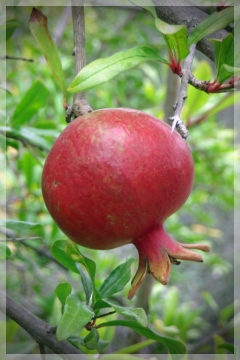 The culture of the 1st century was agrarian in nature so the analogies used by Jesus and the evangelists often were those of agriculture – seeds, soil, fruit, and vines. For example, when writing about the characteristics in the lives of those who follow Jesus, Paul spoke of the fruit of the Spirit. But, if Paul were writing to modern industrial society, he might have used a different metaphor. Instead of the fruit of the Holy Spirit, we might have the Spirit’s toolbox. Rather than fruit, we’d have God’s tools to help us to build His Kingdom. The saw in the box would be God’s peace that cuts worry and fear out of our lives. The sandpaper would be kindness as it smooths out life’s rough edges. Protective gear like safety goggles and steel-toed shoes would be the self-discipline that protects us from sin. Duct tape and WD-40 would be as essential as love, a flashlight would shine our joy, and we’d have clamps to hold us tight to the faith. God’s word would be our blueprint and, instead of being connected to a vine, the power tools would be plugged into the Holy Spirit’s power. Regardless of the metaphor, the Holy Spirit provides us with what we need to be more like Christ.
 For a Christian, being hospitable should be second nature but, for many, the thought of entertaining is terrifying. Entertaining, however, has nothing to do with hospitality. One has to do with cuisine, attire, atmosphere, and possessions, and says “Look what I have,” while the other has to do with love, respect, sharing, refreshment, and comfort and says, “What I have is yours!” One is meant to impress and the other is meant to bless.
 In the ancient world, travel was dangerous and the nomadic people of Israel took hospitality seriously. It was the way to transform an unknown person (who might pose a future threat) into a guest and a friend. Hospitality was an integral part to many of the Old Testament’s stories. Both Abraham and Lot welcomed strangers into their home. Rebekah gave water to Abraham’s servant, watered his camels, and then offered food for the animals and rooms for the night. Rahab gave lodging and protection to the Israelite spies, Manoah and his wife fed the stranger who visited them, the widow of Zarephath gave her last morsel of food to Elijah, and the Shunammite woman provided food and a room for the prophet Elisha whenever he passed through Shunem. Abigail generously provided food for David and his band of men and David welcomed Jonathon’s crippled son Mephibosheth at his table as a way of showing God’s kindness.
 This is the Lord’s doing, and it is wonderful to see. This is the day the Lord has made. We will rejoice and be glad in it. [Psalm 118:23-24 (NLT)]
 Devotions of the Heart