
Plant the good seeds of righteousness, and you will harvest a crop of love. [Hosea 10:12 (NLT)]
 In a nutshell, compound interest is getting interest on interest; when it’s on money you have, your investment keeps growing. When it’s on money you owe, however, you pay interest on your interest and end up deeper in debt. The economics lesson is because of C.S. Lewis’s words that “Good and evil both increase at compound interest.” While Lewis then switches metaphors from the bank to the battlefield, Scripture often uses the metaphor of sowing and reaping for the same concept of the exponential growth of both good and evil.
After planting just one sunflower, for example, we’d get between 1,000 and 1,400 seeds per head. If each of those seeds were planted, we’d have between one and 1.96 million sunflower seeds the next year and, if we planted those, we’d have between one and 2.7 billion sunflower seeds the third year. If those were perennial sunflowers, we’d also get seeds from the previous years’ plants! Like compound interest, that’s exponential growth (which is what happens with good thoughts and actions).
Of course, if just one Canada thistle seed got planted in that field of sunflowers, it could produce as many as 5,300 seeds that first season! Those thistle seeds would get dispersed by the wind and sow themselves far and wide. Should those seeds take root, more than 28 million new thistle seeds could be blowing through our fields the second year, with the potential of more than 148 billion seeds the following one. With that kind of exponential growth, our beautiful field of sunflowers soon would be overrun by thistles. Worse, those thistles would have spread into our neighbors’ fields. Noxious weeds and evil have a way of doing that!
Since thistles also sprout from their roots, that one thistle could grow into a six-foot thistle patch in a year. Turning to Lewis’ battle metaphor, that loss of acreage is similar to a general losing an asset like a seaport. Worse, because thistle seeds can remain viable in the soil for up to twenty years, like an enemy who’s patiently waited for our troops to get careless, those weeds can spring up years later when least expected. Just as the farmer has to be vigilant in his fight to keep thistles from overtaking his fields, the general must keep his troops battle-ready.
The subject, however, is neither military science nor agriculture; it’s spiritual warfare. Generals and farmers don’t want to cede territory to their enemies, nor do we. Our battle isn’t against armed troops or thistles; it’s against evil. Rather than tanks or herbicides, we need obedience to God’s word and the power of the Holy Spirit! When we act as would Jesus, by sowing seeds of goodness, it’s like planting another sunflower in the garden of life. But, every time we follow our own sinful desires, instead of losing a field to thistles, we lose ground to Satan. In our every act, either a seed of good or evil is planted and, like a thistle seed, any seed of evil is one seed too many!
Good and evil both increase at compound interest. That is why the little decisions you and I make every day are of such infinite importance. The smallest good act today is the capture of a strategic point from which, a few months later, you may be able to go on to victories you never dreamed of. An apparently trivial indulgence in lust or anger today is the loss of a ridge or railway line or bridgehead from which the enemy may launch an attack otherwise impossible. [From “Mere Christianity” by C.S. Lewis]
 Because the parable of the rich man and Lazarus is the only parable in which names are used, some people in the early church believed that it was a real-life incident. Whether a true story or a parable is of no consequence because its lessons remain the same.
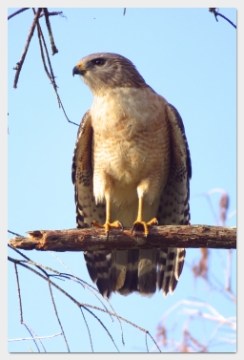 A red-shouldered hawk soared through the sky, swooped down, and settled in a tree just a few feet from us. After getting a photo, I walked back to a man we’d passed earlier on the boardwalk. His tripod and huge lens told me he was hoping to get some good shots and I let him know a Kodak moment was waiting on the side trail. He followed me back and my husband pointed out the impressive bird perched above him.
 More than thirty years ago, a friend confided that she wanted her obituary to be a good one. A few years ago, explaining that she wanted an updated photo in case it was needed for her obituary, she asked me to take her picture. Although she was in excellent health at the time, this woman clearly understood the fragility of life. Sadly, she died unexpectedly just a few days ago.
 The book of Daniel makes reference to the resurrection of both the wicked and righteous, with the destiny of the one being shame and disgrace and the other being everlasting life. By the time of Jesus, many Jews believed in some sort of eternal life and that it would come by obedience to the Law. Matthew, Mark, and Luke tell of the rich young man who asked Jesus what good deed he must do to have eternal life. He wanted Jesus to check his resume of good works and, if found lacking, to give him a task that would assure his immortality.
 In Matthew 25, Jesus uses a long simile to describe the final judgment. As for whether this occurs at the beginning or the end of Christ’s millennial kingdom, is unclear; that it will occur, is not! When it happens, God will separate people the way a shepherd does his goats and sheep.
 Devotions of the Heart