
 This is the Lord’s doing, and it is wonderful to see. This is the day the Lord has made. We will rejoice and be glad in it. [Psalm 118:23-24 (NLT)]
My biggest fear is waking up to find what matters
Is miles away from what I spent my life chasing after.
Is my story gonna have the same two words in every chapter?
What if, what if? …
What if today’s the only day I got?
I don’t wanna waste it if it’s my last shot.
No regrets, in the end
I wanna know I got no what ifs! [Matthew West]
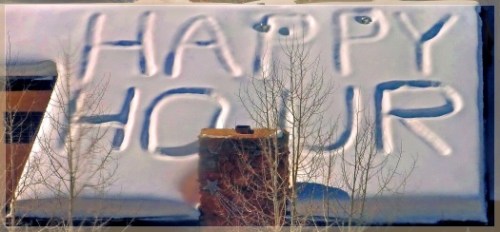
While enjoying discounted drinks and small plates during a local “happy hour” with our old skiing buddies, we reminisced about the many happy hours we spent together in Colorado. One of our favorite lunch (and “happy hour”) spots used to publicize their “happy hour” by spelling out the words in the snow on their rooftop. Since the pub was located right beneath the gondola, skiers couldn’t avoid seeing the message as they rode up the mountain. Tourists would speculate how the words got there and most assumed there were specially placed heat tapes beneath the letters. The letters, however, were carefully stomped out after every major snowfall by a friend who had more enthusiasm than common sense as he jumped from letter to letter on the sloped roof.
For many of us, “happy hour” probably means discounted, beer, wine and cocktails, half-price appetizers, and maybe some entertainment between the hours of 4 and 7. But, is a happy hour really about three hours of discounted drinks and food or a great band?
Today, while listening to Matthew West sing, “What if today’s the only day I got? I don’t wanna waste it if it’s my last shot!” I pondered what makes any of our hours truly happy ones. It certainly isn’t cheap drinks and food! What kinds of things would an hour of happiness encompass? If you had only a few hours remaining in life, how would you spend them? What would you do to make that hour a happy one? I doubt you would spend them eating and drinking in a bar.
Henry Ward Beecher said, “The art of being happy lies in the power of extracting happiness from common things.” I have to agree. When I think about happiness, my happy hour includes things like God, family, friends, peace, service, generosity, love, hope, faith, worship, salvation, smiles, hugs, laughter, a few silly games with the grands, and maybe a butterfly or two. There are no discounted drinks, chicken wings, peanuts, popcorn, guacamole, salsa, or chips in the scenario because they have nothing to do with true happiness and joy. Also missing from that picture are things like wealth, success, and fame along with quarrels, resentment, conflict, anger, regret, guilt, heartache, disdain, bitterness, fear, hatred, and animosity. In short, a happy hour is one spent in gratitude. It was gratitude for all that God gave us, not the discounted drinks, appies, or sunshine and powdery snow, that made those hours so enjoyable back in Colorado and continue to do so in Florida!
The man who stomped out those letters on the rooftop? When in his mid-forties, his hours were unexpectedly cut short by a freak accident. I’m sure his family would agree that happy hours should never be limited to a few hours at the end of the day. How will we choose to spend whatever is left of our hours to make them happy ones—the kind of hours truly worth having and remembering? After all, today could be our “last shot!”
Do not look back on happiness, or dream of it in the future. You are only sure of today; do not let yourself be cheated out of it. [Henry Ward Beecher]
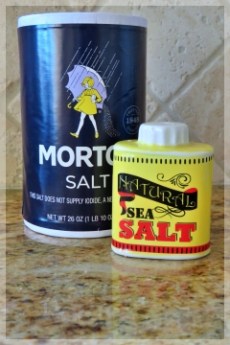 Today, when someone is called the “salt of the earth,” the speaker probably means he or she is a dependable, unpretentious and honest person—someone of moral integrity. That is well and good as far as it goes, but Jesus meant more than that when He called us to be “the salt of the earth.”
 For many in the Christian community, last Wednesday marked the beginning of Lent, a season in remembrance of the forty days Jesus fasted in the wilderness and was tempted by Satan. For them, Lent is a penitential season of repentance, fasting, and self-denial leading up to Easter. The idea of fasting as a form of preparation for Resurrection Sunday comes from Jesus’ statement, “But the time will come when the bridegroom is taken away from them; and when that day comes, they will fast,” found in Mark 2:20.
 Back in 2008, my husband and I joined others from our church to see Fireproof, a movie by Alex and Stephen Kendrick. It was about Caleb Holt, a firefighter, who’s urged by a friend and his father to hold off on getting the divorce to which he and his wife have agreed. Counseling him to fight for his crumbling marriage, his father gives him a Christian self-help book called The Love Dare and urges him to go on its forty-day challenge. Having nothing to do with the game “Truth or Dare,” the book dares Caleb to improve his marriage, not by changing his wife, but by changing the way he treats her. After completing the forty day challenge, Caleb continues changing his behavior and he and his wife eventually reconcile. As I remember, the movie ends with them renewing their marriage vows. Several months after seeing the movie, I spotted The Love Dare book while browsing through a bookstore. Whether the movie gave birth to the book or the book gave birth to the movie, I don’t know. In any case, I purchased it and, without my husband knowing, took on its 40-day challenge.
 When we spotted some Sandhill Cranes last week, I recalled the cranes we frequently saw when we lived in rural Illinois. In the fall, flocks of them could be found eating the crop residue remaining from the recently harvested fields. As they gleaned the corn fields, I thought of the words in Deuteronomy and Leviticus directing the Israelites to deliberately leave some produce behind for those less fortunate—the people who wouldn’t have land of their own from which to harvest. Allowing the poor to maintain their dignity as they labored in the fields, rather than a handout, the gleaning was considered a rightful opportunity to improve their lives. The command to leave left-overs from the harvest for the poor was not to be taken lightly. In fact, if nothing remained in his fields following harvest, a landowner could be punished.
 Devotions of the Heart