WHAT PRONOUN?

God replied to Moses, “I AM WHO I AM.  Say this to the people of Israel: I AM has sent me to you.” [Exodus 3:14 (NLT)]

“I am the Alpha and the Omega—the beginning and the end,” says the Lord God. “I am the one who is, who always was, and who is still to come—the Almighty One.” [Revelation 1:8 (NLT)]

As Christianity Today aptly points out, “Changing gender norms, new social media platforms, and deepening class divisions have led to a renewed conflict over language.” As a writer, I have more than enough opportunities to intentionally or unintentionally offend with my words and, as a reader, you have plenty of opportunities to criticize my choice of words. As a Christian, I want to speak with love and in such a way that doesn’t isolate any race, gender, religion, sexuality or ethnic background so I try to use inclusive language and avoid words that might be thought of as exclusionary of any group. Nevertheless, I’m not always successful. While I understand using “police officer” instead of “policeman,” other words are more problematic and not so easily changed.

Moreover, eventually we need a pronoun and most pronouns are gender specific. In 2012, the Swedes started using hen, a gender neutral pronoun that can replace the gender specific hon (she) and han (he). We don’t have that option in English. Our pronouns take the gender of the noun they replace and substituting every “his” and “her” with “his or her” or “his/her” is cumbersome at best. Using “they,” “them” or “their” for a singular person when gender is unknown can be misleading and goes against rules of grammar I learned as a girl!

When referring to Jesus, it’s easy to know the correct pronoun because Scripture makes it clear—the Savior presented Himself on earth as a man. With God and the Holy Spirit, it’s not so clear cut. Regardless of who is referring to God or if it’s written in Hebrew, Aramaic, or Greek, male pronouns are used for God in Scripture. Since God chose to reveal Himself to us as a man when He clothed Himself in flesh and Jesus made about 160 references to God as father (not parent), does that make God male? What about the Holy Spirit? Although the Greek word for spirit (pneuma) was gender neutral, the Holy Spirit is referred to as masculine throughout the New Testament. Is the Spirit male, as well?

God is God: the great I AM—the Alpha and Omega—the beginning and the end! Although God is a person—with intellect, emotion, motivation, insight and a will—a person who can communicate, create, and have relationships—God is spirit. Without flesh, bones, and the limitations of a physical body, God has no gender—neither male nor female. Like God, the Holy Spirit is both a person and a spirit and, as such, is genderless, as well. Without a gender, there are no perfect pronouns for either God or the Holy Spirit. The Lord is not an “it” nor is the Holy Spirit a “they.”

Although some women writers refer to God as “she,” lacking a better solution and, in deference to Scripture’s original writers, I will continue to refer to God and the Holy Spirit as “He.” I understand that being referred to by the right pronoun can be pivotal to a person’s identity, but I doubt it is crucial for God. Something tells me that God is far more interested in having us talk about Him (or Her) and pray to Him (or Her) than what pronouns we use when doing it.

For God is Spirit, so those who worship him must worship in spirit and in truth.” [John 4:24 (NLT)]

Copyright ©2021 jsjdevotions. All rights reserved.

WHAT DOES GOD WANT?

Listen to the Lord, you leaders of Sodom. Listen to the law of our God, people of Gomorrah. “What makes you think I want all your sacrifices?” says the Lord. “I am sick of your burnt offerings of rams and the fat of fattened cattle. I get no pleasure from the blood of bulls and lambs and goats.” [Isaiah 1:10-11 (NLT)]

Although Hosea and Micah told Israel that God rejected their insincere sacrifices, when Isaiah addressed the people of Judah as the wicked Gentile cities of Sodom and Gomorrah, the vehemence of God’s words was unmistakable. The prophets’ words did not mean that God was rejecting the sacrificial system but that He found their offerings and sacrifices meaningless because of the people’s depravity, hypocrisy, and superficial worship.

Sacrifices and offerings of incense, grain and animals were an essential part of the Israelites’ rituals at the time. They were made as a way of praising God, showing dedication to Him, in thanksgiving for His many gifts, as a way of asking forgiveness, and as atonement for sins. Most of Leviticus is dedicated to the conduct of sacrifices and Numbers includes additional requirements concerning offerings. Yet, some 600 years after being given those regulations, the prophets told the people that God did not want their sacrifices and burnt offerings because, without faith in and love for Him, their offerings were meaningless.

Since we no longer make burnt sacrifices at our altars, what do those prophets’ words mean to us? To me, it means that it is not enough to simply go to church, sing in the choir, usher, recite Bible verses, teach Sunday school, bring treats, participate in a small group, or be diligent about our financial offerings to the church. God wants more!

As a girl, in confirmation class, I learned that the sacraments were “an outward and visible sign of an inner and spiritual grace.” The prophets’ words tell us that, no matter what the “outward and visible sign” may be, without an “inner and spiritual grace” it is meaningless. Even being dunked in a baptismal tank or regularly taking Communion are nothing more than empty rituals if our hearts and souls are not committed to God. Just as God wanted changed lives rather than bulls, lambs, and goats from the Israelites, He wants more from us than simply going through the motions of being a Christian.

God doesn’t want us just to know His word; He wants us to live it. He doesn’t want us just to know about Him, He wants us to know Him. He doesn’t want us going through the motions; He wants us! Rather than lip service; He wants our hearts. He must be an essential part of our lives. God wants us to serve Him not just with our bodies, but with our hearts and souls.  The prophets told the Israelites what God wanted; we should listen to them!

I want you to show love, not offer sacrifices. I want you to know me more than I want burnt offerings. [Hosea 6:6 (NLT)]

Wash yourselves and be clean! Get your sins out of my sight. Give up your evil ways. Learn to do good. Seek justice. Help the oppressed. Defend the cause of orphans. Fight for the rights of widows. [Isaiah 1:16-17 (NLT)]

Copyright ©2021 jsjdevotions. All rights reserved.

CONTRADICTION OR CONFIRMATION?

Having carefully investigated everything from the beginning, I also have decided to write an accurate account for you, most honorable Theophilus, so you can be certain of the truth of everything you were taught. [Luke 1:3-4 (NLT)]

Both Matthew and Luke tell the story of the Roman centurion so confident in Jesus’ power to heal his servant from afar that he told Jesus just to say the word. Although their versions differ, that does not necessarily mean they are faulty or false. Let’s see if we can reconcile their differences.

In Matthew’s version, the centurion personally sought Jesus’ help but Luke says he sent some Jewish elders on his behalf. From a 1st century viewpoint, however, there is no discrepancy. When an intermediary acted or spoke for someone, it was as if he’d done it himself, just as the Secretary of State or press secretary can speak for the president. Both versions say the centurion sought Jesus’ help and Luke merely explained that he did this through his representatives. While today’s Bibles use quotation marks, they were unknown to Scripture’s writers so the centurion’s words are not necessarily a direct quote. While Luke’s account is more detailed, both can be true.

The central point of both versions is Jesus’ amazement at the centurion’s faith in His authority and His words, “I tell you the truth, I haven’t seen faith like this in all Israel!”  While both gospels repeat the centurion’s words about his unworthiness and Jesus’ ability to heal, Luke says Jesus started to the centurion’s before being stopped by those words but Matthew never said He started out. Matthew, however, does report that Jesus said He’d come and, since he never said Jesus didn’t start walking, both versions can be correct, especially since they both mention a crowd following Jesus. Again, in spite of their differences, neither version really contradicts the other.

While Matthew repeats Jesus’ words that many Jews would be excluded from the Kingdom, Luke doesn’t. Luke, on the other hand, gives us details about the centurion when Matthew doesn’t. That, however, doesn’t mean that one account is incorrect—just that the authors chose what to include. An explanation for their choices can be found in the identity of the writers. Although the gospels were written for all Christians, with his emphasis on prophetic fulfillment, frequent references to Hebrew Scripture, and focus on Jesus’ work within Galilee among the Jews, Matthew’s gospel is geared toward Jews. Any account of this encounter directed toward a Jewish audience would surely pass along Jesus’ warning to them.

The Gentile Luke addressed his gospel to Theophilus, another Gentile (possibly a new covert). His account was written for a larger predominately Gentile audience to spread the truth that the Messiah came for all nations. Rather than repeating Jesus’ warning to the Jews, He chose to elaborate about the centurion’s good character and explain why Jews would speak on his behalf.

Finally, if the gospel of Matthew was written by Matthew the disciple (as the early church held and a growing number of Biblical scholars believe), his would be a first-hand account told from his viewpoint. Luke, however, consulted several eyewitnesses, maybe even the centurion or those who spoke on his behalf, so his perception would vary from Matthew’s.

By carefully reading both accounts of this encounter, we get a fuller picture of the event, just as we did yesterday by reading all of the reports about that Chicago plane accident. When we come across what appear to be contradictory stories in the Bible, a closer examination will show that they are complementary. 19th century theologian Charles Hodge said, “The best evidence of the Bible’s being the word of God is to be found between its covers. It proves itself.” Indeed, it does.

For when we brought you the Good News, it was not only with words but also with power, for the Holy Spirit gave you full assurance that what we said was true. [1 Thessalonians 1:5a (NLT)]

Copyright ©2021 jsjdevotions. All rights reserved.

ALEXAMENOS

“I’ve said these things to you,” Jesus went on, “to stop you from being tripped up. They will put you out of the synagogues. In fact, the time is coming when anyone who kills you will suppose that they are in that way offering worship to God. They will do these things because they haven’t known the father, or me. But I have been talking to you about these things so that, when their time comes, you will remember that I told you about them.” [John 16:1-4 (NLT)]

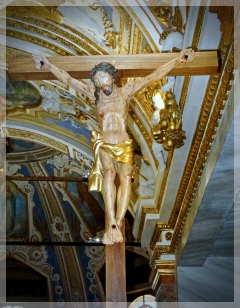
Locarno-Madonna del SassowIn any cathedral or art museum, we’ll find many pictures of Jesus and even rather graphic depictions of Him on the cross. None of them, however, tell us anything about His appearance because they were created long after His time. Still, in a world where we seem to memorialize everything with pictures, you’d think one of Jesus’ followers would have sketched Him while blessing the children, giving the Sermon on the Mount, or feeding the multitude! 1st century rabbis in Judah, however, vehemently objected to the depiction of human figures because the second commandment prohibited making a “graven image.” With its Jewish roots, this prohibition carried into the early church and inhibited early Christian art.

At first, Jesus was represented indirectly by symbols such as the peacock, lamb, dove, and anchor. One of the most common was the ichthus (fish) because the Greek word served as an acronym “Jesus Christ, Son of God, Savior.” While making the sign of the cross dated from sometime in the second century, because of its connection with the horrific death of criminals, the cross did not became a symbol of Christianity until the 4th century; crucifixes and other depictions of the crucifixion did not occur until the 6th.

One earlier depiction of Jesus’ crucifixion, however, does exist. Crudely scratched into a stone wall, it was discovered in 1857 during an excavation of the Paedagogiumon (a school for the training of slaves) on Rome’s Palatine Hill. Dating from around 200 AD, it shows a man (or boy) worshiping a figure on a cross; the figure, however, has the head of an ass. The inscription reads, “Alexamenos worships his God.” This derisive graffiti gives us an idea of the way early Christians were ridiculed for worshiping a man who had been executed as a criminal.

Along with claims of onolatry (donkey worship), the early Christians had to deal with several other disparaging, malicious, and false accusations such as incest, cannibalism, and drinking the blood of infants. Roman orator Marcus Cornelius Fronto (c. 100-160) wrote that Christians were “initiated by the slaughter and the blood of an infant” and that Christianity was “foolish” because, “they worship a crucified man, and even the instrument itself of his punishment” and “are said to worship the head of an ass.”

This was the world—a world that misunderstood, slandered, ridiculed, hated and persecuted them—of the early Christians. And yet, they proceeded in faith and spread the gospel. I wonder how the 21st century church would do in similar circumstances! As for Alexamenos, the fellow mocked by that ancient graffiti—more graffiti was found on a wall in an adjacent room. In Latin it said, “Alexamenos is faithful.”  In the face of opposition, we must be the same!

Think back on those early days when you first learned about Christ. Remember how you remained faithful even though it meant terrible suffering. Sometimes you were exposed to public ridicule and were beaten, and sometimes you helped others who were suffering the same things. You suffered along with those who were thrown into jail, and when all you owned was taken from you, you accepted it with joy. You knew there were better things waiting for you that will last forever. So do not throw away this confident trust in the Lord. Remember the great reward it brings you! [Hebrews 10:32-35 (NLT)]

Copyright ©2021 jsjdevotions. All rights reserved.

THE RICH YOUNG RULER (Part 1)

Someone came to Jesus with this question: “Teacher, what good deed must I do to have eternal life?” [Matthew 19:16 (NLT)]

Most of the Jews in Jesus’ day believed that God would never bestow wealth on a sinner so the rich young ruler presumed he’d inherit eternal life. Nevertheless, he asked Jesus what good deed was needed to guarantee it. While we might expect Jesus to give an answer about faith in Him, He tells the man to obey the commandments. When the man wants to know which ones, Jesus lists several of the commandments dealing with man’s relationship with man. The man, unable to recognize his own sinfulness, proudly claims to have obeyed every one since childhood. Assuming Jesus will tell him he’s done all that is necessary, he asks if there is anything else he needs to do. Thinking his prosperity is evidence of God’s favor, he’s stunned when Jesus tells him to sell all he owns, give the money to the poor, and then come follow Him. Unwilling to part with his possessions, the rich young man sadly departs.

Jesus, however, isn’t establishing a universal principle that, to be saved, we must all be penniless. After all, God never told Abraham, Isaac, Jacob, David, or Solomon to give away their wealth. Martha, Mary and Lazarus appeared to be people of means and Joseph of Arimathea was wealthy, but Jesus never told them to sell their possession and give everything away.

Although the rich man’s wealth obstructed his discipleship, the issue wasn’t his wealth: it was his heart! He loved and trusted in money more than God. Without even realizing it, this man who claimed to obey the commandments had violated the first and greatest one of all: “You shall have no other gods before me.” The man couldn’t put his faith in God and follow Jesus until he stopped having faith in and following his money! We can have only one God and He must take precedence over everything else in our lives!

While it was wealth that deterred the young man from following Jesus, their exchange was about more than wealth and applies to every one of us. Indeed, wealth can be a hindrance to our salvation, but so can a number of other things—things like reputation, appearance, status, security, family, education, profession, comfort, drink or drugs, science, sex, or self. Like the rich young ruler, do we love something more than God? What would He ask you to give away?

You must not have any other god but me. [Exodus 20:3 (NLT)]

No one can serve two masters. For you will hate one and love the other; you will be devoted to one and despise the other. You cannot serve God and be enslaved to money. [Matthew 6:24 (NLT)]

Copyright ©2021 jsjdevotions. All rights reserved.

WHAT CHANGED THEM? (Easter – Part 2)

But beware! For you will be handed over to the courts and will be flogged with whips in the synagogues. You will stand trial before governors and kings because you are my followers. … Then Jesus said to his disciples, “If any of you wants to be my follower, you must give up your own way, take up your cross, and follow me.” [Matthew 10:17-18,16:24 (NLT)]

rabbitThe Federal Trade Commission is charged with enforcing truth-in-advertising laws so that all advertisements are truthful, not misleading, and backed by scientific evidence. Although drug companies abide by the FTC’s regulations by listing their products’ side effects, between the fine print and the announcer’s fast talk, most consumers don’t understand them. Jesus didn’t resort to fast talk, deceit, or ambiguity when he told His disciples the cost of following him. He was brutally honest and told the disciples they would arrested, persecuted and hated because of Him.

While the disciples may not have comprehended completely, they couldn’t say they weren’t warned and Jesus told them the possibility of losing their lives was very real. Nevertheless, I imagine they thought He was speaking figuratively when He spoke of them carrying a cross. Even though He’d predicted His own death, I suspect his followers really didn’t understand what lay ahead until that fateful night when Jesus was arrested. Once He’d been tried, sentenced, and crucified, I’m sure the Lord’s cautionary words echoed in their minds and they finally understood the reality of that cross they’d be expected to carry! No wonder they cowered together in a locked room. The next step after arresting a revolutionary was to arrest his followers.

It was only John and a few women followers at the foot of the cross and it was a stranger, not a follower, who carried the cross for Christ. Jesus’ disciples, the men with whom he’d lived for three years, weren’t there to carry his heavy load or share his final hours. Rather than His friends, it was a secret follower of Jesus, Joseph of Arimathea, who placed Him in a borrowed tomb. Rather than a day of rest, the disciples’ Sabbath probably was a day of mourning, disappointment, confusion, and fear. Sunday morning, with the Sabbath over, some followers returned home while the rest continued to cower together in fear.

What turned a veritable group of despondent deserters into men who bravely spread the good news of Christ the Savior? These are the same men who fled from Jesus when He was arrested and Peter publicly denied knowing Him three times that night. What caused the two disheartened men from Emmaus to return to Jerusalem and the disciples in that locked room? What turned Jesus’ followers into people who courageously faced persecution and martyrdom? Of the disciples, all but John are thought to have been martyred. They had nothing to gain from a lie but everything to lose with the truth. What turned a bunch of deserters into evangelists? They saw the risen Christ! They spoke with Him, touched his scars, and broke bread with Him. They knew it to be the truth!

We haven’t walked with Jesus, but we’ve read the words of those who have. We haven’t been in the same room with Him, but we’ve heard His voice. We’ve not touched Him, but He has touched us. We haven’t seen his wounds, but He’s healed ours. We didn’t see His ascent into heaven, but we’ve experienced his Holy Spirit. No—we haven’t actually seen the risen Christ but, as Jesus people, “We live by believing and not by seeing.” [2 Corinthians 5:7]

You can kill us. But you cannot hurt us. [Justin Martyr (c. AD 150)]

During the forty days after he suffered and died, he appeared to the apostles from time to time, and he proved to them in many ways that he was actually alive. And he talked to them about the Kingdom of God. [Acts 1:3 (NLT)]

Then Jesus told him, “You believe because you have seen me. Blessed are those who believe without seeing me.” [John 20:29 (NLT)]